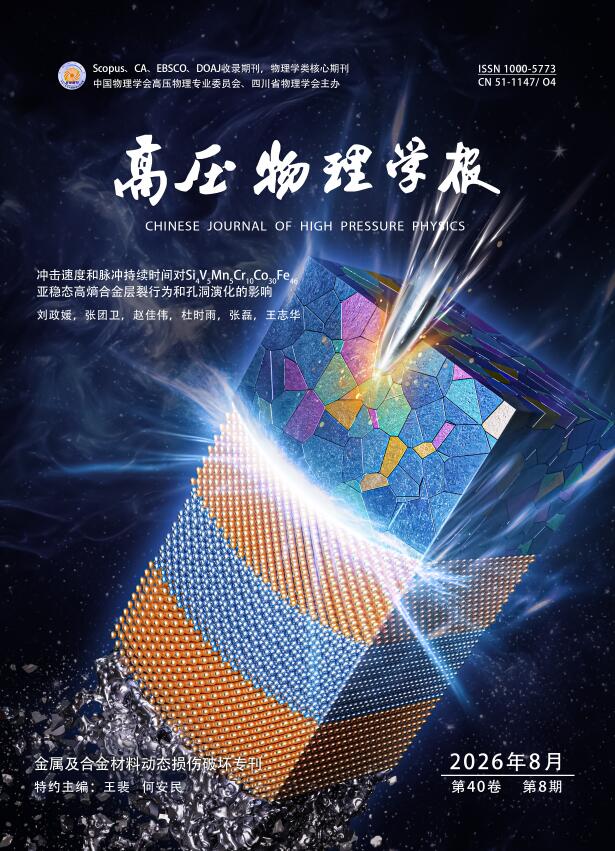



Special Themes
-
-
-
The study of material properties under dynamic loading is a key focus in both scientific and industrial communities, serving as a crucial foundation for breakthroughs in areas such as national defense and advanced manufacturing. Existing research often follows the conventional sequence of "material design – static testing – dynamic analysis," overlooking the fundamental differences in material behavior under static versus dynamic conditions. Factors such as pressure and strain rate under dynamic loading can significantly influence phase transitions, strength, and failure modes, ultimately impacting material design and application.
Traditional approaches, relying on isolated experiments and empirical models, are not only time-consuming but also limited in establishing comprehensive relationships between material composition, microstructure, and macroscopic performance under dynamic/static loading. With the rapid advancement of artificial intelligence, machine learning and high-throughput technologies are transforming research across disciplines. By integrating machine learning algorithms—such as big data analytics and advanced modeling techniques—with high-throughput methods, including high-throughput experiments, simulations, and testing, researchers can overcome traditional limitations. This synergy not only accelerates material design but also enables effective handling of multi-feature, weakly correlated, and high-dimensional data. It facilitates deep exploration of material evolution from the atomic scale to macroscopic failure under dynamic loading, gradually shaping a new research paradigm: "high-throughput simulation/experimentation – machine learning modeling – theoretical validation." This approach is driving the field toward intelligent and precise research.
This special issue aims to showcase and discuss how machine learning and high-throughput technologies are fostering innovation in the study of material properties under dynamic loading. Through the platform of the Chinese Journal of High Pressure Physics, we present recent advances in this area, hoping to inspire more researchers in high-pressure science to engage in machine learning and high-throughput studies.
Finally, we extend our sincere gratitude to all authors, reviewers, and editorial colleagues for their dedicated efforts in preparing this special issue. Their professionalism and rigorous work have been essential to its successful publication.
LUO Guoqiang, ZHANG Jian
Wuhan University of Technology
October 13, 2025
-
-
The perovskite structure is commonly observed in diverse functional materials, including ferroelectric ceramics, fuel cell electrodes, and solar cell materials. Originally identified in the mineral calcium titanate (CaTiO₃), from which it derives its name, "perovskite" now broadly encompasses compounds adopting this archetypal structure or its distorted variants. Perovskites follow the general formula ABX₃, where: The A-site is occupied by a larger cation (e.g., alkali metal, alkaline earth metal, rare-earth ion) or bulky atomic group; The B-site hosts a smaller transition metal cation; The X-site is an anion (e.g., halide or chalcogenide ion).
Owing to their compositional flexibility, perovskite materials exhibit rich chemical diversity and numerous derivative structures. Variations in ionic radii can stabilize ideal cubic, tetragonal, orthorhombic, or trigonal symmetries. Their high structural tolerance permits extensive ion substitution at A-, B-, or X-sites and accommodates nonstoichiometry, enabling tailored properties through controlled structural engineering.
Perovskites remain a focal point in both fundamental research and technological applications, with breakthroughs continuously emerging. Similar to temperature and chemical composition, pressure is a pivotal parameter for modulating structure and properties. Under high pressure, reduced interatomic distances intensify interactions, altering crystal and electronic structures to establish novel equilibrium states. High pressure facilitates: Stabilization of dense perovskite phases (e.g., BaRuO₃ synthesized at 18 GPa); Emergence of unusual valence states (e.g., Cu³⁺ in LaCuO₃). Differential compressibility of A–X and B–X bonds induces structural rearrangements under compression, yielding diverse physical phenomena.
To highlight the role of high pressure in synthesizing perovskites and tuning their structures and functionalities, Chinese Journal of High Pressure Physics presents this Special Topic. Contributions explore pressure-driven structural and property evolution in systems including BaMO₃ and PbMO₃ (M = transition metal), NaPO₃, ReO₃, and halide perovskites. We anticipate this topic will engage the high-pressure science community in advancing perovskite research. We extend our gratitude to all contributors and reviewers for their dedication to this Special Topic.
Zhi-Guo Liu
School of Physics, Harbin Institute of Technology
-
Nitrogen, the primary component of Earth's atmosphere, is an indispensable element in vital compounds such as biological macromolecules, nitrogen fertilizers, and explosives, playing a crucial role in human production and daily life. Under ambient conditions, nitrogen atoms form diatomic molecular gas (N₂) with a triple-bonded N≡N structure. The covalent N≡N bond is one of the strongest chemical bonds, with a bond energy of approximately 946 kJ/mol, significantly higher than that of N–N single bond and N=N double bond. This immense difference in bond energy implies that the transformation of polymeric nitrogens and nitrogen-rich compounds into N₂ gas releases substantial chemical energy. Consequently, polymeric nitrogens and nitrogen-rich compounds represent highly promising eco-friendly high-energy-density materials.
The key to screening and applying stable, high-energy-density materials lies in finding viable strategies to overcome the energy barrier required for N₂ dissociation, systematically exploring the structure-property relationships of polymeric nitrogen and nitrides, and gaining a deeper understanding of the processes and mechanisms governing structural phase transitions and chemical reactions in nitrogen-containing materials.
High pressure offers unique advantages in the theoretical design and experimental synthesis of polymeric nitrogen and nitrides. In 2004, the first polymeric nitrogen material, cubic gauche nitrogen (cg-N), was synthesized under extreme high-pressure and high-temperature condition. Subsequently, various polymeric nitrogen structures were predicted or synthesized, including cage-type diamondoid polymeric nitrogen, layered crystalline polymeric nitrogen, black phosphorus-type polymeric nitrogen, and amorphous polymeric nitrogen. However, synthesizing polymeric nitrogen typically requires extreme pressures exceeding 1 million atmospheres (100 GPa), presenting significant challenges. Research has revealed that introducing metal elements into nitrogen can provide electrons to the N≡N antibonding orbitals, and thereby induce N₂ dissociation. This "chemical precompression" effect effectively modulates the reaction barrier, reducing the synthesis pressure required for polymeric nitrogen. This discovery has spurred scientific interest in exploring high-energy-density materials within nitrides of reactive metals (e.g., alkali metals, alkaline earth metals).
Recently, Chinese scientists, utilizing a self-developed intelligent structure prediction method, have conducted pioneering work in the theoretical design and experimental synthesis of polymeric nitrogen and nitrides. For instance, novel stoichiometric gallium nitride was theoretically predicted, guiding the successful experimental synthesis of GaN₅ and GaN₁₀, which set new energy density records for nitrides of p-block elements. HeN₂₂ was predicted to possess a partially ionic nitrogen cage structure, and a strategy was proposed to "strip away the noble gas atoms” in consideration of the weak interaction between noble gas elements and the nitrogen framework, yielding novel polymeric nitrogen frameworks stable under ambient pressure.
To highlight recent advancements in this field, we present this Special Topic on Polymeric Nitrogen and Nitrogen Compounds in Chinese Journal of High Pressure Physics. This Special Topic: Examines high-pressure phase structures and properties across diverse polymeric nitrogen systems and nitrides; Deciphers dissociation mechanisms and phase transitions in molecular nitrogen under compression; Showcases novel and intriguing chemical bonding motifs in nitrogen compounds. We hope this collection stimulates further research interest in polymeric nitrogen and nitrides, advancing progress in this exciting domain. We sincerely appreciate all contributors to the preparation and writing of this Special Topic.
Quan Li
College of Physics, Jilin University
Key Laboratory of Material Simulation Methods and Software (Ministry of Education)
July 9, 2024
-
Understanding material behavior under dynamic loading represents both a critical industrial challenge and a scientific foundation for modern manufacturing innovation. Research in this domain constitutes a frontier in materials science, applied physics, and high-pressure physics due to its broad practical implications.
Traditional material characterization, following a "composition design → static properties → structural analysis" paradigm, overlooks a vital consideration: material performance under real-world dynamic loading conditions. Extensive studies confirm that loading conditions dramatically alter material responses, for example: Dynamic loading modifies phase transition pressures; Stress-rate dependence governs strength properties. These factors directly impact material selection and application boundary design.
Recent advances in loading technologies and computational modeling have accelerated global research on multiscale material behavior under dynamic loading. Chinese research in this field now parallels international progress, employing two complementary approaches: Loading methods including static, quasi-static, and dynamic loading; Methodologies exhibits experimental, theoretical, and simulation techniques, and gradually forms an paradigm of integrated experiment-characterization-theory frameworks.
To spotlight advancements in this field, Chinese Journal of High Pressure Physics presents 11 representative studies from the China Academy of Engineering Physics (CAEP). These contributions showcase multiscale investigations of material structures and properties under dynamic loading. Given the breadth of this research field, the scope of this Special Topic is intentionally focused on representative directions within the authors' expertise. We acknowledge that this approach cannot provide an exhaustive overview and sincerely appreciate readers' understanding.
We extend special gratitude to all contributors and reviewers for their essential roles in this Special Topic.
Zhipeng GAO Jun LI
National Key Laboratory of Shock Wave and Detonation Physics
Institute of Fluid Physics, China Academy of Engineering Physics
April 2, 2024
-
In 1911, Dutch physicist Heike Kamerlingh Onnes discovered the vanishing electrical resistance of mercury below 4.2 K, marking the dawn of superconductivity research. The persistent pursuit of higher transition temperatures—particularly room-temperature superconductivity—has driven global scientific efforts for over a century. Groundbreaking discoveries of unconventional high-temperature superconductors, including cuprates and iron-based systems, have not only elevated transition temperatures to the liquid nitrogen regime (77 K) but also profoundly expanded condensed matter physics frontiers.
Guided by theoretical predictions, recent high-pressure breakthroughs near 1 million atmospheres have revealed near-room-temperature superconductivity in hydrogen-rich compounds (e.g., SH₃, LaH₁₀), repeatedly setting record transition temperatures and reigniting the quest for room-temperature superconductors. Notably, Chinese researchers have identified a novel nickelate superconductor in the liquid nitrogen temperature range under high pressure. China's sustained leadership in this field—demonstrated through seminal contributions to cuprate, iron-based, nickelate, and hydride superconductors—has established collective expertise and delivered transformative advances.
Pressure, as a fundamental state variable, uniquely expands materials exploration. Its critical advantages in discovering novel superconductors and elucidating mechanisms are exemplified by recent progress in hydride and nickelate systems. To advance high-pressure techniques in superconductivity research, Chinese Journal of High Pressure Physics presents this Special Topic, where experts comprehensively showcase: Latest advances in high-pressure superconducting studies; Future research trajectories.
We anticipate this collection will stimulate further engagement of young high-pressure scientists in superconductivity research.
We extend profound gratitude to all contributing scholars for their dedication.
Jinguang CHENG
Institute of Physics, Chinese Academy of Sciences
Hanyu LIU
Key Laboratory of Materials Simulation Methods and Software of Ministry of Education, Jilin University
-
Perovskite oxides with the general formula ABO₃ rank among Earth's most abundant minerals. First discovered in 1839 by German chemist Gustav Rose within Russia's Ural Mountains as calcium titanate (CaTiO₃), these materials were later named "perovskite" in honor of Russian mineralogist Lev Perovski. The structural versatility of perovskite oxides arises from: A-site occupancy of larger cations (~90% metallic elements); B-site occupancy of smaller transition-metal cations (including magnetic ions).
This compositional flexibility enables diverse crystal structures and multifunctional properties, including piezoelectricity, ferroelectricity, optoelectronic responses, catalytic activity, superconductivity, colossal magnetoresistance, and multiferroicity. Consequently, perovskites have become pivotal research subjects across condensed matter physics, materials science, solid-state chemistry, and geoscience. Recent breakthroughs extend beyond traditional oxides to hybrid halide perovskites exhibiting exceptional photovoltaic performance.
Perovskite oxides exhibit highly tunable crystal structures that extend beyond simple ABO₃ configurations. Through B-site doping, one can engineer B-site-ordered double perovskites with the formula A₂BB'O₆. In these ordered structures, the concurrent incorporation of magnetic ions at both B and B' sites enables novel physical effects and enhanced functional properties mediated by their interactions. Advancing this design paradigm, substituting magnetic ions at 75% of the A sites yields higher-order A-site-ordered quadruple perovskites (AA'₃B₄O₁₂) or co-ordered A/B-site quadruple perovskites (AA'₃B₂B'₂O₁₂). These complex architectures host enriched magnetoelectric couplings, unlocking opportunities for unprecedented physical phenomena and functionality. These higher-order structures exhibit enhanced magnetoelectric couplings, creating opportunities for novel physics and functionalities.
This Special Topic of Chinese Journal of High Pressure Physics examines high-pressure synthesis and unique physical mechanisms in ABO₃, A₂BB'O₆, and quadruple perovskite systems. While focusing on selected research domains within the authors' expertise, we acknowledge the field's breadth and appreciate readers' understanding of this necessary scope limitation. We anticipate this collection will stimulate further research on perovskite oxides among emerging scholars.
We extend profound gratitude to all contributors for their indispensable efforts.
Youwen LONG
State Key Laboratory of Magnetism, Institute of Physics, Chinese Academy of Sciences*
-
Energetic materials constitute critical components in defense systems, where their micro/mesostructures fundamentally govern both basic properties and dynamic responses. Phase transitions—ubiquitous microstructural changes occurring in most energetic crystals prior to reaction—significantly alter material properties and kinetic behaviors, thereby impacting detonation performance and safety.
Despite decades of international research, phase transitions remain a challenging frontier due to complex experimental methodologies and incompletely resolved transition mechanisms. Current limitations in understanding phase evolution hinder accurate physical modeling and engineering predictions, and often lead to unanticipated phenomena in applications. Thus, deciphering phase transitions carries profound scientific and engineering significance.
In recent years, through the support of the Scientific Challenges Initiative, collaborative efforts with domestic research teams have advanced studies on phase transition mechanisms in explosive materials. This work has enabled the development of an experimental framework integrating multi-path loading techniques and multi-parameter diagnostics. New insights into phase transition behaviors and material properties have been gained for crystalline explosives including RDX, HMX, and TATB.
To acknowledge the critical support from the Scientific Challenges Initiative and our national colleagues, this Special Topic presents five representative papers showcasing recent advances in phase transition methodologies and mechanistic understanding. Expert comments and insights from the research community are most welcome.
We acknowledge the Special Scientific Challenge Project and national colleagues for their support.
Xianxu ZHENG
Institute of Fluid Physics, China Academy of Engineering Physics
- First
- Prev
- 1
- 2
- 3
- Next
- Last
- Total:3
- To
- Go