


Special Topic: Polymeric Nitrogen and Nitrogen Compounds
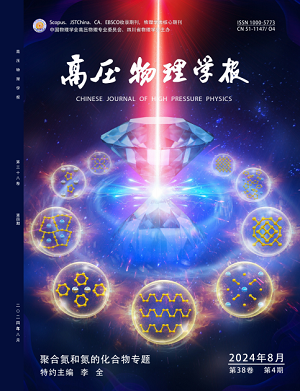
Nitrogen, the primary component of Earth's atmosphere, is an indispensable element in vital compounds such as biological macromolecules, nitrogen fertilizers, and explosives, playing a crucial role in human production and daily life. Under ambient conditions, nitrogen atoms form diatomic molecular gas (N₂) with a triple-bonded N≡N structure. The covalent N≡N bond is one of the strongest chemical bonds, with a bond energy of approximately 946 kJ/mol, significantly higher than that of N–N single bond and N=N double bond. This immense difference in bond energy implies that the transformation of polymeric nitrogens and nitrogen-rich compounds into N₂ gas releases substantial chemical energy. Consequently, polymeric nitrogens and nitrogen-rich compounds represent highly promising eco-friendly high-energy-density materials.
The key to screening and applying stable, high-energy-density materials lies in finding viable strategies to overcome the energy barrier required for N₂ dissociation, systematically exploring the structure-property relationships of polymeric nitrogen and nitrides, and gaining a deeper understanding of the processes and mechanisms governing structural phase transitions and chemical reactions in nitrogen-containing materials.
High pressure offers unique advantages in the theoretical design and experimental synthesis of polymeric nitrogen and nitrides. In 2004, the first polymeric nitrogen material, cubic gauche nitrogen (cg-N), was synthesized under extreme high-pressure and high-temperature condition. Subsequently, various polymeric nitrogen structures were predicted or synthesized, including cage-type diamondoid polymeric nitrogen, layered crystalline polymeric nitrogen, black phosphorus-type polymeric nitrogen, and amorphous polymeric nitrogen. However, synthesizing polymeric nitrogen typically requires extreme pressures exceeding 1 million atmospheres (100 GPa), presenting significant challenges. Research has revealed that introducing metal elements into nitrogen can provide electrons to the N≡N antibonding orbitals, and thereby induce N₂ dissociation. This "chemical precompression" effect effectively modulates the reaction barrier, reducing the synthesis pressure required for polymeric nitrogen. This discovery has spurred scientific interest in exploring high-energy-density materials within nitrides of reactive metals (e.g., alkali metals, alkaline earth metals).
Recently, Chinese scientists, utilizing a self-developed intelligent structure prediction method, have conducted pioneering work in the theoretical design and experimental synthesis of polymeric nitrogen and nitrides. For instance, novel stoichiometric gallium nitride was theoretically predicted, guiding the successful experimental synthesis of GaN₅ and GaN₁₀, which set new energy density records for nitrides of p-block elements. HeN₂₂ was predicted to possess a partially ionic nitrogen cage structure, and a strategy was proposed to "strip away the noble gas atoms” in consideration of the weak interaction between noble gas elements and the nitrogen framework, yielding novel polymeric nitrogen frameworks stable under ambient pressure.
To highlight recent advancements in this field, we present this Special Topic on Polymeric Nitrogen and Nitrogen Compounds in Chinese Journal of High Pressure Physics. This Special Topic: Examines high-pressure phase structures and properties across diverse polymeric nitrogen systems and nitrides; Deciphers dissociation mechanisms and phase transitions in molecular nitrogen under compression; Showcases novel and intriguing chemical bonding motifs in nitrogen compounds. We hope this collection stimulates further research interest in polymeric nitrogen and nitrides, advancing progress in this exciting domain. We sincerely appreciate all contributors to the preparation and writing of this Special Topic.
Quan Li
College of Physics, Jilin University
Key Laboratory of Material Simulation Methods and Software (Ministry of Education)
July 9, 2024
-
-
Research Progress of High Energy Density Nitrogen
2024, 38(4): 040102. doi: 10.11858/gywlxb.20230797
-
-
Pressure-Induced Polymerization of One-Dimensional Nitrogen Chains in K2N2
2024, 38(4): 040104. doi: 10.11858/gywlxb.20240719
-
On the Existence of Layered Polymeric Nitrogen
2024, 38(4): 040105. doi: 10.11858/gywlxb.20240821
 HTML
HTML PDF
PDF- Previous: 钙钛矿结构材料专题
- Next: 动态载荷下材料多尺度结构与物性专题