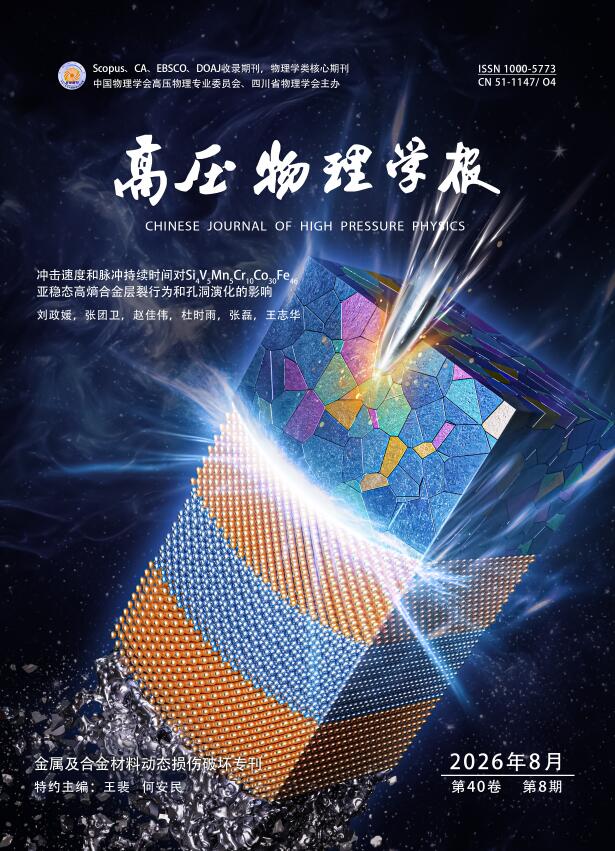
| Citation: | LIU Zhengyuan, ZHANG Tuanwei, ZHAO Jiawei, DU Shiyu, ZHANG Lei, WANG Zhihua. Effects of Impact Velocity and Pulse Duration on Spallation Behavior and Void Evolution of a Metastable Si4V5Mn5Cr10Co30Fe46 High-Entropy Alloy[J]. Chinese Journal of High Pressure Physics, 2026, 40(8): 080102. doi: 10.11858/gywlxb.20261102

|

| [1] |
HUANG S, HUANG H, LI W, et al. Twinning in metastable high-entropy alloys [J]. Nature Communications, 2018, 9(1): 2381. doi: 10.1038/s41467-018-04780-x
|
| [2] |
LI Z M, PRADEEP K G, DENG Y, et al. Metastable high-entropy dual-phase alloys overcome the strength-ductility trade-off [J]. Nature, 2016, 534(7606): 227–230. doi: 10.1038/nature17981
|
| [3] |
LI Z M, TASAN C C, PRADEEP K G, et al. A TRIP-assisted dual-phase high-entropy alloy: grain size and phase fraction effects on deformation behavior [J]. Acta Materialia, 2017, 131: 323–335. doi: 10.1016/j.actamat.2017.03.069
|
| [4] |
JO Y H, YANG J H, CHOI W M, et al. Body-centered-cubic martensite and the role on room-temperature tensile properties in Si-added SiVCrMnFeCo high-entropy alloys [J]. Journal of Materials Science & Technology, 2021, 76: 222–230. doi: 10.1016/j.jmst.2020.10.038
|
| [5] |
JIAO M X, ZHANG T W, MA J Y, et al. Superior cryogenic strength-ductility synergy in a multiphase lamellar-structured metastable high-entropy alloy [J]. Journal of Materials Science & Technology, 2026, 257: 73–86. doi: 10.1016/j.jmst.2025.09.016
|
| [6] |
SHEN J J, ZHANG W, LOPES J G, et al. Evolution of microstructure and deformation mechanisms in a metastable Fe42Mn28Co10Cr15Si5 high entropy alloy: a combined in-situ synchrotron X-ray diffraction and EBSD analysis [J]. Materials & Design, 2024, 238: 112662. doi: 10.1016/j.matdes.2024.112662
|
| [7] |
CHEN S J, OH H S, GLUDOVATZ B, et al. Real-time observations of TRIP-induced ultrahigh strain hardening in a dual-phase CrMnFeCoNi high-entropy alloy [J]. Nature Communications, 2020, 11(1): 826. doi: 10.1038/s41467-020-14641-1
|
| [8] |
YANG J H, JO Y H, KIM D W, et al. Effects of transformation-induced plasticity (TRIP) on tensile property improvement of Fe45Co30Cr10V10Ni5−xMnx high-entropy alloys [J]. Materials Science and Engineering: A, 2020, 772: 138809. doi: 10.1016/j.msea.2019.138809
|
| [9] |
MEHRANPOUR M S, RASOOLI N, KIM H S, et al. Deformation-induced martensitic transformations: a strategy for overcoming the strength-ductility trade-off in high-entropy alloys [J]. Current Opinion in Solid State and Materials Science, 2024, 31: 101177. doi: 10.1016/j.cossms.2024.101177
|
| [10] |
XU J, LIANG L, TONG W, et al. Role of strain rate in phase stability and deformation mechanism of non-equiatomic Fe38−xMn30Co15Cr15Ni2Gdx high-entropy alloy [J]. Materials Characterization, 2022, 194: 112356. doi: 10.1016/j.matchar.2022.112356
|
| [11] |
JAIN R, PARAMESWARAN V, BISWAS K, et al. Bidirectional transformation enabled improvement in strength and ductility of metastable Fe50Mn30Co10Cr10 complex concentrated alloy under dynamic deformation [J]. International Journal of Plasticity, 2023, 166: 103633. doi: 10.1016/j.ijplas.2023.103633
|
| [12] |
FANG Q H, CHEN Y, LI J, et al. Probing the phase transformation and dislocation evolution in dual-phase high-entropy alloys [J]. International Journal of Plasticity, 2019, 114: 161–173. doi: 10.1016/j.ijplas.2018.10.014
|
| [13] |
JO Y H, YANG J H, DOH K Y, et al. Analysis of damage-tolerance of TRIP-assisted V10Cr10Fe45Co30Ni5 high-entropy alloy at room and cryogenic temperatures [J]. Journal of Alloys and Compounds, 2020, 844: 156090. doi: 10.1016/j.jallcom.2020.156090
|
| [14] |
YADAV M, NAYAN N, BISWAS K, et al. Tailoring fracture resistance of a metastable Fe42Mn28Co10Cr15Si5 high entropy alloy by intrinsic toughening [J]. International Journal of Plasticity, 2025, 188: 104315. doi: 10.1016/j.ijplas.2025.104315
|
| [15] |
EGUCHI T, KOYAMA M, FUKUSHIMA Y, et al. Fatigue crack growth behavior and associated microstructure in a metastable high-entropy alloy [J]. Procedia Structural Integrity, 2018, 13: 831–836. doi: 10.1016/j.prostr.2018.12.159
|
| [16] |
HE Z F, JIA N, WANG H W, et al. The effect of strain rate on mechanical properties and microstructure of a metastable FeMnCoCr high entropy alloy [J]. Materials Science and Engineering: A, 2020, 776: 138982. doi: 10.1016/j.msea.2020.138982
|
| [17] |
JO Y H, KIM D G, JO M C, et al. Effects of deformation-induced BCC martensitic transformation and twinning on impact toughness and dynamic tensile response in metastable VCrFeCoNi high-entropy alloy [J]. Journal of Alloys and Compounds, 2019, 785: 1056–1067. doi: 10.1016/j.jallcom.2019.01.293
|
| [18] |
FIELD J E, WALLEY S M, PROUD W G, et al. Review of experimental techniques for high rate deformation and shock studies [J]. International Journal of Impact Engineering, 2004, 30(7): 725–775. doi: 10.1016/j.ijimpeng.2004.03.005
|
| [19] |
WIELEWSKI E, APPLEBY-THOMAS G J, HAZELL P J, et al. An experimental investigation into the micro-mechanics of spall initiation and propagation in Ti-6Al-4V during shock loading [J]. Materials Science and Engineering: A, 2013, 578: 331–339. doi: 10.1016/j.msea.2013.04.055
|
| [20] |
LI C, LI B, HUANG J Y, et al. Spall damage of a mild carbon steel: effects of peak stress, strain rate and pulse duration [J]. Materials Science and Engineering: A, 2016, 660: 139–147. doi: 10.1016/j.msea.2016.02.080
|
| [21] |
YUAN F P, PRAKASH V. Plate impact experiments to investigate shock-induced inelasticity in Westerly granite [J]. International Journal of Rock Mechanics and Mining Sciences, 2013, 60: 277–287. doi: 10.1016/j.ijrmms.2012.12.024
|
| [22] |
REMINGTON T P, REMINGTON B A, HAHN E N, et al. Deformation and failure in extreme regimes by high-energy pulsed lasers: a review [J]. Materials Science and Engineering: A, 2017, 688: 429–458. doi: 10.1016/j.msea.2017.01.114
|
| [23] |
LI H J, ZHAO L, DING X D, et al. Mechanism of the β to ω phase transformation in shock compressed Zr-Nb alloys [J]. Physical Review B, 2024, 110(13): 134105. doi: 10.1103/PhysRevB.110.134105
|
| [24] |
SINGH S P, SINGH H, MAHAJAN P. Comprehensive analysis of wave interactions and resulting spall damage in layered heterogeneous medium under impact [J]. Mechanics of Materials, 2024, 199: 105182. doi: 10.1016/j.mechmat.2024.105182
|
| [25] |
ANTOUN T, CURRAN D R, RAZORENOV S V, et al. Spall fracture [M]. New York: Springer, 2003: 37–58.
|
| [26] |
MACNIDER B, JONES D, CALLANAN J, et al. In situ measurement of damage evolution in shocked magnesium as a function of microstructure [J]. Science Advances, 2023, 9(45): eadi2606. doi: 10.1126/sciadv.adi2606
|
| [27] |
QIU Y J, SHI X B, YAN P, et al. Dynamic recrystallization/recovery of FCC and B2 phases in a Ni36Fe36Cr10Al17Mo1 eutectic high entropy alloy [J]. Metals and Materials International, 2026, 32(1): 372–383. doi: 10.1007/s12540-025-01979-8
|
| [28] |
CHENG J C, QIN H L, LI C, et al. Deformation and damage of equiatomic CoCrFeNi high-entropy alloy under plate impact loading [J]. Materials Science and Engineering: A, 2023, 862: 144432. doi: 10.1016/j.msea.2022.144432
|
| [29] |
CHENG J C, XU J, ZHAO X J, et al. Shock compression and spallation of a medium-entropy alloy Fe40Mn20Cr20Ni20 [J]. Materials Science and Engineering: A, 2022, 847: 143311. doi: 10.1016/j.msea.2022.143311
|
| [30] |
ZHAO S P, FENG Z D, LI L X, et al. Dynamic mechanical properties, deformation and damage mechanisms of eutectic high-entropy alloy AlCoCrFeNi2.1 under plate impact [J]. Journal of Materials Science & Technology, 2023, 134: 178–188. doi: 10.1016/j.jmst.2022.05.060
|
| [31] |
ZHANG N B, TANG Z J, LIN Z H, et al. Deformation and damage of heterogeneous-structured high-entropy alloy CrMnFeCoNi under plate impact [J]. Materials Science and Engineering: A, 2022, 843: 143069. doi: 10.1016/j.msea.2022.143069
|
| [32] |
罗小平, 李绪海, 唐泽明, 等. 冲击应力和脉宽对NbTiZr中熵合金层裂的影响 [J]. 高压物理学报, 2024, 38(6): 064101. doi: 10.11858/gywlxb.20240771
LUO X P, LI X H, TANG Z M, et al. Effects of shock peak stress and pulse duration on spall damage of NbTiZr medium-entropy alloy [J]. Chinese Journal of High Pressure Physics, 2024, 38(6): 064101. doi: 10.11858/gywlxb.20240771
|
| [33] |
SUN Y F, LIU Y S, WU W, et al. Impact response of metastable body-centered cubic high-entropy alloy HfZrTiTa0.53: deformation and spallation damage [J]. Materials Science and Engineering: A, 2025, 924: 147727. doi: 10.1016/j.msea.2024.147727
|
| [34] |
HAWKINS M C, THOMAS S, HIXSON R S, et al. Dynamic properties of FeCrMnNi, a high entropy alloy [J]. Materials Science and Engineering: A, 2022, 840: 142906. doi: 10.1016/j.msea.2022.142906
|
| [35] |
PAN R C, FAN D, BIAN Y L, et al. Effect of minor elements Al and Ti on dynamic deformation and fracture of CoCrNi-based medium-entropy alloys [J]. Materials Science and Engineering: A, 2023, 884: 145535. doi: 10.1016/j.msea.2023.145535
|
| [36] |
YANG X, XIONG X, YIN Z, et al. Interrupted test of advanced high strength steel with tensile split Hopkinson bar method [J]. Experimental Mechanics, 2014, 54(4): 641–652. doi: 10.1007/s11340-013-9828-0
|
| [37] |
AVOLEDO E, PETRUZZI M, PELEGATTI M, et al. Defect analysis by computed tomography in metallic materials: optimisation, uncertainty quantification and classification [J]. Precision Engineering, 2025, 97: 235–248. doi: 10.1016/j.precisioneng.2025.09.008
|
| [38] |
YANG P, ZHAO P Y. Void nucleation at dislocation boundaries aided by the synergy of multiple dislocation pile-ups [J]. International Journal of Plasticity, 2023, 171: 103779. doi: 10.1016/j.ijplas.2023.103779
|
| [39] |
WILLIAMS C L, CHEN C Q, RAMESH K T, et al. The effects of cold rolling on the microstructural and spall response of 1100 aluminum [J]. Journal of Applied Physics, 2013, 114(9): 093502. doi: 10.1063/1.4817844
|
| [40] |
WILLIAMS C L, RAMESH K T, DANDEKAR D P. Spall response of 1100-O aluminum [J]. Journal of Applied Physics, 2012, 111(12): 123528. doi: 10.1063/1.4729305
|
Figures(17) / Tables(1)
Website Copyright© Editorial Office of Chinese Journal of High Pressure Physics
Tel:0816-2490042 E-mail:gaoya@caep.cn
Supported by: Beijing Renhe Information Technology Co. Ltd support:
info@rhhz.net







 DownLoad: