




Research Progress on Ion-Partitioning Pathways in High-Pressure Saline Water Systems
-
摘要: 高压盐水体系中的相变行为是理解冰卫星深部水圈、富水行星冰幔以及高压冰物理的重要基础。与纯H2O体系相比,盐离子不仅改变冰Ⅵ、冰Ⅶ等高压冰相的形成路径,也可能通过盐水合物和盐影响冰Ⅶ或残余卤水等形式的重新分配。围绕“盐离子在高压水体系中去向何处”这一问题,从相变路径控制因素和证据判读维度两个层面建立比较框架。其中,浓度、水活度、压力-温度路径、前驱体状态和水合物稳定性主要影响盐离子在冰相、水合物和残余流体之间的分配路径;证据类型和证据强度则用于限定不同结论的可靠性和表述边界。在此基础上,重点综述LiCl、NaCl、KCl、KBr、CaCl2和MgCl2等体系的研究进展。现有结果表明:LiCl体系提供了非平衡路径下盐影响冰Ⅶ的代表性证据;NaCl体系表现出明显的条件依赖和争议性;KCl/KBr及部分NaCl体系更倾向于形成盐水合物;CaCl2体系揭示了水合物形成、分解并进一步影响冰Ⅶ的阶段性机制;MgCl2体系则显示多水合物与潜在MgCl2-冰Ⅶ之间的关系仍需连续原位实验证实。需要说明的是,本综述重点关注已有高压实验资料较为系统的代表性氯盐和卤盐体系,硫酸盐、碳酸盐及多离子复盐体系仅在行星背景和未来研究方向中作有限讨论。Abstract: Phase-transition behavior in high-pressure saline water systems is fundamental to understanding the deep hydrospheres of icy moons, the ice mantles of water-rich planets, and high-pressure ice physics. Compared with pure H2O systems, salt ions not only modify the formation pathways of high-pressure ice phases such as ice Ⅵ and ice Ⅶ, but may also be redistributed as salt hydrates, salt-affected ice Ⅶ, or residual brines. In this review, we address the question of where salt ions reside in high-pressure aqueous systems by establishing a comparative framework based on two aspects: phase-transition pathway controls and evidence-assessment criteria. Concentration, water activity, pressure-temperature path, precursor state, and hydrate stability mainly govern the partitioning of salt ions among ice phases, hydrates, and residual fluids, whereas evidence type and evidence strength define the reliability and wording boundaries of different conclusions. On this basis, we review recent progress in representative systems including LiCl, NaCl, KCl, KBr, CaCl2, and MgCl2. Existing studies show that the LiCl system provides representative evidence for salt-affected ice Ⅶ formed through a non-equilibrium pathway; the NaCl system exhibits strong condition dependence and remains controversial with respect to extensive lattice incorporation; KCl/KBr and some NaCl systems preferentially form salt hydrates; the CaCl2 system reveals a stepwise mechanism involving hydrate formation, hydrate decomposition, and subsequent perturbation of ice Ⅶ; and the MgCl2 system indicates that the relationship between multiple hydrates and potential MgCl2-ice Ⅶ still requires confirmation by continuous in situ experiments. It should be noted that this review focuses on representative chloride and halide systems for which relatively systematic high-pressure experimental data are available, whereas sulfate, carbonate, and multicomponent salt systems are discussed only briefly in the context of planetary implications and future research directions.
-
Key words:
- high-pressure saline water systems /
- salt hydrates /
- ice Ⅶ /
- ionic partitioning /
- icy moons
-
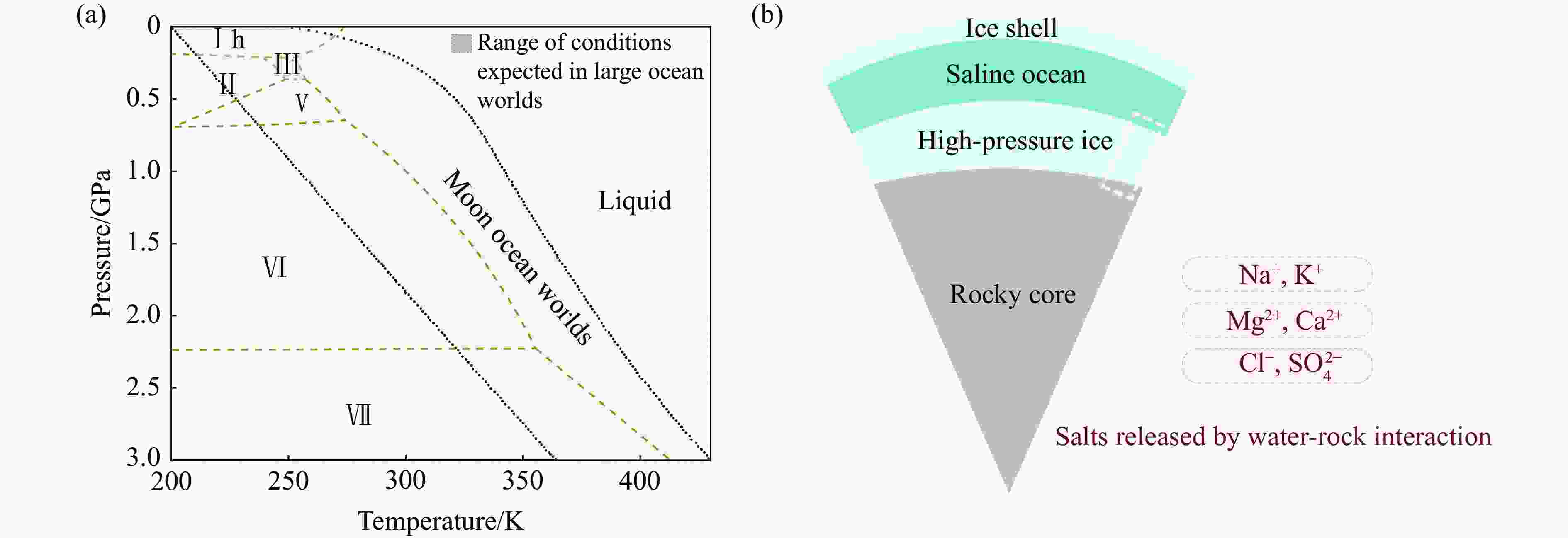
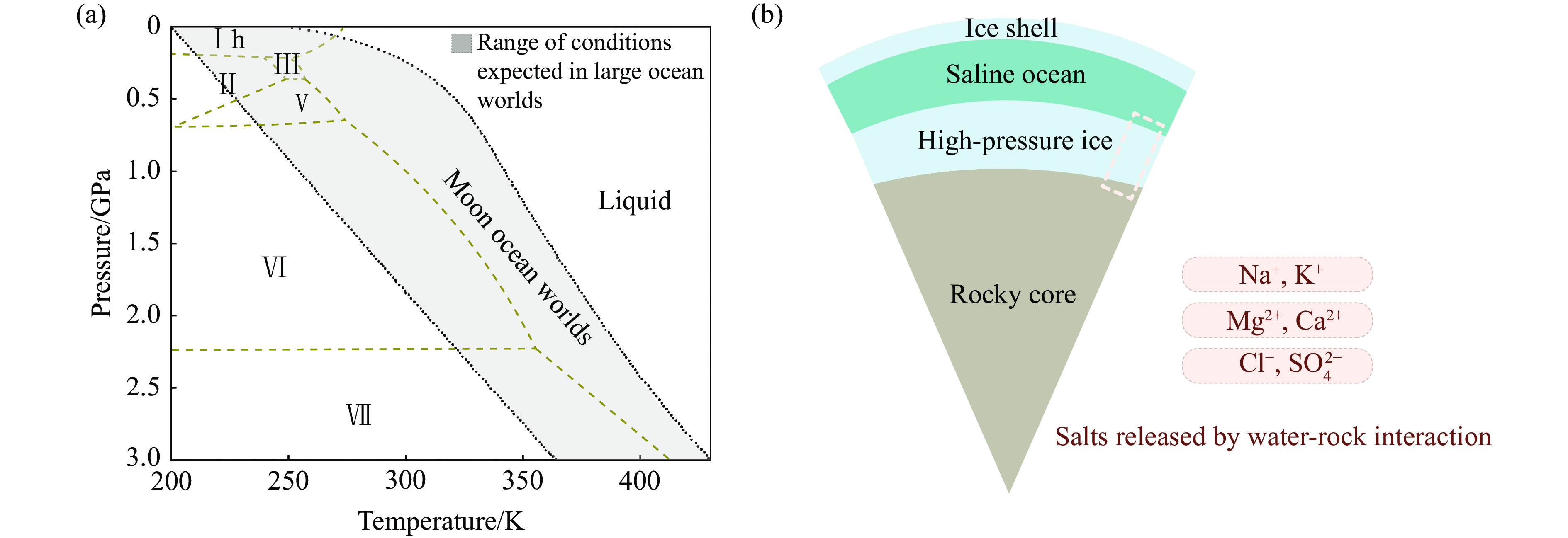
图 1 冰卫星或富水行星内部高压盐水环境下(a) 水的相图[8]以及(b) 结构示意图(图1(b)中压力随深度增加而增大,盐离子可由水-岩相互作用输入地下海洋或深部高压冰层)
Figure 1. High-pressure saline water environments in icy moons or water-rich planets: (a) phase diagram of H2O[8]; (b) schematic internal structure showing the increase of pressure with depth and the potential transport of salt ions into subsurface oceans or deep high-pressure ice layers through water-rock interactions
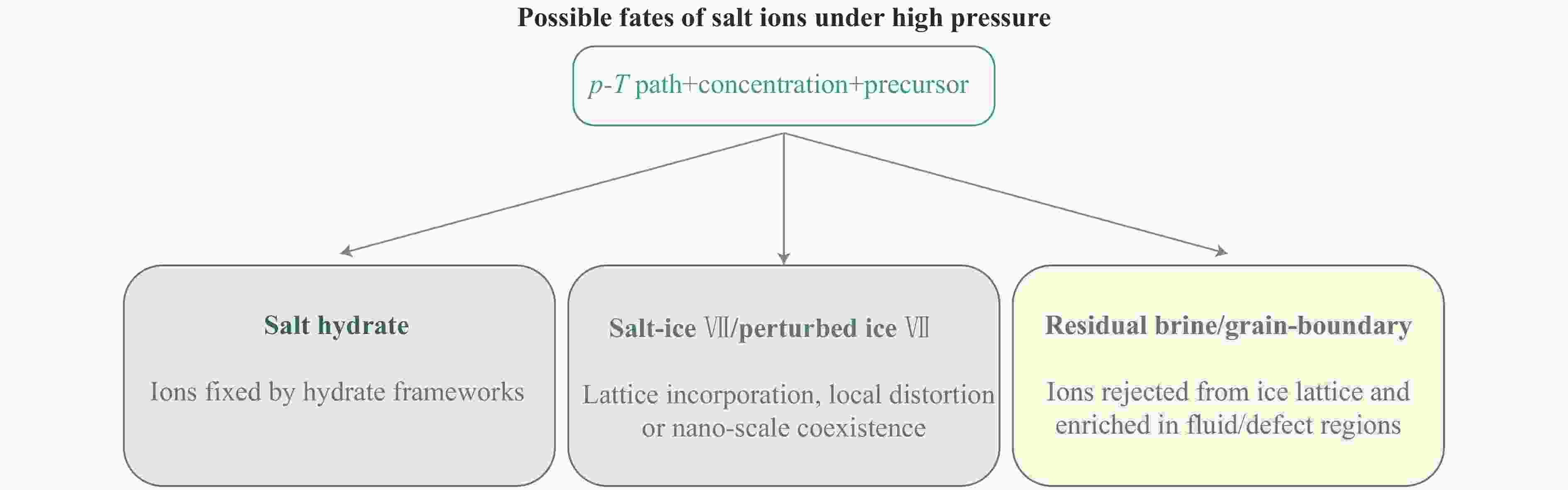
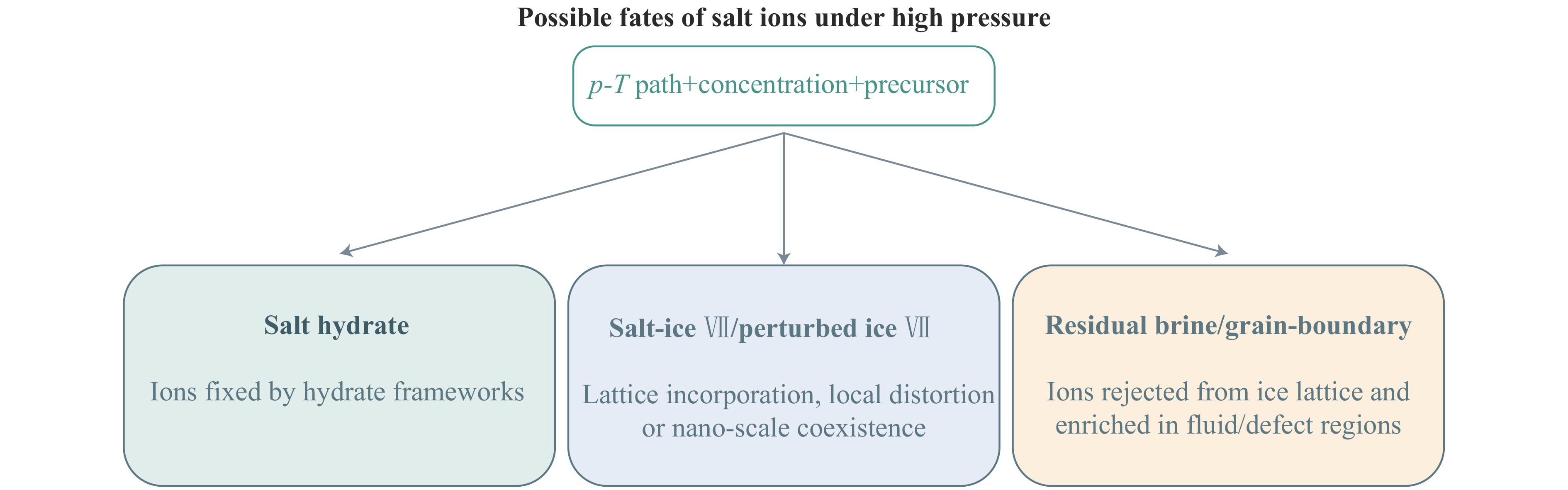
图 2 高压盐水体系中盐离子的3种可能去向:盐水合物、盐影响冰Ⅶ以及残余卤水或晶界富集
Figure 2. Three possible fates of salt ions under high pressure: hydrate formation, salt-affected ice Ⅶ, and residual brine or grain-boundary enrichment
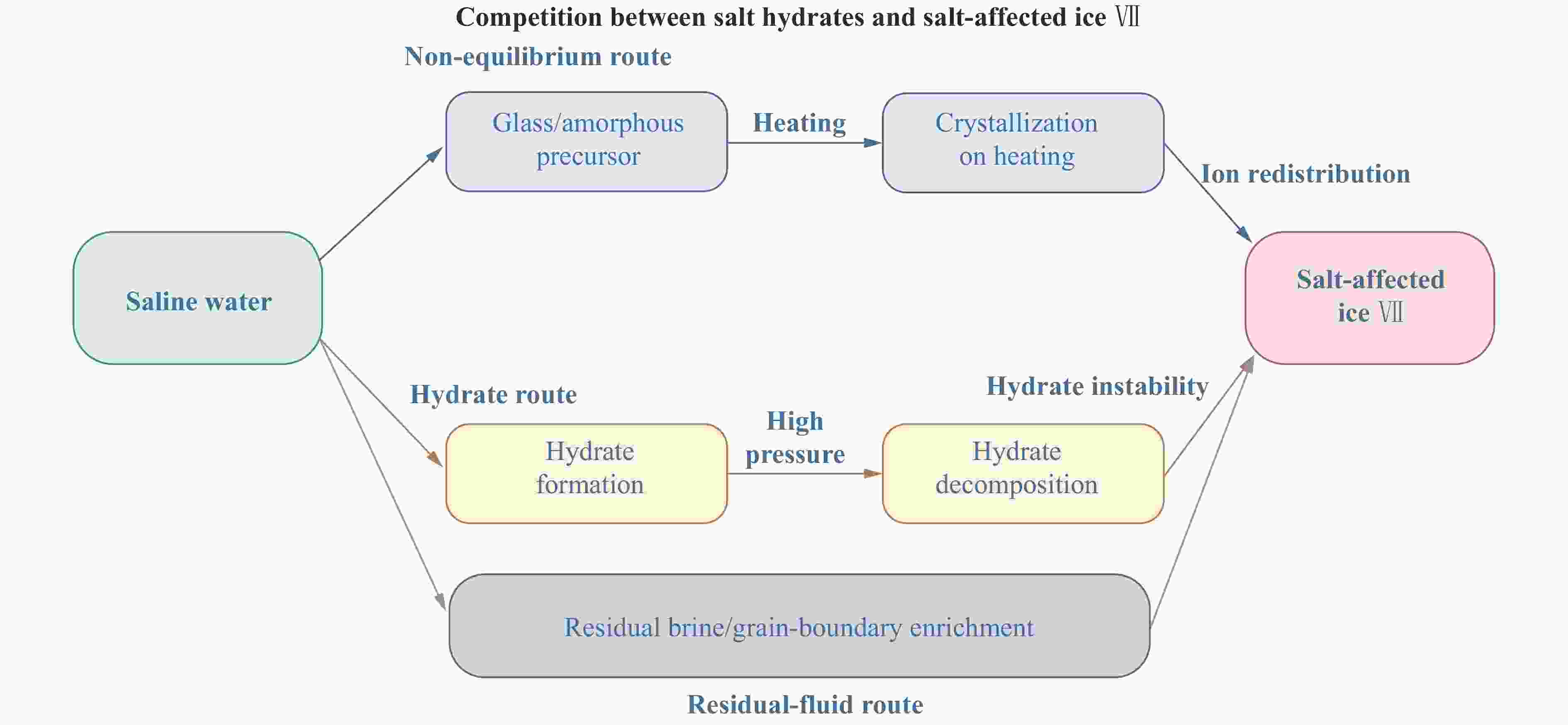
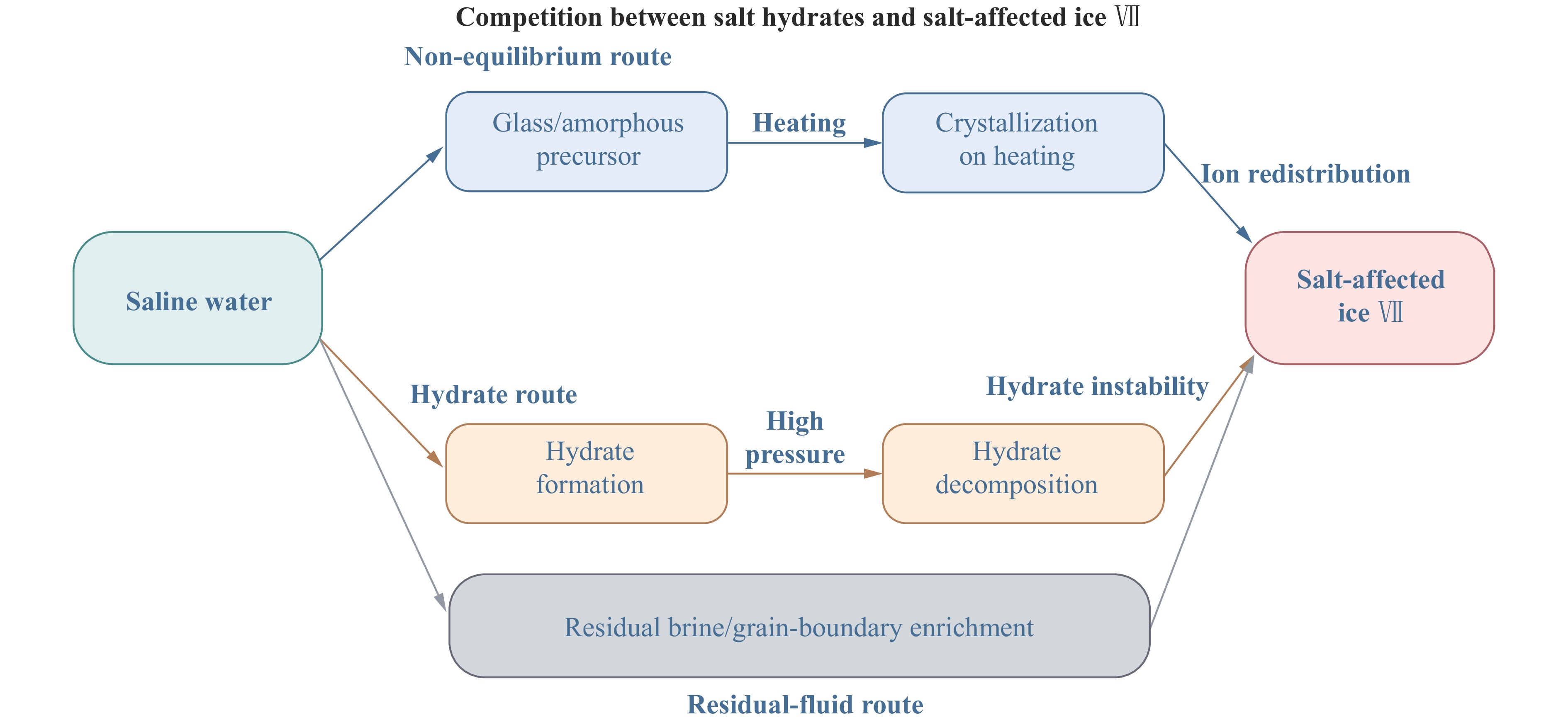
图 3 盐水合物与盐影响冰Ⅶ之间的竞争路径示意图(盐离子在升压和变温过程中可经历水合物固定、水合物失稳后的重新分配、冰Ⅶ局部扰动以及残余卤水富集等不同路径。不同路径的证据确定性不同。)
Figure 3. Conceptual pathways for competition between salt hydrates and salt-affected ice Ⅶ (Salt ions may follow different pathways during compression and temperature variation, including hydrate immobilization, redistribution after hydrate destabilization, local perturbation of ice Ⅶ, and residual-brine enrichment. Notes: evidential support differs among pathways.)
表 1 高压盐水体系相变路径的控制因素与证据判读维度
Table 1. Control factors and evidence-assessment dimensions for phase-transition pathways in high-pressure saline water systems
Factor/assessment dimension Role in pathway control or interpretation Representative systems Main evidence Concentration/
water activityControls material partitioning among ice
phases, hydrates, and residual fluidsLiCl, NaCl,
MgCl2Initial composition, residual liquid, phase fraction from diffraction p-T path Controls vitrification, crystallization on heating,
hydrate formation, and hydrate decompositionLiCl, CaCl2 In situ XRD/Raman changes
along the pathPrecursor state Glassy or amorphous precursors can modify
salt rejection and nucleation processesLiCl, NaCl Amorphous scattering, crystallization temperature, sequence of phase appearance Hydrate stability Hydrates can immobilize salt ions and
may act as intermediate phases for ion
redistribution at higher pressuresNaCl, KCl, KBr, CaCl2, MgCl2 Independent hydrate peaks,
structural refinementEvidence type/evidence strength Does not control phase transitions, but
distinguishes lattice incorporation, local
perturbation, nanoscale coexistence,
and residual-brine enrichmentAll systems XRD/Raman/Brillouin combined
with refinement, neutron
diffraction, and DFT/MDNote: DFT represents density functional theory; MD represents molecular dynamics.  下载: 导出CSV
表 2 典型盐水体系中相变路径、起始组成与证据强度的横向比较
Table 2. Cross-comparison of phase-transition pathways, starting compositions, and evidence strength in representative saline systems
System Starting composition and p-T path Main product or phenomenon Evidence basis and
conclusion strengthMechanistic
implicationLiCl-H2O Glassy precursor, e.g., LiCl·6H2O solutions compressed at 4–6 GPa and crystallized
on heatingSalt-affected ice Ⅶ; lattice expansion and hydrogen-bond network perturbation Neutron diffraction, simulations, volume anomaly; relatively strong evidence for a non-equilibrium
salt-affected ice Ⅶ pathway[15]Proof of principle for salt-affected ice Ⅶ, but path-specific rather
than universalNaCl-H2O Crystallization from amorphous precursor, high-T high-p simulations, and high-p low-T hydrate experiments Limited evidence for extensive incorporation; possible limited solubility in high-temperature dense ice; hyperhydrated phases can form Hydrate structures provide strong structural evidence; dense-ice solubility is mainly supported by simulations; extensive incorporation remains limited or controversial[21–23] Boundary system with strong pathway divergence under different p-T conditions KCl-H2O KCl-nH2O (n=20, 29, 32, 38, 56, 111) solutions; 0 to 3 GPa; 298–405 K KCl·H2O Single-crystal/powder XRD and spectroscopy; strong evidence
for hydrate formation under
reported conditions[9]Hydrate formation dominates under
reported conditionsKBr-H2O KBr-nH2O (n=20, 29) solutions; 0 to 3 GPa; 298 K KBr·H2O; structural family related to KCl·H2O XRD and spectroscopy; strong evidence for a monohydrate
structural family[14]Halide substitution within a monohydrate structural family CaCl2-H2O CaCl2-nH2O (n=55) solution; 298 K; hydrate formation at 2 GPa and decomposition at 10 GPa β-CaCl2·4H2O coexists with ice Ⅶ; hydrate decomposes upon further compression and
affects ice ⅦRaman, XRD, simulations, and phase-transition anomalies; strong evidence for hydrate formation,
but ice Ⅶ perturbation after decomposition requires
combined constraints[24]Two-stage mechanism: hydrate formation-decomposition-ice Ⅶ perturbation MgCl2-H2O Different MgCl2-nH2O compositions and
p-T pathsMgCl2·6H2O-Ⅱ, MgCl2·7H2O, MgCl2·10H2O, and low-concentration MgCl2- related perturbations
on ice ⅦNeutron diffraction, XRD, Raman, and simulations; strong evidence for several hydrates, but the hydrate-
ice Ⅶ transition relationship
remains unresolved [25–28]Multiple hydrates are established, but their link to potential ice Ⅶ perturbation remains
an open problemNote: Conclusion strength refers to how directly the available evidence supports the proposed pathway; it is not a phase-transition control factor.
下载: 导出CSV
表 3 典型高压盐水合物的形成条件与结构特征
Table 3. Formation conditions and structural characteristics of representative high-pressure salt hydrates
Hydrate Structure/feature Formation condition Starting system Ion-partitioning implication NaCl·13H2O Hyperhydrated sodium chloride hydrate ↓180 K, ↑0.3 GPa; formed at 243 K, ~0.5 GPa[23] NaCl-nH2O
(n=15)Immobilizes Na+ and Cl− in a hyperhydrated phase 2NaCl·17H2O Hyperhydrated sodium chloride hydrate ↓270 K , ↑1.5 GPa[23] NaCl-nH2O
(n=15)Immobilizes Na+ and Cl− in a hyperhydrated phase KCl·H2O Monohydrate with a salt-water framework 298 K, ~2 GPa[9] KCl-nH2O
(n=20, 29, 32,
38, 56, 111)K+ and Cl− preferentially enter an independent salt-water framework KBr·H2O Structural family related to KCl·H2O 298 K, ~2 GPa[14] KBr-nH2O
(n=20, 29)Provides a structural analogue for KCl/KBr monohydrates β-CaCl2·4H2O Calcium chloride
hydrate298 K, forms at 2 GPa and decomposes
at 10 GPa[24]CaCl2-nH2O
(n=55)Immobilizes Ca2+ and Cl− at moderate pressure; instability at higher pressure may affect ice Ⅶ MgCl2·10H2O High-pressure decahydrate ↓100 K, ↑4 GPa;
↑285 K, 2.7 GPa[25]MgCl2-nH2O
(n=25)Reflects strong Mg2+ hydration and high-pressure hydrate stability MgCl2·6H2O-Ⅱ High-pressure hexahydrate 295–323 K,
0.9–1.6 GPa[26]MgCl2-nH2O
(n=12)Shows the stability of Mg2+ coordination-water environments at GPa-level pressure MgCl2·7H2O High-pressure heptahydrate with anisotropic compression 298 K, 3 GPa[27] MgCl2-nH2O
(n=10)Constrains the structural evolution of MgCl2 hydrates Note: “↑” denotes heating or compression, and “↓” denotes cooling or decompression. Pressures and temperatures are given in GPa and K, respectively. Starting compositions or salt-to-water ratios follow the original reports where possible.
下载: 导出CSV
-
[1] SALZMANN C G. Advances in the experimental exploration of water’s phase diagram [J]. The Journal of Chemical Physics, 2019, 150(6): 060901. doi: 10.1063/1.5085163 [2] 施伟刚, 李新阳, 魏鑫苗, 等. 富水星体内部物质的高温高压实验研究: 进展与展望 [J]. 矿物岩石地球化学通报, 2026, 45(2): 631–645. doi: 10.3724/j.issn.1007-2802.20250059SHI W G, LI X Y, WEI X M, et al. High-pressure and high-temperature experimental studies of interior materials in water-rich planets: progresses and perspectives [J]. Bulletin of Mineralogy, Petrology and Geochemistry, 2026, 45(2): 631–645. doi: 10.3724/j.issn.1007-2802.20250059 [3] PRAKAPENKA V B, HOLTGREWE N, LOBANOV S S, et al. Structure and properties of two superionic ice phases [J]. Nature Physics, 2021, 17(11): 1233–1238. doi: 10.1038/s41567-021-01351-8 [4] ACKLAND G J, HERMANN A, KOMATSU K, et al. Distinction between ice phases Ⅶ, Ⅷ, and X [J]. Physical Review B, 2025, 112(9): 094116. doi: 10.1103/nmlm-rtxz [5] YAMASHITA K, KOMATSU K, KLOTZ S, et al. Atomic distribution and local structure in ice Ⅶ from in situ neutron diffraction [J]. Proceedings of the National Academy of Sciences of the United States of America, 2022, 119(40): e2208717119. doi: 10.1073/pnas.2208717119 [6] KLOTZ S, KOMATSU K, KAGI H, et al. Bulk moduli and equations of state of ice Ⅶ and ice Ⅷ [J]. Physical Review B, 2017, 95(17): 174111. doi: 10.1103/PhysRevB.95.174111 [7] JOURNAUX B, BROWN J M, PAKHOMOVA A, et al. Holistic approach for studying planetary hydrospheres: gibbs representation of ices thermodynamics, elasticity, and the water phase diagram to 2300 MPa [J]. Journal of Geophysical Research: Planets, 2020, 125(1): e2019JE006176. doi: 10.1029/2019JE006176[8] JOURNAUX B, KALOUSOVÁ K, SOTIN C, et al. Large ocean worlds with high-pressure ices [J]. Space Science Reviews, 2020, 216(1): 7. doi: 10.1007/s11214-019-0633-7 [9] WEI X M, ZHOU Q, LI F F, et al. Novel high-pressure potassium chloride monohydrate and its implications for water-rich planetary bodies [J]. Journal of Geophysical Research: Planets, 2023, 128(10): e2022JE007622. doi: 10.1029/2022JE007622 [10] VANCE S D, JOURNAUX B, HESSE M, et al. The salty secrets of icy ocean worlds [J]. Journal of Geophysical Research: Planets, 2021, 126(1): e2020JE006736. doi: 10.1029/2020JE006736 [11] TRUMBO S K, BROWN M E, HAND K P. Sodium chloride on the surface of Europa [J]. Science Advances, 2019, 5(6): eaaw7123. doi: 10.1126/sciadv.aaw7123 [12] TOSI F, MURA A, COFANO A, et al. Salts and organics on Ganymede’s surface observed by the JIRAM spectrometer onboard Juno [J]. Nature Astronomy, 2024, 8(1): 82–93. doi: 10.1038/s41550-023-02107-5 [13] BROWN M E, HAND K P. Salts and radiation products on the surface of Europa [J]. The Astronomical Journal, 2013, 145(4): 110. doi: 10.1088/0004-6256/145/4/110 [14] CHENG R, XIE C L, PAN Y L, et al. Pressure-induced formation of KBr monohydrate and bromide substitution effects in alkali halide monohydrates [J]. iScience, 2026, 29(5): 115825. doi: 10.1016/j.isci.2026.115825 [15] KLOTZ S, BOVE L E, STRÄSSLE T, et al. The preparation and structure of salty ice Ⅶ under pressure [J]. Nature Materials, 2009, 8(5): 405–409. doi: 10.1038/nmat2422 [16] FRANK M R, SCOTT H P, AARESTAD E, et al. Potassium chloride-bearing ice Ⅶ and ice planet dynamics [J]. Geochimica et Cosmochimica Acta, 2016, 174: 156–166. doi: 10.1016/j.gca.2015.11.027 [17] TSIRONI I, SCHLESINGER D, SPÄH A, et al. Brine rejection and hydrate formation upon freezing of NaCl aqueous solutions [J]. Physical Chemistry Chemical Physics, 2020, 22(14): 7625–7632. doi: 10.1039/C9CP05436G [18] VRBKA L, JUNGWIRTH P. Brine rejection from freezing salt solutions: a molecular dynamics study [J]. Physical Review Letters, 2005, 95(14): 148501. doi: 10.1103/PhysRevLett.95.148501 [19] PAN Y L, YONG W J, SECCO R A. Electrical conductivity of aqueous NaCl at high pressure and low temperature: application to deep subsurface oceans of icy moons [J]. Geophysical Research Letters, 2021, 48(17): e2021GL094020. doi: 10.1029/2021GL094020 [20] YAN H C, ZHANG Q X, ZHUANG Q, et al. Salt ice Ⅵ as solid-state electrolytes [J]. Advanced Materials, 2026, 38(5): e15243. doi: 10.1002/adma.202515243 [21] LUDL A A, BOVE L E, CORRADINI D, et al. Probing ice Ⅶ crystallization from amorphous NaCl-D2O solutions at gigapascal pressures [J]. Physical Chemistry Chemical Physics, 2017, 19(3): 1875–1883. doi: 10.1039/C6CP07340A [22] HERNANDEZ J A, CARACAS R, LABROSSE S. Stability of high-temperature salty ice suggests electrolyte permeability in water-rich exoplanet icy mantles [J]. Nature Communications, 2022, 13(1): 3303. doi: 10.1038/s41467-022-30796-5 [23] JOURNAUX B, PAKHOMOVA A, COLLINGS I E, et al. On the identification of hyperhydrated sodium chloride hydrates, stable at icy moon conditions [J]. Proceedings of the National Academy of Sciences of the United States of America, 2023, 120(9): e2217125120. doi: 10.1073/pnas.2217125120 [24] WEI X M, LI X Y, ZHANG Z H, et al. Impact of CaCl2-induced chemical pressure on the phase transition of H2O at high pressure [J]. Physical Review B, 2024, 109(13): 134108. doi: 10.1103/PhysRevB.109.134108 [25] KOMATSU K, SHINOZAKI A, MACHIDA S, et al. Crystal structure of magnesium dichloride decahydrate determined by X-ray and neutron diffraction under high pressure [J]. Acta Crystallographica Section B: Structural Science, Crystal Engineering and Materials, 2015, 71(1): 74–80. doi: 10.1107/S205252061500027X [26] YAMASHITA K, KOMATSU K, HATTORI T, et al. Crystal structure of a high-pressure phase of magnesium chloride hexahydrate determined by in-situ X-ray and neutron diffraction methods [J]. Acta Crystallographica Section C, 2019, 75(12): 1605–1612. doi: 10.1107/S2053229619014670 [27] YAMASHITA K, KOMATSU K, HATTORI T, et al. Crystal structure and compressibility of magnesium chloride heptahydrate found under high pressure [J]. Acta Crystallographica Section B: Structural Science, Crystal Engineering and Materials, 2024, 80(6): 695–705. doi: 10.1107/S205252062400903X [28] WATANABE M, KOMATSU K, NORITAKE F, et al. Structural incorporation of MgCl2 into ice Ⅶ at room temperature [J]. Japanese Journal of Applied Physics, 2017, 56(5S3): 05FB03. doi: 10.7567/JJAP.56.05FB03 -

 下载:

计量
- 文章访问数: 172
- HTML全文浏览量: 47
- PDF下载量: 19
