





Structure and Properties of Glassy Carbon under High Pressure
-
摘要: 玻璃碳是一种几乎全sp2杂化的非晶态碳材料,由于其自身高度无序的原子结构和各向同性特点,成为研究压力诱导非晶结构相变的理想非晶模型体系,同时也是探索新型非晶碳材料合成的最佳前驱体。为此,重点讨论了玻璃碳在常温高压以及高温高压下的结构相变、性质演化、相变机制及其在实现高压态物质的常压保存方面的应用。玻璃碳在高压下会发生结构相变并伴随sp2-sp3转变,转变为含有极高比例sp3键的四面体非晶碳,这种高压相具有光学透明、高电阻、高强度、高体模量等特性,但是无法在常压下保持稳定。而引入高温后,在不同的高温高压条件下,玻璃碳可以转变为具有超高弹性和比强度的压缩玻璃碳、近全sp3键合的非晶态金刚石等可以保存到常压的新型非晶态碳材料。此外,利用玻璃碳独特的纳米孔洞结构及其压力诱导的可渗透性,还可以合成能够脱离高压装置保存高压态物质的“金刚石纳米高压舱”,为高压研究和高压态材料的应用提供了新的机遇。Abstract: Glassy carbon is a nearly fully sp2-bonded amorphous carbon allotrope. Its highly disordered atomic structure and isotropic nature make it an ideal model system for studying pressure-induced transitions in amorphous materials and a versatile precursor for the synthesis of novel amorphous carbon materials. This review summarizes recent advances in understanding the structural transformations, property evolution, and transition mechanisms of glassy carbon under high-pressure and high-pressure-high-temperature (HPHT) conditions, as well as its emerging applications in high-pressure science. Experimental and theoretical studies have shown that glassy carbon undergoes a pressure-induced sp2 to sp3 bonding transition, forming a tetrahedral amorphous carbon phase with high transparency, electrical resistivity, strength, and bulk modulus. Although this high-pressure phase is not recoverable at ambient conditions, HPHT treatment can produce new amorphous carbon materials, including compressed glassy carbon and nearly fully sp3-bonded amorphous diamond. In addition, the unique nano-pore structure of glassy carbon and its pressure-induced permeability have enabled the development of nanostructured diamond capsules capable of preserving high-pressure phases at ambient conditions. This capability opens new opportunities for high-pressure research and for the practical utilization of high-pressure materials beyond the confines of high-pressure apparatus.
-
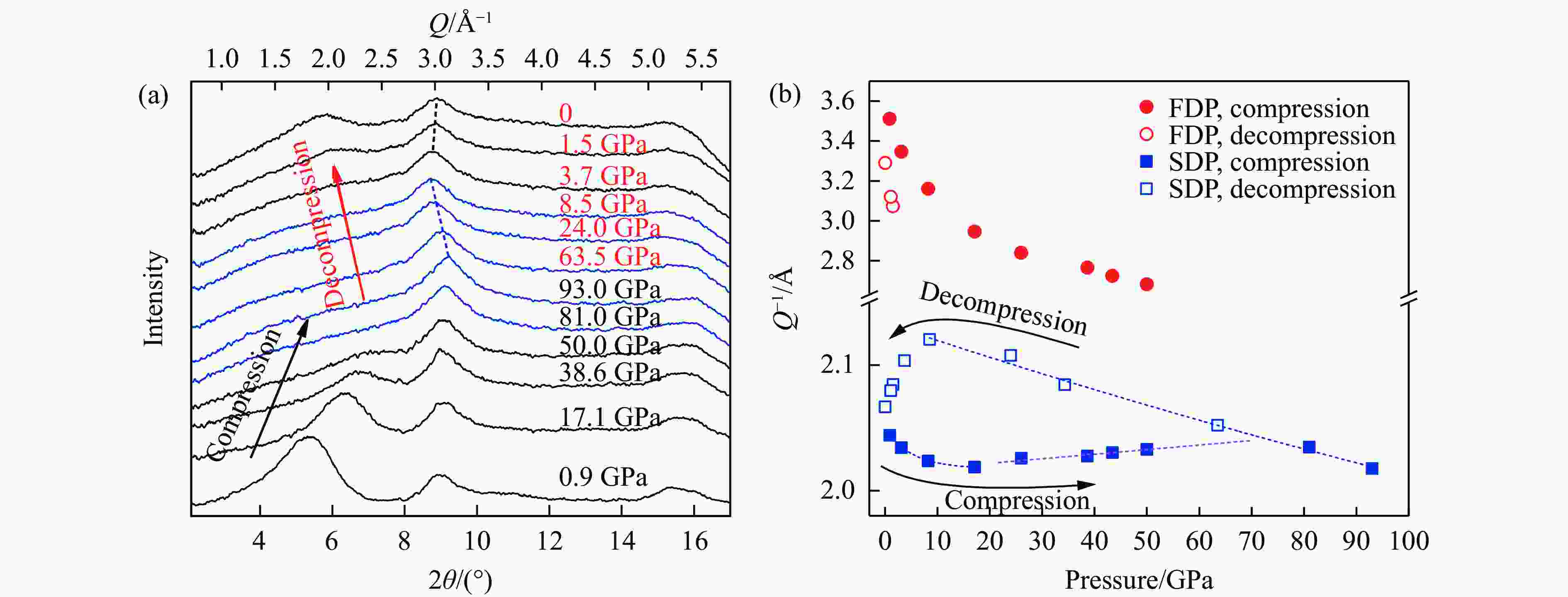
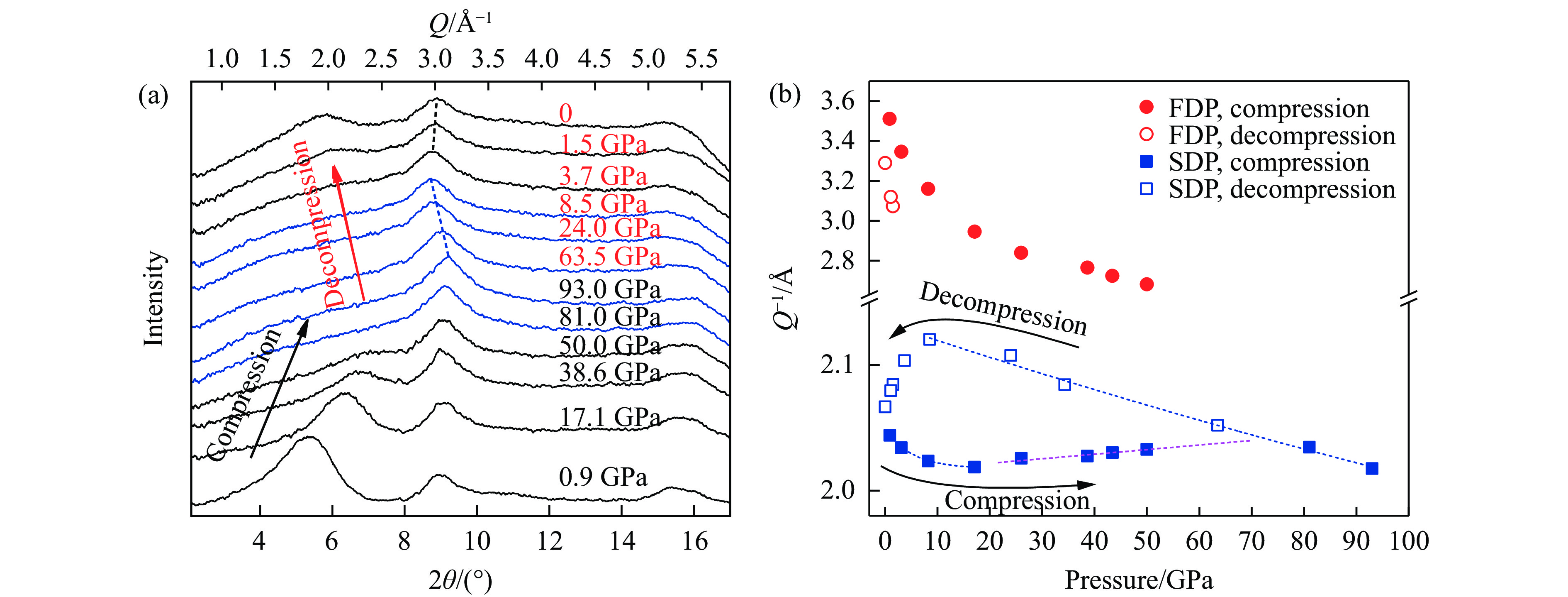
图 1 (a) 玻璃碳在压缩至 93.0 GPa 并卸压至 0 GPa 过程中不同代表性压力下的原位高压 XRD 图谱; (b) 玻璃碳第1衍射峰(FDP,圆点)和第2衍射峰(SDP,方块)的峰位随压力的变化关系(实心符号表示加压过程,空心符号表示卸压过程,虚线仅用于引导视线)[23]
Figure 1. (a) In situ high-pressure XRD patterns of GC at representative pressures during compression up to 93.0 GPa and decompression to 0 GPa; (b) position of the FDP (circles) and SDP (squares) of GC as functions of pressure during compression up to 93.0 GPa (solid symbols) and decompression (open symbols) (The dashed lines serve as a guide to the eye[23].)
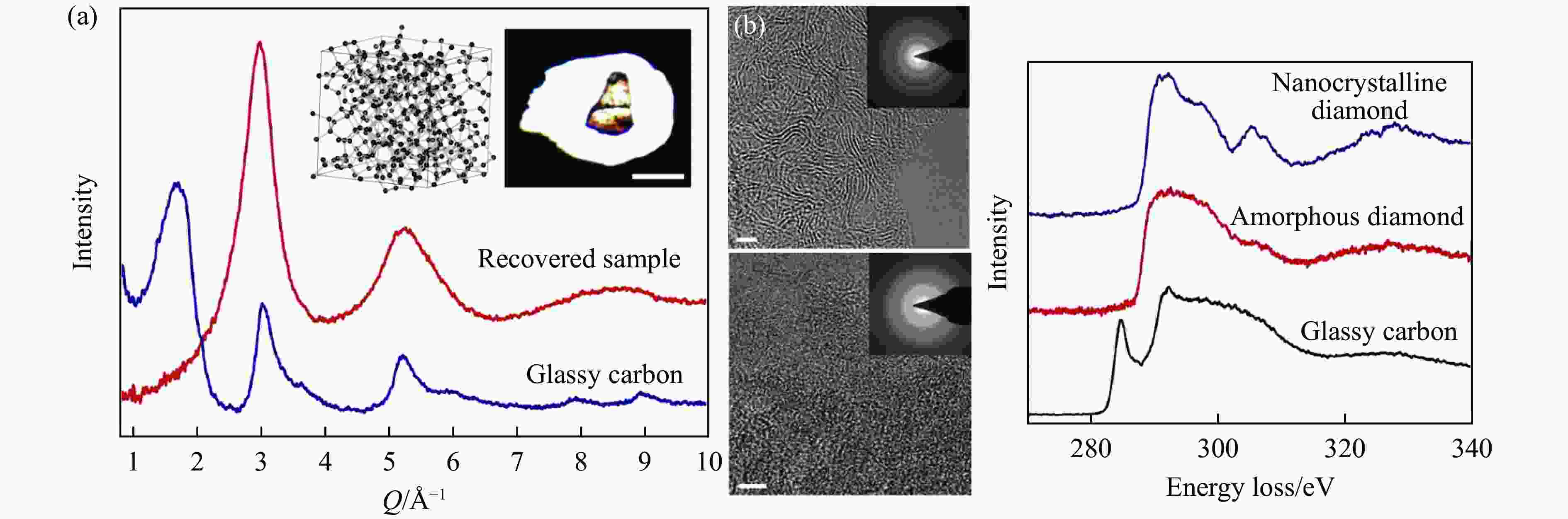
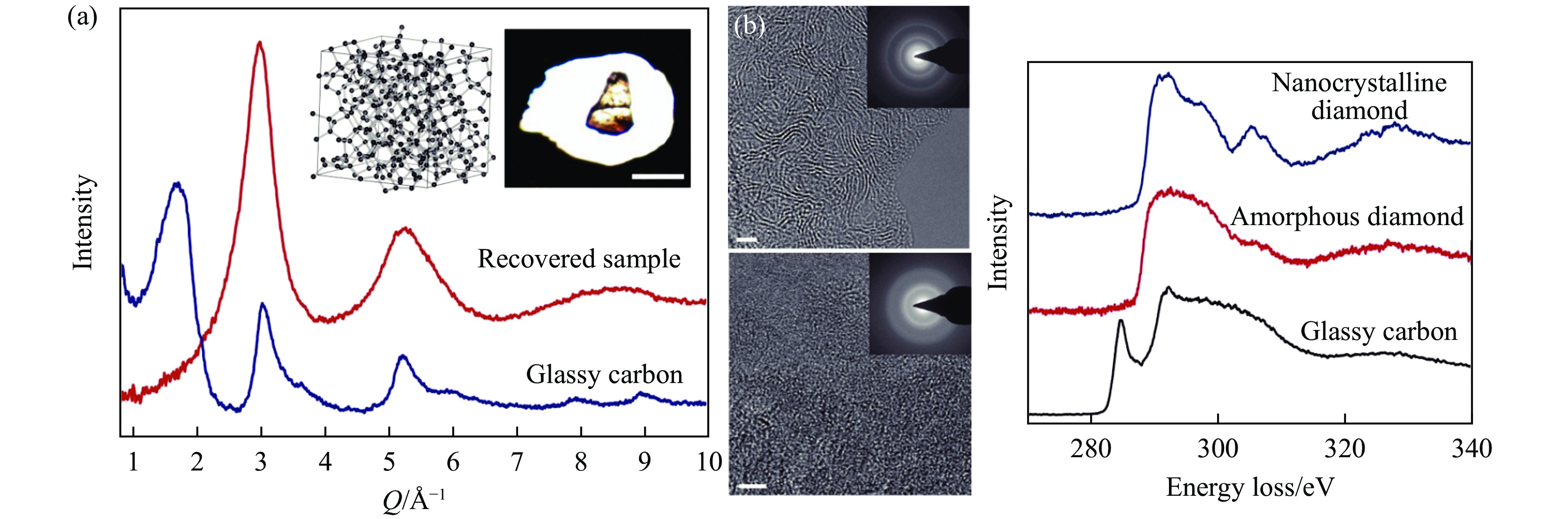
图 2 (a) 初始玻璃碳样品和非晶态金刚石的同步辐射XRD谱(左插图为非晶态金刚石的原子结构模型,右插图为非晶态金刚石样品的光学显微镜照片),(b) 初始玻璃碳样品和非晶态金刚石的高分辨透射电镜图像、选区电子衍射图像及碳的电子能量损失谱[29]
Figure 2. (a) Synchrotron XRD patterns of glassy carbon and quenchable amorphous diamond (Left inset: atomic model of amorphous diamond; right inset: microscope image of quenchable amorphous diamond.); (b) high-resolution transmission electron microscope (HRTEM) images, selected area electron diffraction (SAED) images and electron energy-loss spectra (EELS) of glassy carbon and quenchable amorphous diamond[29]
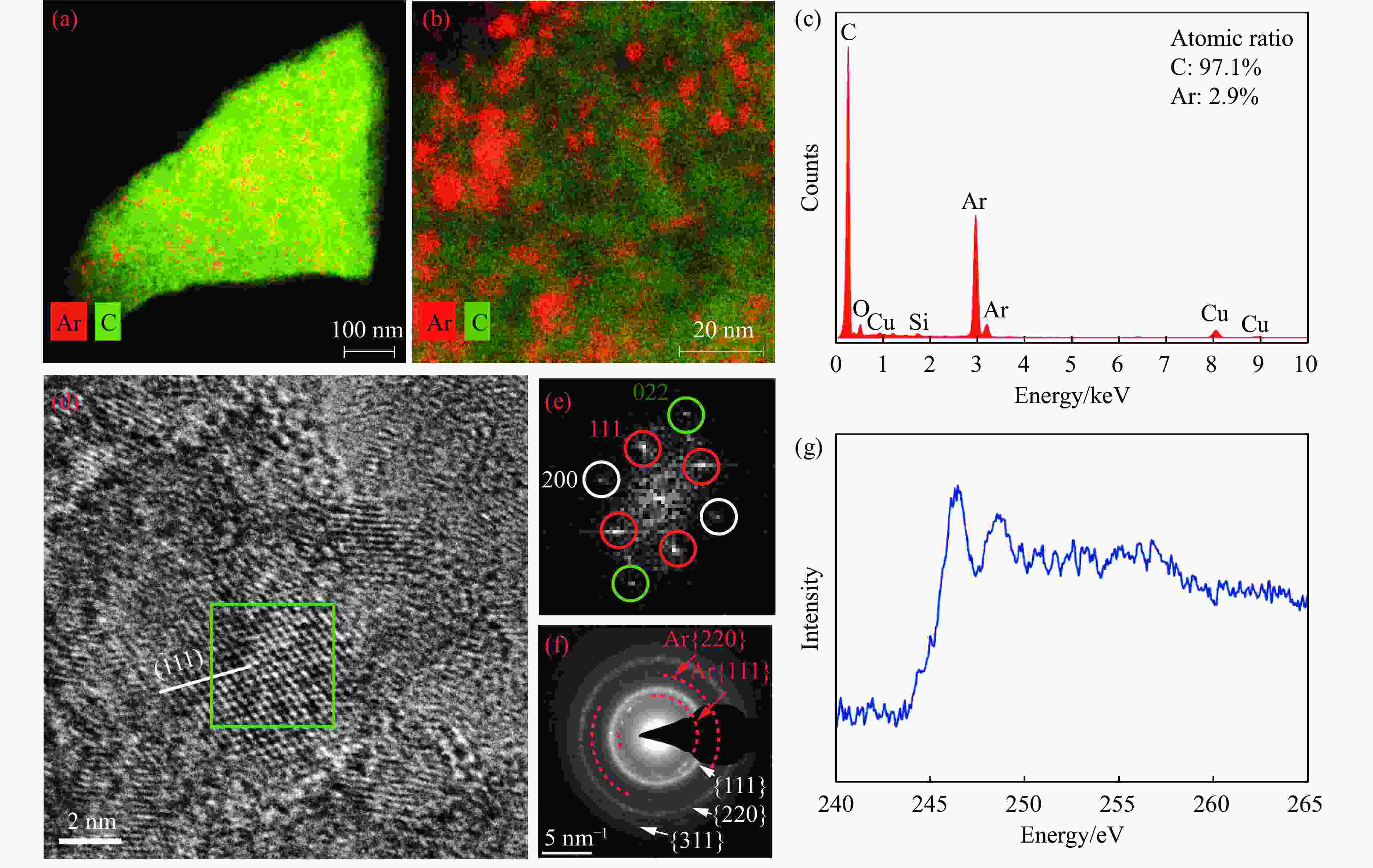
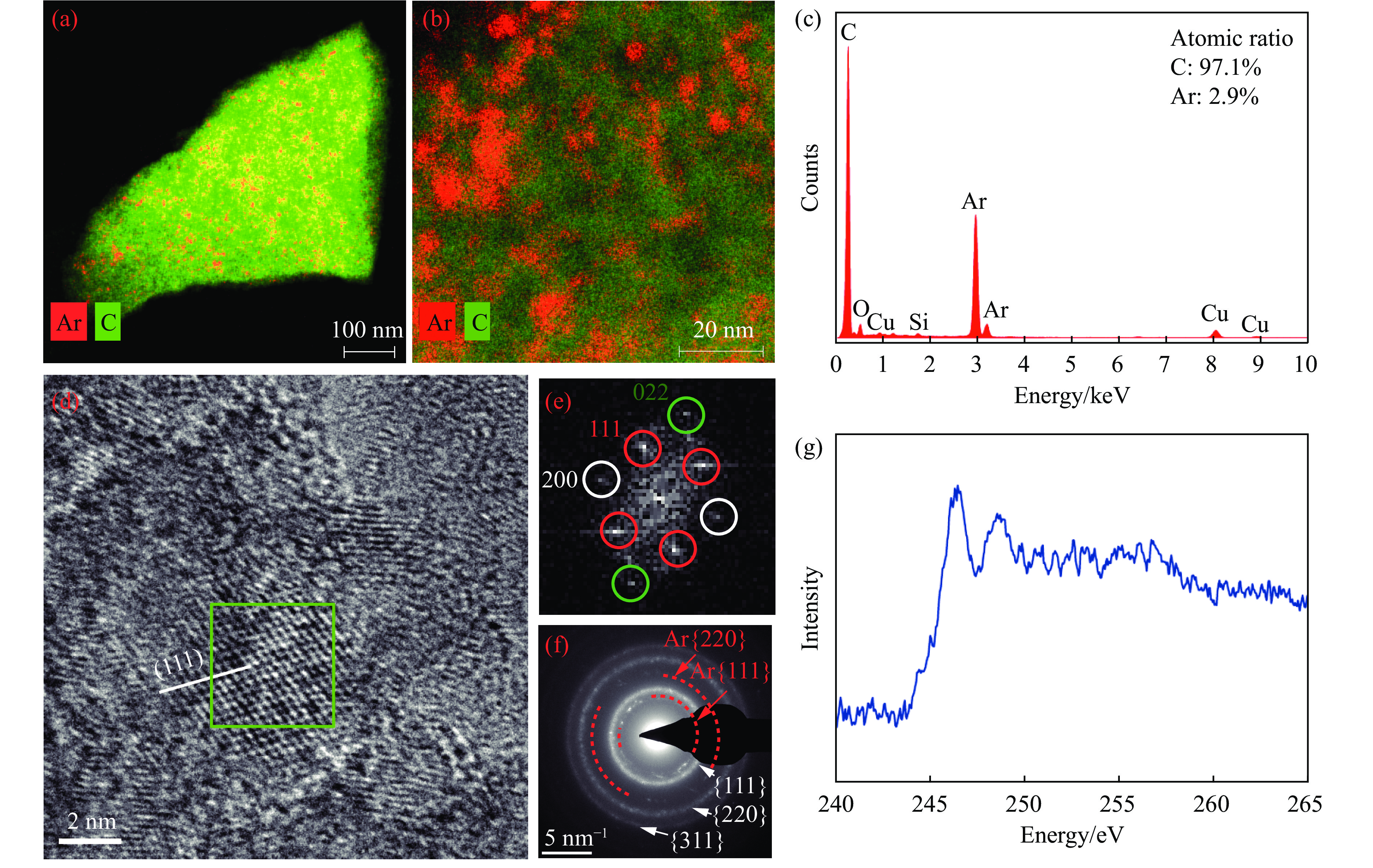
图 3 金刚石纳米高压舱内封存的高压氩晶粒的TEM表征[37]:(a)~(b) 通过 EDS 元素面扫描获得的 NDCs 中碳元素(绿色)和氩元素(红色)的空间分布,(c) 在整个 TEM 样品区域采集的 EDS 能谱,(d) HRTEM图像(显示了嵌在纳米晶金刚石基体中的高压氩晶粒,绿色方框标示),(e) 图 3(d) 中绿色方框区域对应的快速傅里叶变换图像,(f) SAED图像,(g) 在高压氩晶粒上采集的 Ar L2,3 边电子能量损失谱(由 10 条谱线求平均得到)
Figure 3. Characterization of high-pressure crystalline argon grains in NDCs using TEM-based techniques[37]: (a)–(b) distribution of carbon (green) and argon (red) elements in NDCs obtained by EDS elemental mapping; (c) an EDS spectrum collected on the entire TEM sample; (d) HRTEM image showing a high-pressure argon grain (green square) embedded in a nanocrystalline diamond matrix; (e) FFT image of the marked region (green square) in Fig. 3(d); (f) SAED image; (g) Ar L2,3-edge EELS collected on high-pressure argon grains, obtained by averaging ten spectra
表 1 压缩玻璃碳、四面体非晶碳及非晶态金刚石的合成条件及其结构和性质[26–29]
Table 1. Synthesis conditions and properties of compressed glassy carbon, tetrahedral amorphous carbon and quenchable amorphous diamond[26–29]
Material Synthesis conditions sp3 fraction Properties Ref. Compressed glassy carbon 5 GPa, 1000 ℃
25 GPa, 400−1000 ℃9%−22% Opaque, high elasticity, hardness
10−26 GPa, quenchable[26−27] Tetrahedral amorphous carbon 58 GPa, 728 K About 50% Translucent, obvious G-band dispersion, quenchable [28] Quenchable amorphous diamond 40−50 GPa,
about1800 KNearly 100% Transparent, bulk modulus of
about 378 GPa, quenchable[29]  下载: 导出CSV
-
[1] SUNDQVIST B. Carbon under pressure [J]. Physics Reports, 2021, 909: 1–73. doi: 10.1016/j.physrep.2020.12.007 [2] MAO W L, MAO H K, ENG P J, et al. Bonding changes in compressed superhard graphite [J]. Science, 2003, 302(5644): 425–427. doi: 10.1126/science.1089713 [3] WANG Z, ZHAO Y, TAIT K, et al. A quenchable superhard carbon phase synthesized by cold compression of carbon nanotubes [J]. Proceedings of the National Academy of Sciences of the United States of America, 2004, 101(38): 13699–13702. doi: 10.1073/pnas.0405877101 [4] WANG L, LIU B B, LI H, et al. Long-range ordered carbon clusters: a crystalline material with amorphous building blocks [J]. Science, 2012, 337(6096): 825–828. doi: 10.1126/science.1220522 [5] YANG X G, YAO M G, WU X Y, et al. Novel superhard sp3 carbon allotrope from cold-compressed C70 peapods [J]. Physical Review Letters, 2017, 118(24): 245701. doi: 10.1103/PhysRevLett.118.245701 [6] USKOKOVIĆ V. A historical review of glassy carbon: synthesis, structure, properties and applications [J]. Carbon Trends, 2021, 5: 100116. doi: 10.1016/j.cartre.2021.100116 [7] VIEIRA L D S. A review on the use of glassy carbon in advanced technological applications [J]. Carbon, 2022, 186: 282–302. doi: 10.1016/j.carbon.2021.10.022 [8] SHIELL T B, WONG S, YANG W J, et al. The composition, structure and properties of four different glassy carbons [J]. Journal of Non-Crystalline Solids, 2019, 522: 119561. doi: 10.1016/j.jnoncrysol.2019.119561 [9] HARRIS P J F. Fullerene-related structure of commercial glassy carbons [J]. Philosophical Magazine, 2004, 84(29): 3159–3167. doi: 10.1080/14786430410001720363 [10] ZHAO Z S, WANG E F, YAN H P, et al. Nanoarchitectured materials composed of fullerene-like spheroids and disordered graphene layers with tunable mechanical properties [J]. Nature Communications, 2015, 6(1): 6212. doi: 10.1038/ncomms7212 [11] SHIELL T B, MCCULLOCH D G, BRADBY J E, et al. Nanocrystalline hexagonal diamond formed from glassy carbon [J]. Scientific Reports, 2016, 6(1): 37232. doi: 10.1038/srep37232 [12] SHIELL T B, MCCULLOCH D G, MCKENZIE D R, et al. Graphitization of glassy carbon after compression at room temperature [J]. Physical Review Letters, 2018, 120(21): 215701. doi: 10.1103/PhysRevLett.120.215701 [13] WONG S, SHIELL T B, COOK B A, et al. The shear-driven transformation mechanism from glassy carbon to hexagonal diamond [J]. Carbon, 2019, 142: 475–481. doi: 10.1016/j.carbon.2018.10.080 [14] MCCULLOCH D G, WONG S, SHIELL T B, et al. Investigation of room temperature formation of the ultra-hard nanocarbons diamond and lonsdaleite [J]. Small, 2020, 16(50): 2004695. doi: 10.1002/smll.202004695 [15] HUANG X S, SHIELL T B, SALEK A, et al. Comparison of hydrostatic and non-hydrostatic compression of glassy carbon to 80 GPa [J]. Carbon, 2024, 219: 118763. doi: 10.1016/j.carbon.2023.118763 [16] SALEK A G, SUN Q B, HUANG X S, et al. High-pressure pathways for the formation of amorphous diamond and other tetrahedrally-bonded phases from glassy carbon [J]. Carbon, 2026, 247: 120952. doi: 10.1016/j.carbon.2025.120952 [17] LIN Y, ZHANG L, MAO H K, et al. Amorphous diamond: a high-pressure superhard carbon allotrope [J]. Physical Review Letters, 2011, 107(17): 175504. doi: 10.1103/PhysRevLett.107.175504 [18] GONCHAROV A F. Graphite at high pressures: pseudomelting at 44 GPa [J]. Zhurnal Eksperimental’noy i Teoreticheskoy Fiziki, 1990, 98: 1824–1827. doi: 10.1080/08957959108260697 [19] SOLOPOVA N A, DUBROVINSKAIA N, DUBROVINSKY L. Raman spectroscopy of glassy carbon up to 60 GPa [J]. Applied Physics Letters, 2013, 102(12): 121909. doi: 10.1063/1.4798660 [20] YAO M G, XIAO J P, FAN X H, et al. Transparent, superhard amorphous carbon phase from compressing glassy carbon [J]. Applied Physics Letters, 2014, 104(2): 021916. doi: 10.1063/1.4861929 [21] YAO M G, FAN X H, ZHANG W W, et al. Uniaxial-stress-driven transformation in cold compressed glassy carbon [J]. Applied Physics Letters, 2017, 111(10): 101901. doi: 10.1063/1.4996278 [22] ZENG Z D, SHENG H W, YANG L X, et al. Structural transition in cold-compressed glassy carbon [J]. Physical Review Materials, 2019, 3(3): 033608. doi: 10.1103/PhysRevMaterials.3.033608 [23] TAN L, SHENG H, LOU H, et al. High-pressure tetrahedral amorphous carbon synthesized by compressing glassy carbon at room temperature [J]. The Journal of Physical Chemistry C, 2020, 124(9): 5489–5494. doi: 10.1021/acs.jpcc.0c00247 [24] LI Z H, WANG Y J, MA M D, et al. Ultrastrong conductive in situ composite composed of nanodiamond incoherently embedded in disordered multilayer graphene [J]. Nature Materials, 2023, 22(1): 42–49. doi: 10.1038/s41563-022-01425-9 [25] SOLOPOVA N A, DUBROVINSKAIA N, DUBROVINSKY L. Synthesis of nanocrystalline diamond from glassy carbon balls [J]. Journal of Crystal Growth, 2015, 412: 54–59. doi: 10.1016/j.jcrysgro.2014.11.041 [26] HU M, HE J L, ZHAO Z S, et al. Compressed glassy carbon: an ultrastrong and elastic interpenetrating graphene network [J]. Science Advances, 2017, 3(6): e1603213. doi: 10.1126/sciadv.1603213 [27] HU M, ZHANG S S, LIU B, et al. Heat-treated glassy carbon under pressure exhibiting superior hardness, strength and elasticity [J]. Journal of Materiomics, 2021, 7(1): 177–184. doi: 10.1016/j.jmat.2020.06.007 [28] ZENG Z D, SHENG H W, LOU H B, et al. Mechanism of thermally assisted stabilization of pressure-induced sp3 bonds in amorphous carbon [J]. Physical Review B, 2024, 109(21): 214113. doi: 10.1103/PhysRevB.109.214113 [29] ZENG Z D, YANG L X, ZENG Q S, et al. Synthesis of quenchable amorphous diamond [J]. Nature Communications, 2017, 8(1): 322. doi: 10.1038/s41467-017-00395-w [30] MARKS N A, MCKENZIE D R, PAILTHORPE B A, et al. Microscopic structure of tetrahedral amorphous carbon [J]. Physical Review Letters, 1996, 76(5): 768–771. doi: 10.1103/PhysRevLett.76.768 [31] MCKENZIE D R. Tetrahedral bonding in amorphous carbon [J]. Reports on Progress in Physics, 1996, 59(12): 1611–1664. doi: 10.1088/0034-4885/59/12/002 [32] DROZDOV A P, EREMETS M I, TROYAN I A, et al. Conventional superconductivity at 203 kelvin at high pressures in the sulfur hydride system [J]. Nature, 2015, 525(7567): 73–76. doi: 10.1038/nature14964 [33] JI C, ADELEKE A A, YANG L X, et al. Nitrogen in black phosphorus structure [J]. Science Advances, 2020, 6(23): eaba9206. doi: 10.1126/sciadv.aba9206 [34] LANIEL D, WINKLER B, FEDOTENKO T, et al. High-pressure polymeric nitrogen allotrope with the black phosphorus structure [J]. Physical Review Letters, 2020, 124(21): 216001. doi: 10.1103/PhysRevLett.124.216001 [35] MAO H K, CHEN X J, DING Y, et al. Solids, liquids, and gases under high pressure [J]. Reviews of Modern Physics, 2018, 90(1): 015007. doi: 10.1103/RevModPhys.90.015007 [36] CAPPELLETTI R, UDOVIC T J, LI H, et al. Glassy carbon, NIST standard reference material (SRM 3600): hydrogen content, neutron vibrational density of states and heat capacity [J]. Journal of Applied Crystallography, 2018, 51(5): 1323–1328. doi: 10.1107/s1600576718010828 [37] ZENG Z D, WEN J G, LOU H B, et al. Preservation of high-pressure volatiles in nanostructured diamond capsules [J]. Nature, 2022, 608(7923): 513–517. doi: 10.1038/s41586-022-04955-z [38] ZENG Z D, LOU H B, LAN F J, et al. Structural mechanism for gas permeability in noncrystalline carbon under pressure [J]. Journal of the American Chemical Society, 2026, 148(2): 2449–2455. doi: 10.1021/jacs.5c17051 [39] SATO T, FUNAMORI N, YAGI T. Helium penetrates into silica glass and reduces its compressibility [J]. Nature Communications, 2011, 2(1): 345. doi: 10.1038/ncomms1343 [40] SHEN G Y, MEI Q, PRAKAPENKA V B, et al. Effect of helium on structure and compression behavior of SiO2 glass [J]. Proceedings of the National Academy of Sciences of the United States of America, 2011, 108(15): 6004–6007. doi: 10.1073/pnas.1102361108 [41] LIANG T, ZENG Z D, YANG Z Y, et al. Preserving high-pressure solids via freestanding thin-film engineering [J]. Nature Communications, 2025, 16(1): 5777. doi: 10.1038/s41467-025-61260-9 [42] SHANG Y C, LIU Z D, DONG J J, et al. Ultrahard bulk amorphous carbon from collapsed fullerene [J]. Nature, 2021, 599(7886): 599–604. doi: 10.1038/s41586-021-03882-9 [43] TANG H, YUAN X H, CHENG Y, et al. Synthesis of paracrystalline diamond [J]. Nature, 2021, 599(7886): 605–610. doi: 10.1038/s41586-021-04122-w [44] ZHANG S S, LI Z H, LUO K, et al. Discovery of carbon-based strongest and hardest amorphous material [J]. National Science Review, 2021, 9(1): nwab140. doi: 10.1093/nsr/nwab140 -

 下载:
下载:

计量
- 文章访问数: 284
- HTML全文浏览量: 100
- PDF下载量: 40
