





First-Principles Study of the Crystal Structure and Elastic Properties of FeO2H2He under High Pressure
-
摘要: 洋岛玄武岩中高比值的3He/4He指示地球深部存在原始氦储库,而地球深部的物质组成和波速异常同样也是当前研究的热点。然而,关于地球深部稳定含氦化合物的了解知之甚少。为此,采用基于密度泛函理论的第一性原理方法,系统计算了30~150 GPa压力条件下FeO2H2He的晶体结构和弹性性质。声子色散和弹性常数计算结果表明, FeO2H2He的R3m三方晶系结构在所计算的静态高压条件下表现出良好的局部动力学稳定性和力学稳定性。泊松比与Pugh比分析显示,FeO2H2He在所研究的压力范围内均表现为延性状态。密度和波速特征综合揭示了FeO2H2He具有作为核幔边界附近候选含氦相的可能性,并且可能是解释超低速区(ultra-low velocity zones, ULVZs)波速异常的潜在矿物组成。研究结果丰富了核幔边界的物质组成,为地球深部氦的赋存与分布提供了新的矿物学约束。Abstract: The composition and seismic anomalies of the deep Earth serve as key research topics, and the high 3He/4He ratio in ocean island basalts indicates the presence of the primordial helium reservoir in the Earth’s deep interior. However, our understanding of stable helium-bearing compounds in the deep Earth is still limited. This study systematically calculated the crystal structure and elastic properties of FeO2H2He at 30–150 GPa using first principles methods based on density functional theory. The static calculation results of phonon dispersion and elastic constants indicate that the R3m cubic crystal structure of FeO2H2He exhibits excellent local dynamic stability and mechanical stability within the studied pressure range. Poisson’s ratio and Pugh ratio analyses consistently show that FeO2H2He exhibits a ductile state throughout the investigated pressure range. The comprehensive characteristics of density and wave velocity reveal that FeO2H2He could potentially serve as one of the helium-bearing components near the core-mantle boundary, and may represent a potential mineral component for explaining the wave velocity anomalies observed in ultra-low velocity zones (ULVZs). This research enriches our understanding of the core-mantle boundary composition and provides new mineralogical constraints on the occurrence and distribution of helium in the deep Earth.
-
Key words:
- first-principles calculations /
- FeO2H2He /
- core-mantle boundary /
- elastic properties /
- seismic velocity
-
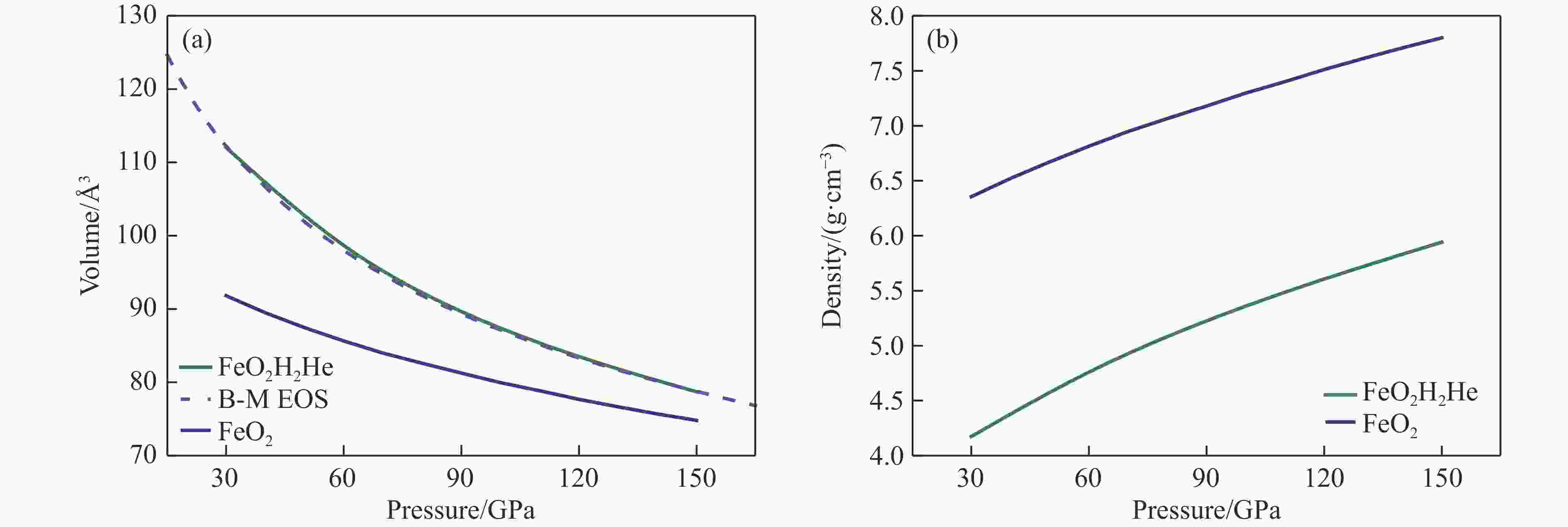
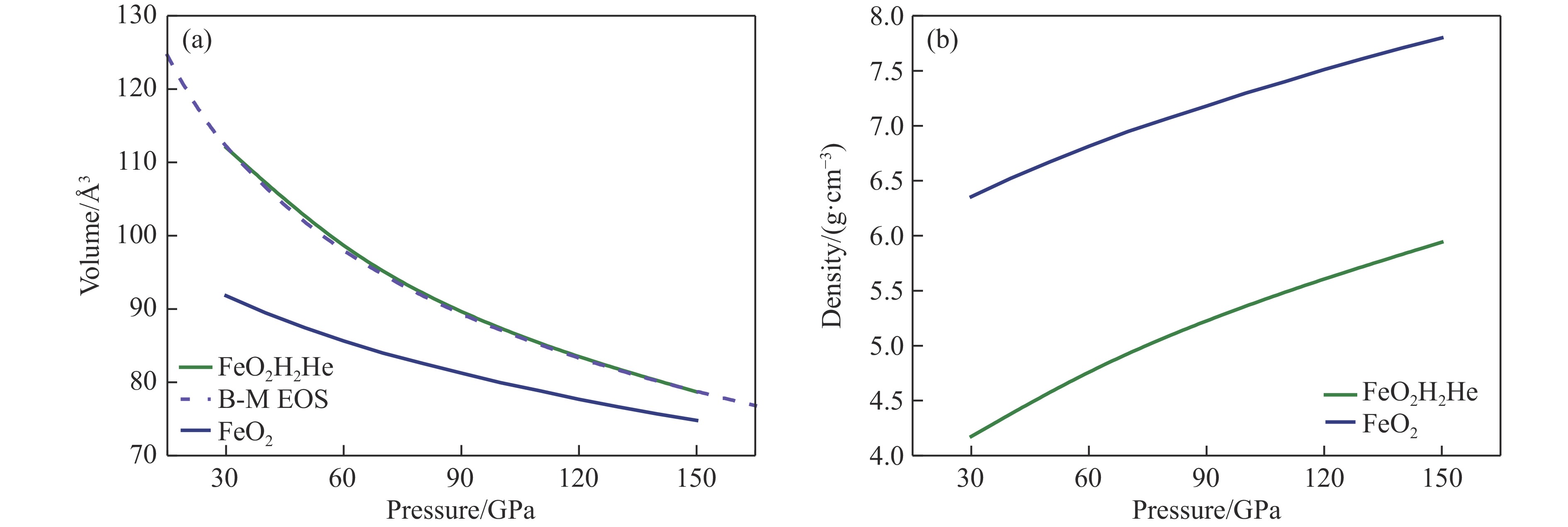
图 2 FeO2H2He的体积(a)和密度(b)随压力的变化
Figure 2. Volume (a) and density (b) of FeO2H2He as a function of pressure
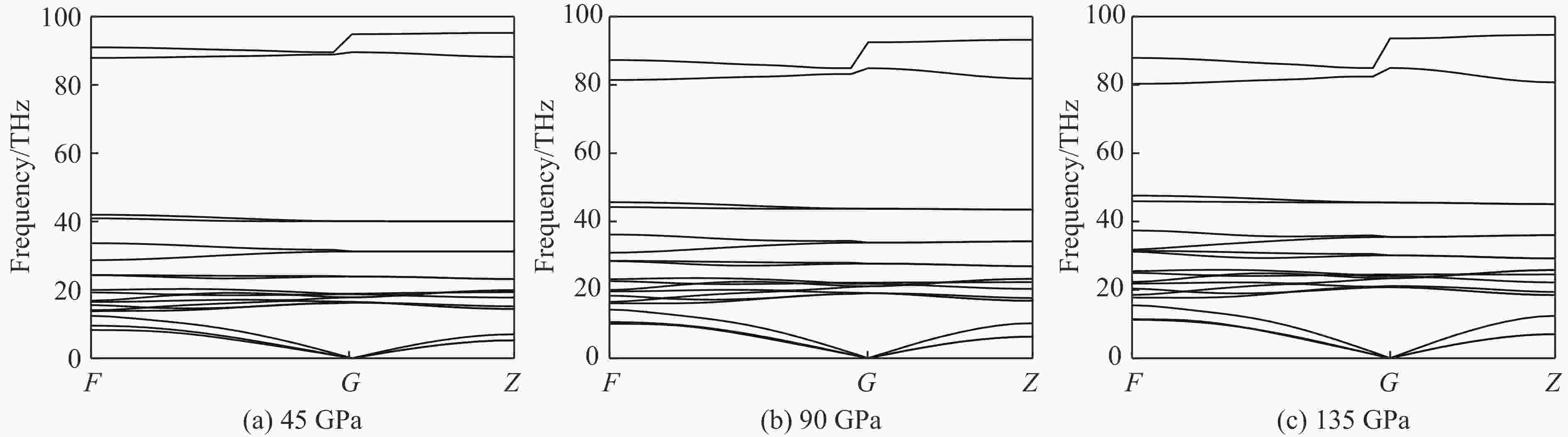
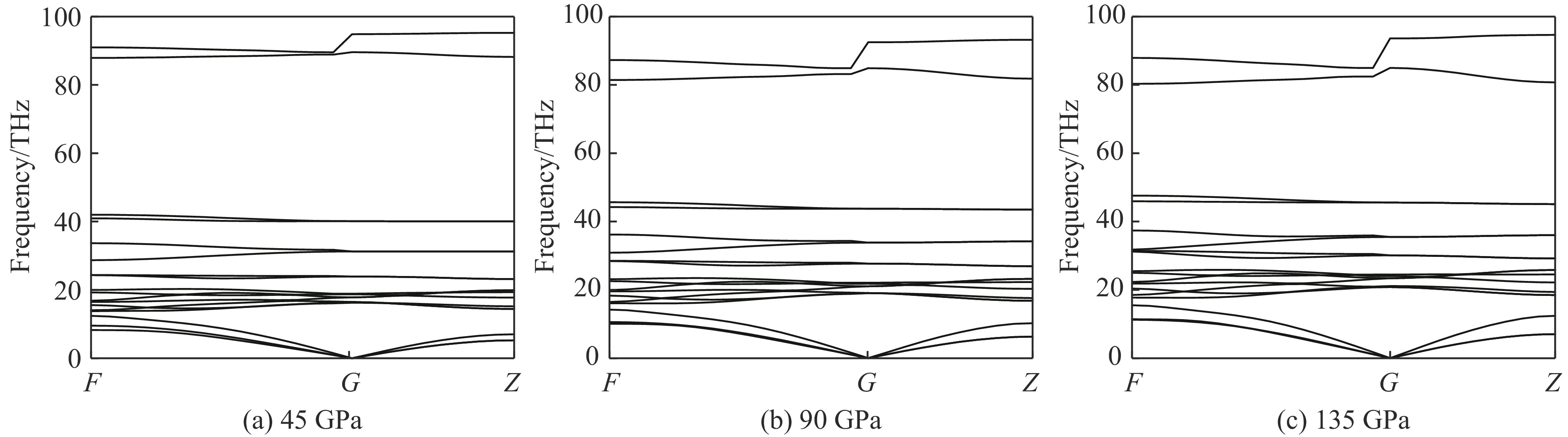
图 3 不同压力下FeO2H2He的声子色散曲线
Figure 3. Phonon dispersion curves of FeO2H2He under different pressures
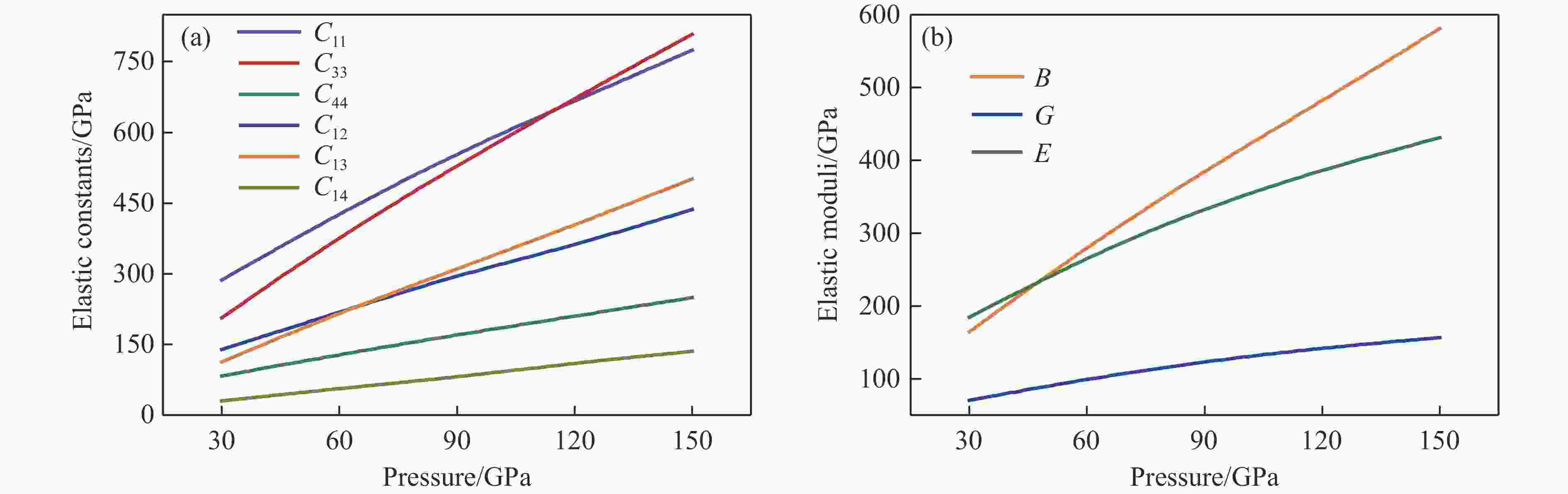
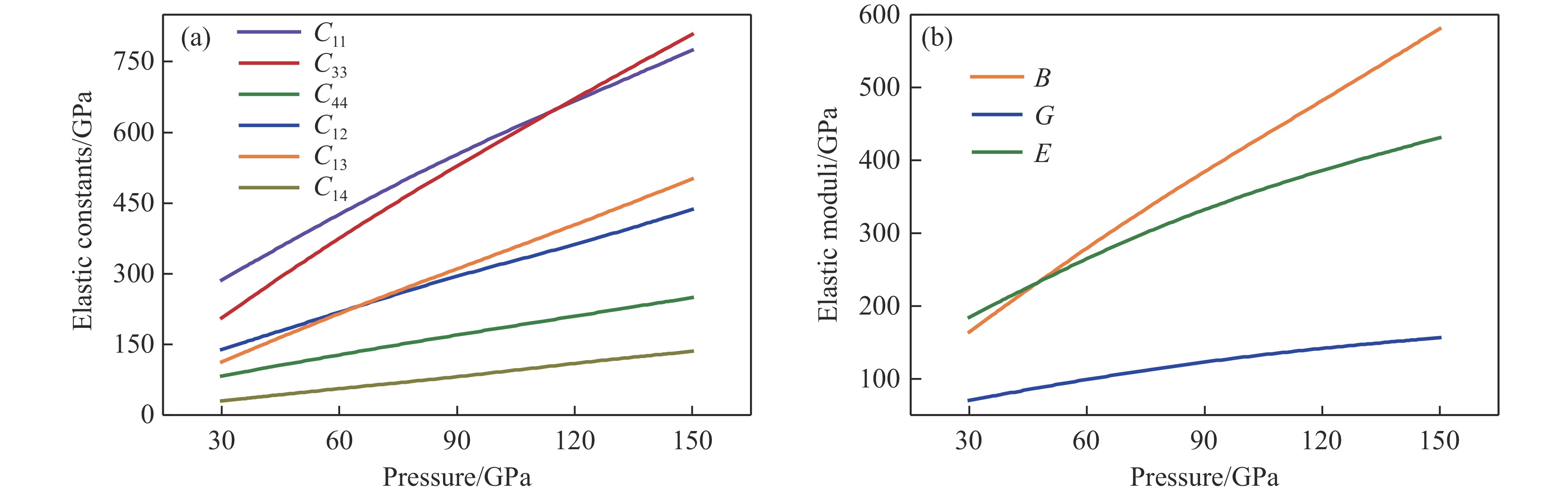
图 4 静态条件下FeO2H2He的弹性常数(a)与弹性模量(b)随压力的变化
Figure 4. Elastic constants (a) and elastic moduli (b) of FeO2H2He under static conditions as a function of pressure
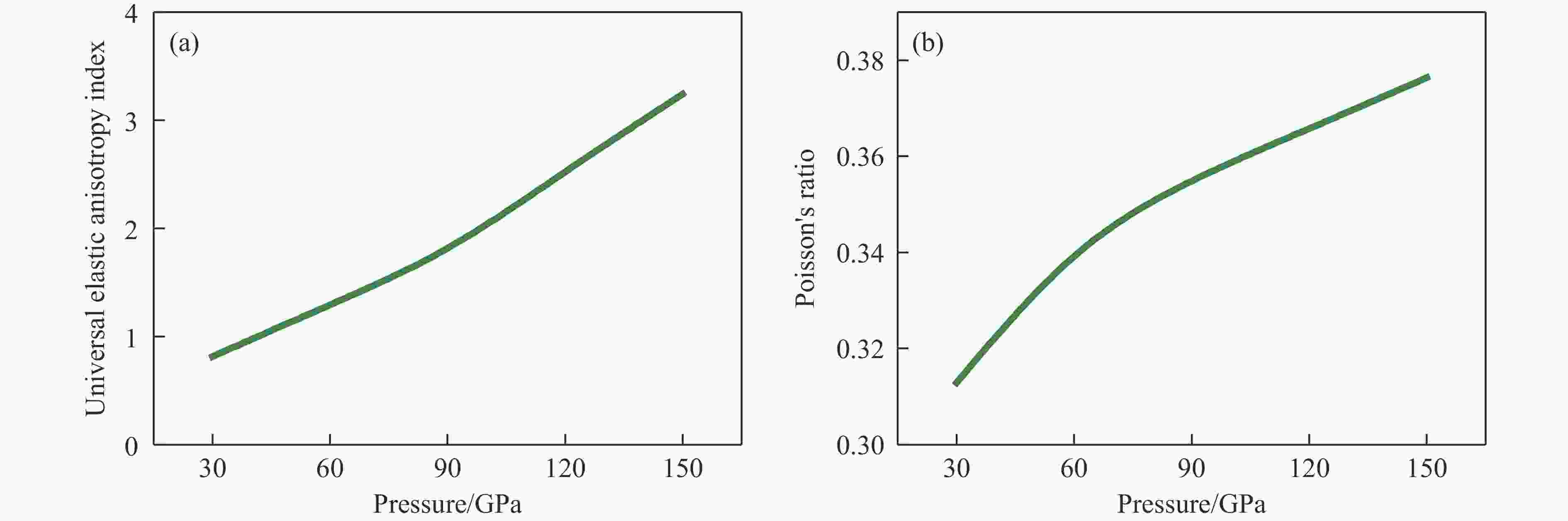
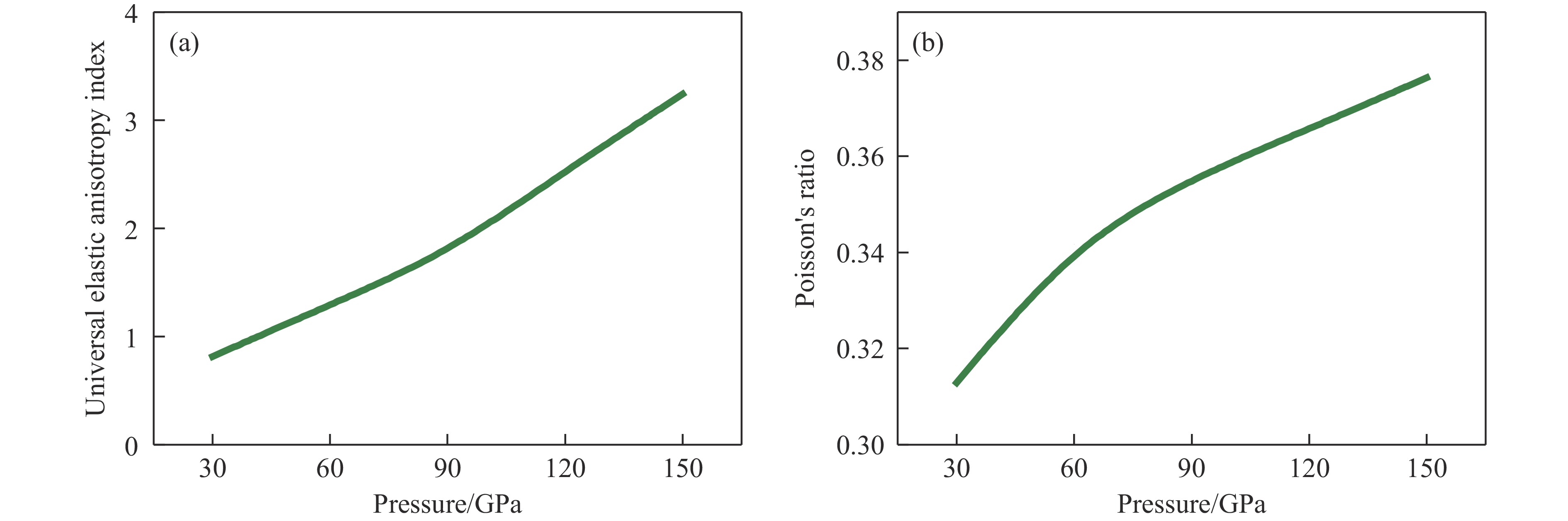
图 5 FeO2H2He的弹性各向异性指数(a)和泊松比(b)随压力的变化
Figure 5. Universal elastic anisotropy index (a) and Poisson's ratio (b) of FeO2H2He as a function of pressure
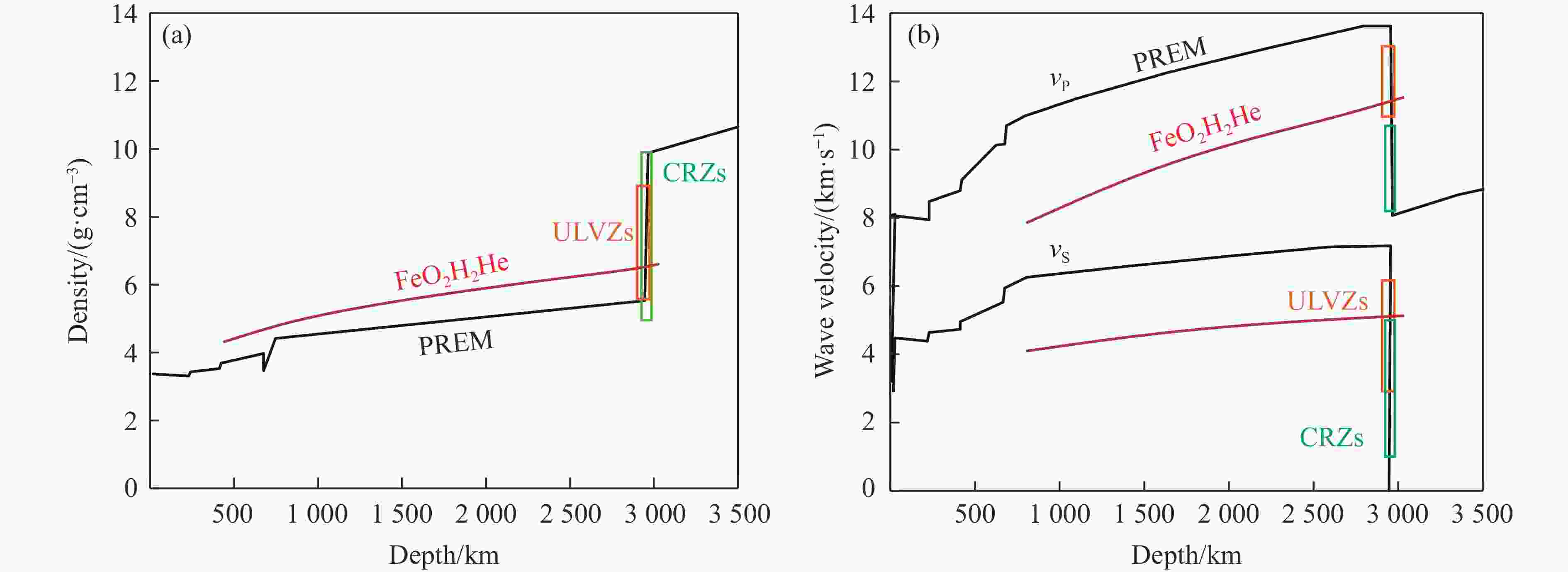
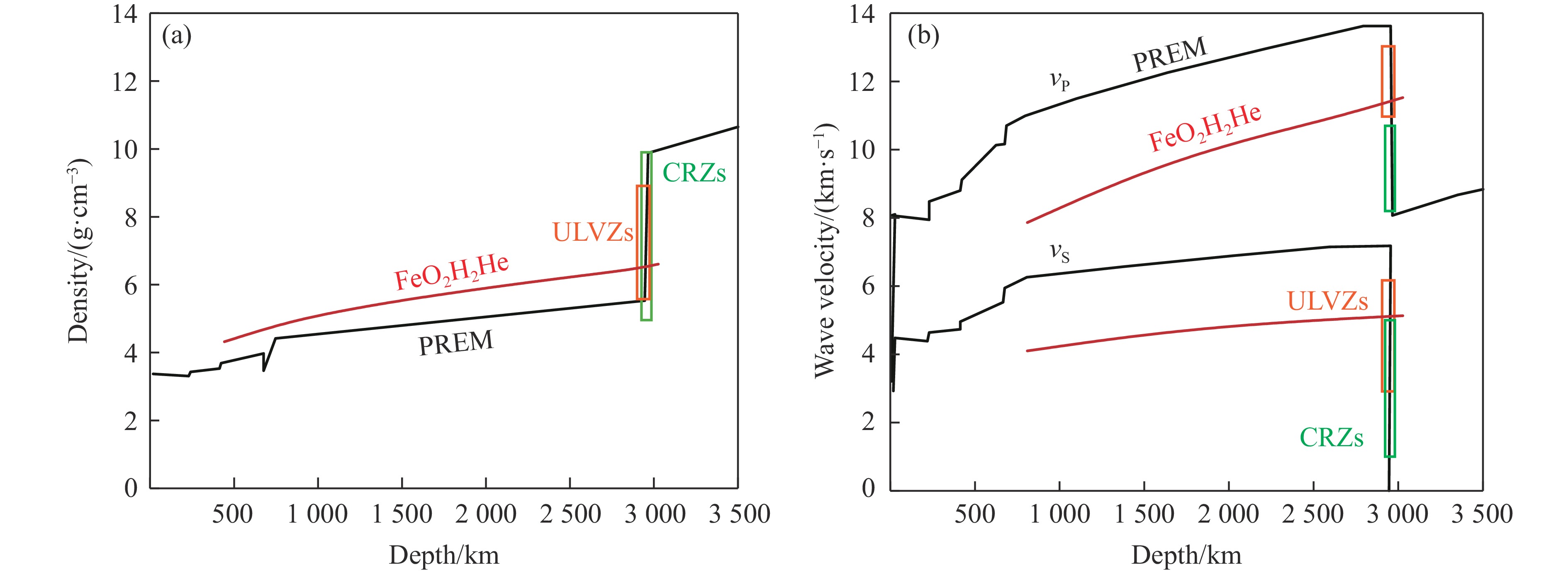
图 6 FeO2H2He的密度(a)和波速(b)随深度的变化
Figure 6. Density (a) and wave velocity (b) of FeO2H2He as a function of depth
表 1 135 GPa下不同矿物(模型)的波速和密度对比
Table 1. Comparison of wave velocity and density of different minerals (model) at 135 GPa
 下载: 导出CSV
-
[1] LAY T, WILLIAMS Q, GARNERO E J. The core-mantle boundary layer and deep Earth dynamics [J]. Nature, 1998, 392(6675): 461–468. doi: 10.1038/33083 [2] GARNERO E J, HELMBERGER D V. Seismic detection of a thin laterally varying boundary layer at the base of the mantle beneath the central-Pacific [J]. Geophysical Research Letters, 1996, 23(9): 977–980. doi: 10.1029/95GL03603 [3] GARNERO E J, MCNAMARA A K, SHIM S H. Continent-sized anomalous zones with low seismic velocity at the base of Earth’s mantle [J]. Nature Geoscience, 2016, 9(7): 481–489. doi: 10.1038/ngeo2733 [4] THOMSON A R, CRICHTON W A, BRODHOLT J P, et al. Seismic velocities of CaSiO3 perovskite can explain LLSVPs in Earth’s lower mantle [J]. Nature, 2019, 572(7771): 643–647. doi: 10.1038/s41586-019-1483-x [5] THORNE M S, GARNERO E J. Inferences on ultralow-velocity zone structure from a global analysis of SPdKS waves [J]. Journal of Geophysical Research: Solid Earth, 2004, 109(B8): B08301. doi: 10.1029/2004JB003010 [6] WILLIAMS Q, REVENAUGH J, GARNERO E. A correlation between ultra-low basal velocities in the mantle and hot spots [J]. Science, 1998, 281(5376): 546–549. doi: 10.1126/science.281.5376.546 [7] OGANOV A R, ONO S. Theoretical and experimental evidence for a post-perovskite phase of MgSiO3 in Earth’s D″ layer [J]. Nature, 2004, 430(6998): 445–448. doi: 10.1038/nature02701 [8] DOBSON D P, BRODHOLT J P. Subducted banded iron formations as a source of ultralow-velocity zones at the core-mantle boundary [J]. Nature, 2005, 434(7031): 371–374. doi: 10.1038/nature03430 [9] WILLIAMS Q, GARNERO E J. Seismic evidence for partial melt at the base of Earth’s mantle [J]. Science, 1996, 273(5281): 1528–1530. doi: 10.1126/science.273.5281.1528 [10] MAO W L, MAO H K, STURHAHN W, et al. Iron-rich post-perovskite and the origin of ultralow-velocity zones [J]. Science, 2006, 312(5773): 564–565. doi: 10.1126/science.1123442 [11] HU Q Y, KIM D Y, YANG W G, et al. FeO2 and FeOOH under deep lower-mantle conditions and Earth’s oxygen-hydrogen cycles [J]. Nature, 2016, 534(7606): 241–244. doi: 10.1038/nature18018 [12] NISHI M, KUWAYAMA Y, TSUCHIYA J, et al. The pyrite-type high-pressure form of FeOOH [J]. Nature, 2017, 547(7662): 205–208. doi: 10.1038/nature22823 [13] LIU H B, LIU L, XIN C L, et al. A first-principles study of the structural, electronic and elastic properties of the FeO2-FeO2He system under high pressure [J]. Physical Chemistry Chemical Physics, 2023, 25(30): 20225–20234. doi: 10.1039/d3cp02315j [14] LIU J, HU Q Y, YOUNG KIM D, et al. Hydrogen-bearing iron peroxide and the origin of ultralow-velocity zones [J]. Nature, 2017, 551(7681): 494–497. doi: 10.1038/nature24461 [15] CLASS C, GOLDSTEIN S L. Evolution of helium isotopes in the Earth’s mantle [J]. Nature, 2005, 436(7054): 1107–1112. doi: 10.1038/nature03930 [16] JACKSON M G, KONTER J G, BECKER T W. Primordial helium entrained by the hottest mantle plumes [J]. Nature, 2017, 542(7641): 340–343. doi: 10.1038/nature21023 [17] KURZ M D, JENKINS W J, HART S R. Helium isotopic systematics of oceanic islands and mantle heterogeneity [J]. Nature, 1982, 297(5861): 43–47. doi: 10.1038/297043a0 [18] MUKHOPADHYAY S. Early differentiation and volatile accretion recorded in deep-mantle neon and xenon [J]. Nature, 2012, 486(7401): 101–104. doi: 10.1038/nature11141 [19] ZHANG J R, LIU H Y, MA Y M, et al. Direct H-He chemical association in superionic FeO2H2He at deep-Earth conditions [J]. National Science Review, 2022, 9(7): nwab168. doi: 10.1093/nsr/nwab168 [20] ZHANG J R, LV J, LI H F, et al. Rare helium-bearing compound FeO2He stabilized at deep-Earth conditions [J]. Physical Review Letters, 2018, 121(25): 255703. doi: 10.1103/PhysRevLett.121.255703 [21] BROYDEN C G. The convergence of a class of double-rank minimization algorithms 1. general considerations [J]. IMA Journal of Applied Mathematics, 1970, 6(1): 76–90. doi: 10.1093/imamat/6.1.76 [22] CLARK S J, SEGALL M D, PICKARD C J, et al. First principles methods using CASTEP [J]. Zeitschrift für Kristallographie—Crystalline Materials, 2005, 220(5/6): 567–570. doi: 10.1524/zkri.220.5.567.65075 [23] PERDEW J P, BURKE K, ERNZERHOF M. Generalized gradient approximation made simple [J]. Physical Review Letters, 1996, 77(18): 3865–3868. doi: 10.1103/PhysRevLett.77.3865 [24] HUANG S X, QIN S, WU X. Elasticity and anisotropy of the pyrite-type FeO2H-FeO2 system in Earth’s lowermost mantle [J]. Journal of Earth Science, 2019, 30(6): 1293–1301. doi: 10.1007/s12583-018-0836-y [25] HILL R. The elastic behaviour of a crystalline aggregate [J]. Proceedings of the Physical Society. Section A, 1952, 65(5): 349–354. doi: 10.1088/0370-1298/65/5/307 [26] BARONI S, DE GIRONCOLI S, DAL CORSO A, et al. Phonons and related crystal properties from density-functional perturbation theory [J]. Reviews of Modern Physics, 2001, 73(2): 515–562. doi: 10.1103/RevModPhys.73.515 [27] GONZE X, LEE C. Dynamical matrices, Born effective charges, dielectric permittivity tensors, and interatomic force constants from density-functional perturbation theory [J]. Physical Review B, 1997, 55(16): 10355–10368. doi: 10.1103/PhysRevB.55.10355 [28] PUGH S F. XCII. relations between the elastic moduli and the plastic properties of polycrystalline pure metals [J]. The London, Edinburgh, and Dublin Philosophical Magazine and Journal of Science, 1954, 45(367): 823–843. doi: 10.1080/14786440808520496 [29] RANGANATHAN S I, OSTOJA-STARZEWSKI M. Universal elastic anisotropy index [J]. Physical Review Letters, 2008, 101(5): 055504. doi: 10.1103/PhysRevLett.101.055504 [30] DZIEWONSKI A M, ANDERSON D L. Preliminary reference Earth model [J]. Physics of the Earth and Planetary Interiors, 1981, 25(4): 297–356. doi: 10.1016/0031-9201(81)90046-7 [31] BIRCH F. Finite elastic strain of cubic crystals [J]. Physical Review, 1947, 71(11): 809–824. doi: 10.1103/PhysRev.71.809 [32] ZHANG X L, NIU Z W, TANG M, et al. First-principles thermoelasticity and stability of pyrite-type FeO2 under high pressure and temperature [J]. Journal of Alloys and Compounds, 2017, 719: 42–46. doi: 10.1016/j.jallcom.2017.05.143 [33] MOUHAT F, COUDERT F X. Necessary and sufficient elastic stability conditions in various crystal systems [J]. Physical Review B, 2014, 90(22): 224104. doi: 10.1103/PhysRevB.90.224104 [34] LIU H B, LIU L, XIN C L. Effect of alloying elements on the structure and mechanical properties of NbMoTaWX (X=Cr, V, Ti, Zr, and Hf) refractory high-entropy alloys [J]. AIP Advances, 2021, 11(2): 025044. doi: 10.1063/5.0038405 [35] ROST S, REVENAUGH J. Seismic detection of rigid zones at the top of the core [J]. Science, 2001, 294(5548): 1911–1914. doi: 10.1126/science.1065617 [36] YU S L, GARNERO E J. Ultralow velocity zone locations: a global assessment [J]. Geochemistry, Geophysics, Geosystems, 2018, 19(2): 396–414. doi: 10.1002/2017GC007281 [37] KNITTLE E, JEANLOZ R. Earth’s core-mantle boundary: results of experiments at high pressures and temperatures [J]. Science, 1991, 251(5000): 1438–1443. doi: 10.1126/science.251.5000.1438 [38] HOU M Q, HE Y, JANG B G, et al. Superionic iron oxide-hydroxide in Earth’s deep mantle [J]. Nature Geoscience, 2021, 14(3): 174–178. doi: 10.1038/s41561-021-00696-2 [39] WANG Y, WEN L X. Geometry and P and S velocity structure of the “African anomaly” [J]. Journal of Geophysical Research: Solid Earth, 2007, 112(B5): B05313. doi: 10.1029/2006JB004483 [40] MAO H K, HU Q Y, YANG L X, et al. When water meets iron at Earth’s core-mantle boundary [J]. National Science Review, 2017, 4(6): 870–878. doi: 10.1093/nsr/nwx109 [41] PORCELLI D, HALLIDAY A N. The core as a possible source of mantle helium [J]. Earth and Planetary Science Letters, 2001, 192(1): 45–56. doi: 10.1016/S0012-821X(01)00418-6 -

 下载:

计量
- 文章访问数: 140
- HTML全文浏览量: 41
- PDF下载量: 4
