





Effects of Impact Velocity and Pulse Duration on Spallation Behavior and Void Evolution of a Metastable Si4V5Mn5Cr10Co30Fe46 High-Entropy Alloy
-
摘要: 采用一级轻气炮加载技术,对亚稳态Si4V5Mn5Cr10Co30Fe46高熵合金进行平板冲击实验,研究了不同冲击速度与脉冲持续时间下合金的相变与动态损伤行为,揭示其层裂响应和孔洞演化规律。结果表明:在脉冲时间相同的条件下,随着冲击速度由282 m/s升高至553 m/s,自由面峰值响应和峰值应力明显升高,而层裂强度的整体变化较小;内部孔洞由分散形核向局部聚集演化,孔洞附近相变与应变局域化增强。在冲击速度相同的条件下,随着试样厚度由1.0 mm增至2.0 mm,脉冲持续时间由0.075 μs延长至0.250 μs,层裂强度由1.40 GPa提高至1.83 GPa,孔洞空间分布由分散转向中部集中。显微X射线计算机断层扫描结果表明,冲击速度升高促进孔洞向大体积、集中化和复杂形貌演化,而脉冲持续时间增加有利于损伤累积和局域贯通。研究表明,冲击速度主要控制瞬态损伤驱动力,脉冲持续时间主要调控损伤累积与局域化程度。Abstract: Metastable high-entropy alloys can exhibit coupled phase transformation, strain localization and damage evolution under shock loading, and their spall responses are governed by both the loading intensity and the duration of the stress pulse. To clarify the distinct roles of impact velocity and pulse duration in spallation behavior and void evolution, plate-impact experiments were conducted on a Si4V5Mn5Cr10Co30Fe46 metastable high-entropy alloy using a single-stage light-gas gun. The free-surface velocity response, spall parameters, local microstructural evolution and three-dimensional void morphology under different loading conditions were systematically investigated. The results show that, at a fixed specimen thickness, increasing the impact velocity from 282 m/s to 553 m/s markedly raises the peak free-surface response and the peak compressive stress, whereas the spall strength only slightly changes. Meanwhile, internal voids evolve from dispersed nucleation to localized clustering, accompanied by increased fractions of HCP/BCC (hexagonal close-packed/body-centered cubic) phases and a pronounced rise in high-KAM (kernel average misorientation) regions near the voids, suggesting that higher impact velocity promotes local phase transformation, lattice distortion and concentrated damage development. Micro-X-ray computed tomography further reveals that increasing impact velocity drives the voids towards larger volumes, stronger spatial concentration and more complex morphologies. In contrast, under nearly constant impact velocity, as the specimen thickness increases from 1.0 mm to 2.0 mm, the pulse duration is prolonged from 0.075 μs to 0.250 μs, and the spall strength correspondingly increases from 1.40 GPa to 1.83 GPa. The spatial distribution of voids gradually changes from dispersed to centrally concentrated, with an enhanced tendency for interconnection, indicating that longer pulse duration demonstrates greater favorability towards damage accumulation and localized coalescence. By combining free-surface velocity histories, two-dimensional microstructural characterization and three-dimensional void statistics, it is shown that the impact velocity mainly controls the instantaneous driving force for the damage during spallation, whereas the pulse duration primarily governs the time window for the damage accumulation and the extent of localization. Together, these two factors determine the nucleation sites, growth paths and final failure mode of spall damage in this metastable high-entropy alloy.
-
Key words:
- high-entropy alloy /
- plate impact /
- spallation /
- void evolution /
- phase transformation /
- pulse duration
-

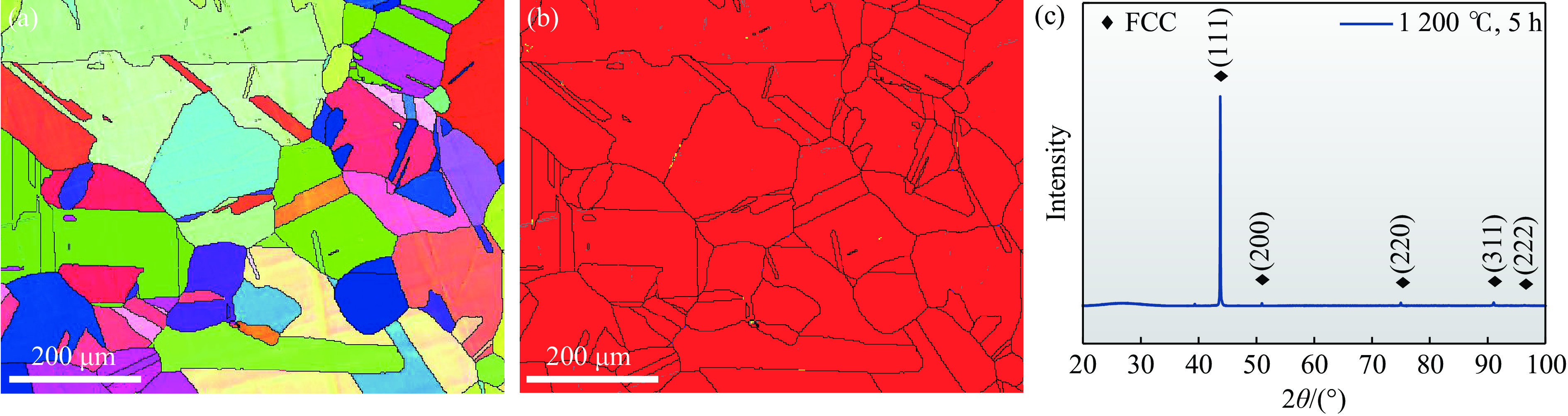
图 1 初始微观结构:(a) EBSD反极图,(b) 相图,(c) XRD谱
Figure 1. Initial microstructure: (a) EBSD IPF-Z (inverse pole figure-Z) map; (b) phase map; and (c) XRD pattern

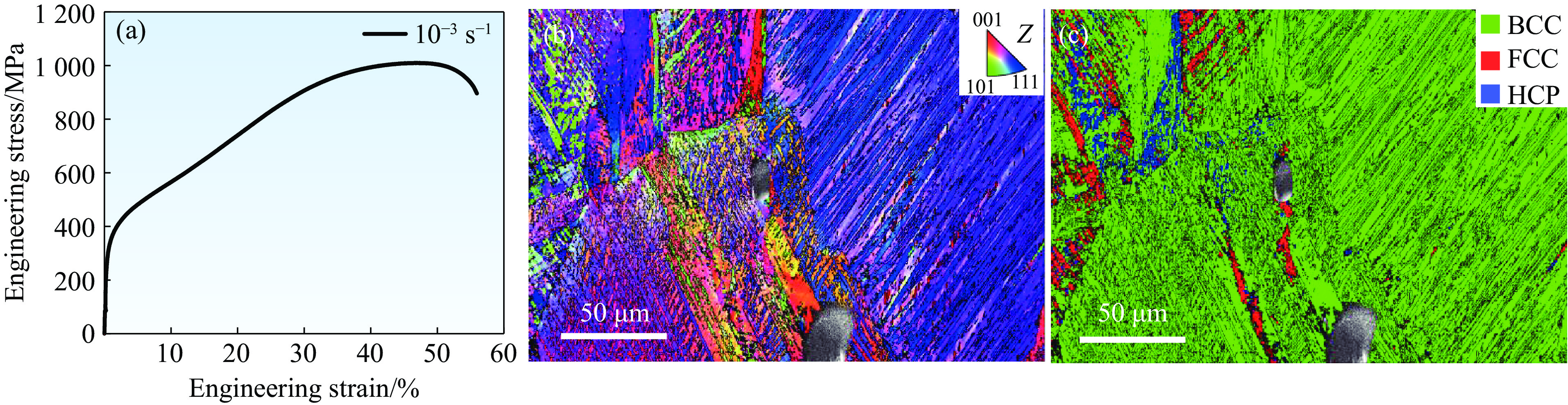
图 2 (a) 工程应力-应变曲线,(b) 变形后组织的EBSD反极图,(c) 对应的相分布图
Figure 2. (a) Engineering stress-strain curve; (b) EBSD IPF-Z map of the deformed microstructure; (c) corresponding phase map

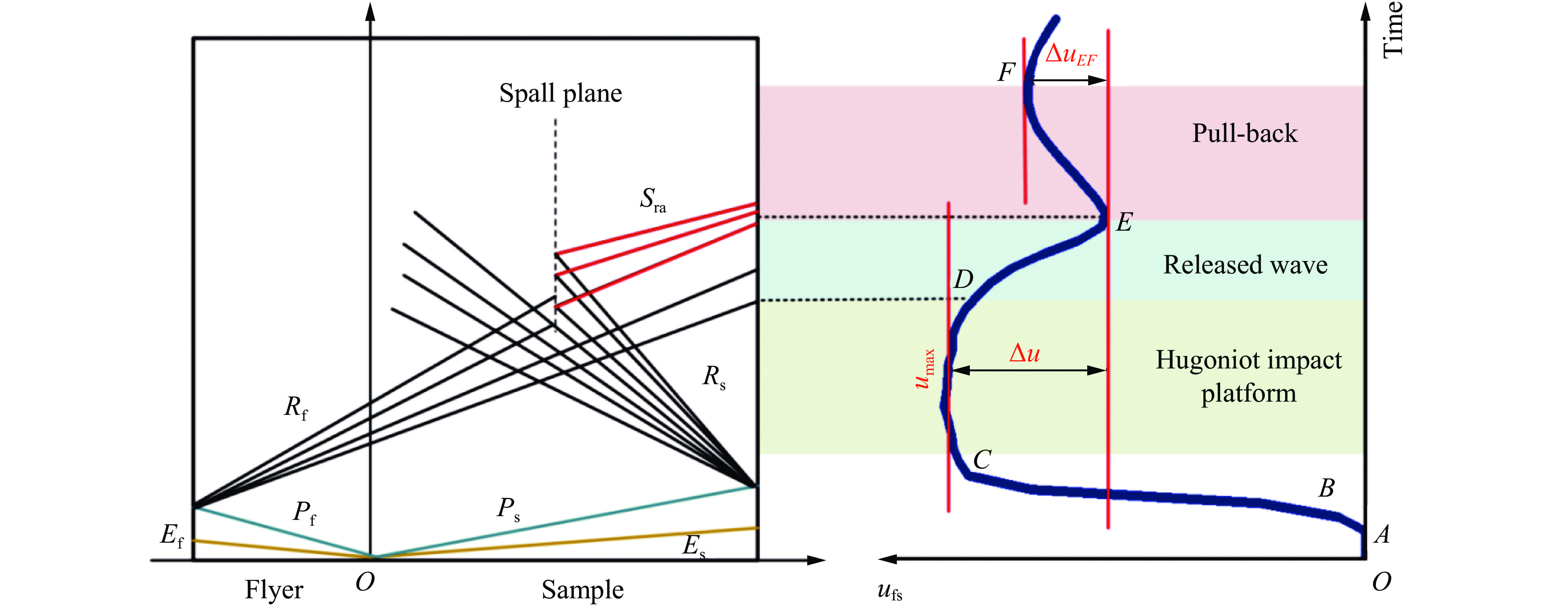
图 3 平板冲击实验原理示意图及典型自由面速度-时间(ufs-t)曲线
Figure 3. Schematic of the plate-impact experiment and a typical free-surface velocity-time (ufs-t) profile

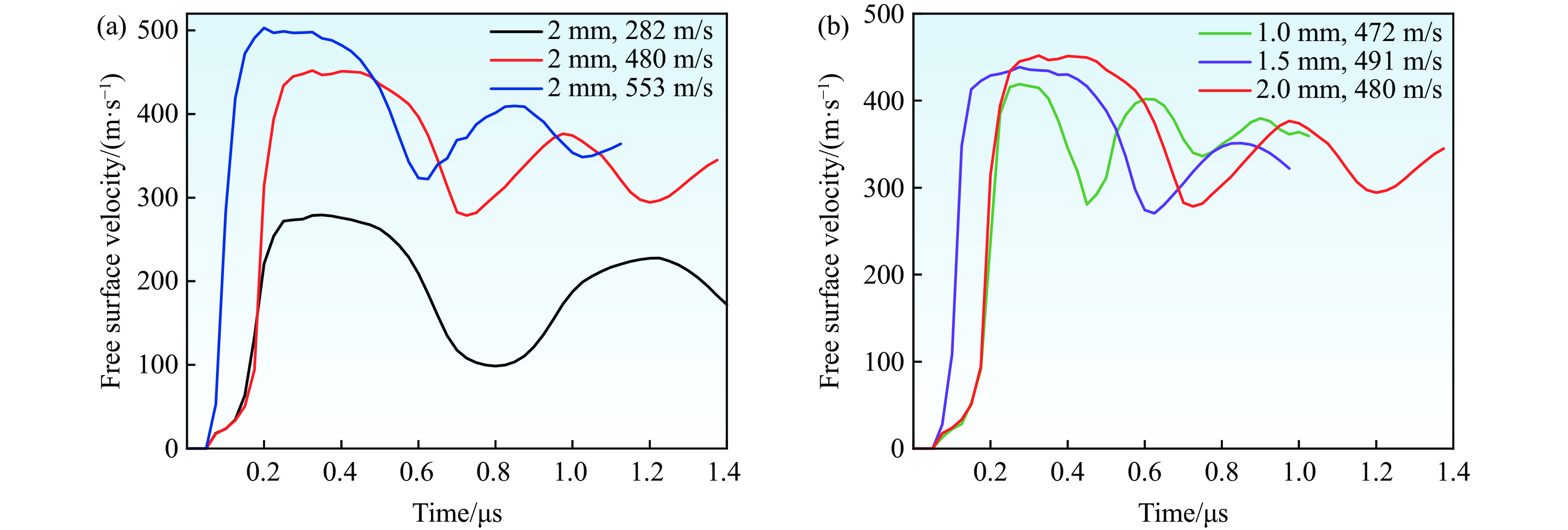
图 4 试样自由面速度历程曲线:(a) 不同速度,(b) 不同脉冲持续时间
Figure 4. Free-surface velocity curves for specimens with (a) different impact velocities and (b) different shock pulse durations

图 5 层裂响应参数随(a)冲击速度及(b)样品厚度(脉冲持续时间)的变化
Figure 5. Variations of spall response parameters with (a) impact velocity and (b) sample thickness (pulse duration)

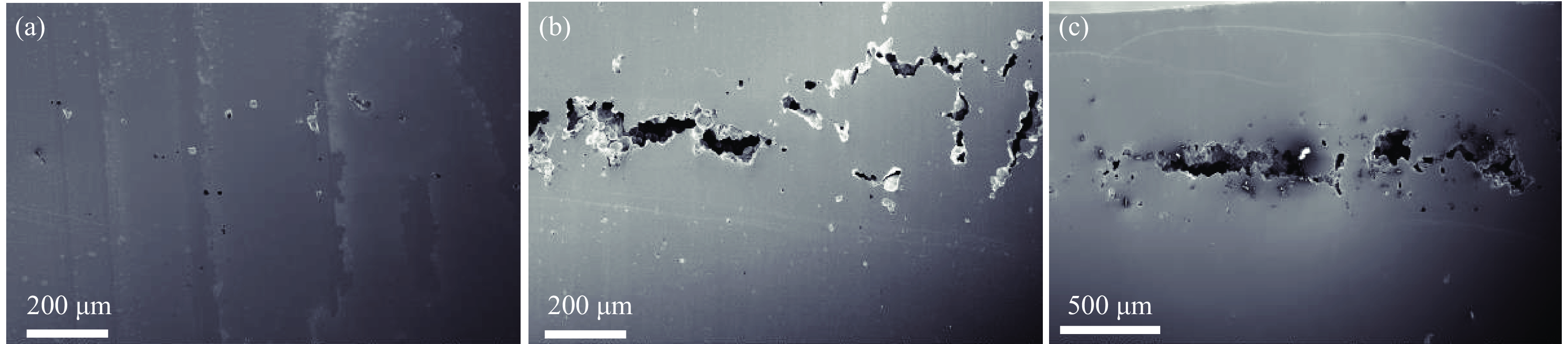
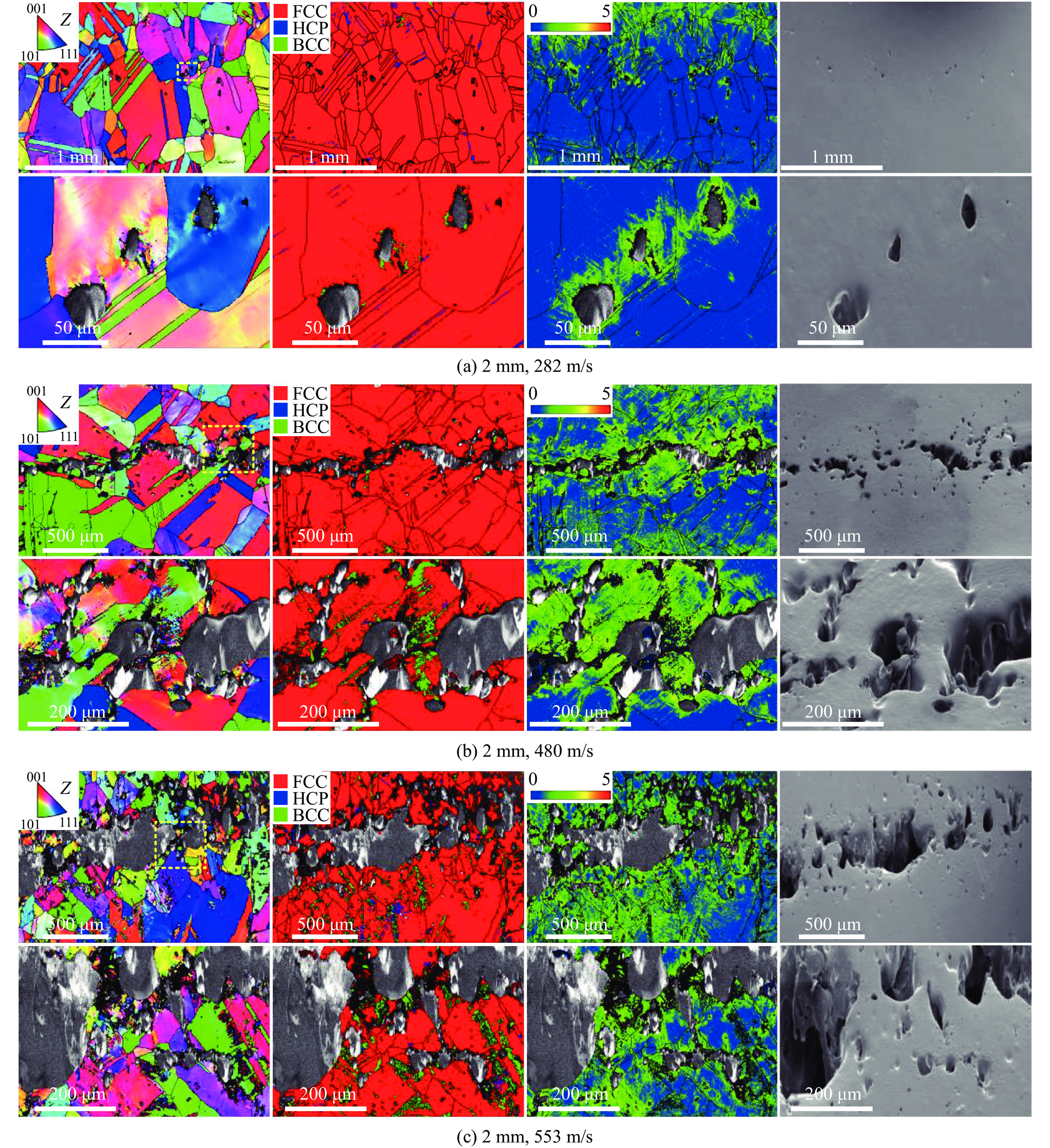
图 6 2 mm试样在不同冲击速度下的宏观变形形貌及局部孔洞特征:(a) 282 m/s,(b) 480 m/s,(c) 553 m/s
Figure 6. Macroscopic deformation morphologies and local void features of 2 mm samples under different impact velocities: (a) 282 m/s; (b) 480 m/s; (c) 553 m/s
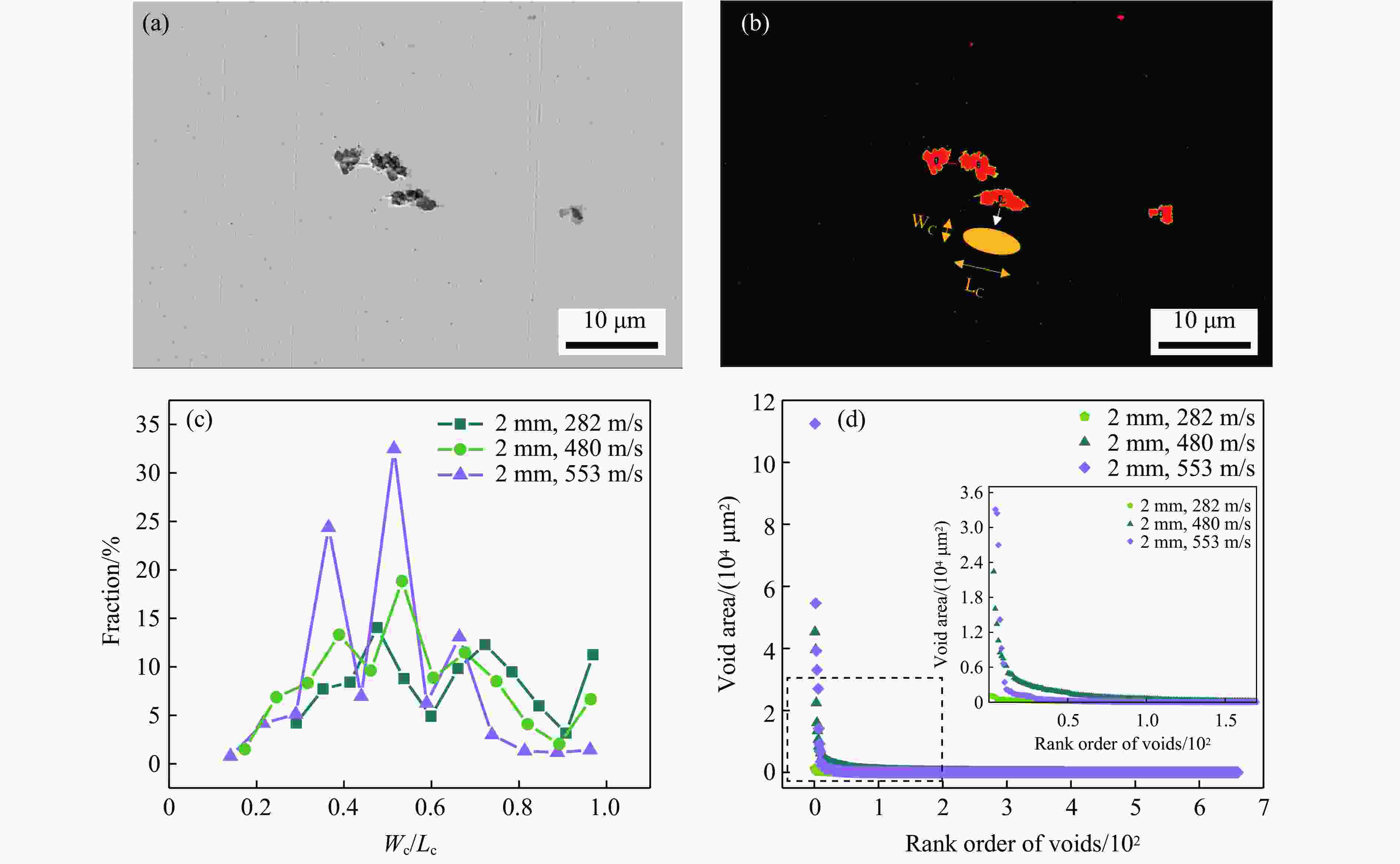
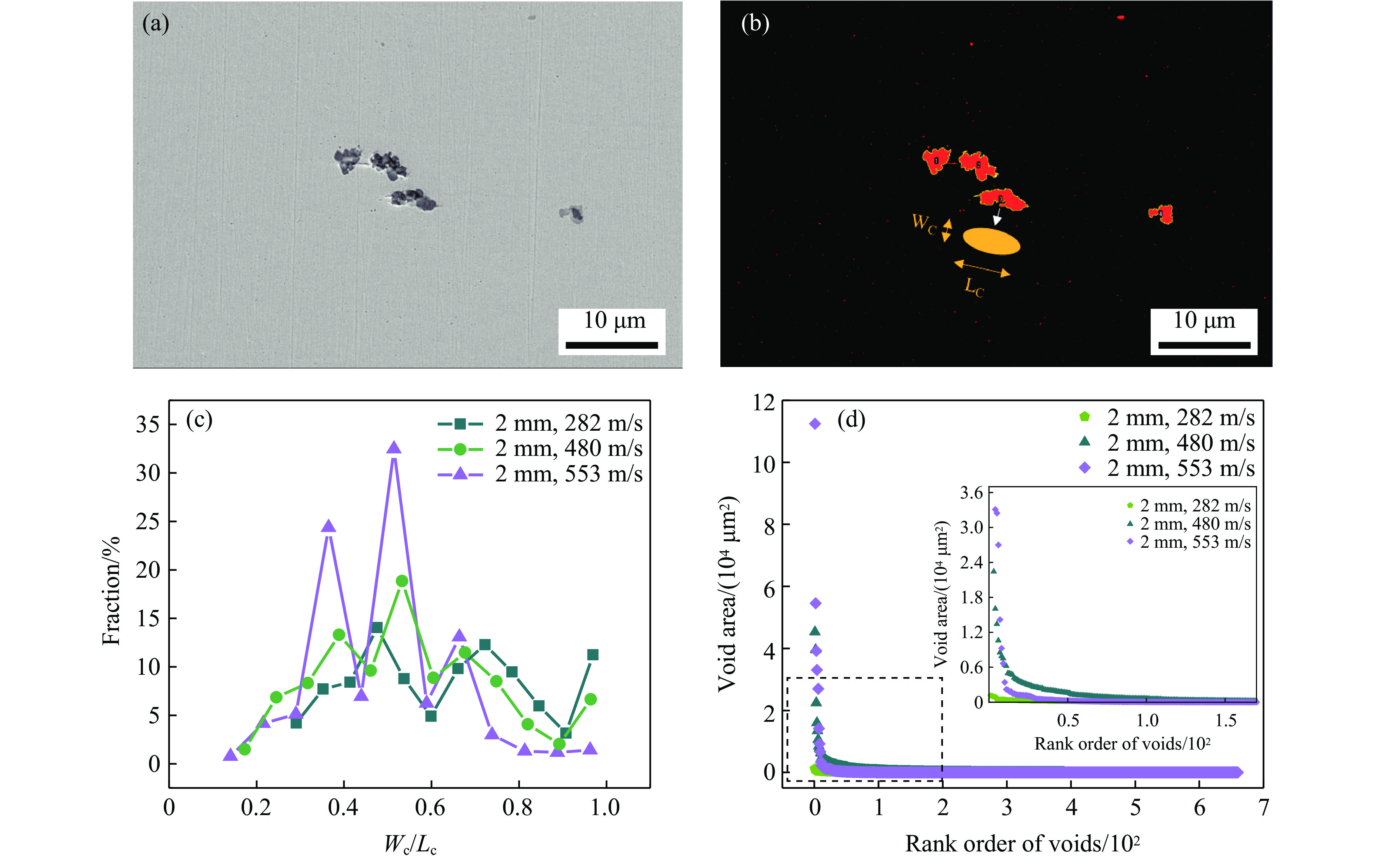
图 7 不同冲击速度下2 mm试样孔洞宽长比Wc/Lc的统计与定义示意:(a) 典型孔洞区域的SEM形貌,(b) 基于ImageJ阈值分割得到的二值化结果及孔洞宽长比定义示意,(c) 不同冲击速度下孔洞宽长比Wc/Lc分布特征,(d) 按面积降序排列的孔洞面积分布
Figure 7. Statistical analysis and definition of the void width-to-length ratio (Wc/Lc) in 2 mm samples under different impact velocities: (a) SEM image of a typical void region; (b) binarized image obtained by threshold segmentation in ImageJ, together with the definition of the void width-to-length ratio; (c) distribution of the void width-to-length ratio (Wc/Lc) under different impact velocities; (d) void area distribution ranked in descending order
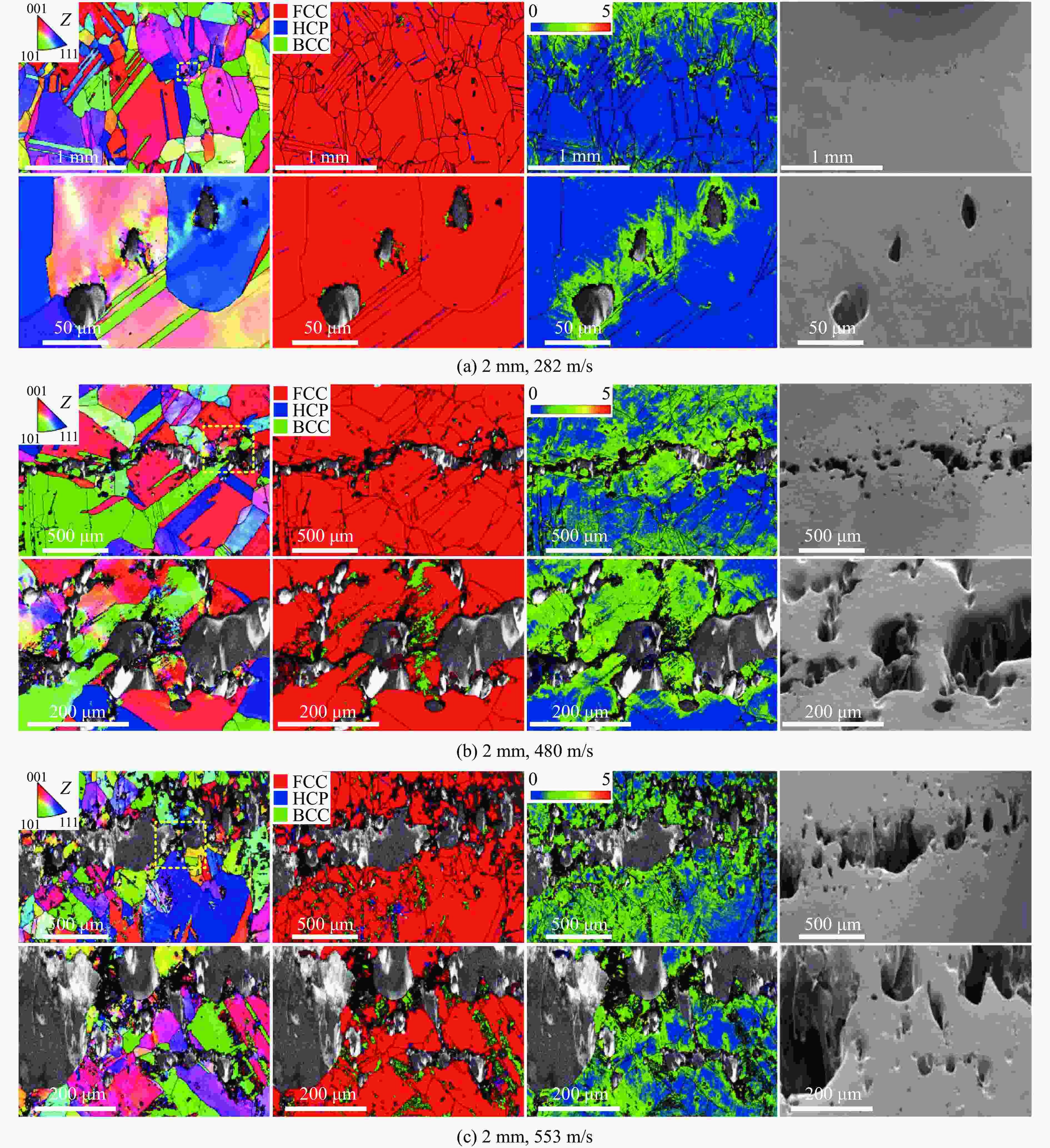
图 8 在不同冲击速度下2 mm试样中孔洞附近区域的EBSD及SEM表征
Figure 8. EBSD and SEM characterization of regions near voids in 2 mm samples under different impact velocities
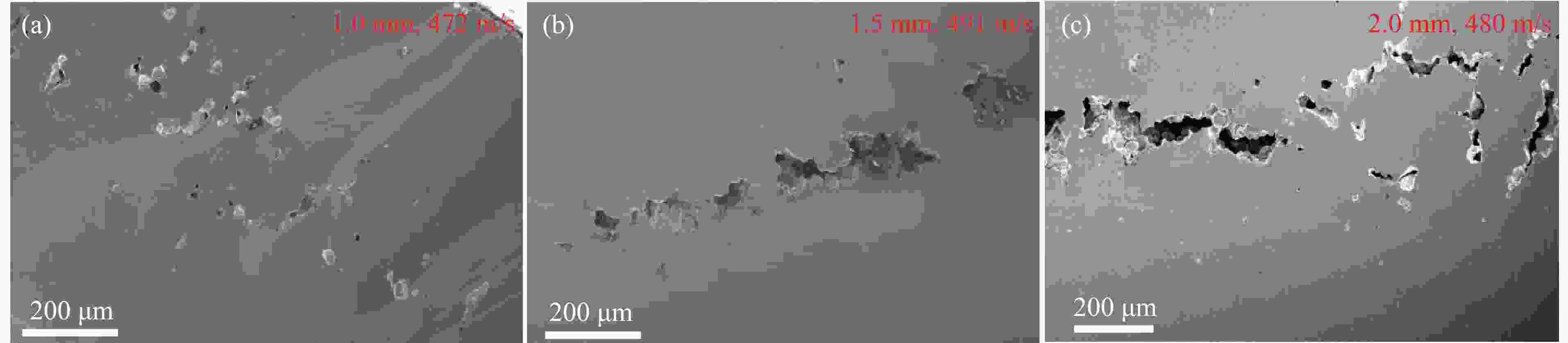
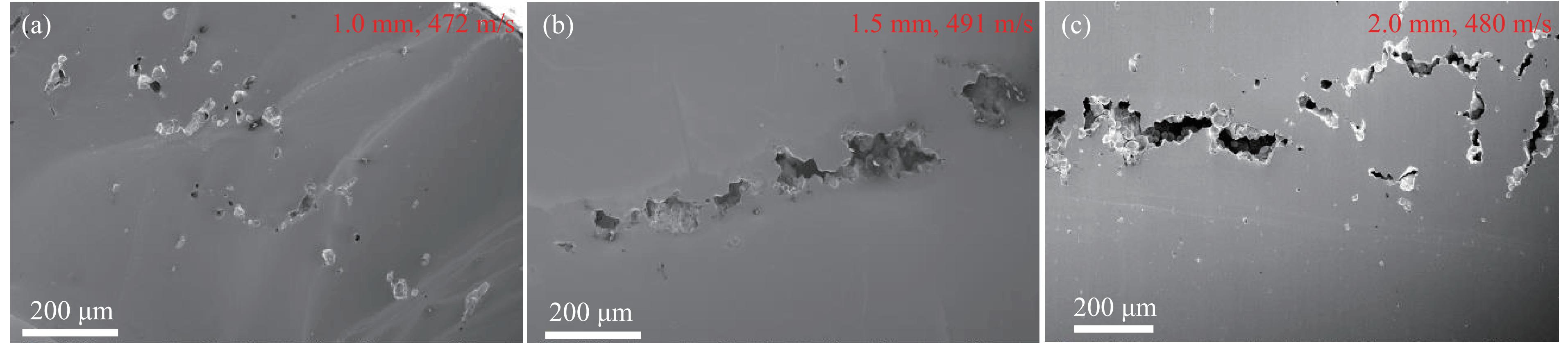
图 9 约500 m/s冲击速度下不同厚度样品的宏观形貌及局部孔洞特征:(a) 1.0 mm,(b) 1.5 mm,(c) 2.0 mm
Figure 9. Macroscopic morphologies and local void features of samples with different thicknesses at an impact velocity of about 500 m/s: (a) 1.0 mm; (b) 1.5 mm; (c) 2.0 mm
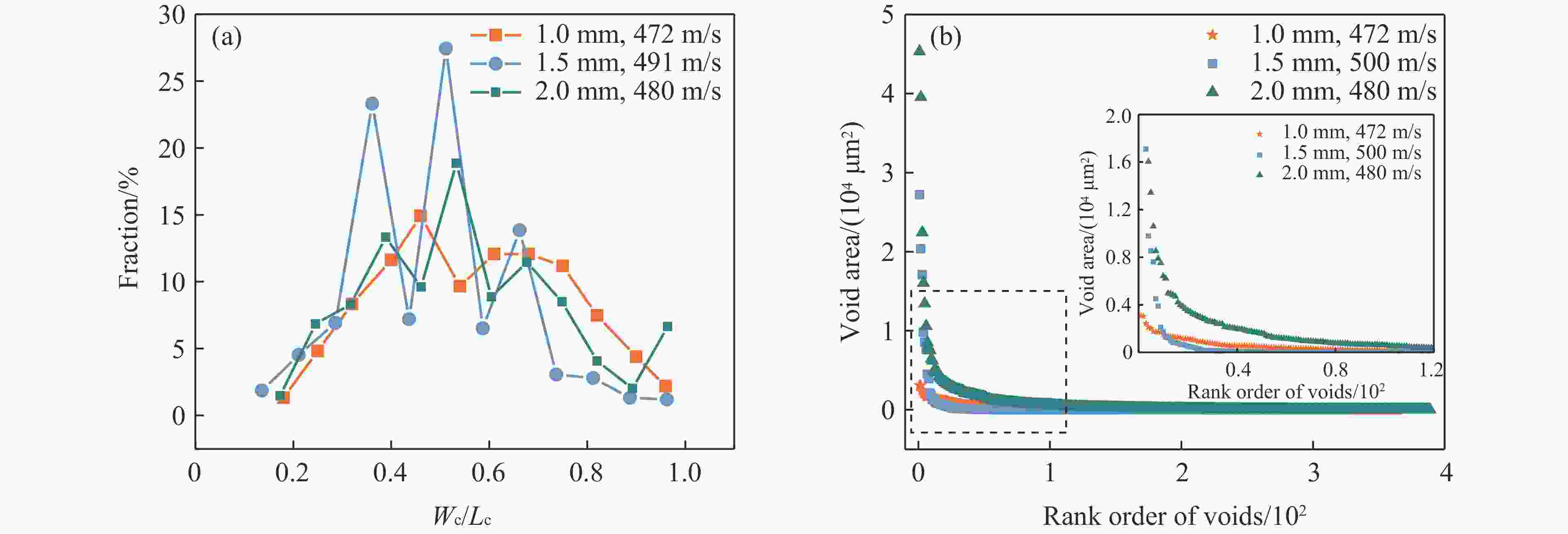
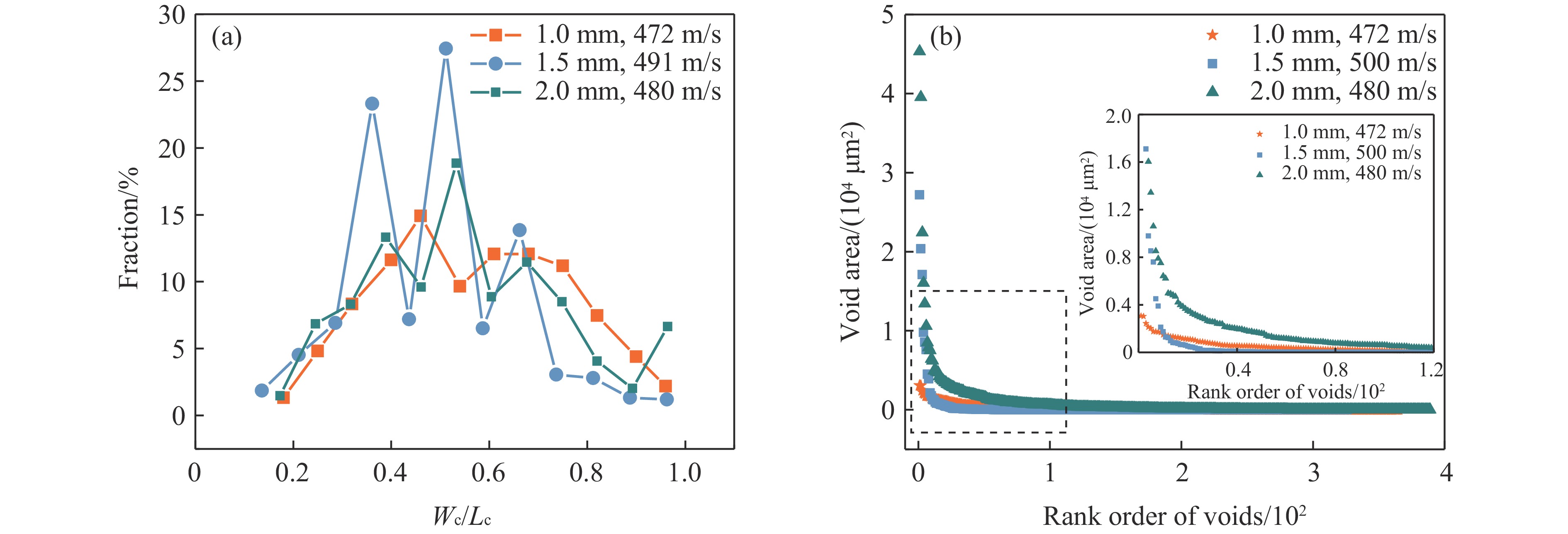
图 10 不同脉冲持续时间下孔洞形貌与面积分布统计:(a) 孔洞宽长比分布,(b) 按面积降序排列的孔洞面积分布
Figure 10. Statistical characterization of void morphology and area distribution under different pulse durations: (a) distribution of void width-to-length ratio; (b) void area distribution ranked in descending order
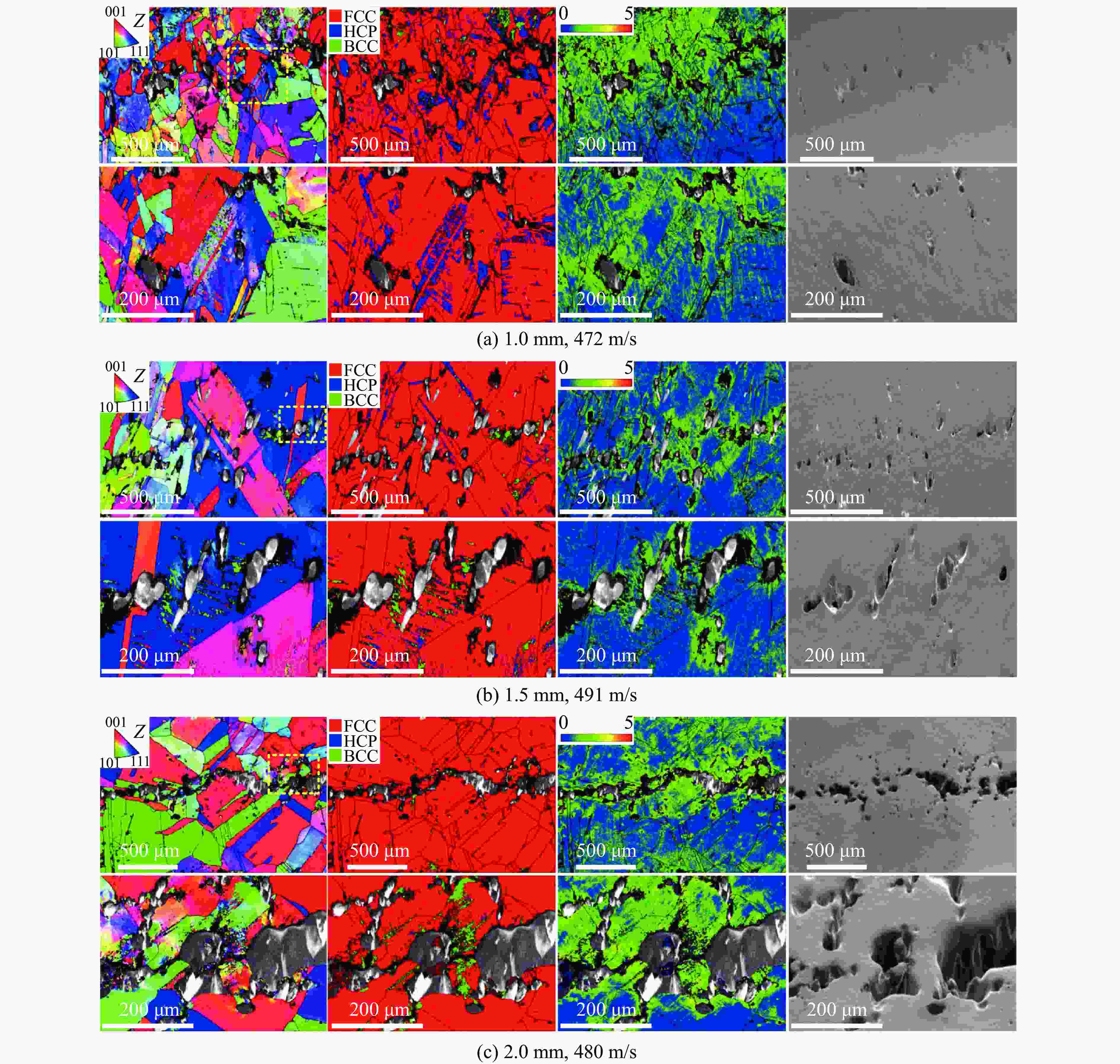
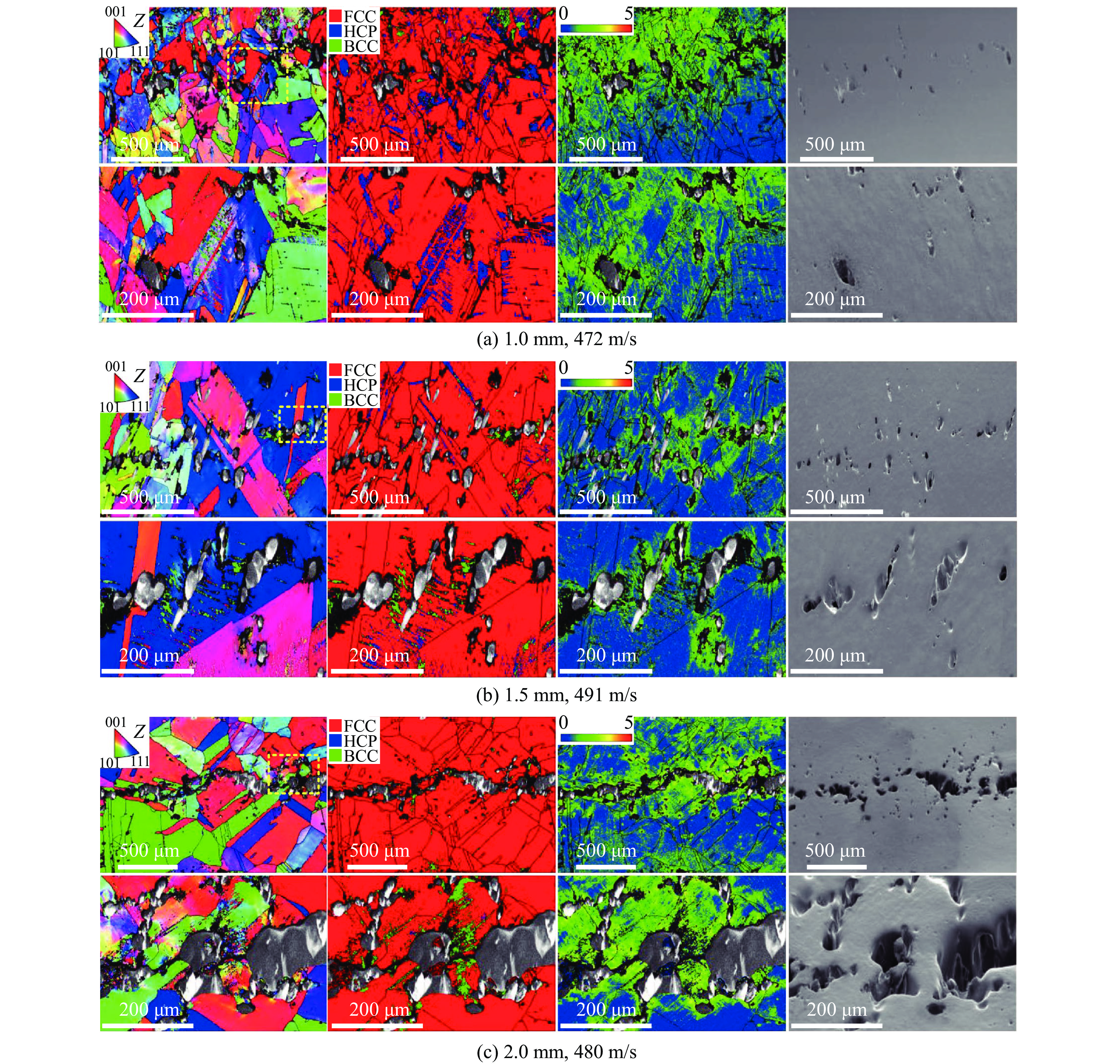
图 11 约500 m/s冲击速度下不同厚度试样孔洞附近区域的EBSD及SEM表征
Figure 11. EBSD and SEM characterizations of regions near voids in samples with different thicknesses at an impact velocity of about 500 m/s
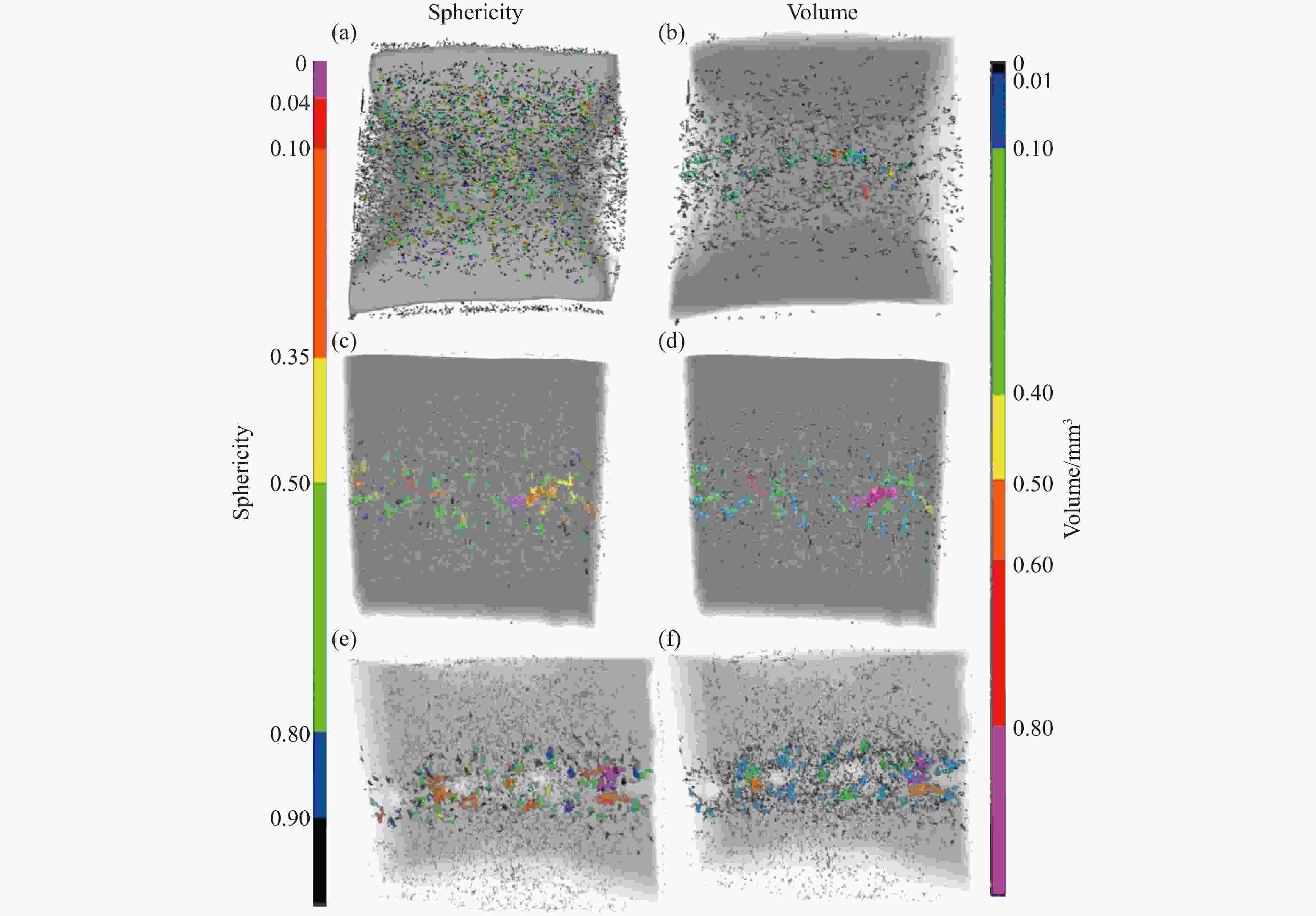
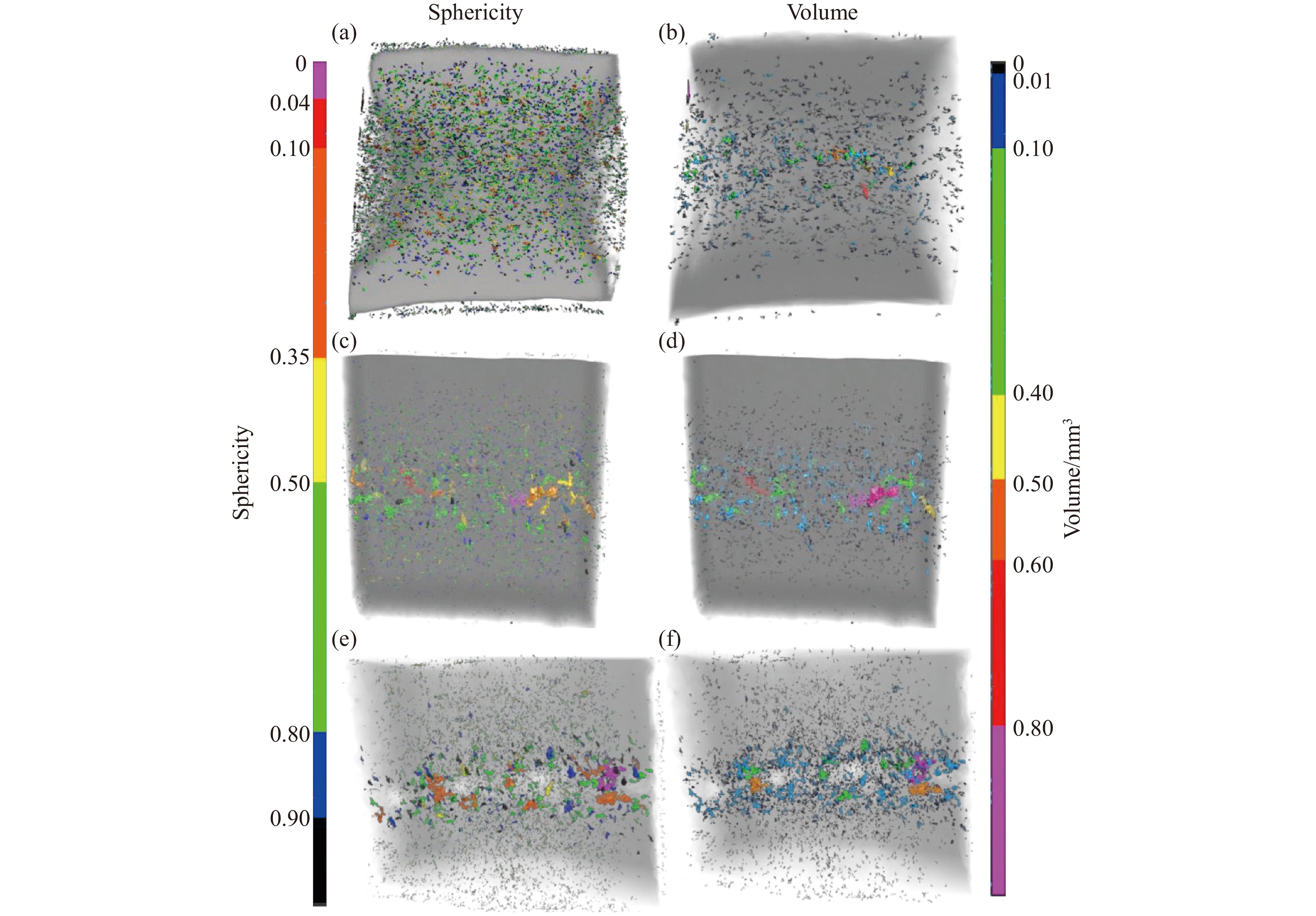
图 12 不同冲击速度下孔洞形貌参数三维分布:(a) 282 m/s下球形度分布,(b) 282 m/s下体积分布,(c) 480 m/s下球形度分布,(d) 480 m/s下体积分布,(e) 553 m/s下球形度分布,(f) 553 m/s下体积分布
Figure 12. Three-dimensional distributions of pore morphology parameters at different impact velocities: (a) sphericity distribution at 282 m/s; (b) volume distribution at 282 m/s; (c) sphericity distribution at 480 m/s; (e) volume distribution at 480 m/s; (f) sphericity distribution at 553 m/s; (g) volume distribution at 553 m/s
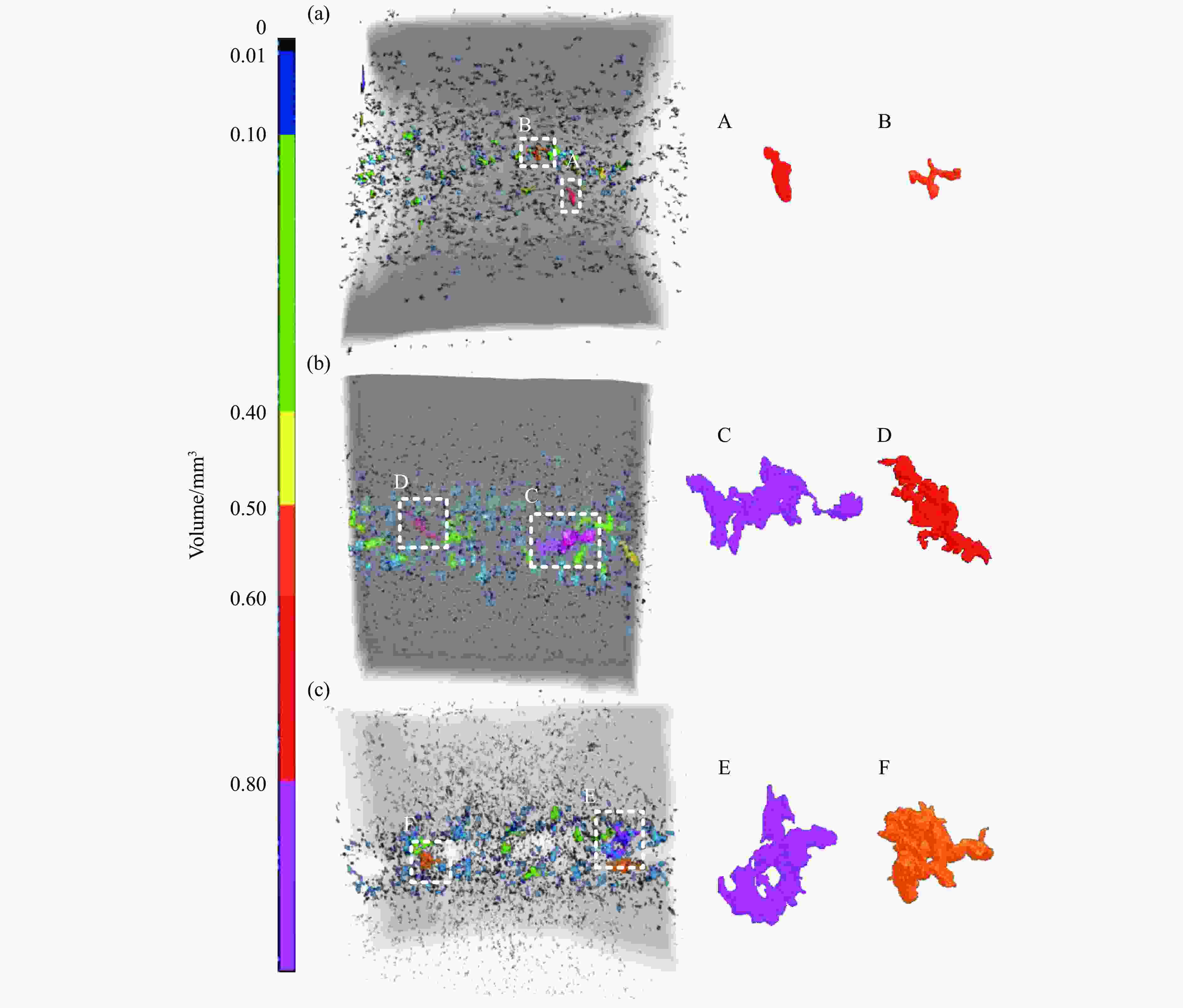
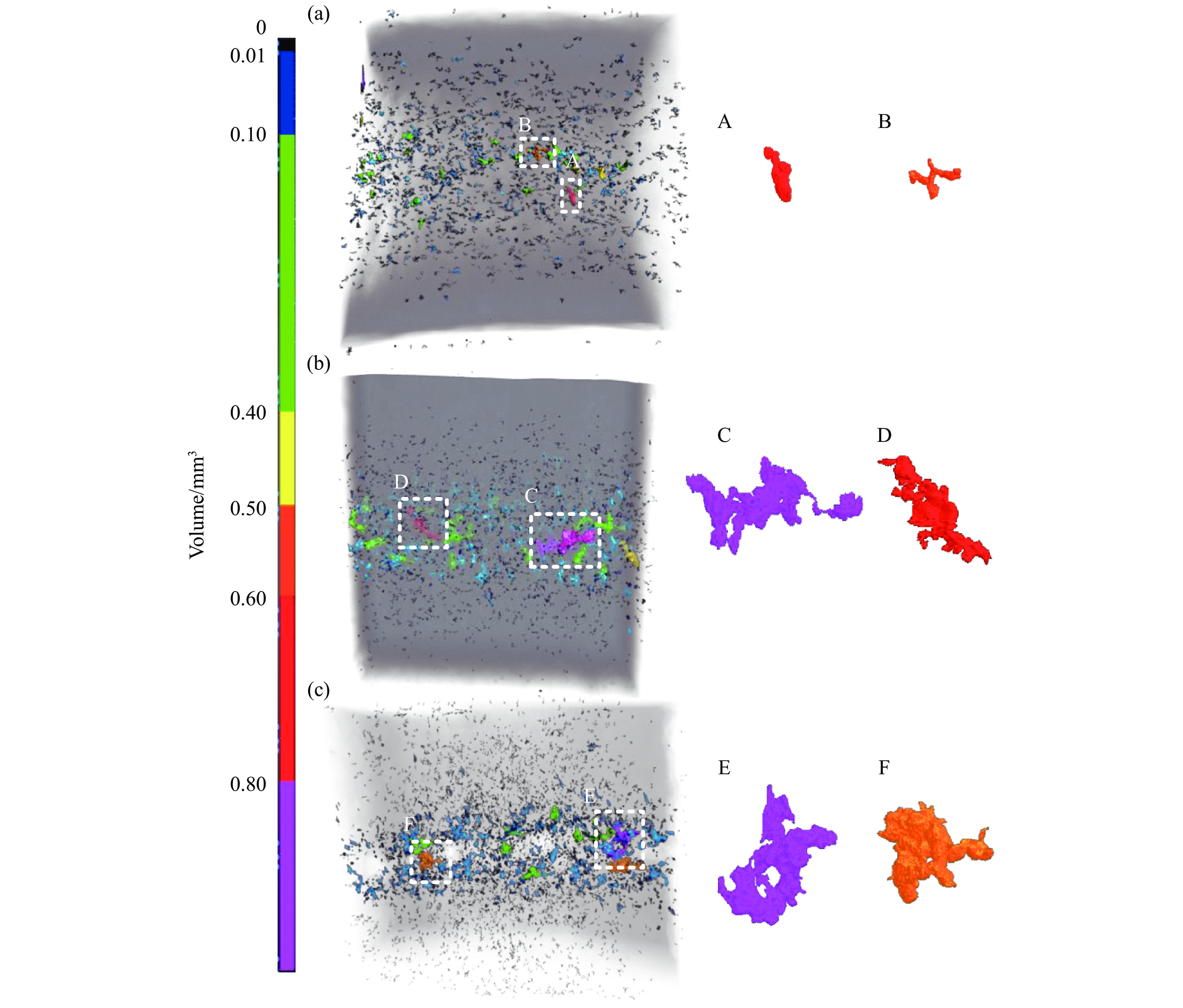
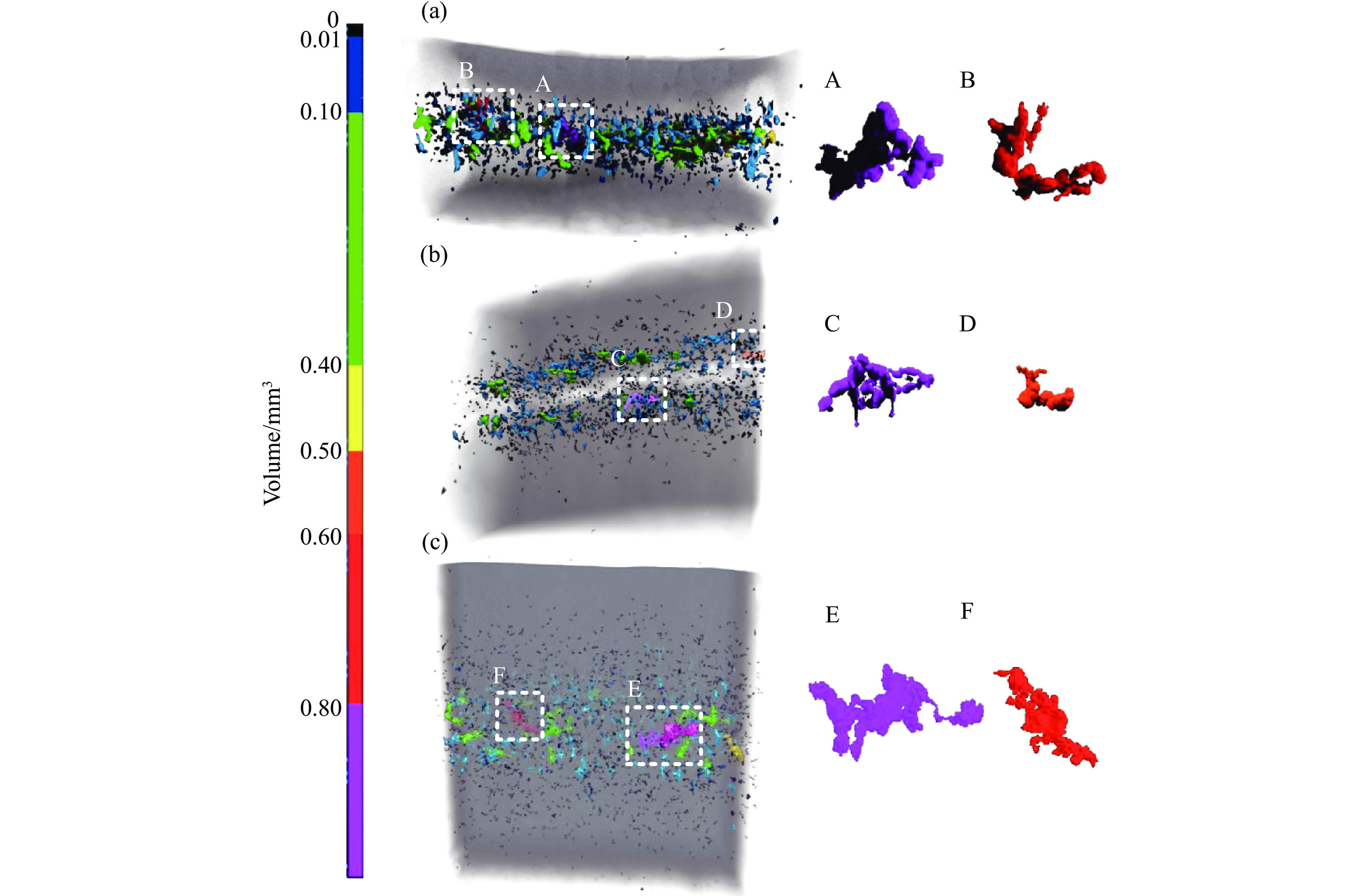
图 13 不同冲击速度下试样中最大的2个孔洞的三维重构结果:(a) 282 m/s,(b) 480 m/s,(c) 553 m/s
Figure 13. Three-dimensional extraction of the two largest voids in samples under different impact velocities: (a) 282 m/s; (b) 480 m/s; (c) 553 m/s
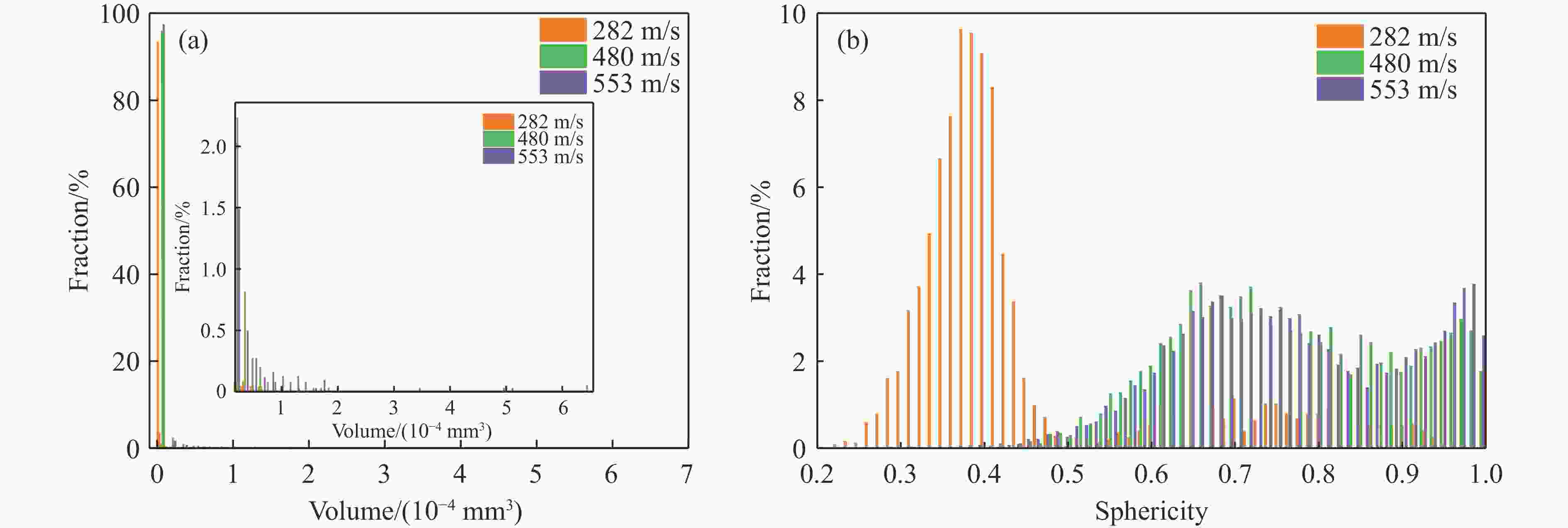
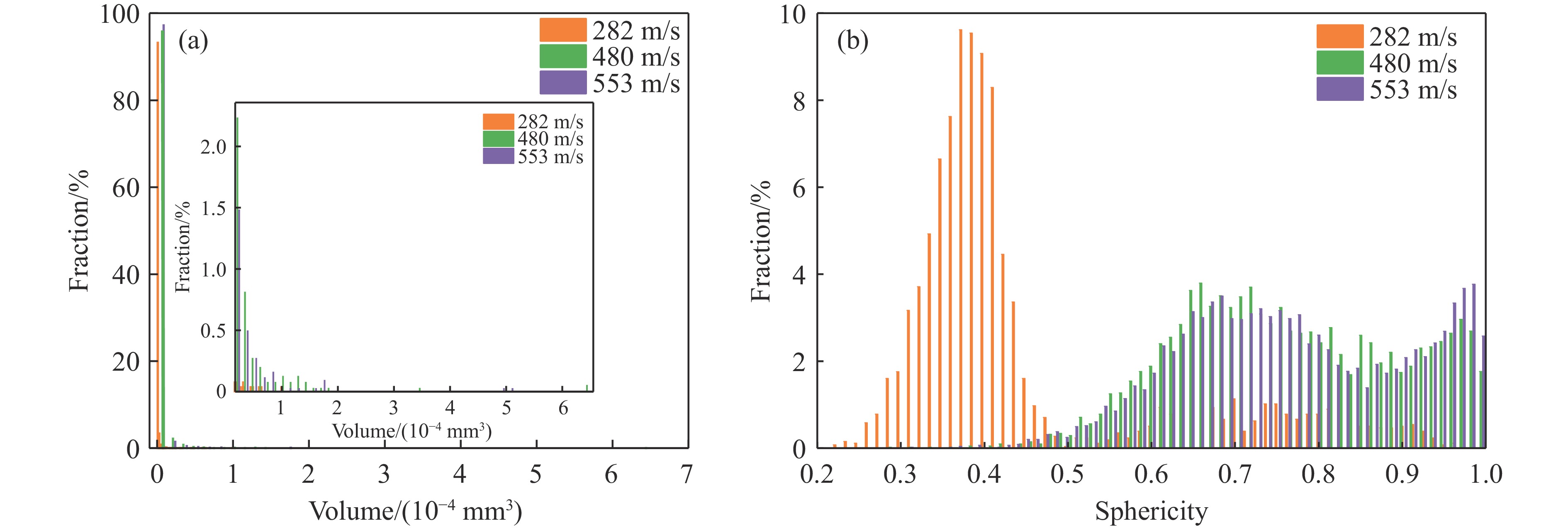
图 14 不同冲击速度下2.0 mm试样的孔洞体积与球形度分布统计结果:(a) 孔洞体积分布,(b) 孔洞球形度分布
Figure 14. Statistical distributions of void volume and sphericity in 2.0 mm samples under different impact velocities: (a) volume distribution of voids; (b) sphericity distribution of voids
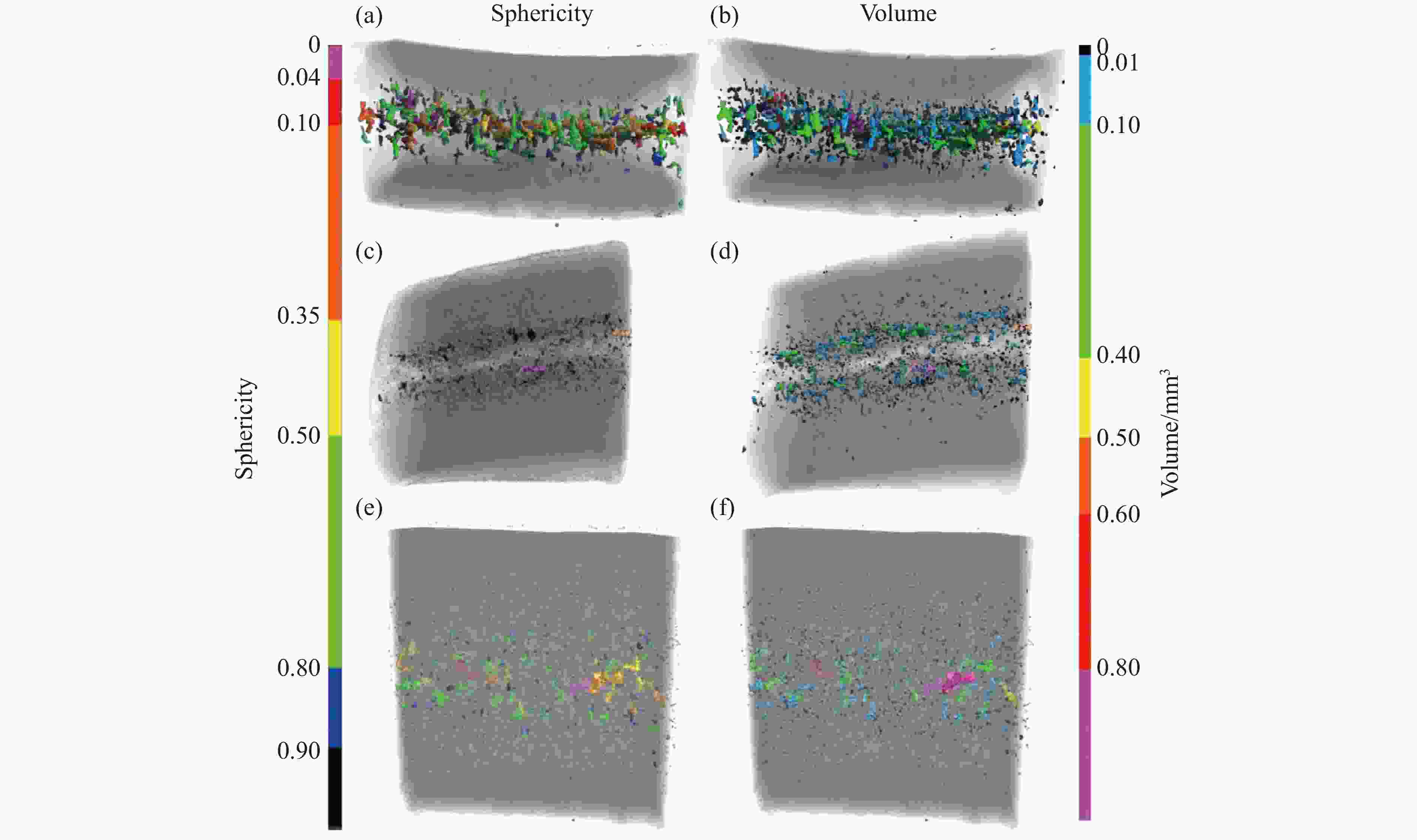
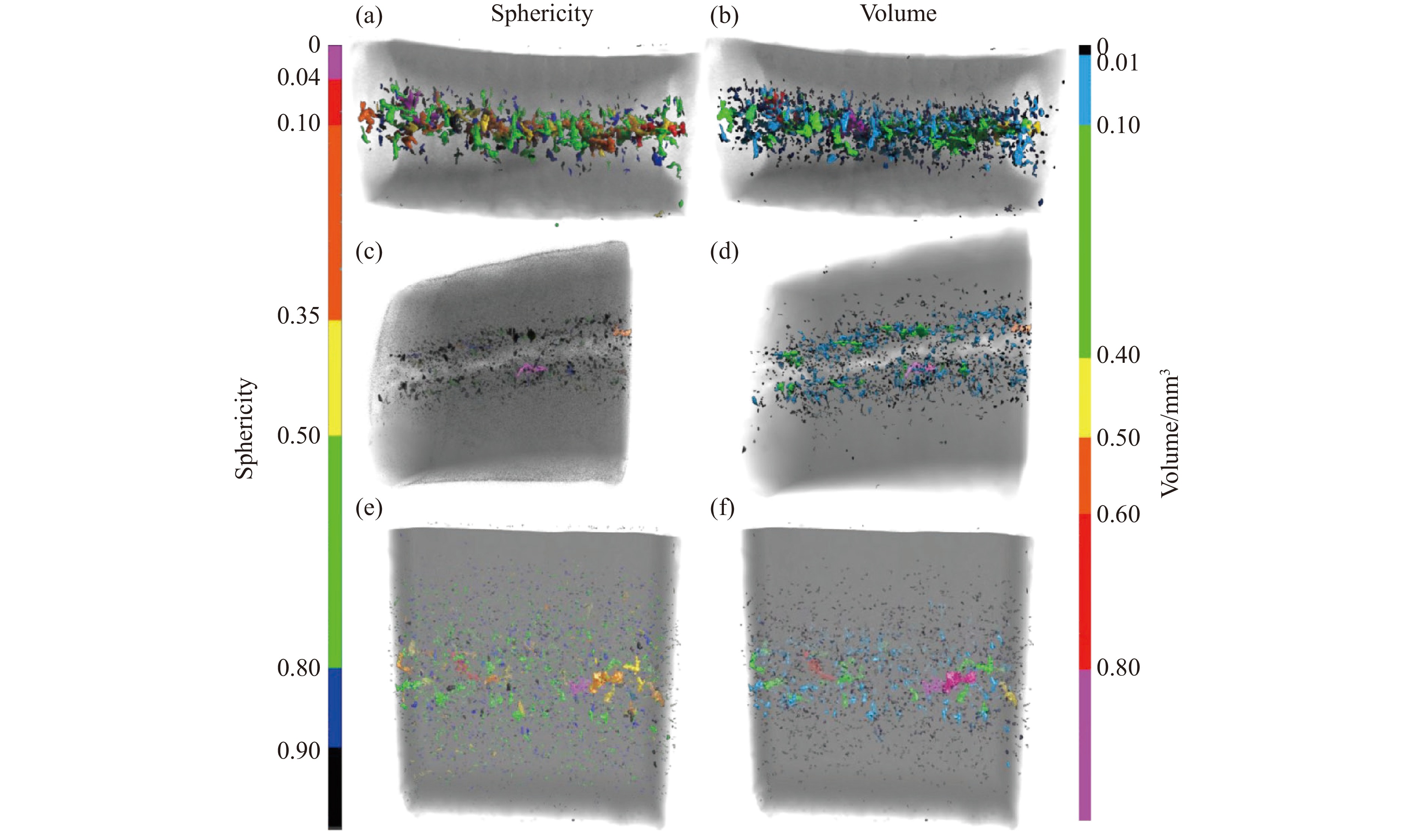
图 15 相同冲击速度下不同厚度试样中孔洞球形度与体积分布三维重构图:(a) 1.0 mm时球形度分布,(b) 1.0 mm时体积分布,(c) 1.5 mm时球形度分布,(d) 1.5 mm时体积分布,(e) 2.0 mm时球形度分布,(f) 2.0 mm时体积分布
Figure 15. Three-dimensional reconstruction of the sphericity and volume distributions of voids in samples with different thicknesses at the same impact velocity: (a) sphericity distribution at 1.0 mm; (b) volume distribution at 1.0 mm; (c) sphericity distribution at 1.5 mm; (e) volume distribution at 1.5 mm; (f) sphericity distribution at 2.0 mm; (g) volume distribution at 2.0 mm
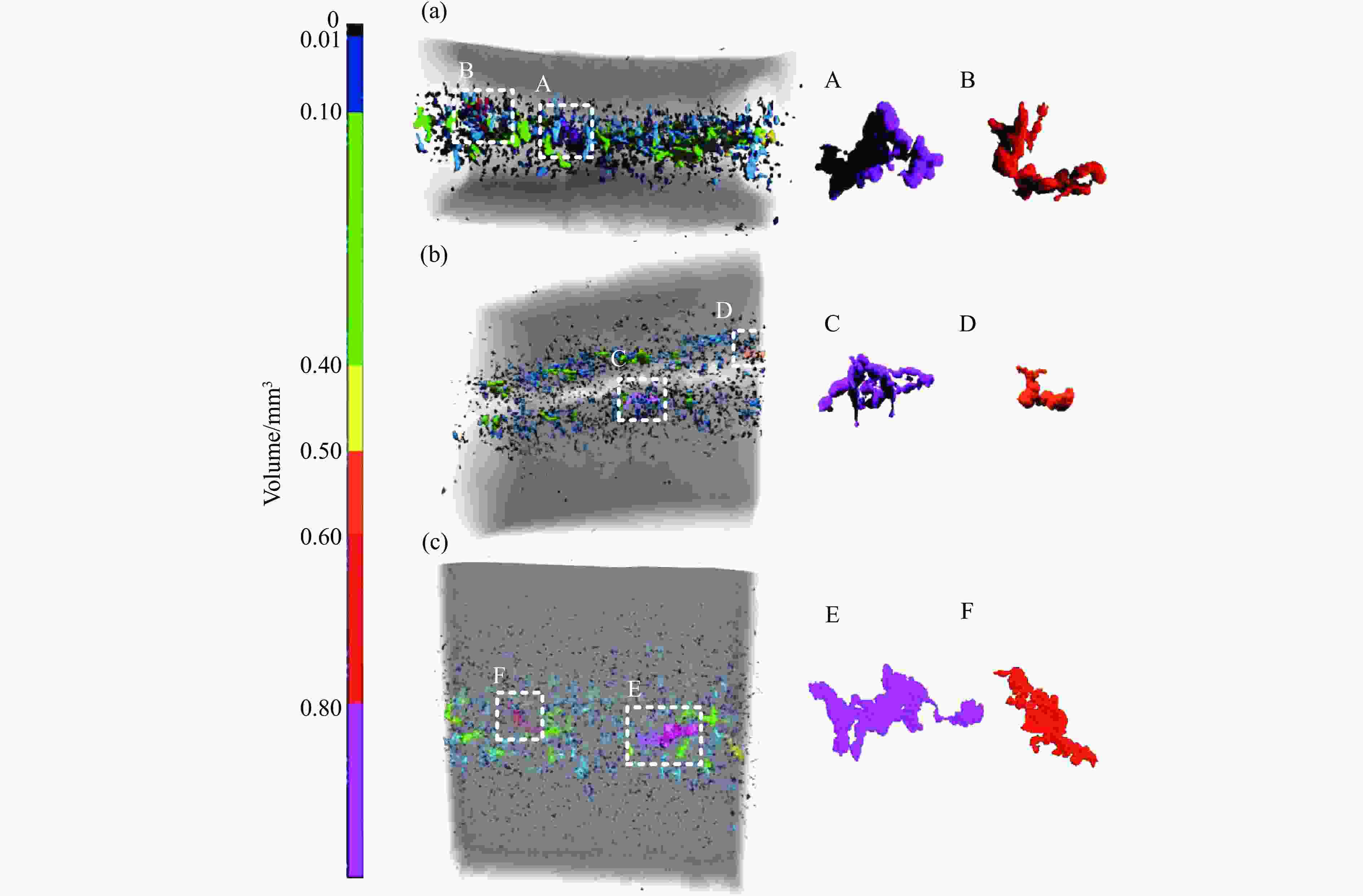
图 16 不同厚度试样中体积最大的2个孔洞的三维重构结果:(a) 1.0 mm,(b) 1.5 mm,(c) 2.0 mm
Figure 16. Three-dimensional reconstruction of the two largest voids in samples with different thicknesses: (a) 1.0 mm; (b) 1.5 mm; (c) 2.0 mm
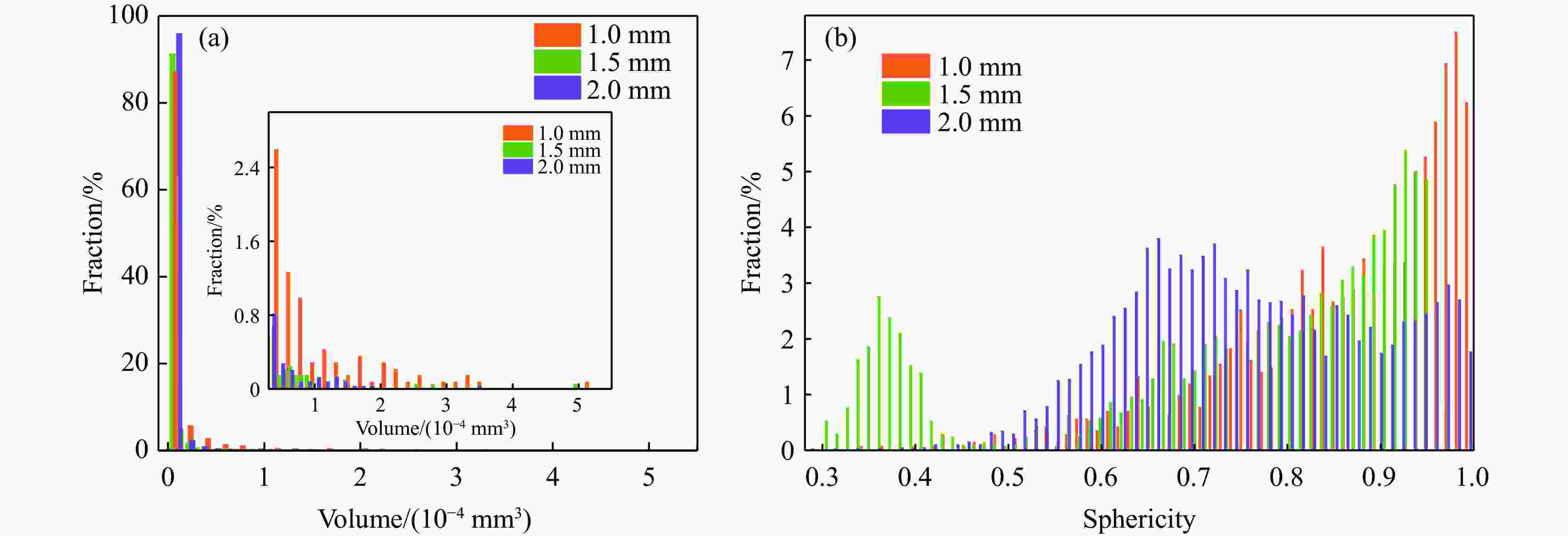
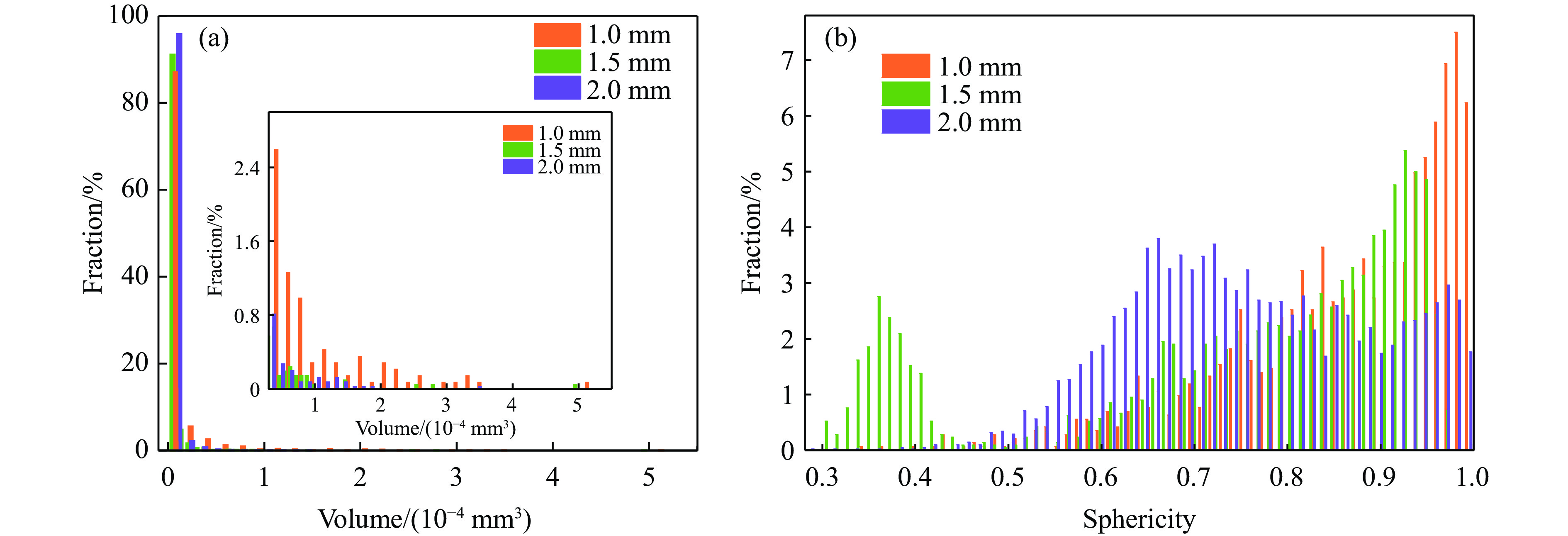
图 17 不同厚度试样孔洞体积与球形度分布统计结果:(a) 孔洞体积分布,(b) 孔洞球形度分布
Figure 17. Statistical distributions of void volume and sphericity in samples with different thicknesses: (a) volume distribution of voids; (b) sphericity distribution of voids.
表 1 平板冲击实验参数及层裂响应特征
Table 1. Experimental parameters and spall response characteristics for the plate-impact tests
Shot No. uimp/(m·s−1) Lf/mm Ls/mm $ \tau $/μs σHEL/GPa σspall/GPa $ \dot{\varepsilon } $/s−1 ar/(m·s−2) A1 282 1.02 2.03 0.250 0.64 1.83 6.63×10⁵ 3.04×10⁸ A2 480 0.97 2.01 0.261 0.94 1.85 8.35×10⁵ 3.92×10⁸ A3 553 0.98 1.98 0.245 1.00 1.95 1.01×10⁶ 4.28×10⁸ B1 472 0.49 1.03 0.075 0.53 1.40 1.10×10⁶ 8.07×10⁸ B2 491 0.72 1.48 0.225 0.51 1.67 9.32×10⁵ 3.76×10⁸  下载: 导出CSV
-
[1] HUANG S, HUANG H, LI W, et al. Twinning in metastable high-entropy alloys [J]. Nature Communications, 2018, 9(1): 2381. doi: 10.1038/s41467-018-04780-x [2] LI Z M, PRADEEP K G, DENG Y, et al. Metastable high-entropy dual-phase alloys overcome the strength-ductility trade-off [J]. Nature, 2016, 534(7606): 227–230. doi: 10.1038/nature17981 [3] LI Z M, TASAN C C, PRADEEP K G, et al. A TRIP-assisted dual-phase high-entropy alloy: grain size and phase fraction effects on deformation behavior [J]. Acta Materialia, 2017, 131: 323–335. doi: 10.1016/j.actamat.2017.03.069 [4] JO Y H, YANG J H, CHOI W M, et al. Body-centered-cubic martensite and the role on room-temperature tensile properties in Si-added SiVCrMnFeCo high-entropy alloys [J]. Journal of Materials Science & Technology, 2021, 76: 222–230. doi: 10.1016/j.jmst.2020.10.038 [5] JIAO M X, ZHANG T W, MA J Y, et al. Superior cryogenic strength-ductility synergy in a multiphase lamellar-structured metastable high-entropy alloy [J]. Journal of Materials Science & Technology, 2026, 257: 73–86. doi: 10.1016/j.jmst.2025.09.016 [6] SHEN J J, ZHANG W, LOPES J G, et al. Evolution of microstructure and deformation mechanisms in a metastable Fe42Mn28Co10Cr15Si5 high entropy alloy: a combined in-situ synchrotron X-ray diffraction and EBSD analysis [J]. Materials & Design, 2024, 238: 112662. doi: 10.1016/j.matdes.2024.112662 [7] CHEN S J, OH H S, GLUDOVATZ B, et al. Real-time observations of TRIP-induced ultrahigh strain hardening in a dual-phase CrMnFeCoNi high-entropy alloy [J]. Nature Communications, 2020, 11(1): 826. doi: 10.1038/s41467-020-14641-1 [8] YANG J H, JO Y H, KIM D W, et al. Effects of transformation-induced plasticity (TRIP) on tensile property improvement of Fe45Co30Cr10V10Ni5−xMnx high-entropy alloys [J]. Materials Science and Engineering: A, 2020, 772: 138809. doi: 10.1016/j.msea.2019.138809 [9] MEHRANPOUR M S, RASOOLI N, KIM H S, et al. Deformation-induced martensitic transformations: a strategy for overcoming the strength-ductility trade-off in high-entropy alloys [J]. Current Opinion in Solid State and Materials Science, 2024, 31: 101177. doi: 10.1016/j.cossms.2024.101177 [10] XU J, LIANG L, TONG W, et al. Role of strain rate in phase stability and deformation mechanism of non-equiatomic Fe38−xMn30Co15Cr15Ni2Gdx high-entropy alloy [J]. Materials Characterization, 2022, 194: 112356. doi: 10.1016/j.matchar.2022.112356 [11] JAIN R, PARAMESWARAN V, BISWAS K, et al. Bidirectional transformation enabled improvement in strength and ductility of metastable Fe50Mn30Co10Cr10 complex concentrated alloy under dynamic deformation [J]. International Journal of Plasticity, 2023, 166: 103633. doi: 10.1016/j.ijplas.2023.103633 [12] FANG Q H, CHEN Y, LI J, et al. Probing the phase transformation and dislocation evolution in dual-phase high-entropy alloys [J]. International Journal of Plasticity, 2019, 114: 161–173. doi: 10.1016/j.ijplas.2018.10.014 [13] JO Y H, YANG J H, DOH K Y, et al. Analysis of damage-tolerance of TRIP-assisted V10Cr10Fe45Co30Ni5 high-entropy alloy at room and cryogenic temperatures [J]. Journal of Alloys and Compounds, 2020, 844: 156090. doi: 10.1016/j.jallcom.2020.156090 [14] YADAV M, NAYAN N, BISWAS K, et al. Tailoring fracture resistance of a metastable Fe42Mn28Co10Cr15Si5 high entropy alloy by intrinsic toughening [J]. International Journal of Plasticity, 2025, 188: 104315. doi: 10.1016/j.ijplas.2025.104315 [15] EGUCHI T, KOYAMA M, FUKUSHIMA Y, et al. Fatigue crack growth behavior and associated microstructure in a metastable high-entropy alloy [J]. Procedia Structural Integrity, 2018, 13: 831–836. doi: 10.1016/j.prostr.2018.12.159 [16] HE Z F, JIA N, WANG H W, et al. The effect of strain rate on mechanical properties and microstructure of a metastable FeMnCoCr high entropy alloy [J]. Materials Science and Engineering: A, 2020, 776: 138982. doi: 10.1016/j.msea.2020.138982 [17] JO Y H, KIM D G, JO M C, et al. Effects of deformation-induced BCC martensitic transformation and twinning on impact toughness and dynamic tensile response in metastable VCrFeCoNi high-entropy alloy [J]. Journal of Alloys and Compounds, 2019, 785: 1056–1067. doi: 10.1016/j.jallcom.2019.01.293 [18] FIELD J E, WALLEY S M, PROUD W G, et al. Review of experimental techniques for high rate deformation and shock studies [J]. International Journal of Impact Engineering, 2004, 30(7): 725–775. doi: 10.1016/j.ijimpeng.2004.03.005 [19] WIELEWSKI E, APPLEBY-THOMAS G J, HAZELL P J, et al. An experimental investigation into the micro-mechanics of spall initiation and propagation in Ti-6Al-4V during shock loading [J]. Materials Science and Engineering: A, 2013, 578: 331–339. doi: 10.1016/j.msea.2013.04.055 [20] LI C, LI B, HUANG J Y, et al. Spall damage of a mild carbon steel: effects of peak stress, strain rate and pulse duration [J]. Materials Science and Engineering: A, 2016, 660: 139–147. doi: 10.1016/j.msea.2016.02.080 [21] YUAN F P, PRAKASH V. Plate impact experiments to investigate shock-induced inelasticity in Westerly granite [J]. International Journal of Rock Mechanics and Mining Sciences, 2013, 60: 277–287. doi: 10.1016/j.ijrmms.2012.12.024 [22] REMINGTON T P, REMINGTON B A, HAHN E N, et al. Deformation and failure in extreme regimes by high-energy pulsed lasers: a review [J]. Materials Science and Engineering: A, 2017, 688: 429–458. doi: 10.1016/j.msea.2017.01.114 [23] LI H J, ZHAO L, DING X D, et al. Mechanism of the β to ω phase transformation in shock compressed Zr-Nb alloys [J]. Physical Review B, 2024, 110(13): 134105. doi: 10.1103/PhysRevB.110.134105 [24] SINGH S P, SINGH H, MAHAJAN P. Comprehensive analysis of wave interactions and resulting spall damage in layered heterogeneous medium under impact [J]. Mechanics of Materials, 2024, 199: 105182. doi: 10.1016/j.mechmat.2024.105182 [25] ANTOUN T, CURRAN D R, RAZORENOV S V, et al. Spall fracture [M]. New York: Springer, 2003: 37–58. [26] MACNIDER B, JONES D, CALLANAN J, et al. In situ measurement of damage evolution in shocked magnesium as a function of microstructure [J]. Science Advances, 2023, 9(45): eadi2606. doi: 10.1126/sciadv.adi2606 [27] QIU Y J, SHI X B, YAN P, et al. Dynamic recrystallization/recovery of FCC and B2 phases in a Ni36Fe36Cr10Al17Mo1 eutectic high entropy alloy [J]. Metals and Materials International, 2026, 32(1): 372–383. doi: 10.1007/s12540-025-01979-8 [28] CHENG J C, QIN H L, LI C, et al. Deformation and damage of equiatomic CoCrFeNi high-entropy alloy under plate impact loading [J]. Materials Science and Engineering: A, 2023, 862: 144432. doi: 10.1016/j.msea.2022.144432 [29] CHENG J C, XU J, ZHAO X J, et al. Shock compression and spallation of a medium-entropy alloy Fe40Mn20Cr20Ni20 [J]. Materials Science and Engineering: A, 2022, 847: 143311. doi: 10.1016/j.msea.2022.143311 [30] ZHAO S P, FENG Z D, LI L X, et al. Dynamic mechanical properties, deformation and damage mechanisms of eutectic high-entropy alloy AlCoCrFeNi2.1 under plate impact [J]. Journal of Materials Science & Technology, 2023, 134: 178–188. doi: 10.1016/j.jmst.2022.05.060 [31] ZHANG N B, TANG Z J, LIN Z H, et al. Deformation and damage of heterogeneous-structured high-entropy alloy CrMnFeCoNi under plate impact [J]. Materials Science and Engineering: A, 2022, 843: 143069. doi: 10.1016/j.msea.2022.143069 [32] 罗小平, 李绪海, 唐泽明, 等. 冲击应力和脉宽对NbTiZr中熵合金层裂的影响 [J]. 高压物理学报, 2024, 38(6): 064101. doi: 10.11858/gywlxb.20240771LUO X P, LI X H, TANG Z M, et al. Effects of shock peak stress and pulse duration on spall damage of NbTiZr medium-entropy alloy [J]. Chinese Journal of High Pressure Physics, 2024, 38(6): 064101. doi: 10.11858/gywlxb.20240771 [33] SUN Y F, LIU Y S, WU W, et al. Impact response of metastable body-centered cubic high-entropy alloy HfZrTiTa0.53: deformation and spallation damage [J]. Materials Science and Engineering: A, 2025, 924: 147727. doi: 10.1016/j.msea.2024.147727 [34] HAWKINS M C, THOMAS S, HIXSON R S, et al. Dynamic properties of FeCrMnNi, a high entropy alloy [J]. Materials Science and Engineering: A, 2022, 840: 142906. doi: 10.1016/j.msea.2022.142906 [35] PAN R C, FAN D, BIAN Y L, et al. Effect of minor elements Al and Ti on dynamic deformation and fracture of CoCrNi-based medium-entropy alloys [J]. Materials Science and Engineering: A, 2023, 884: 145535. doi: 10.1016/j.msea.2023.145535 [36] YANG X, XIONG X, YIN Z, et al. Interrupted test of advanced high strength steel with tensile split Hopkinson bar method [J]. Experimental Mechanics, 2014, 54(4): 641–652. doi: 10.1007/s11340-013-9828-0 [37] AVOLEDO E, PETRUZZI M, PELEGATTI M, et al. Defect analysis by computed tomography in metallic materials: optimisation, uncertainty quantification and classification [J]. Precision Engineering, 2025, 97: 235–248. doi: 10.1016/j.precisioneng.2025.09.008 [38] YANG P, ZHAO P Y. Void nucleation at dislocation boundaries aided by the synergy of multiple dislocation pile-ups [J]. International Journal of Plasticity, 2023, 171: 103779. doi: 10.1016/j.ijplas.2023.103779 [39] WILLIAMS C L, CHEN C Q, RAMESH K T, et al. The effects of cold rolling on the microstructural and spall response of 1100 aluminum [J]. Journal of Applied Physics, 2013, 114(9): 093502. doi: 10.1063/1.4817844 [40] WILLIAMS C L, RAMESH K T, DANDEKAR D P. Spall response of 1100-O aluminum [J]. Journal of Applied Physics, 2012, 111(12): 123528. doi: 10.1063/1.4729305 -

 下载:
下载:


计量
- 文章访问数: 449
- HTML全文浏览量: 163
- PDF下载量: 61
