





Effect of Interlayer Materials on the Interfacial Microstructure and Dynamic Mechanical Properties of 7B53 Aluminum Alloy Composite Plates
-
摘要: 铝合金中间层材料对于7B53铝合金复合板(7A52铝合金/中间层/7A63铝合金)的界面结合性能和动态冲击力学性能的影响显著。采用拉伸剪切实验、夏比冲击实验、分离式霍普金森压杆实验和扫描电子显微镜,系统研究了不同铝合金中间层材料(7A01、6061、2024铝合金)对复合板界面结合质量及高应变率(
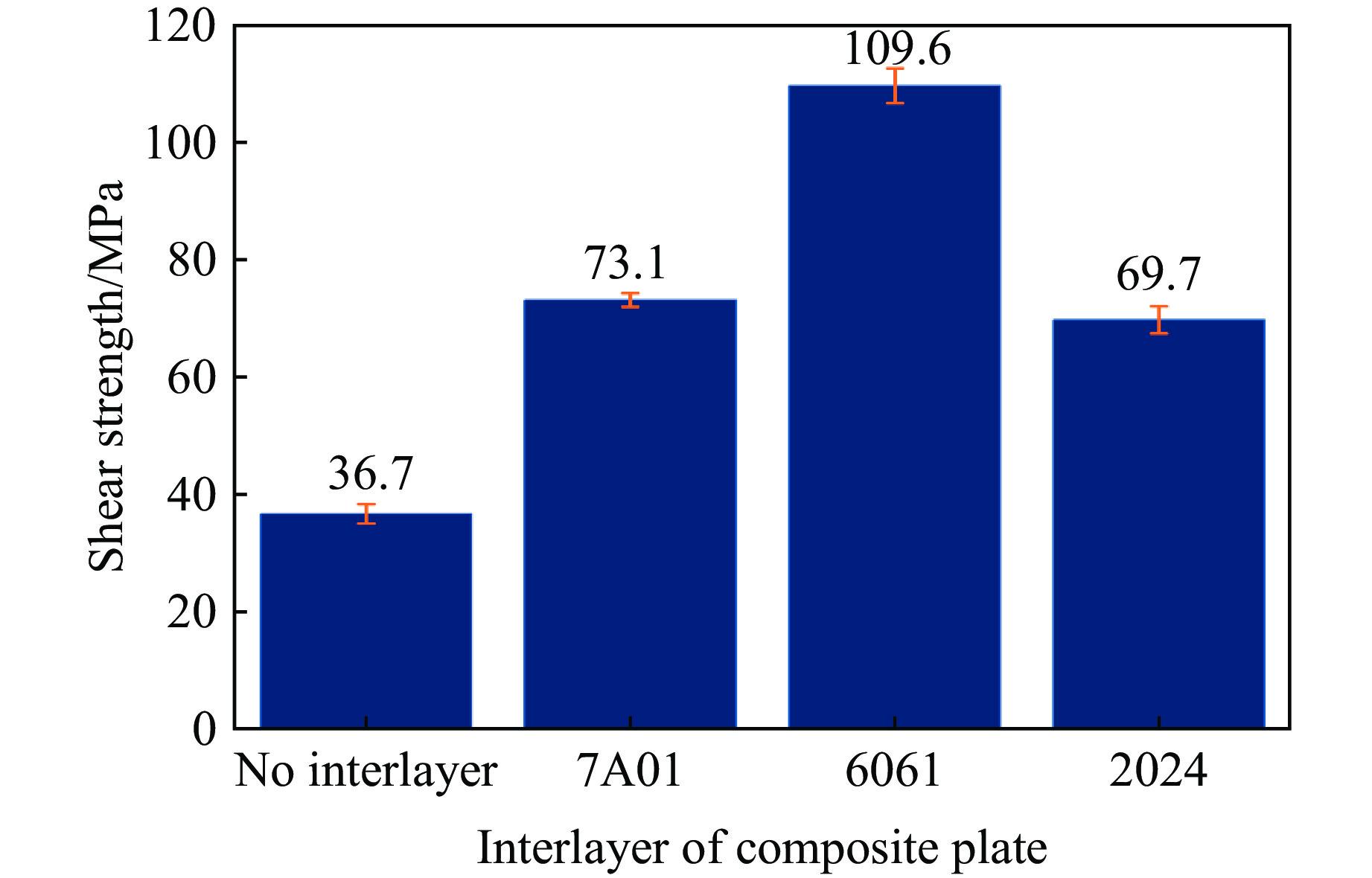
1700 ~3200 s−1)下动态力学行为的影响机制。结果表明,6061中间层复合板表现出最优的界面结合性能,最大剪切强度达109.6 MPa,较7A01中间层复合板(73.1 MPa)提升了36.5 MPa,这是由于6061铝合金促进了界面区域细小均匀晶粒的形成,从而有效强化界面区域。霍普金森压杆实验表明,中间层的不均匀变形可有效阻断裂纹向7A52层的贯穿扩展,并促使裂纹沿界面偏转。7A01中间层复合板的应变率敏感性较低,而6061中间层复合板在1700 ~2700 s−1范围内虽因热软化效应而流变应力下降,但其优异的延展性确保了高速冲击下的稳定变形。与2024中间层复合板相比,6061中间层复合板在保持较高屈服强度的同时,具有更高的塑性应变。6061中间层复合板成功实现了7A52高韧性与7A63高强度的有效融合,为装甲车辆抗冲击防护结构设计提供了重要的理论依据。-
关键词:
- 7B53铝合金复合板 /
- 中间层 /
- 动态冲击力学性能 /
- 界面结合性能 /
- 屈服强度
Abstract: The choice of aluminum alloys used as the interlayers significantly influences the interfacial bonding properties and dynamic impact mechanical properties of 7B53 aluminum alloy composite plates (7A52/interlayer/7A63). In this study, the influence mechanism of different aluminum alloy interlayer materials (7A01, 6061, 2024 aluminum alloy) on the interfacial metallurgical bonding quality and the dynamic mechanical behavior at high strain rates (1700 −3200 s−1) was systematically investigated using tensile-shear tests, Charpy impact tests, split Hopkinson pressure bar (SHPB) tests, and scanning electron microscopy (SEM). The results show that the composite plate with the 6061 interlayer exhibits the optimal interfacial bonding performance, achieving a maximum shear strength of 109.6 MPa, which is 36.5 MPa higher than that of the plate with the 7A01 interlayer (73.1 MPa). This improvement is attributed to the fact that the 6061 alloy promotes the formation of fine and uniform grains at the interface, thereby effectively strengthening the interfacial region. SHPB tests reveal that the inhomogeneous deformation of the interlayer interrupts the penetration of cracks into the 7A52 layer and promotes crack deflection along the interface. The composite plate with the 7A01 interlayer shows low strain rate sensitivity. The plate with the 6061 interlayer, while decreases in flow stress due to thermal softening within the strain rate range of1700 –2700 s−1, maintains stable deformation under high-velocity impact owing to its excellent ductility. Compared to the composite plate with the 2024 interlayer, the plate with the 6061 interlayer achieves higher plastic strain while retaining relatively high yield strength. The 6061 interlayer composite plate successfully achieves an effective integration of the high toughness of 7A52 and the high strength of 7A63, providing an important theoretical basis for the design of impact-resistant protective structures for armored vehicles. -

图 1 铝合金复合板轧制复合示意图
Figure 1. Schematic diagram of roll bonding of aluminum alloy composite plates
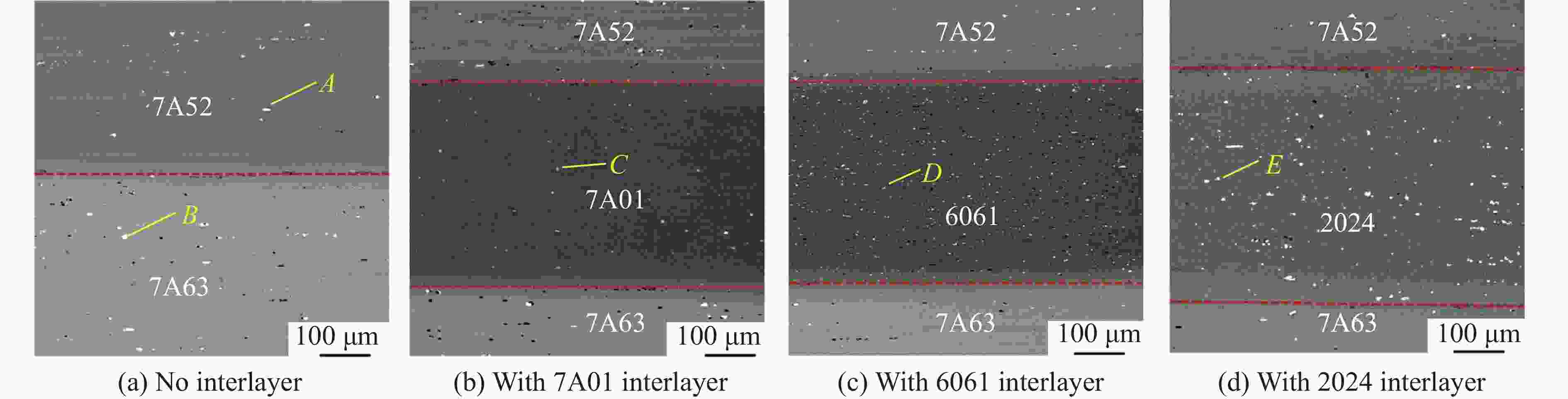
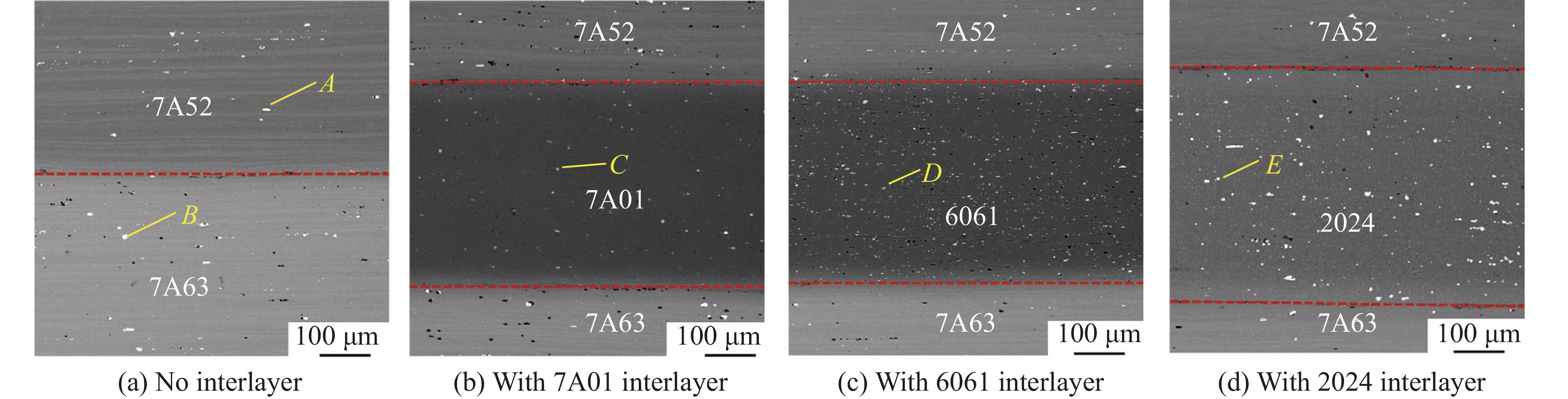
图 3 不同中间层的7B53铝合金复合板界面背散射电子图像
Figure 3. Backscattered electron (BSE) images of the interface of 7B53 aluminum alloy composite plates with different interlayers
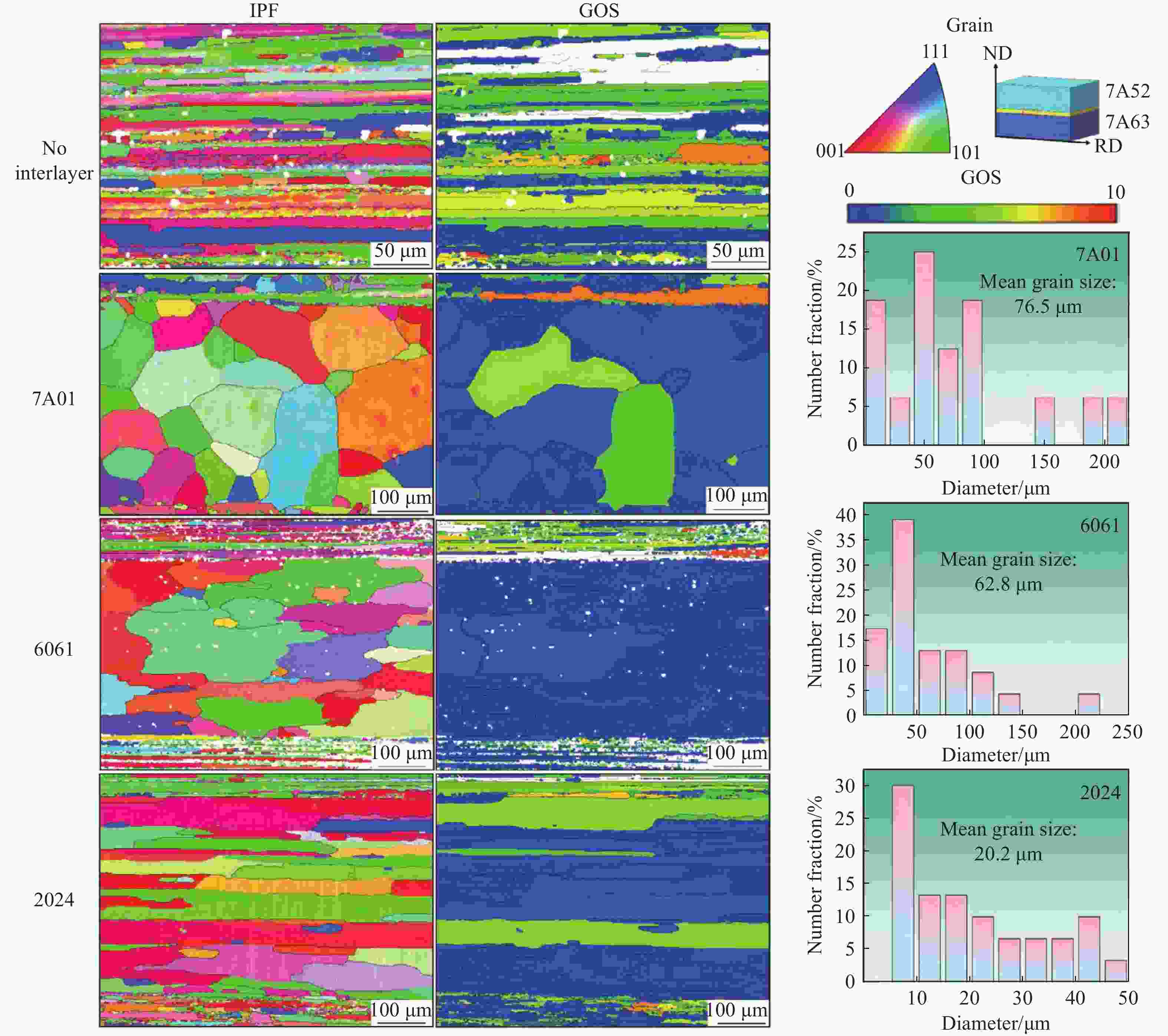
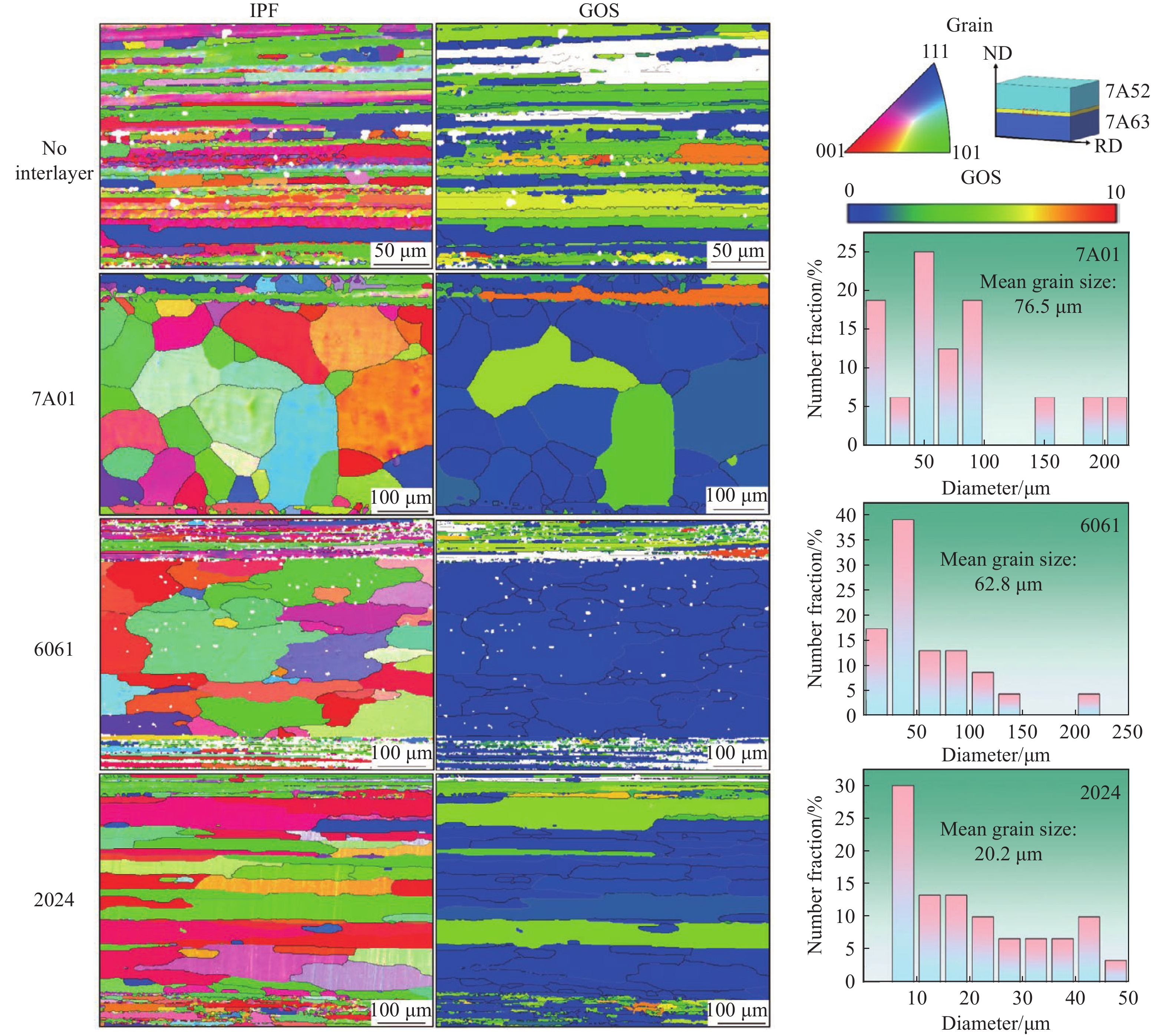
图 4 不同中间层的7B53铝合金复合板界面处的IPF、GOS图及晶粒尺寸分布
Figure 4. IPF, GOS maps and grain size distribution at the interface of 7B53 aluminum alloy composite plates with different interlayers

图 5 不同中间层的7B53复合板的拉伸剪切强度
Figure 5. Tensile-shear strength of 7B53 composite plates with different interlayers
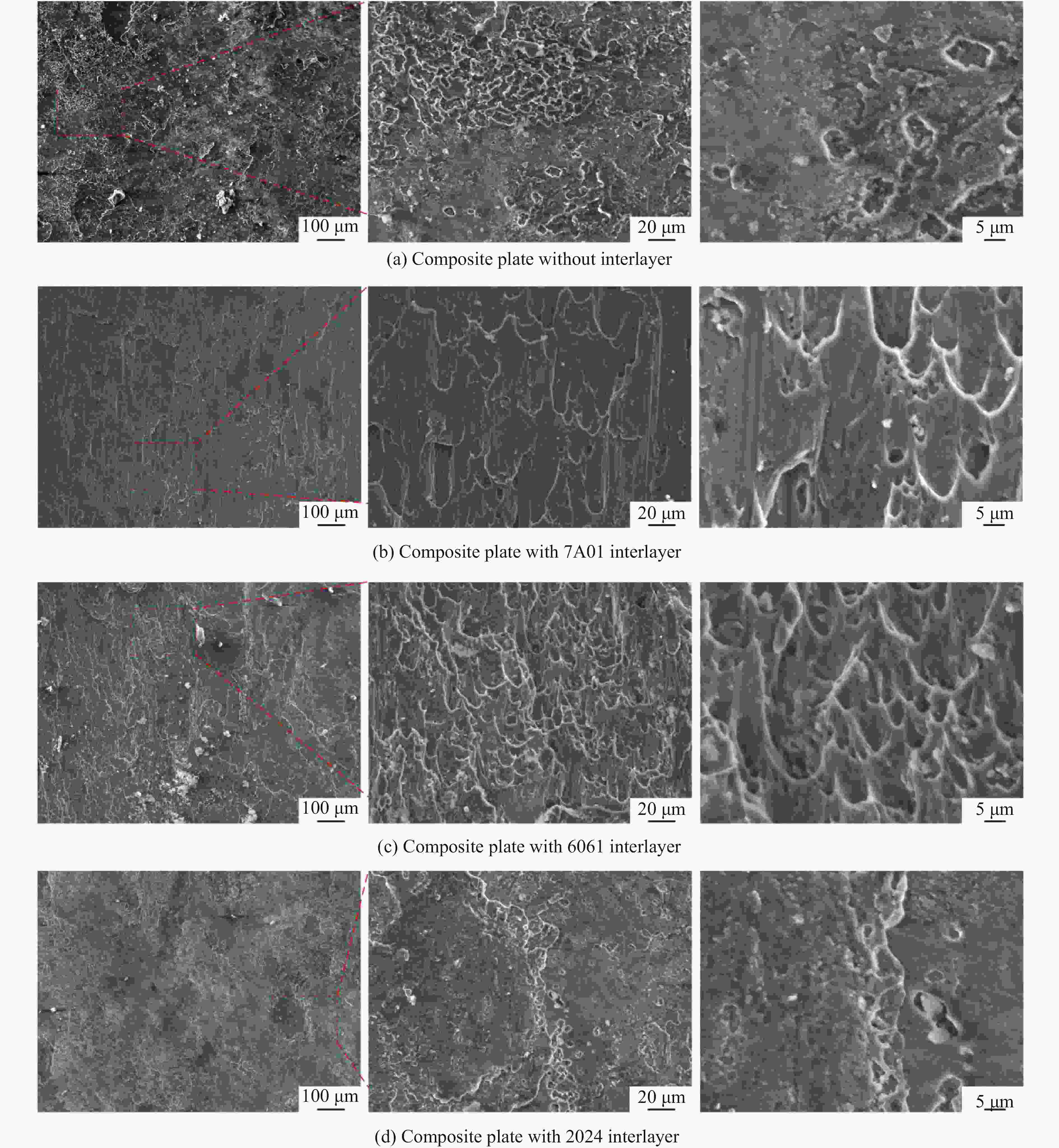
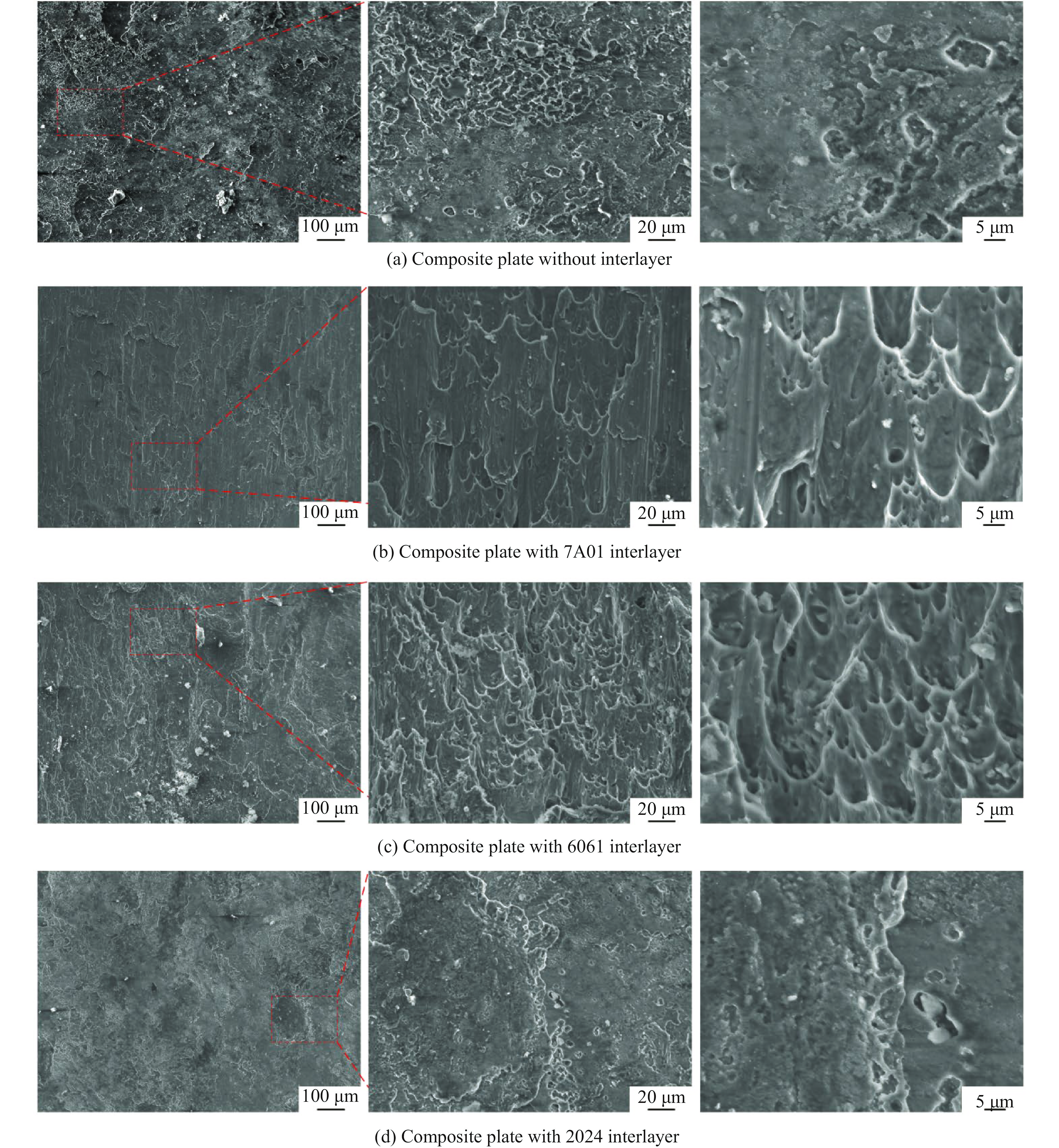
图 6 不同中间层的7B53复合板拉伸剪切7A63面断口形貌
Figure 6. Fracture morphologies of 7A63 surface in tensile shear test of 7B53 composite plates with different interlayers
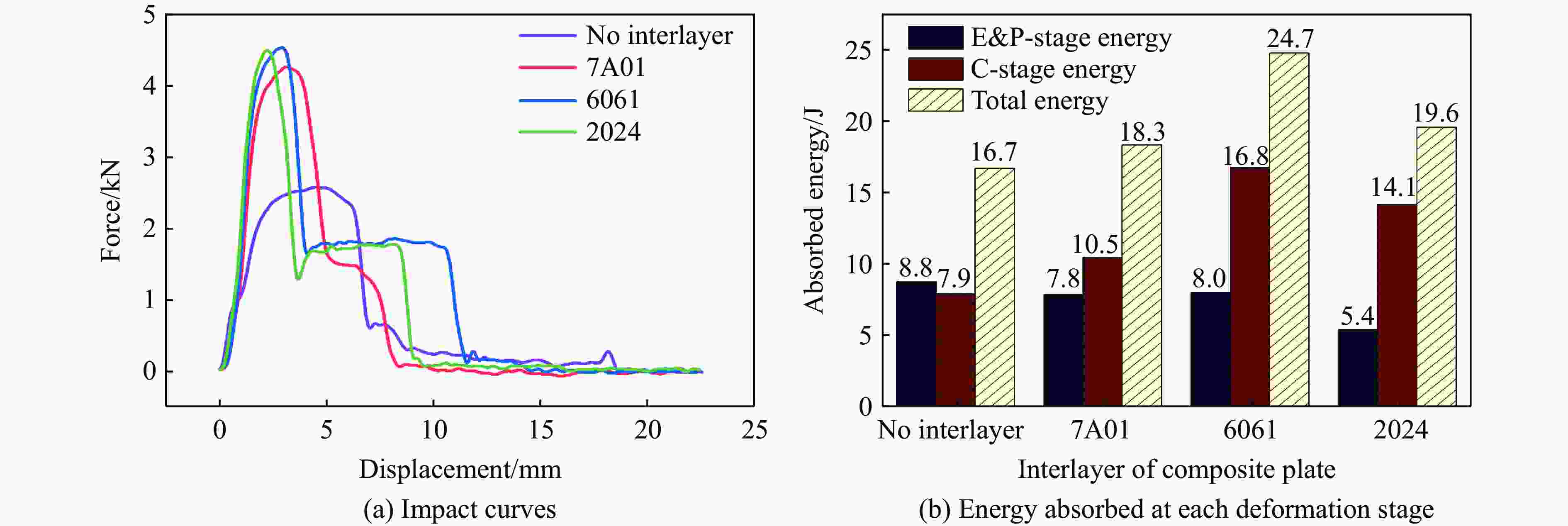
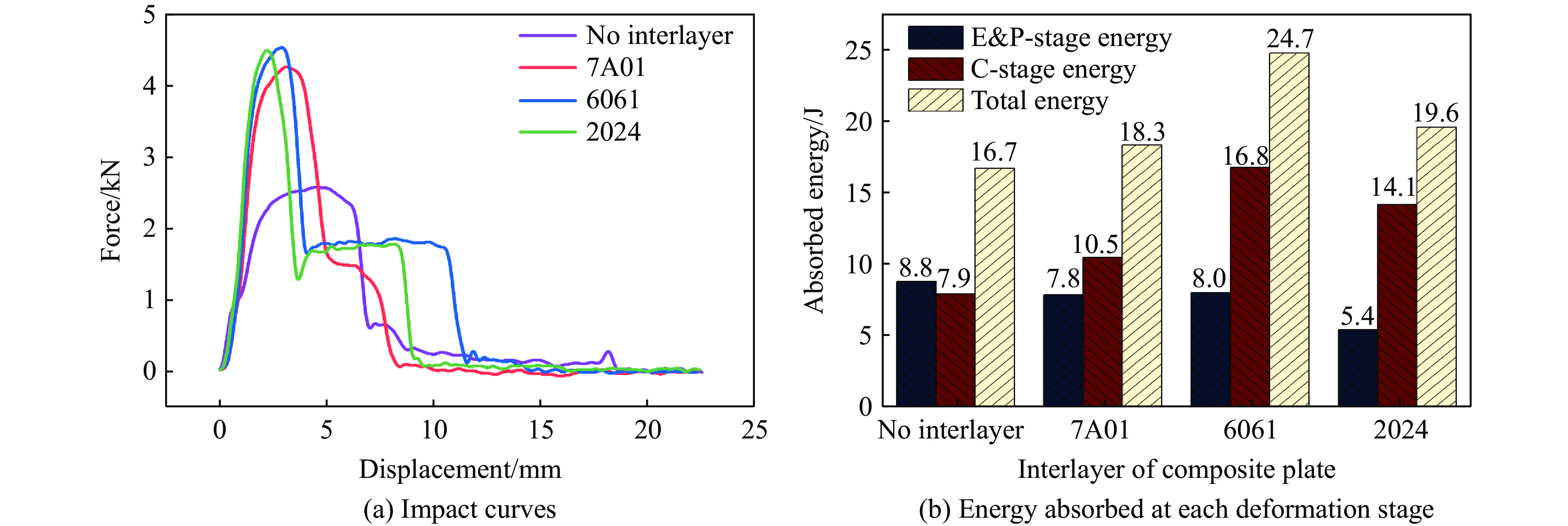
图 7 不同中间层的7B53铝合金复合板的冲击性能
Figure 7. Impact performance of 7B53 aluminum alloy composite plates with different interlayers
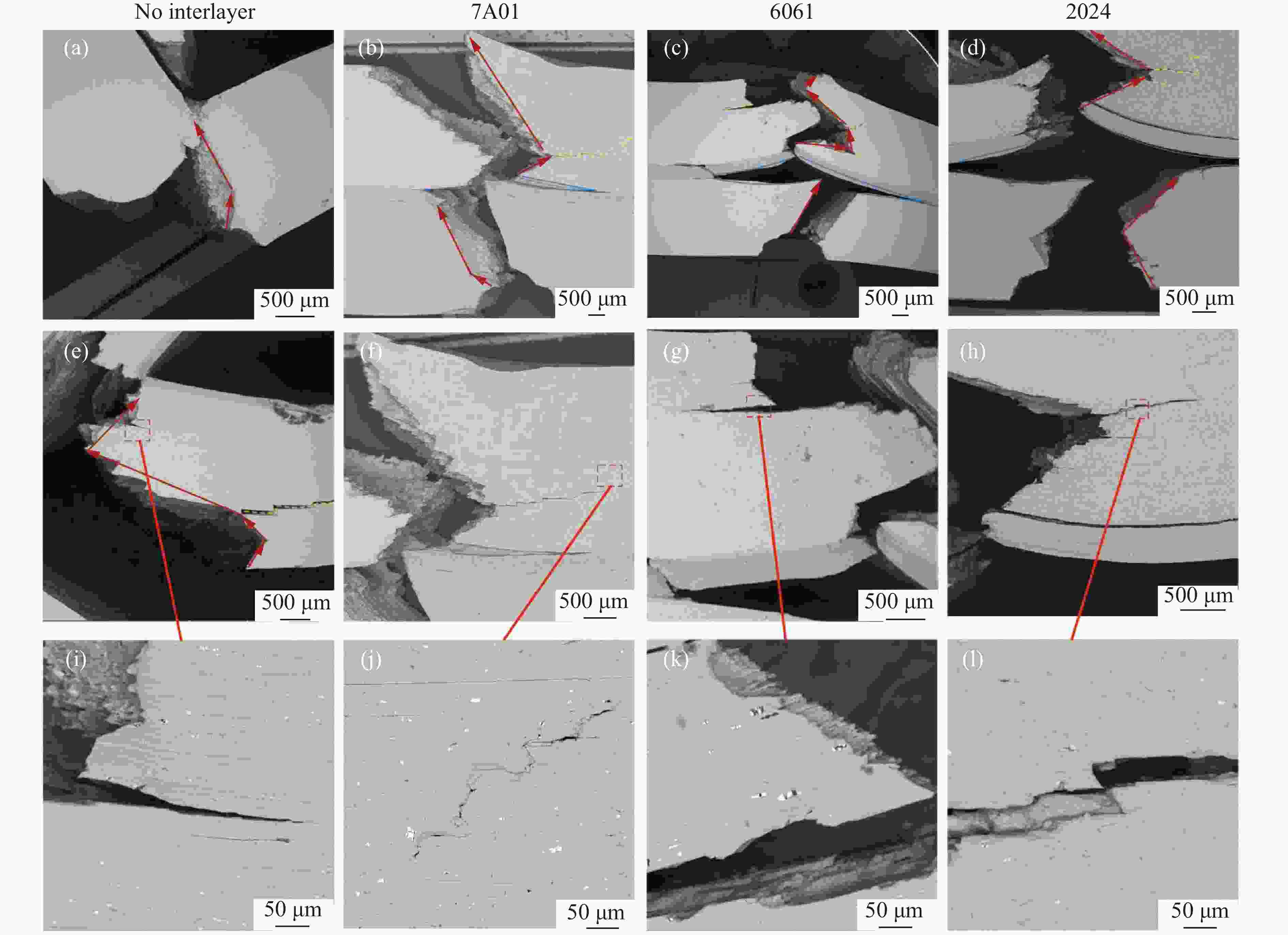
图 8 7B53铝合金复合板侧面冲击断口的SEM形貌:(a)~(d) 裂纹走向,(e)~(h) 7A63,(i)~(l) 7A63裂纹扩展(红色箭头为主裂纹扩展方向,蓝色实线为界面分层,黄色虚线为微裂纹)
Figure 8. SEM micrographs of lateral impact fracture surfaces of 7B53 aluminum alloy composite plates: (a)−(d) crack propagation direction; (e)−(h) 7A63; (i)−(l) crack propagation on the 7A63 surface (Red arrows indicate the main crack propagation direction, blue solid lines denote interfacial delamination, and yellow dashed lines represent microcracks)
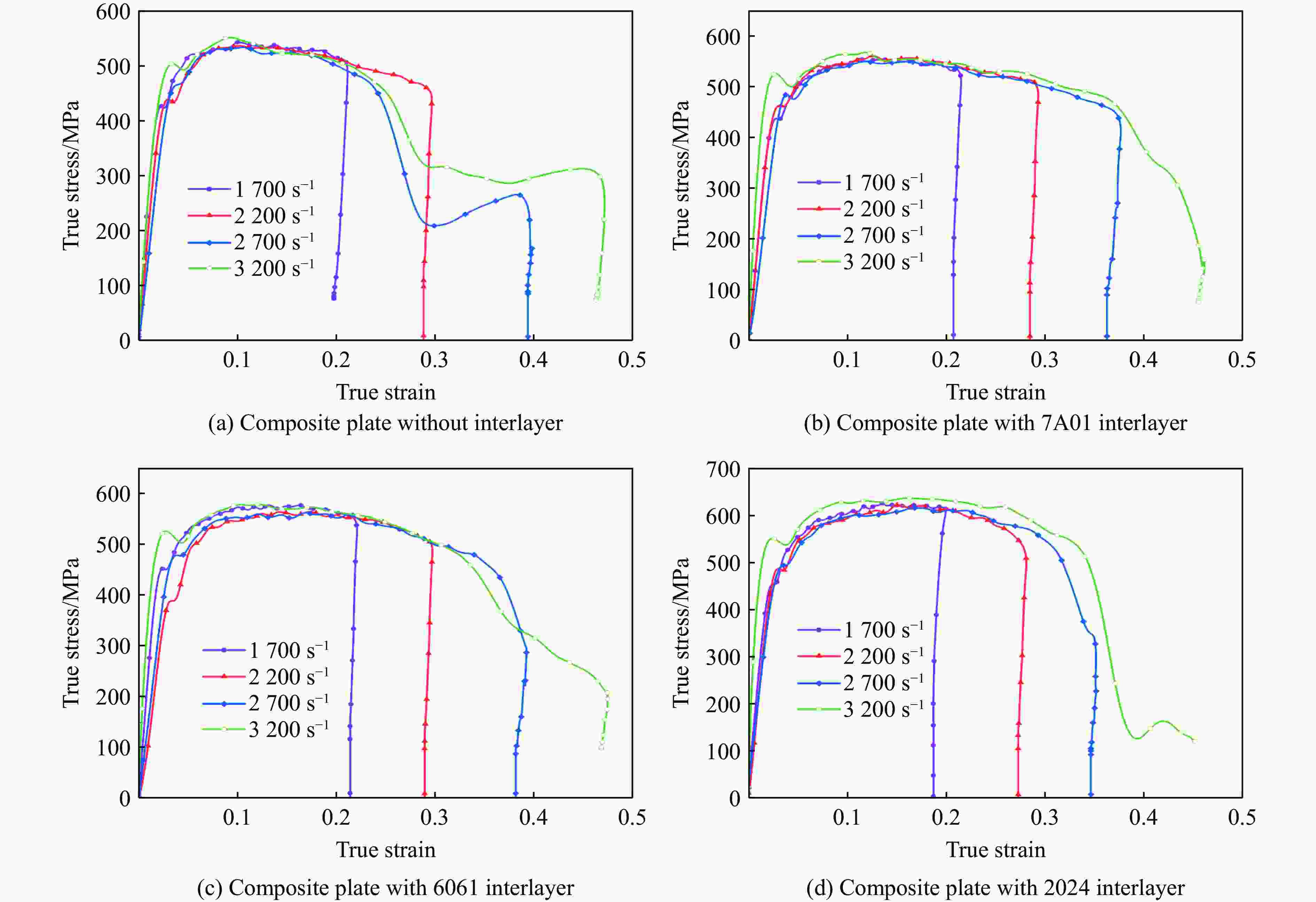
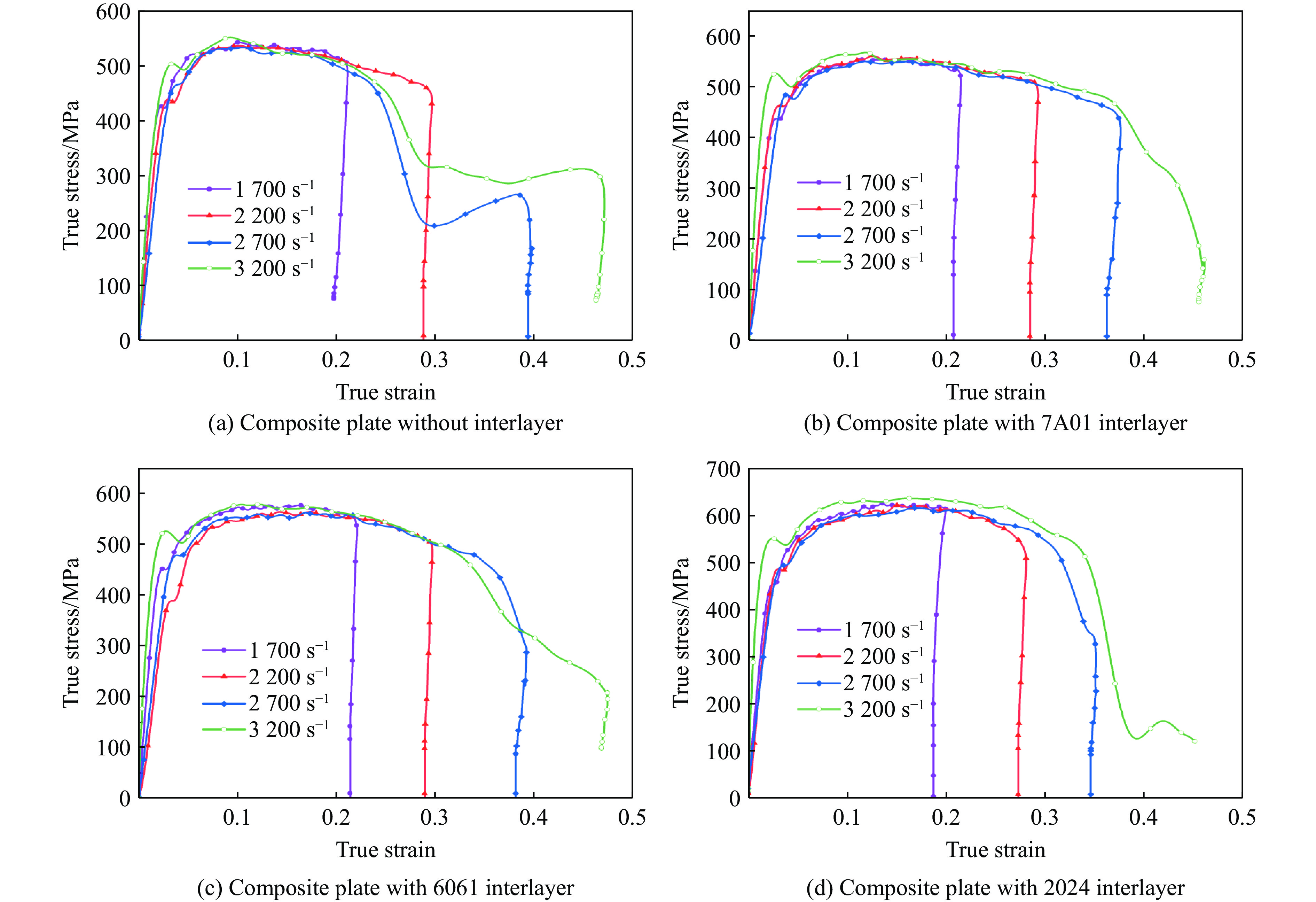
图 9 不同中间层的7B53复合板在各应变率下的真实应力-应变关系曲线
Figure 9. True stress-strain curves of 7B53 composite plates with different interlayers at various strain rates
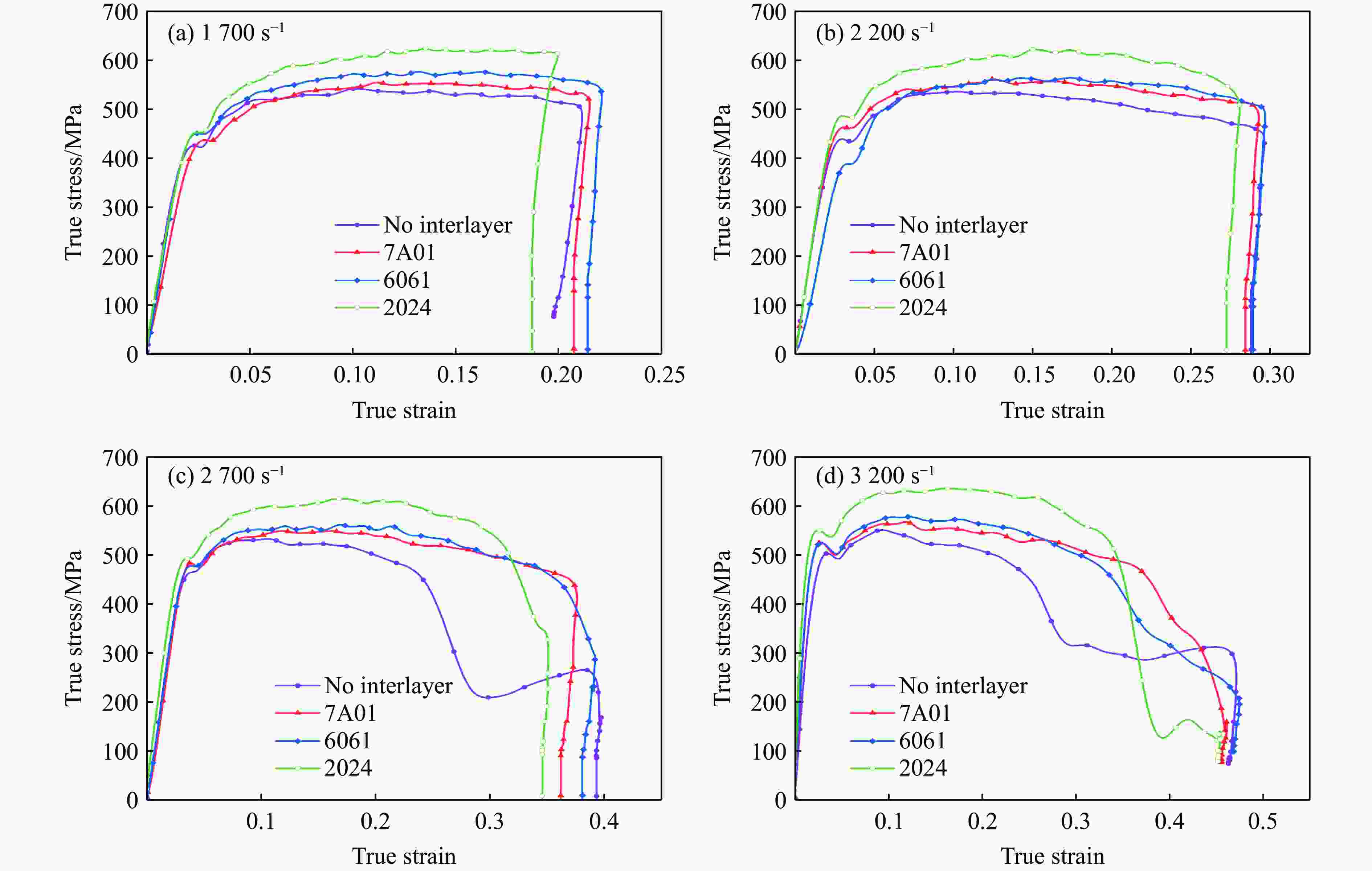
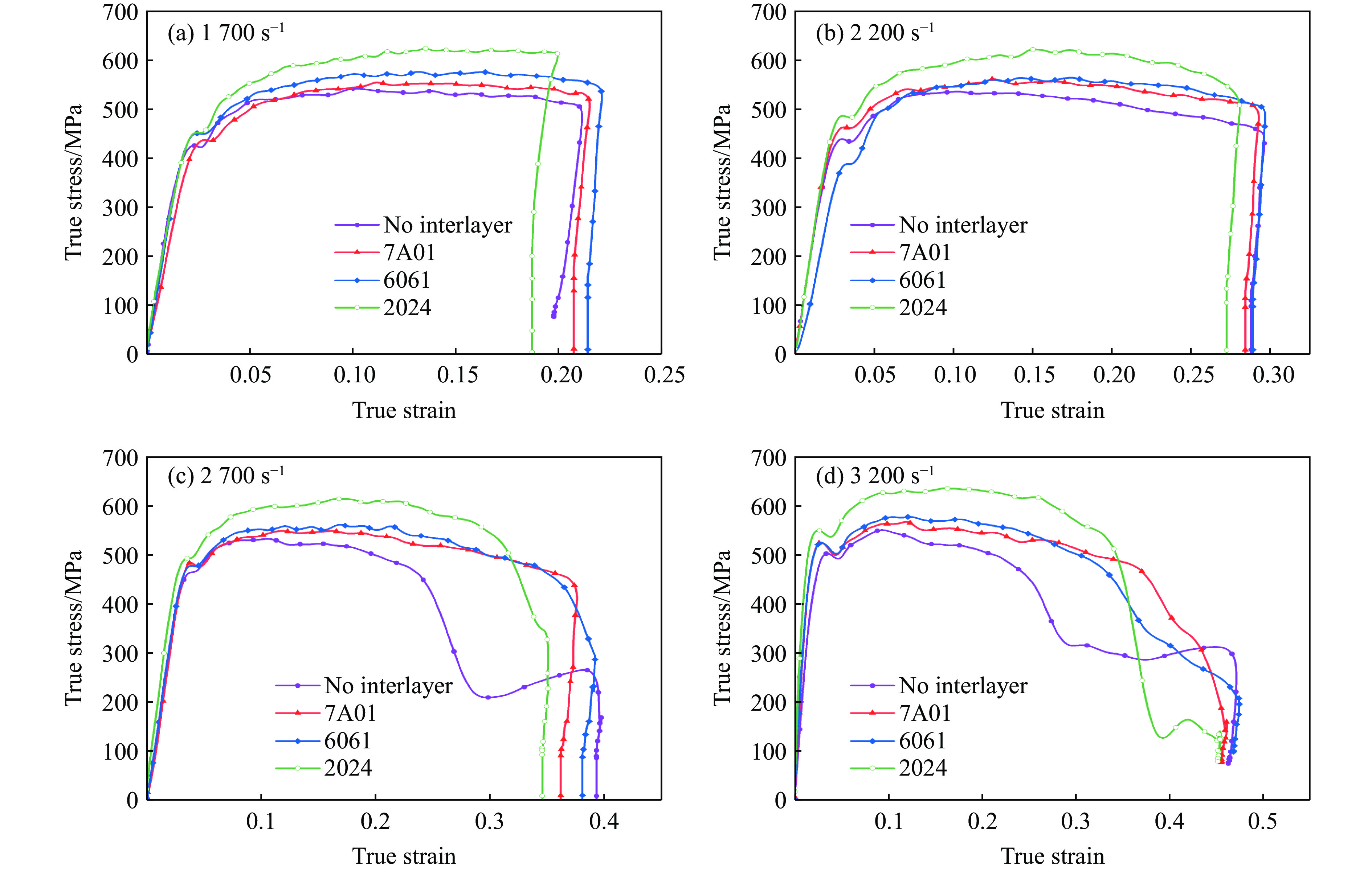
图 10 不同应变率下不同中间层7B53复合板的真实应力-应变关系曲线
Figure 10. True stress-strain curves of 7B53 composite plates with various interlayers at different strain rates

图 11 7A01中间层复合板经不同载荷高速冲击后的宏观特征
Figure 11. Macro-features of 7A01 interlayer composite plates after high-velocity impact under different loads
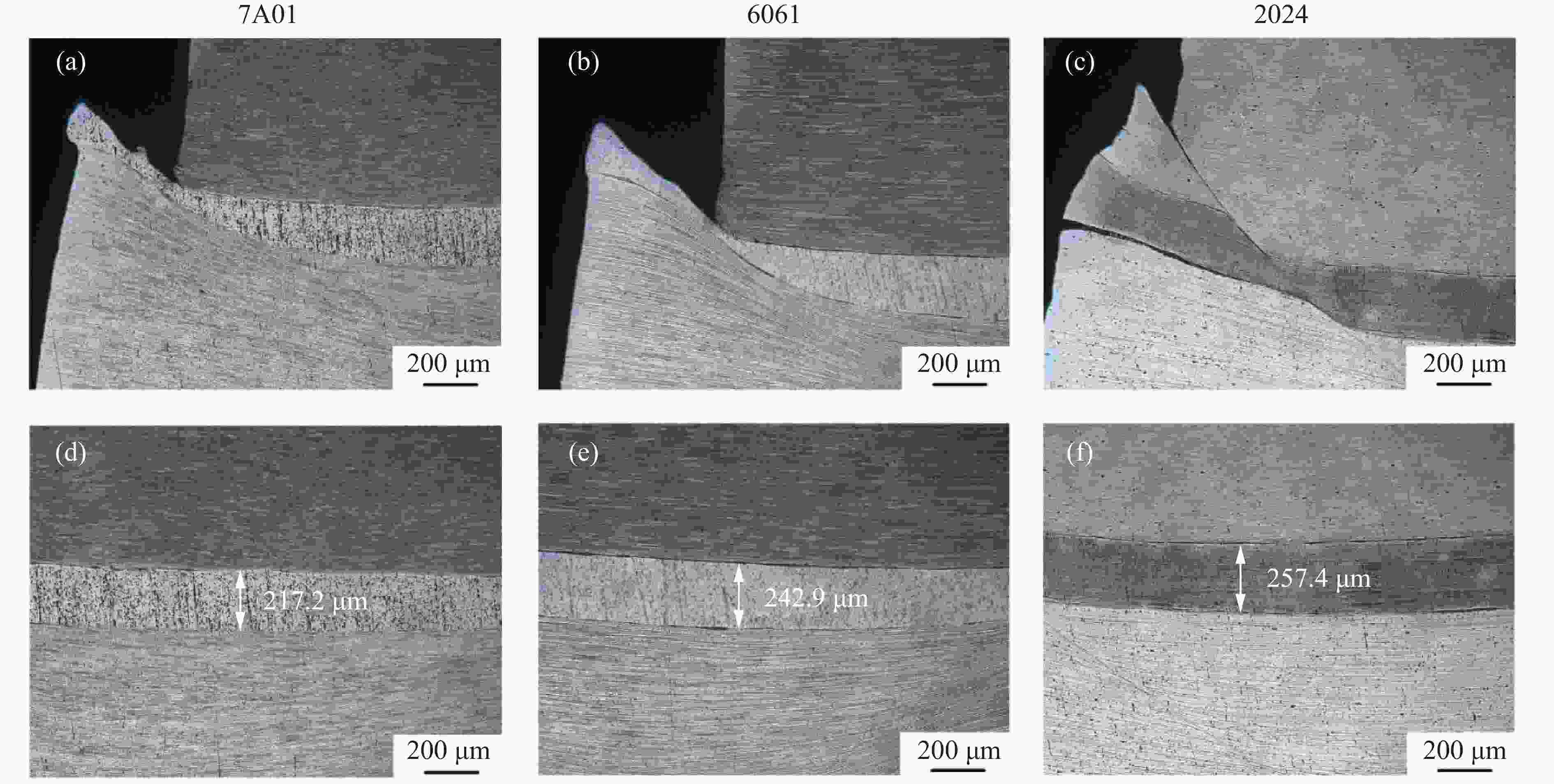
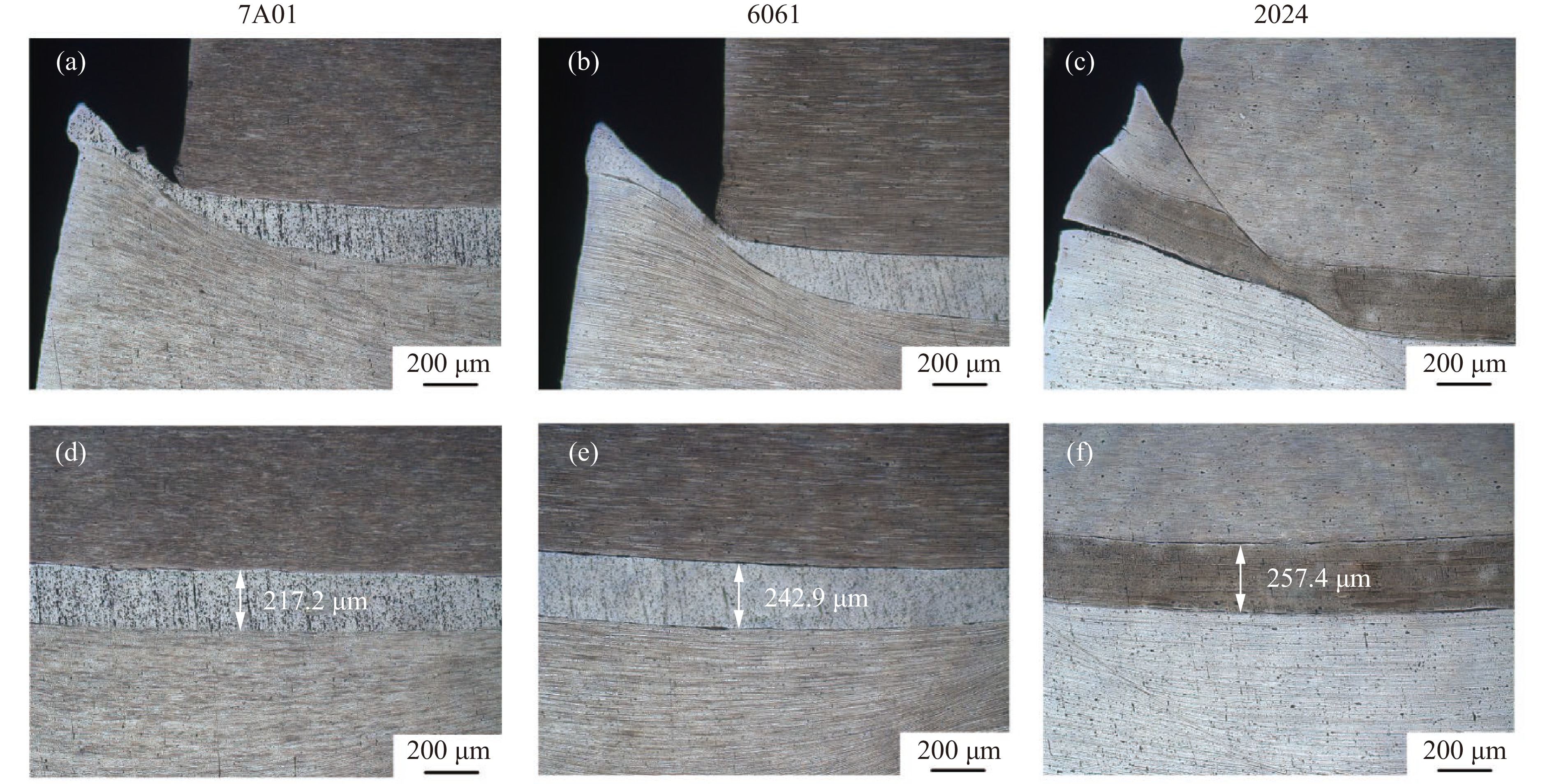
图 12 不同中间层的7B53铝合金复合板的微观组织:(a)~(c) 复合板角部,(d)~(f) 中间层界面
Figure 12. Microstructures of 7B53 aluminum alloy composite plates with different interlayers: (a)−(c) corner of composite plate; (d)−(f) interlayer interface
表 1 铝合金的化学成分(质量分数)
Table 1. Chemical compositions of aluminum alloy (mass fraction)
% Alloys Si Fe Cu Mn Mg Cr Zn Ti Al 7A52 0.25 0.30 0.05−0.20 0.20−0.50 2.0−2.8 0.15−0.25 4.0−4.8 0.05−0.18 Bal. 7A63 0.12 0.15 0.30−0.60 0.20−0.60 2.7−3.1 0.10−0.16 7.4−8.1 0.03−0.06 Bal. 7A01 0.30 0.30 0.01 0.025 0.03 0.03 0.9−1.3 0.03 Bal. 6061 0.61 0.25 0.31 0.11 1.07 0.21 0.17 0.03 Bal. 2024 0.50 0.50 3.98 0.61 1.72 0.01 0.30 0.15 Bal.  下载: 导出CSV
-
[1] ZHANG Z Q, ZHANG X K, HE D Y. Forming and warm die quenching process for AA7075 aluminum alloy and its application [J]. Journal of Materials Engineering and Performance, 2020, 29(1): 620–625. doi: 10.1007/s11665-019-04545-7 [2] ZHOU B, LIU B, ZHANG S G. The advancement of 7XXX series aluminum alloys for aircraft structures: a review [J]. Metals, 2021, 11(5): 718. doi: 10.3390/met11050718 [3] 李龙, 吕金明, 严安, 等. 铝合金装甲材料的应用及发展 [J]. 兵器材料科学与工程, 2017, 40(6): 105–113. doi: 10.14024/j.cnki.1004-244x.20171102.004LI L, LYU J M, YAN A, et al. Application and development of aluminum alloy armor materials [J]. Ordnance Material Science and Engineering, 2017, 40(6): 105–113. doi: 10.14024/j.cnki.1004-244x.20171102.004 [4] HUANG X L, ZHANG W, DENG Y F, et al. Experimental investigation on the ballistic resistance of polymer-aluminum laminated plates [J]. International Journal of Impact Engineering, 2018, 113: 212–221. doi: 10.1016/j.ijimpeng.2017.12.002 [5] GAO K, ZHANG X, LIU B X, et al. The deformation characteristics, fracture behavior and strengthening-toughening mechanisms of laminated metal composites: a review [J]. Metals, 2020, 10(1): 4. doi: 10.3390/met10010004 [6] MIN F L, GAO K Y, ZHOU D J, et al. Dynamic failure behavior of 7B52 laminated aluminum alloy subjected to deformable projectile impact [J]. Engineering Failure Analysis, 2024, 162: 108348. doi: 10.1016/j.engfailanal.2024.108348 [7] TENG X, WIERZBICKI T, HUANG M. Ballistic resistance of double-layered armor plates [J]. International Journal of Impact Engineering, 2008, 35(8): 870–884. doi: 10.1016/j.ijimpeng.2008.01.008 [8] YU C, ZHANG W Z, JIANG R W, et al. Preparation method and properties of Q235/5083 composite plate with 1060 interlayer by differential temperature rolling with induction heating [J]. Metals, 2023, 13(9): 1501. doi: 10.3390/met13091501 [9] SONG Y F, WANG L J, CHEN Y Q, et al. Enhancing the strength and plasticity of laminated aluminum alloy by introducing micron-scale pure aluminum interlayers [J]. International Journal of Plasticity, 2026, 197: 104601. doi: 10.1016/j.ijplas.2025.104601 [10] DAI G, LIU Y M, CHEN K, et al. Effect of cumulative deformation and interlayer mechanical properties on bonding strength of corrugated interface steel/aluminum composite plate [J]. Journal of Manufacturing Processes, 2023, 103: 78–89. doi: 10.1016/j.jmapro.2023.08.028 [11] LIU W H, CAO P, ZHAO C B, et al. Effect of temperature and strain rate on deformation mode and crack behavior of 7B52 laminated aluminum alloy under impact loading [J]. Metals and Materials International, 2021, 27(11): 4397–4407. doi: 10.1007/s12540-020-00853-z [12] ZHU G C, HUANG S H, LI X W, et al. Macro-micro dynamic behaviors and fracture modes of roll bonded 7A52/7A01/7B52 aluminum laminates in high velocity deformation [J]. Progress in Natural Science: Materials International, 2018, 28(4): 510–519. doi: 10.1016/j.pnsc.2018.06.004 [13] 佟有志, 祝国川, 李明原, 等. 7B52铝合金动态力学性能及断裂行为研究 [J]. 铝加工, 2018(4): 39–44. doi: 10.3969/j.issn.1005-4898.2018.04.09TONG Y Z, ZHU G C, LI M Y, et al. Research on dynamic mechanical properties and fracture behavior of 7B52 aluminum alloy [J]. Aluminium Fabrication, 2018(4): 39–44. doi: 10.3969/j.issn.1005-4898.2018.04.09 [14] 周古昕, 郎玉婧, 杜秀征, 等. 高强7A62铝合金动态力学响应及其J-C本构关系 [J]. 中国有色金属学报, 2021, 31(1): 21–29. doi: 10.11817/j.ysxb.1004.0609.2021-37765ZHOU G X, LANG Y J, DU X Z, et al. Dynamic mechanical response and J-C constitutive equation of high strength 7A62 aluminum alloy [J]. The Chinese Journal of Nonferrous Metals, 2021, 31(1): 21–29. doi: 10.11817/j.ysxb.1004.0609.2021-37765 [15] 冯治建, 胡孟磊, 张雪峰. 6061铝合金的静动态力学性能和弹道行为 [J]. 高压物理学报, 2026, 40(3): 034101. doi: 10.11858/gywlxb.20251108FENG Z J, HU M L, ZHANG X F. Static and dynamic mechanical properties and ballistic behavior of 6061 aluminum alloy [J]. Chinese Journal of High Pressure Physics, 2026, 40(3): 034101. doi: 10.11858/gywlxb.20251108 [16] 贾翠玲, 陈芙蓉. 7A52铝合金Johnson-Cook本构模型的有限元模拟 [J]. 兵器材料科学与工程, 2018, 41(1): 30–33. doi: 10.14024/j.cnki.1004-244x.20180105.001JIA C L, CHEN F R. Finite element simulation of Johnson-Cook constitutive model for 7A52 aluminum alloy [J]. Ordnance Material Science and Engineering, 2018, 41(1): 30–33. doi: 10.14024/j.cnki.1004-244x.20180105.001 [17] DING X F, XIAO M Y, LIU W H, et al. Macro-micro-nonuniform deformation behavior of 7B52 laminated aluminum alloy under high-speed impact [J]. Journal of Materials Engineering and Performance, 2023, 32(4): 1508–1514. doi: 10.1007/s11665-022-07214-4 [18] 祝国川, 熊柏青, 佟有志, 等. 固溶处理对7B52铝合金板材力学性能和断裂行为的影响 [J]. 中国有色金属学报, 2017, 27(5): 877–884. doi: 10.19476/j.ysxb.1004.0609.2017.05.001ZHU G C, XIONG B Q, TONG Y Z, et al. Effect of solution treatment on mechanical properties and fracture behavior of 7B52 aluminum alloy plate [J]. The Chinese Journal of Nonferrous Metals, 2017, 27(5): 877–884. doi: 10.19476/j.ysxb.1004.0609.2017.05.001 [19] ZOU S Z, GAO Y T, YANG Z R, et al. Development of the split-hopkinson pressure bar and its application in testing the dynamic mechanical properties of quasi-brittle materials: a review [J]. Journal of Materials Research and Technology, 2024, 33: 9463–9483. doi: 10.1016/j.jmrt.2024.11.244 [20] LIU W H, YUE X M, HU Q, et al. Effects of recrystallization and element diffusion behavior on interfacial bonding quality and mechanical properties of aluminum laminated composites [J]. Journal of Alloys and Compounds, 2024, 985: 174045. doi: 10.1016/j.jallcom.2024.174045 [21] CHEN Z J, LU G M, ZHOU D Y, et al. Effects of the number of layers and thickness ratio on the impact fracture behavior of AA6061/AA7075 laminated metal composites [J]. Crystals, 2023, 14(1): 44. doi: 10.3390/cryst14010044 [22] 张延泽, 秦健, 孟祥尧, 等. 高温高应变率下ZL101A铝合金的流变应力特征与本构模型 [J]. 高压物理学报, 2022, 36(3): 034105. doi: 10.11858/gywlxb.20210923ZHANG Y Z, QIN J, MENG X Y, et al. Flow stress characteristics and constitutive model of ZL101A aluminum alloy under high temperature and high strain rate [J]. Chinese Journal of High Pressure Physics, 2022, 36(3): 034105. doi: 10.11858/gywlxb.20210923 [23] 高志国, 张新明, 陈明安, 等. 温度对2519A铝合金高应变速率下动态屈服应力及显微组织的影响 [J]. 稀有金属材料与工程, 2009, 38(5): 881–886. doi: 10.3321/j.issn:1002-185X.2009.05.029GAO Z G, ZHANG X M, CHEN M A, et al. Effect of temperature on dynamic yield stress and microstructure of 2519A aluminum alloy at high strain rate [J]. Rare Metal Materials and Engineering, 2009, 38(5): 881–886. doi: 10.3321/j.issn:1002-185X.2009.05.029 [24] LI S X, WU J Q, CHEN X R, et al. Two-stage work-hardening of a transformable B2-enhanced metallic glass composite by molecular dynamics simulation [J]. Composites Communications, 2024, 51: 102045. doi: 10.1016/j.coco.2024.102045 [25] ZHANG W L, HE L J, LU Z G, et al. Microstructural characteristics and formation mechanism of adiabatic shear bands in Al-Zn-Mg-Cu alloy under dynamic shear loading [J]. Materials Science and Engineering: A, 2020, 791: 139430. doi: 10.1016/j.msea.2020.139430 -

 下载:
下载:





计量
- 文章访问数: 545
- HTML全文浏览量: 232
- PDF下载量: 54
