





Formation Mechanism of Ceramic Cones in Boron Carbide Ceramic Composite Targets with Different Backplates under High-Velocity Impact
-
摘要: 陶瓷锥是轻型陶瓷复合装甲实现抗弹侵彻能量耗散的关键物理机制。为此,针对碳化硼陶瓷复合装甲,选取6061铝合金、7075铝合金、T300碳纤维板及超高分子量聚乙烯板(ultra-high molecular weight polyethylene, UHMWPE)4种典型背板材料,采用一级轻气炮弹道冲击实验与LS-DYNA数值模拟相结合的方法,系统研究了背板屈服强度、刚度及波阻抗对陶瓷锥形态及演化的影响规律。结果表明:陶瓷锥对背板的载荷传递并非仅依赖单一外锥,而是通过外锥与内锥等多条裂纹的共同作用实现;背板的屈服强度对主要锥形的裂纹扩展无明显影响;在刚度方面,外锥角随弹性模量的增加而线性减小,内锥角则呈指数增大;波阻抗通过调控应力波反射/透射改变陶瓷内部应力场变化,致使内锥角随着波阻抗的增加呈线性增大,外锥角则随之呈指数减小。Abstract: To investigate the influence of backplate mechanical properties on the formation mechanism of ceramic cones in boron carbide ceramic composite armor, four typical backplate materials, including 6061 aluminum alloy, 7075 aluminum alloy, T300 carbon fiber board, and ultra-high molecular weight polyethylene (UHMWPE) were selected. A combination of ballistic impact experiments conducted via a one-stage light gas gun and numerical simulations performed with LS-DYNA was adopted to systematically study the effects of backplate yield strength, stiffness, and wave impedance on the morphology and evolution of ceramic cones. The results indicate that: the load transfer from the ceramic cone to the backplate is not solely dependent on a single outer cone but is achieved through the synergistic action of multiple cracks, including the outer and inner cones; the yield strength of the backplate has no significant effect on the crack propagation of the main cone; regarding stiffness, the outer cone angle decreases linearly with increasing elastic modulus, while the inner cone angle increases exponentially; wave impedance alters the internal stress field of the ceramic by modulating stress wave reflection/transmission, resulting in a linear increase in the inner cone angle and an exponential decrease in the outer cone angle with increasing impedance.
-
Key words:
- ceramic cone /
- boron carbide /
- ceramic composite armor /
- high-velocity impact /
- penetration
-
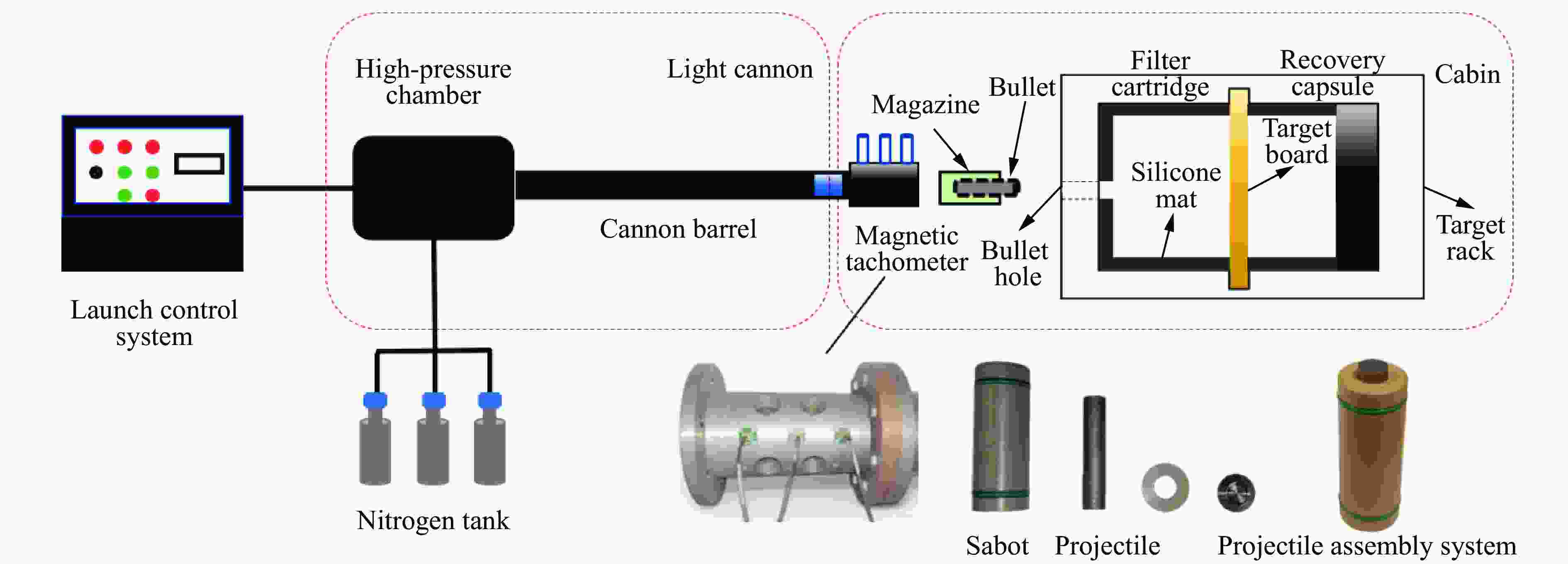
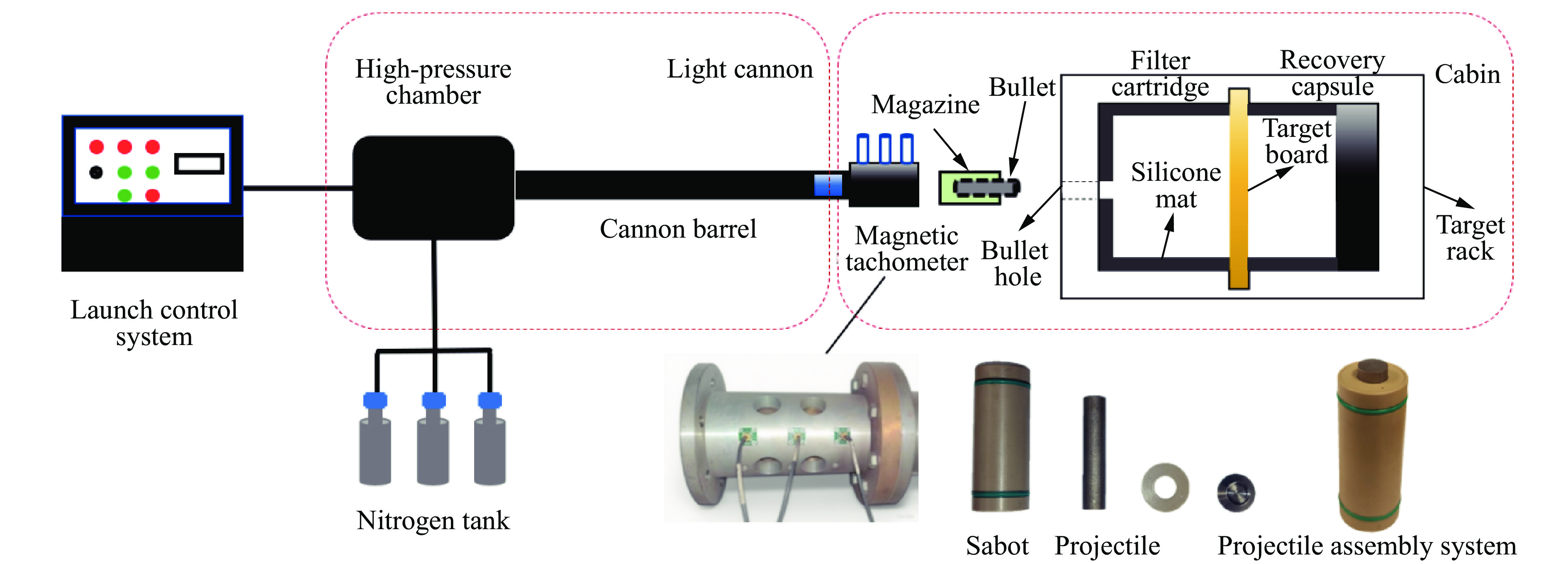
图 2 弹靶侵彻实验装置示意图
Figure 2. Schematic diagram of the projectile-target penetration experimental setup
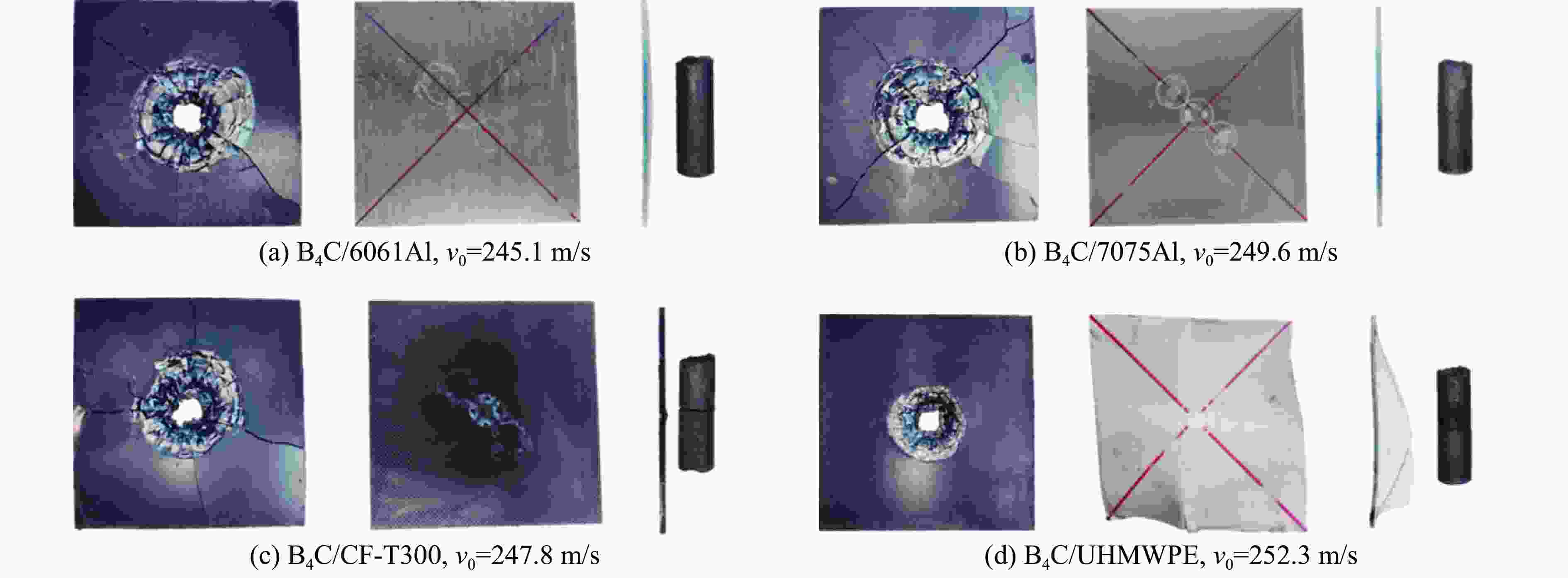
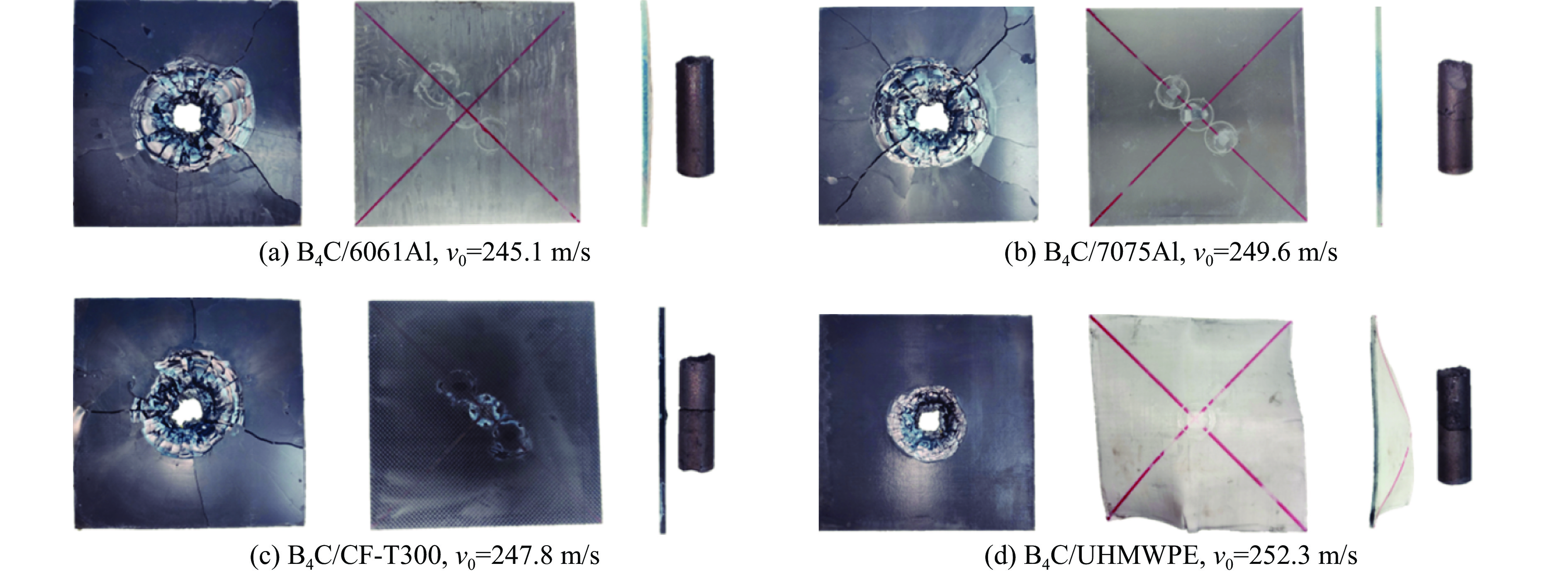
图 3 回收靶板与剩余弹体的照片
Figure 3. Photographs of the recovered target plate and residual projectile
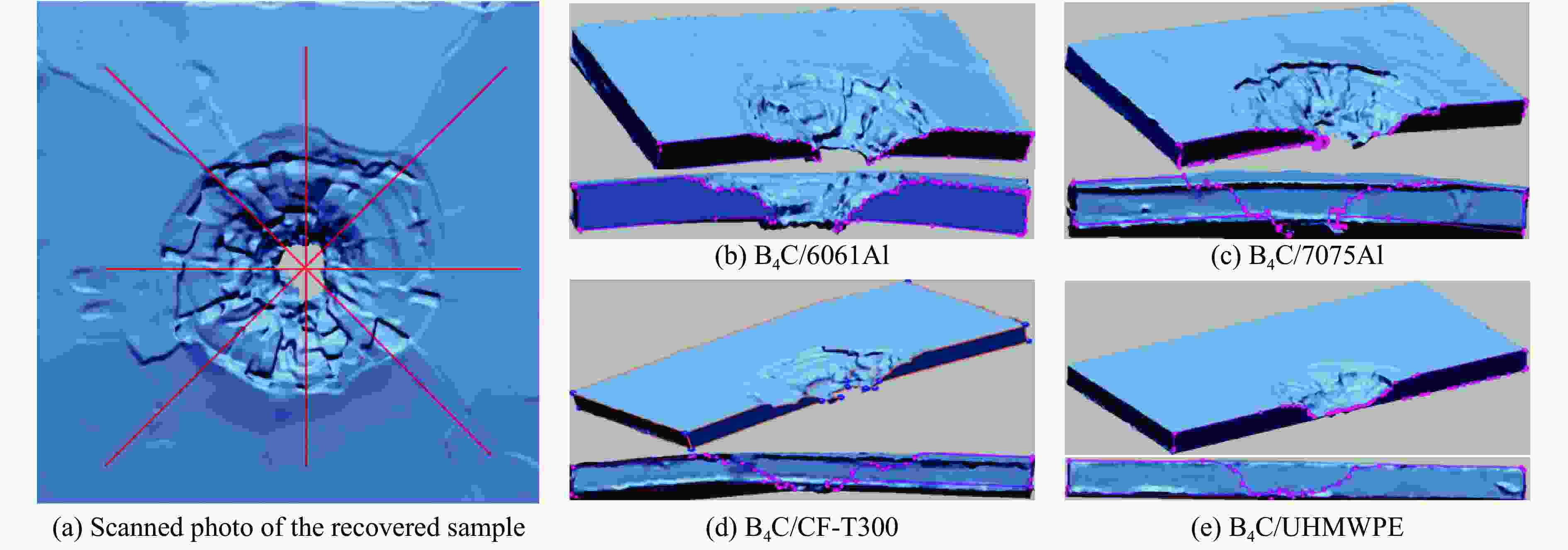
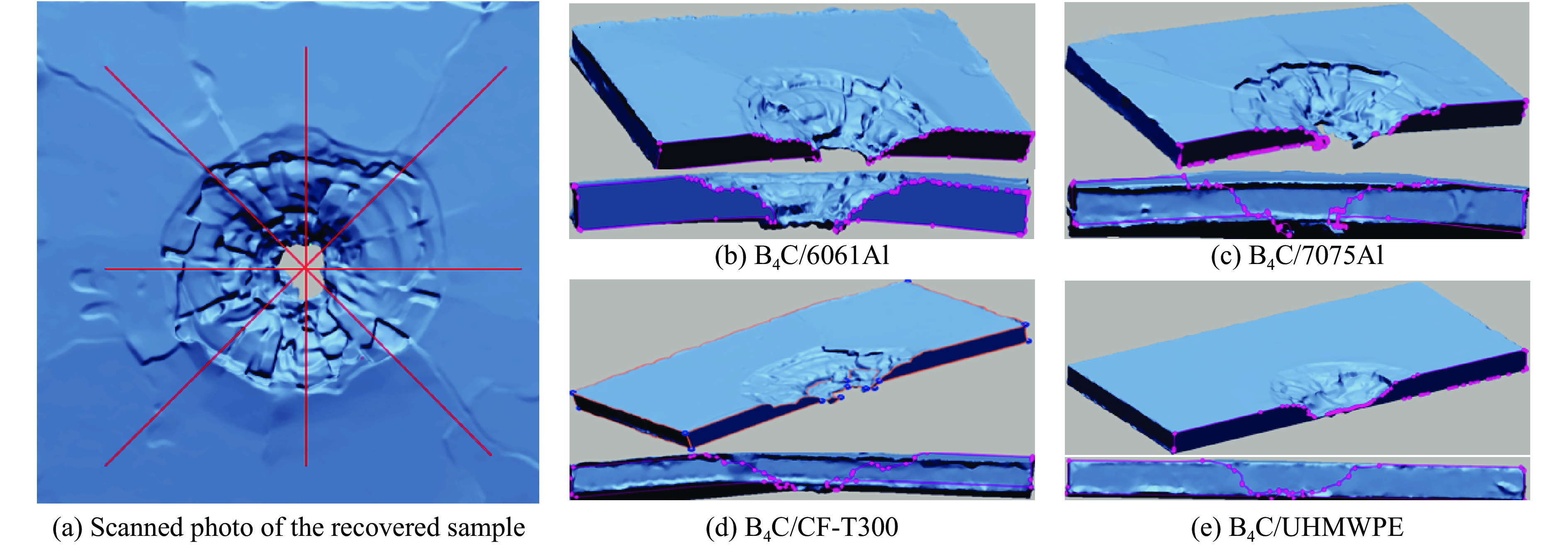
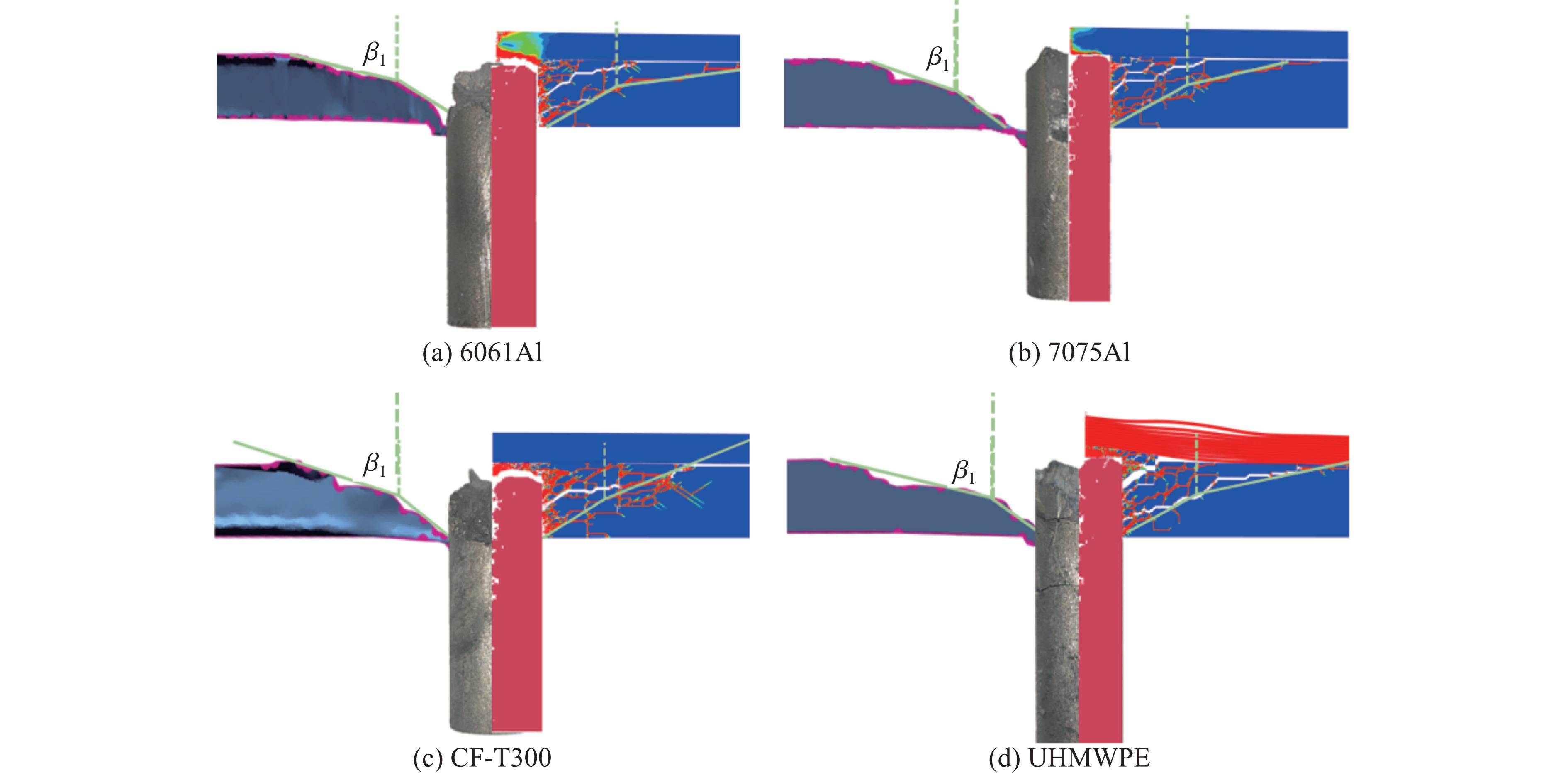
图 4 不同背板条件下碳化硼陶瓷复合靶板的三维锥体重构断裂面
Figure 4. Fracture surfaces of 3D reconstructed cones of boron carbide ceramic composite target plates under different backplate conditions
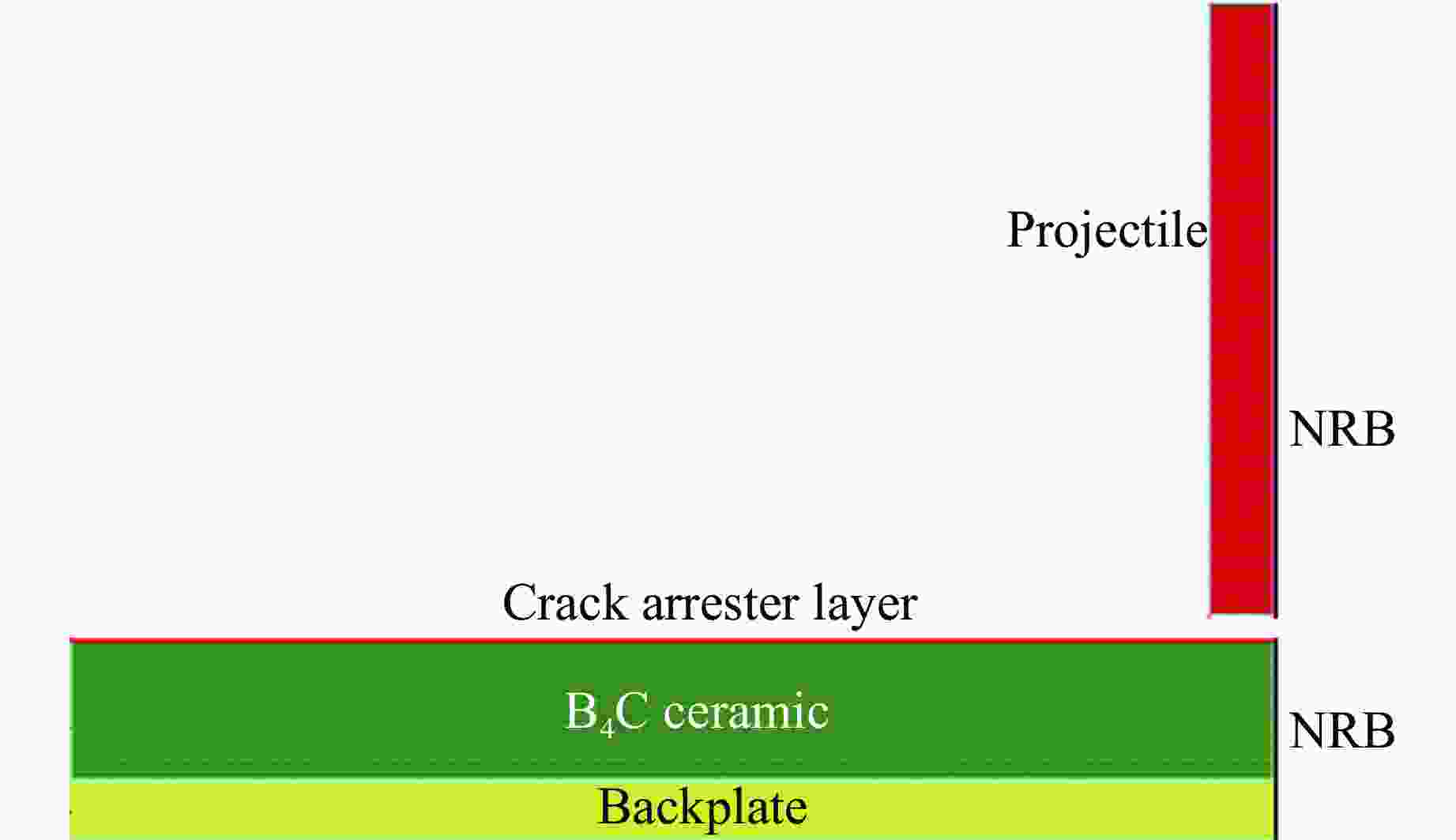
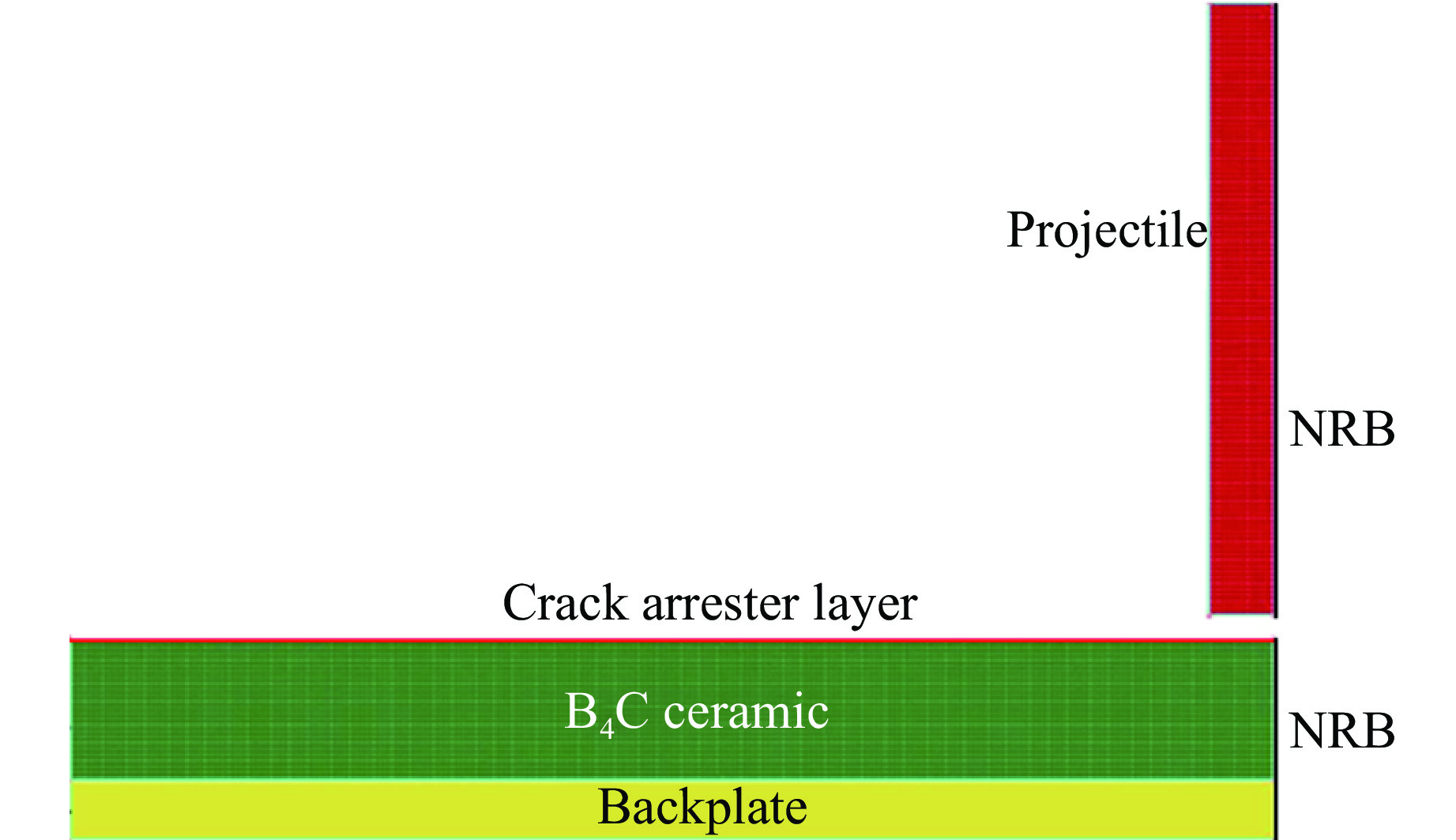
图 5 弹道冲击模拟的数值模型示意图
Figure 5. Schematic diagram of the ballistic impact simulation model
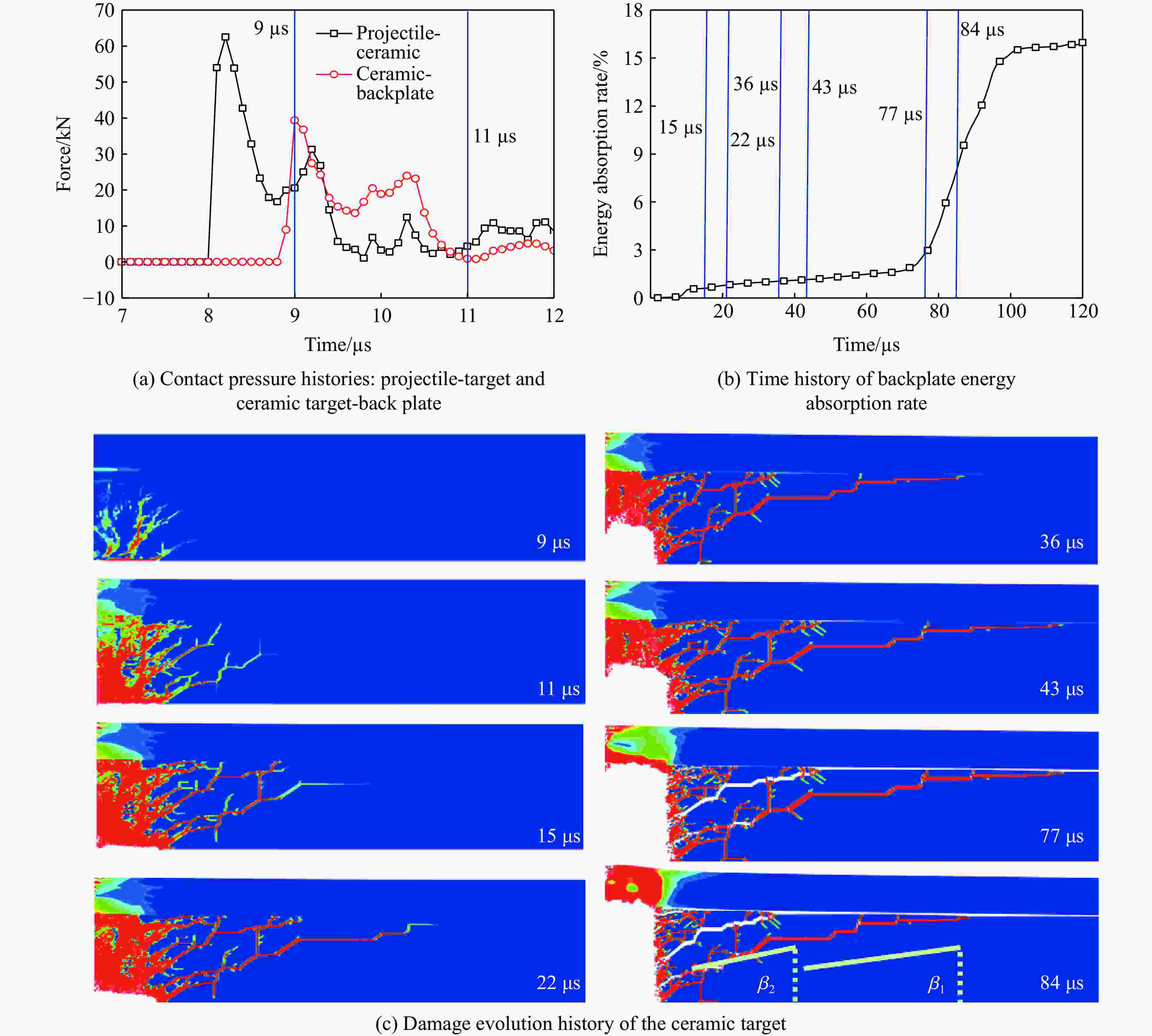
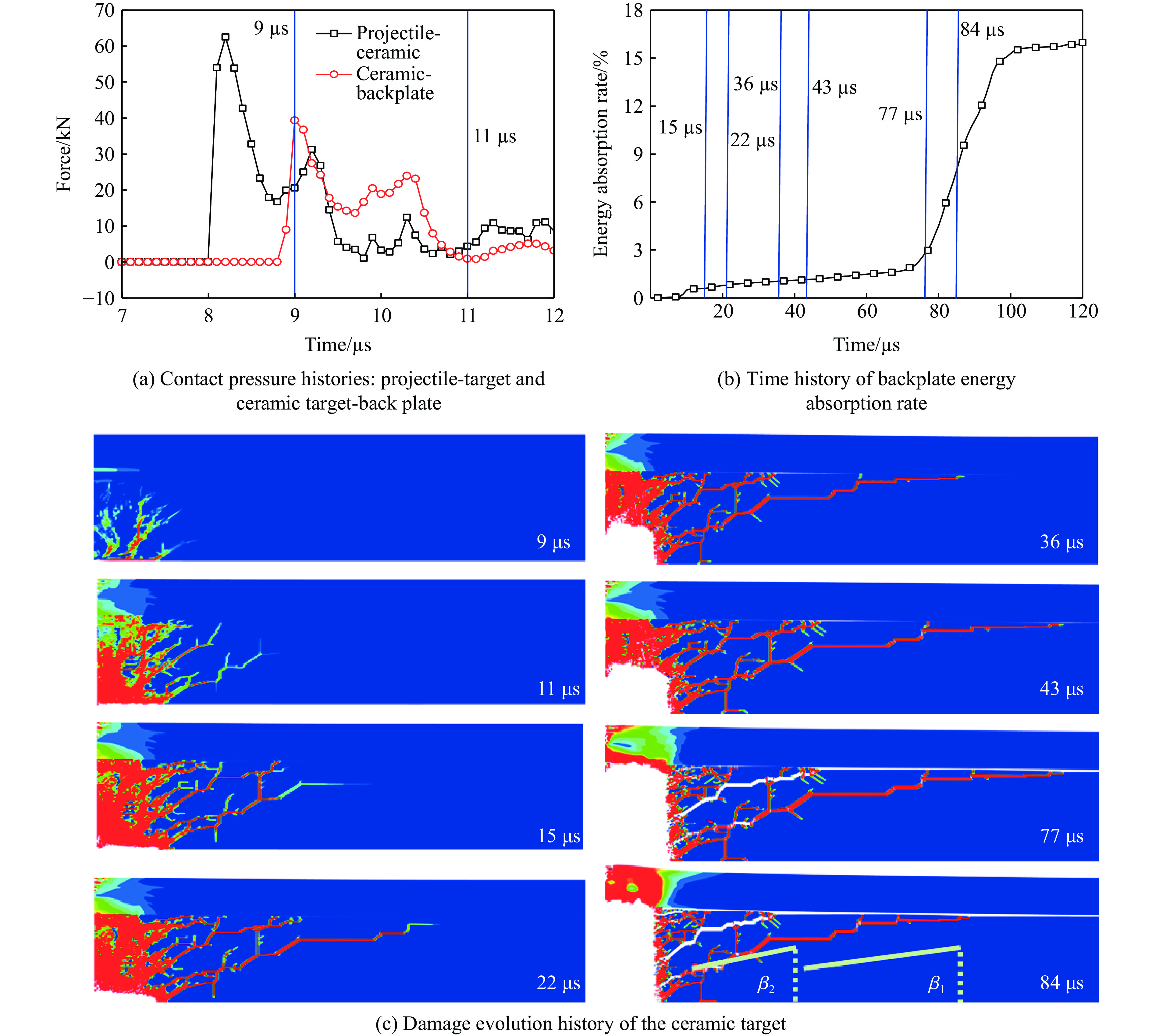
图 7 6061铝合金/碳化硼陶瓷复合靶板的冲击响应
Figure 7. Impact response of a boron carbide ceramic composite target with a 6061 aluminum alloy backplate
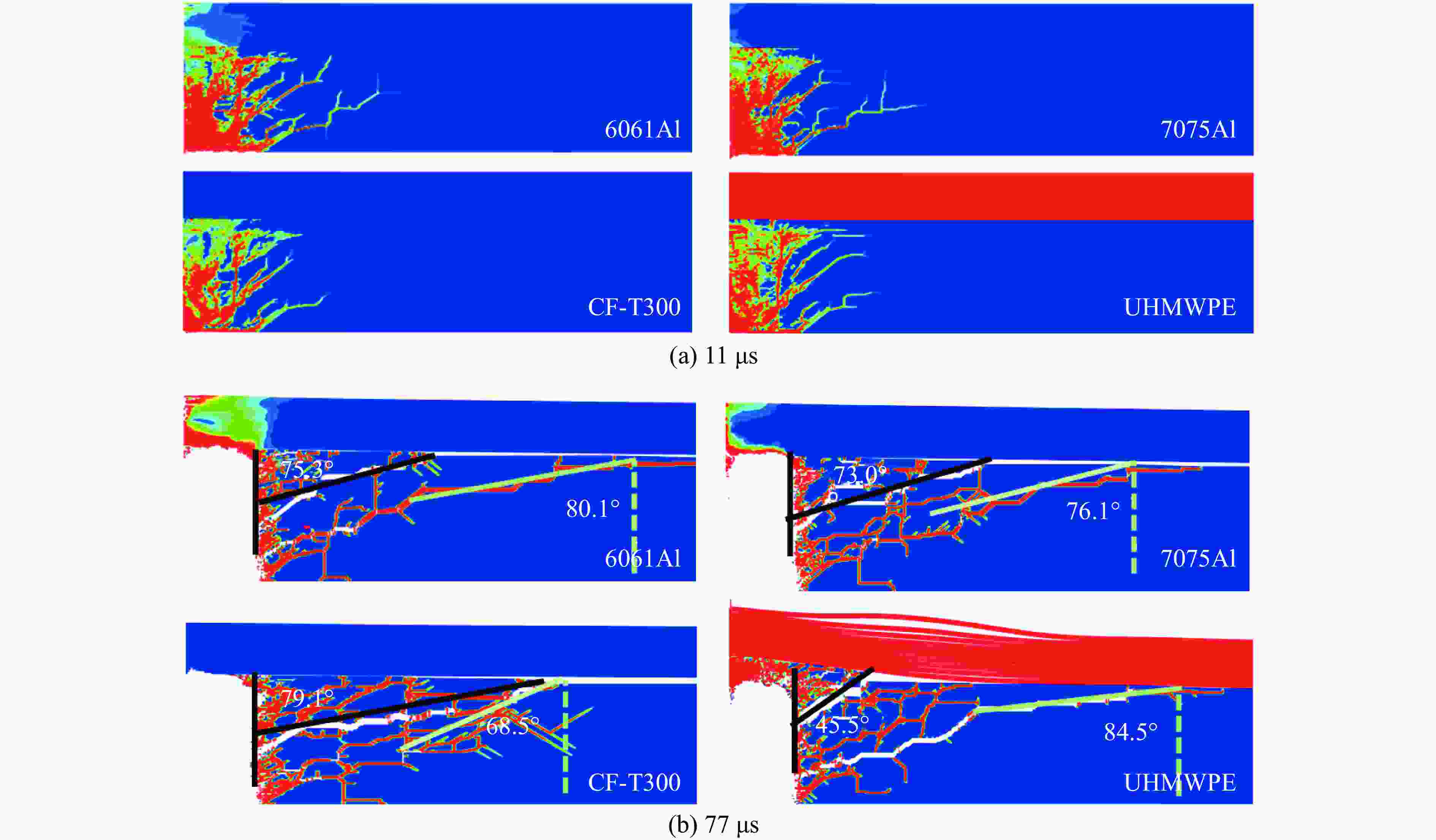
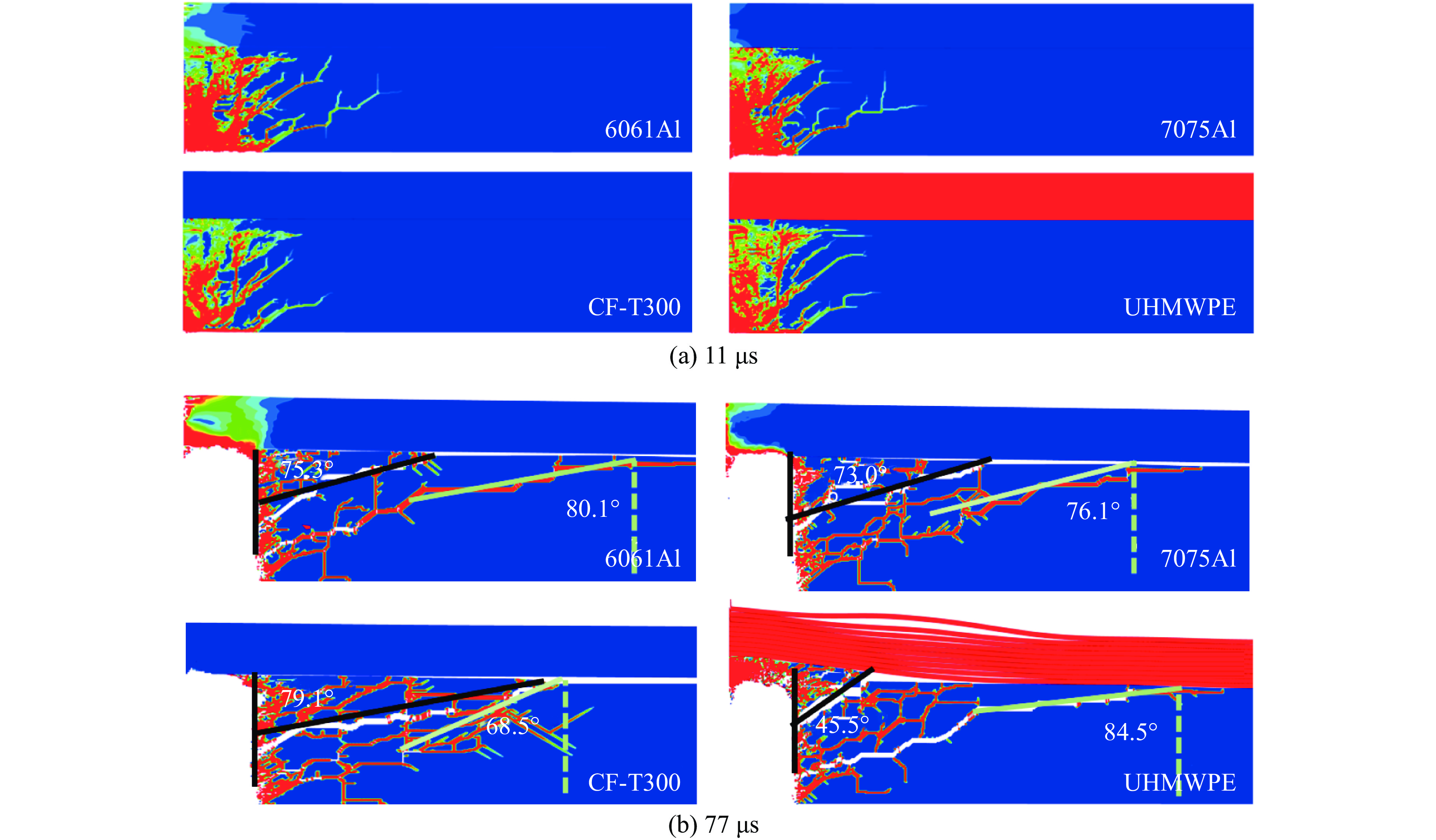
图 8 不同时刻不同背板碳化硼陶瓷复合靶板的陶瓷破坏行为
Figure 8. Failure behavior of ceramics in boron carbide ceramic composite plates with different backplates at different time
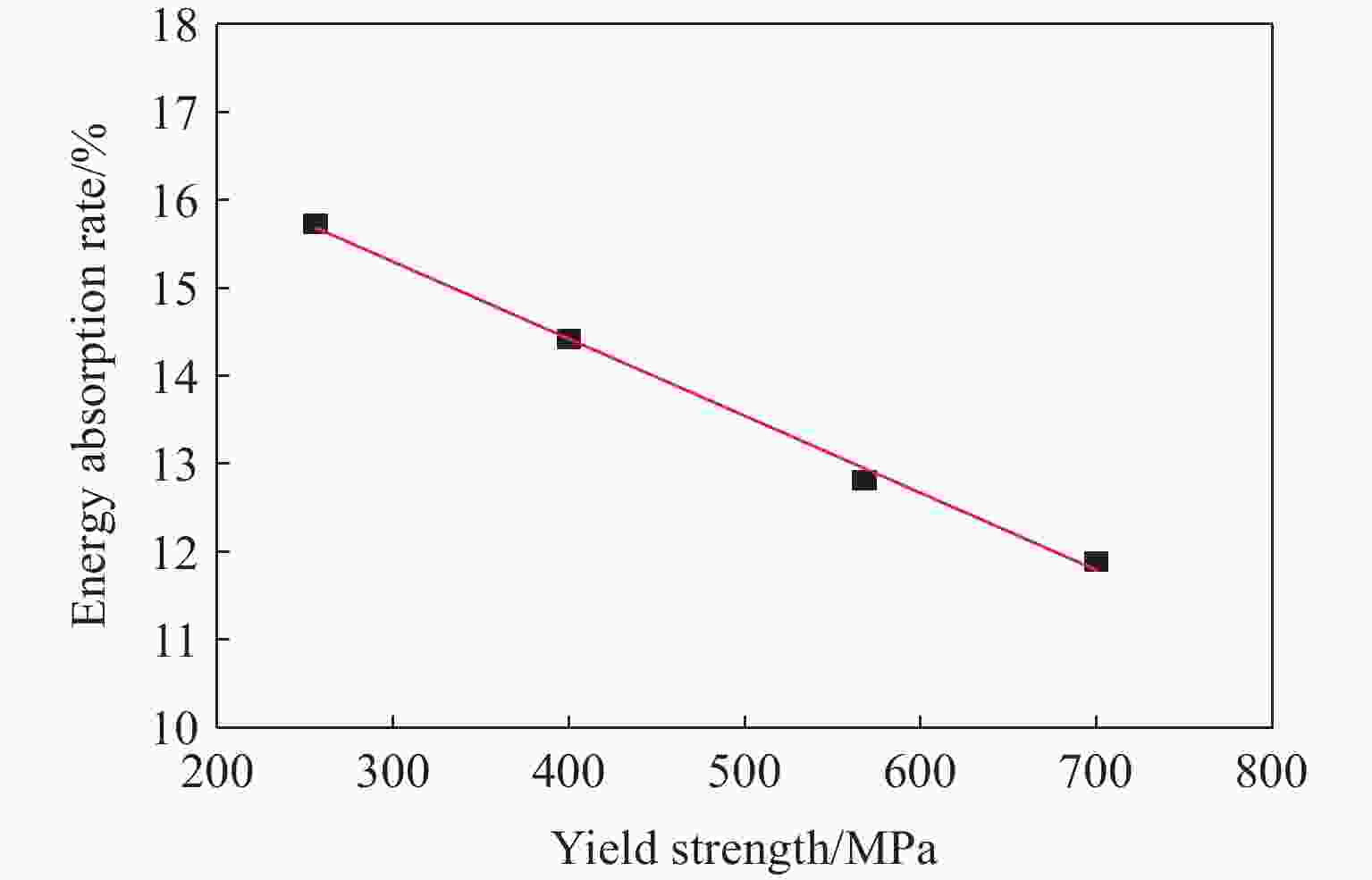
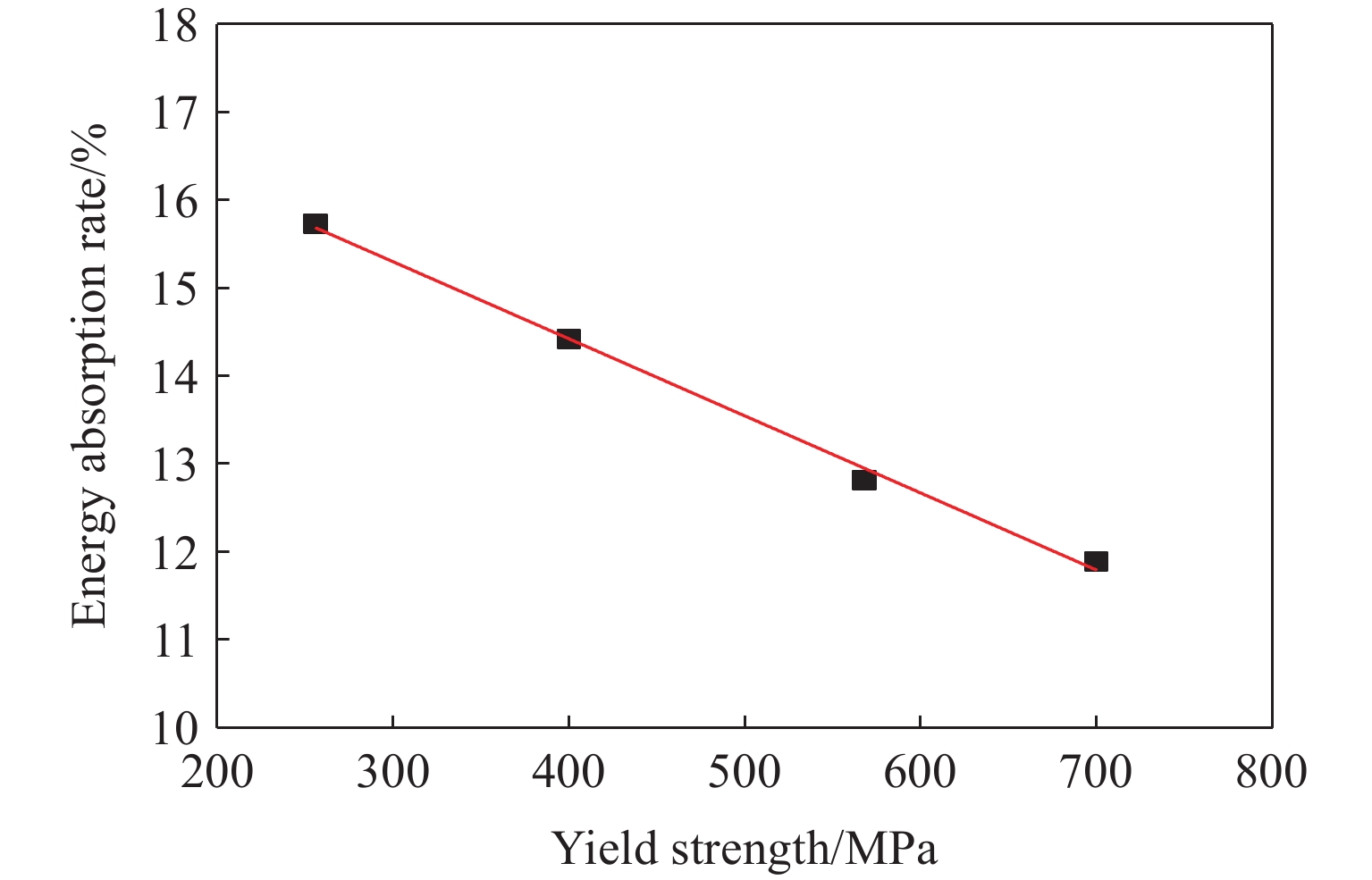
图 9 背板的能量吸收率与屈服强度的相关性
Figure 9. Correlation between energy absorption rate of backplate and yield strength
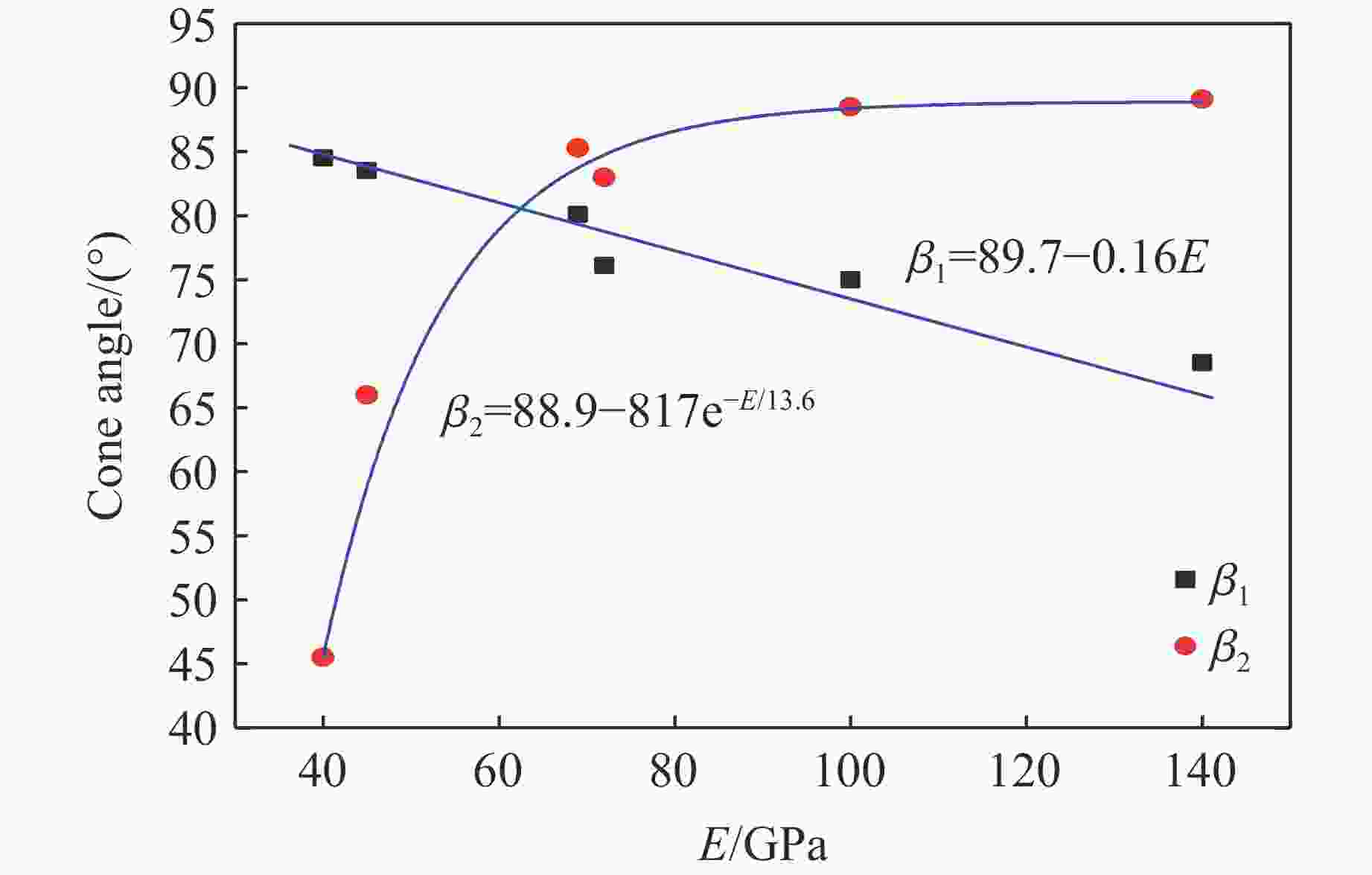
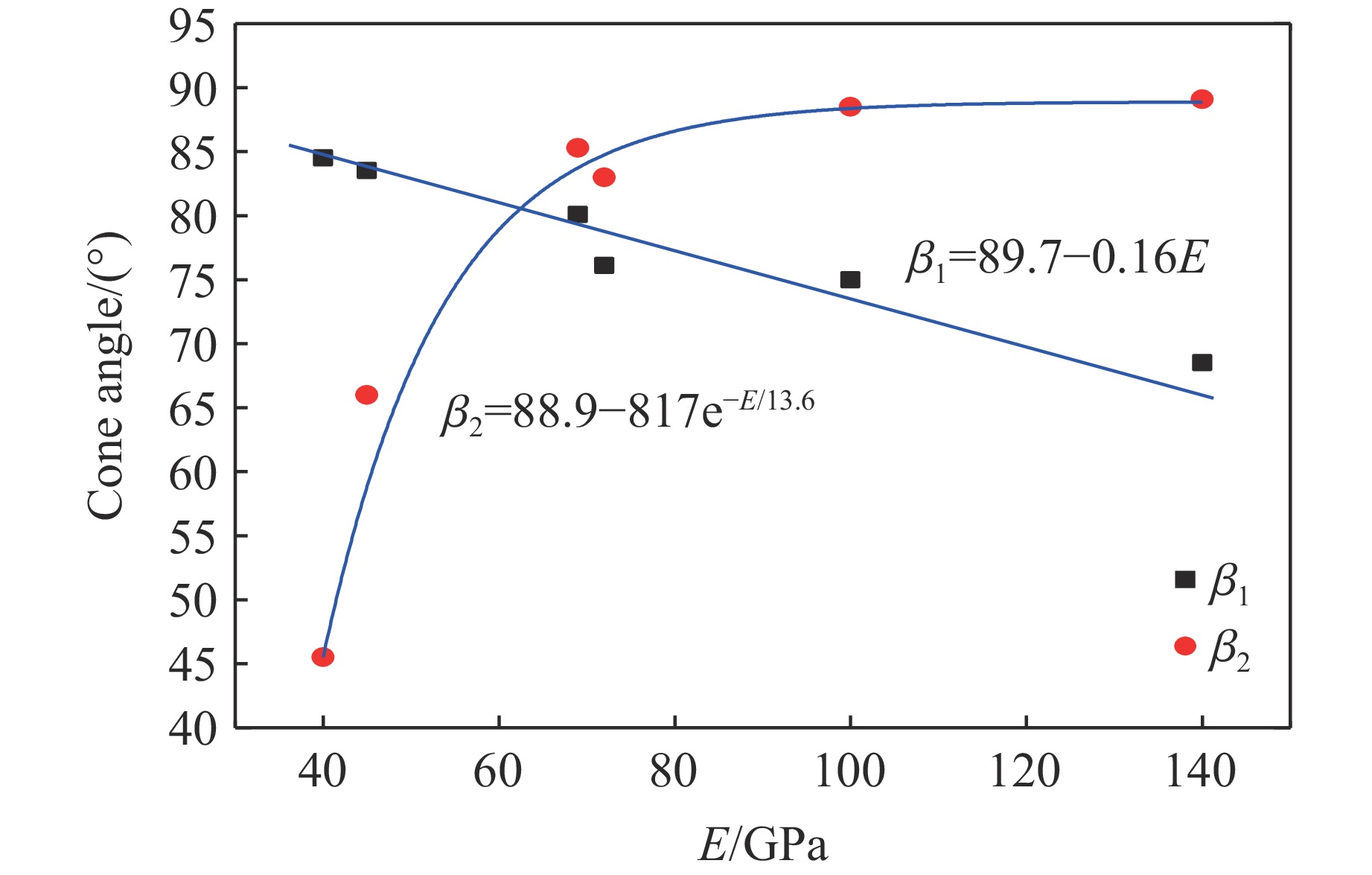
图 10 陶瓷锥角与弹性模量的相关性
Figure 10. Correlation between ceramic cone angle and elastic modulus
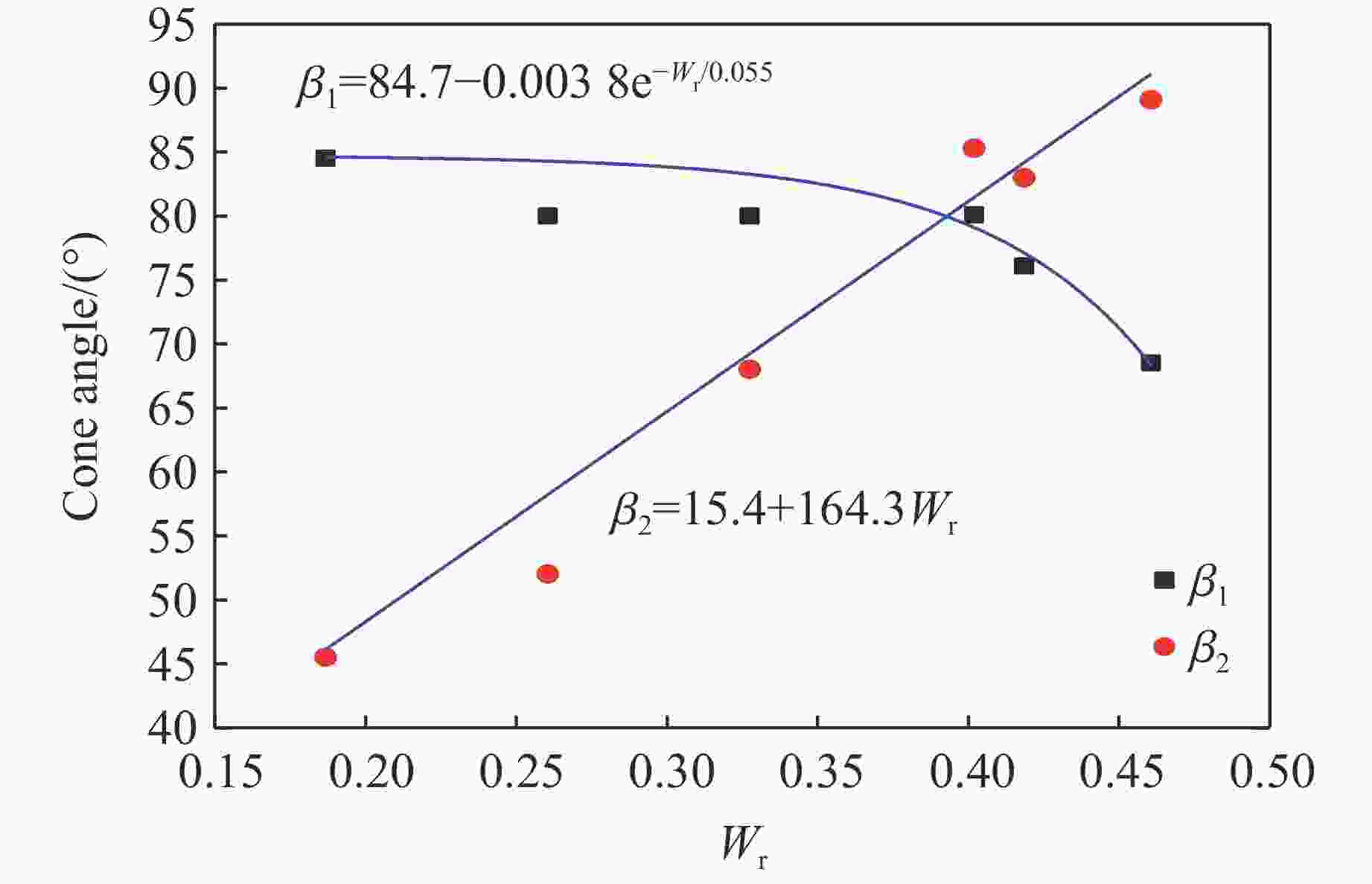
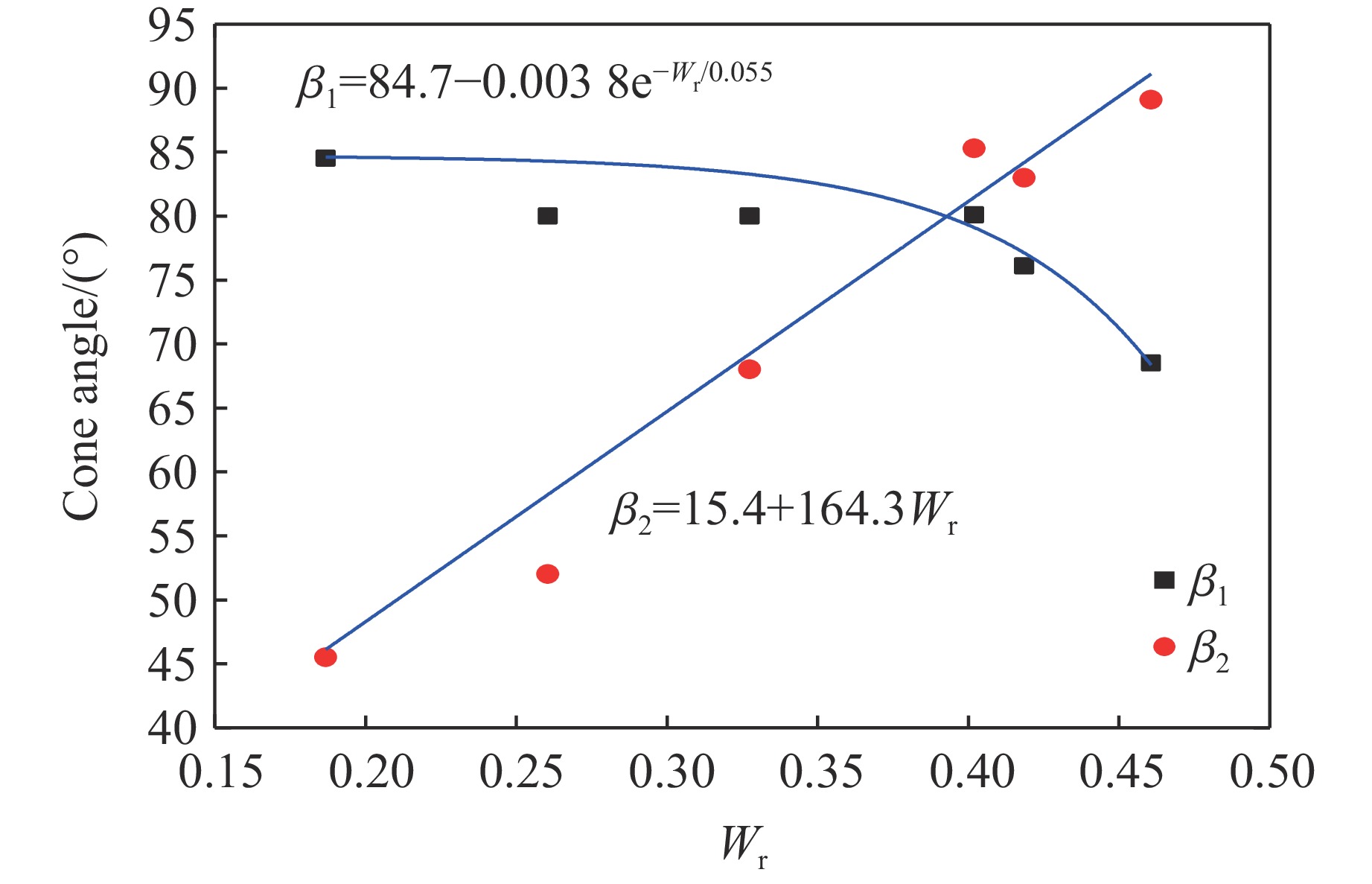
图 11 陶瓷锥角与波阻抗的相关性
Figure 11. Correlation between ceramic cone angle and wave impedance
表 1 不同背板陶瓷靶体的失效特征
Table 1. Failure characteristics of ceramic targets with different backplates
Target materials v0/(m·s−1) $ {\beta }_{1} $/(°) $\varDelta $/(°) Vc/mm3 d/mm B4C/6061Al 245.1 76.7 1.3 55942.11 95.10 B4C/7075Al 249.6 83.8 2.1 41108.19 86.88 B4C/CF-T300 247.8 73.8 2.4 37152.59 74.50 B4C/UHMWPE 252.3 85.1 1.9 21263.85 64.46  下载: 导出CSV
Material $ \rho $/(g·cm−3) E/GPa ν A1/MPa B1/MPa n1 C1 C2 CDX2 steel 7.850 252.3 0.295 3544 5606 0.85 0.012 0.086
下载: 导出CSV
Materials $ \rho $/(g·cm−3) G/GPa A/MPa B/MPa C m n Tm/K 6061Al 2.704 26.69 256 113.8 0.002 1.350 0.420 877.6 7075Al 2.810 27.00 568 327.0 0.014 1.015 0.378 893.0 Materials Tr/K D1 D2 D3 D4 D5 c/(m·s−1) S1 6061Al 293 −0.770 1.450 −0.47 0 1.6 5240 1.40 7075Al 293 0.059 0.246 0 0 0 5190 1.33
下载: 导出CSV
E1/GPa E2/GPa E3/GPa G12/GPa G13/GPa G23/GPa ν12 ν13 ν23 140 9.0 9.0 4.6 4.6 3.082 0.32 0.28 0.21 ρ/(kg·m−3) XT/MPa XC/MPa YT/MPa YC/MPa Sxy/MPa Sxz/MPa Syz/MPa 1750 1760 1100 51 130 70 60 60
下载: 导出CSV
E1/GPa E2/GPa E3/GPa G12/GPa G13/GPa G23/GPa $ {\nu }_{12} $ $ {\nu }_{13} $ $ {\nu }_{23} $ 40.6 40.6 2.6 174 548 548 0.008 0.044 0.044 SN/MPa SC/MPa XT/MPa YT/GPa YC/GPa S23/MPa S13/MPa $ \rho \text{/(kg∙}{\text{m}}^{-3}) $ 900 0.5 3.6 3.6 3.0 900 900 1006
下载: 导出CSV
ρ/(kg·m−3) G/GPa Ai Bi Ci M N $ {\dot{\varepsilon }}_{0}/{\rm s}^{-1} $ $ {t}_{\max }\text{/GPa} $ 2510 462 0.927 0.7 0.005 0.85 0.67 1 0.26 $ {\sigma }_{\text{HEL}} $/GPa $ {p}_{\text{HEL}} $/GPa $ \beta $ $ {K}_{1} $ $ {K}_{2} $ $ {K}_{3} $ $ {D}_{\text{p1}} $ $ {D}_{\text{p2}} $ Fs 15.44 8.71 1 233 −593 2800 0.001 0.5 0.8
下载: 导出CSV
表 7 实验与模拟结果的对比
Table 7. Comparison of experimental and simulated results
Blackplate
materialsLr β1 d Exp./mm Sim./mm Error/% Exp./(°) Sim./(°) Error/% Exp./mm Sim./mm Error/% 6061Al 34.3 36.8 7.3 76.7 80.1 4.4 95.1 81.6 14.1 7075Al 31.6 33.2 5.1 83.8 76.1 9.2 86.9 77.2 11.1 CF-T300 32.7 34.8 6.4 73.8 68.5 7.2 74.5 70.2 5.8 UHMWPE 38.4 41.2 7.3 85.1 84.5 0.7 68.5 59.1 13.7
下载: 导出CSV
-
[1] 代春泉, 矫维成, 金浩正, 等. 拼接式陶瓷复合装甲的研究现状及发展趋势 [J]. 复合材料学报, 2026, 43(4): 1927–1957. doi: 10.13801/j.cnki.fhclxb.20250616.001DAI C Q, JIAO W C, JIN H Z, et al. Research status and development trends of modular ceramic composite armor [J]. Acta Materiae Compositae Sinica, 2026, 43(4): 1927–1957. doi: 10.13801/j.cnki.fhclxb.20250616.001 [2] 苏罗川, 宜晨虹, 刘文杰, 等. 轻质抗侵彻材料及结构研究现状 [J]. 兵器装备工程学报, 2018, 39(1): 157–167. doi: 10.11809/bqzbgcxb2018.01.034SU L C, YI C H, LIU W J, et al. Development of lightweight ballistic armor materials and structures [J]. Journal of Ordnance Equipment Engineering, 2018, 39(1): 157–167. doi: 10.11809/bqzbgcxb2018.01.034 [3] TSIROGIANNIS E C, DASKALAKIS E, VOGIATZIS C, et al. Advanced composite armor protection systems for military vehicles: design methodology, ballistic testing, and comparison [J]. Composites Science and Technology, 2024, 251: 110486. doi: 10.1016/j.compscitech.2024.110486 [4] DOU L L, HE L L, YIN Y H. Ballistic prediction of ceramic armor backed by thin metal plate against threats of small and medium-calibers [J]. International Journal of Applied Ceramic Technology, 2024, 21(2): 1273–1285. doi: 10.1111/ijac.14558 [5] HASSOUNA A, MEZLINI S, AMEUR T B. Numerical study of ballistic impact of hard bulletproof vests: effect of the multilayered armors design [J]. Polymer Composites, 2023, 44(12): 8496–8509. doi: 10.1002/pc.27715 [6] 张茂哲, 王智慧, 纪伟, 等. 约束陶瓷复合装甲的研究进展 [J]. 粉末冶金材料科学与工程, 2024, 29(4): 255–262. doi: 10.19976/j.cnki.43-1448/TF.2024052ZHANG M Z, WANG Z H, JI W, et al. Research progress on confined ceramic composite armor [J]. Materials Science and Engineering of Powder Metallurgy, 2024, 29(4): 255–262. doi: 10.19976/j.cnki.43-1448/TF.2024052 [7] YUAN J C, HUA J Y, BIAN Y L, et al. Cone cracking and fragmentation of alumina plates under high-speed penetration: experiments and modeling [J]. Engineering Fracture Mechanics, 2025, 314: 110733. doi: 10.1016/j.engfracmech.2024.110733 [8] CHAO Z L, WANG Z W, JIANG L T, et al. Ballistic performance and mechanism of a novel multi-scale bionic array gradient (SiCc+B4Cp)/Al armor [J]. Transactions of Materials Research, 2025, 1(2): 100022. doi: 10.1016/j.tramat.2025.100022 [9] YANG S L, LU L K, GAO Y, et al. Experimental and theoretical study of cone angle in alumina tiles under ballistic impact [J]. International Journal of Impact Engineering, 2024, 192: 105025. doi: 10.1016/j.ijimpeng.2024.105025 [10] SIMONS E C, WEERHEIJM J, TOUSSAINT G, et al. An experimental and numerical investigation of sphere impact on alumina ceramic [J]. International Journal of Impact Engineering, 2020, 145: 103670. doi: 10.1016/j.ijimpeng.2020.103670 [11] 侯海量, 朱锡, 李伟. 轻型陶瓷/金属复合装甲抗弹机理研究 [J]. 兵工学报, 2013, 34(1): 105–114. doi: 10.3969/j.issn.1000-1093.2013.01.019HOU H L, ZHU X, LI W. Investigation on bullet proof mechanism of light ceramic/steel composite armor [J]. Acta Armamentarii, 2013, 34(1): 105–114. doi: 10.3969/j.issn.1000-1093.2013.01.019 [12] 高华, 熊超, 殷军辉, 等. 多层异质陶瓷复合靶板抗侵彻试验及数值模拟 [J]. 火炮发射与控制学报, 2019, 40(1): 89–93, 98. doi: 10.19323/j.issn.1673-6524.2019.01.018GAO H, XIONG C, YIN J H, et al. Anti-penetration test and numerical simulation of multilayer heterogeneous ceramic composite target [J]. Journal of Gun Launch & Control, 2019, 40(1): 89–93, 98. doi: 10.19323/j.issn.1673-6524.2019.01.018 [13] 高华, 熊超, 殷军辉, 等. 多层异质复合结构的动力学响应及抗侵彻性能 [J]. 复合材料学报, 2019, 36(5): 1284–1294. doi: 10.13801/j.cnki.fhclxb.20180716.003GAO H, XIONG C, YIN J H, et al. Dynamic response and anti-penetration performance of multi-layered heterogeneous composite structure [J]. Acta Materiae Compositae Sinica, 2019, 36(5): 1284–1294. doi: 10.13801/j.cnki.fhclxb.20180716.003 [14] YU Y L, WANG X D, WU Y D, et al. The impact of backplate support conditions on ceramic fracture and energy absorption in the penetration resistance process of ceramic/metal composite armor [J]. Ceramics International, 2024, 50(7): 10325–10339. doi: 10.1016/j.ceramint.2023.12.344 [15] 武一丁, 王晓东, 余毅磊, 等. 纤维背板结构对B4C陶瓷复合装甲抗侵彻破碎特性的影响 [J]. 爆炸与冲击, 2023, 43(9): 091411. doi: 10.11883/bzycj-2023-0133WU Y D, WANG X D, YU Y L, et al. Affection of fiber backboard structure on the penetration and crushing resistance of B4C ceramic composite armor [J]. Explosion and Shock Waves, 2023, 43(9): 091411. doi: 10.11883/bzycj-2023-0133 [16] 陆文成, 褚庆国, 王晓东, 等. 12.7 mm穿燃弹侵彻603装甲钢行为研究 [J]. 兵器材料科学与工程, 2023, 46(4): 8–14. doi: 10.14024/j.cnki.1004-244x.20230712.001LU W C, CHU Q G, WANG X D, et al. Penetration behavior of 12.7 mm armor piercing incendiary into 603 armor steel [J]. Ordnance Material Science and Engineering, 2023, 46(4): 8–14. doi: 10.14024/j.cnki.1004-244x.20230712.001 [17] 张天星, 余毅磊, 蒋招绣, 等. 薄板氧化铝陶瓷复合装甲抗侵彻行为规律研究 [J]. 兵器材料科学与工程, 2022, 45(4): 24–29. doi: 10.14024/j.cnki.1004-244x.20220707.001ZHANG T X, YU Y L, JIANG Z X, et al. Anti-penetration behavior of thin plate alumina ceramic composite armor [J]. Ordnance Material Science and Engineering, 2022, 45(4): 24–29. doi: 10.14024/j.cnki.1004-244x.20220707.001 [18] 陆文成, 武一丁, 余毅磊, 等. 不同厚度比的SiC陶瓷-纤维增强树脂基复合材料装甲的损伤失效及其抗弹性能 [J]. 复合材料学报, 2025, 42(2): 1125–1139. doi: 10.13801/j.cnki.fhclxb.20240508.003LU W C, WU Y D, YU Y L, et al. Damage failure and ballistic performance of SiC ceramic-fiber reinforced resin-based composite armor with different thickness ratios [J]. Acta Materiae Compositae Sinica, 2025, 42(2): 1125–1139. doi: 10.13801/j.cnki.fhclxb.20240508.003 [19] 赵永青, 余毅磊, 高光发, 等. 超高强钢弹侵彻陶瓷复合靶数值模拟研究 [J]. 宁波大学学报(理工版), 2025, 38(1): 54–62. doi: 10.20098/j.cnki.1001-5132.2024.0136ZHAO Y Q, YU Y L, GAO G F, et al. Numerical simulation study on penetrating ceramic composite target by ultra-high strength steel bullets [J]. Journal of Ningbo University (NSEE), 2025, 38(1): 54–62. doi: 10.20098/j.cnki.1001-5132.2024.0136 [20] 武一丁, 高光发, 王晓东. 不同速度下B4C陶瓷/铝合金轻型复合靶板抗侵彻行为研究 [J]. 南京理工大学学报, 2023, 47(4): 503–513. doi: 10.14177/j.cnki.32-1397n.2023.47.04.008WU Y D, GAO G F, WANG X D. Research on the penetration resistance behavior of B4C ceramic/aluminum alloy lightweight composite target at different speeds [J]. Journal of Nanjing University of Science and Technology, 2023, 47(4): 503–513. doi: 10.14177/j.cnki.32-1397n.2023.47.04.008 [21] ZHANG D N, SHANGGUAN Q Q, XIE C J, et al. A modified Johnson-Cook model of dynamic tensile behaviors for 7075-T6 aluminum alloy [J]. Journal of Alloys and Compounds, 2015, 619: 186–194. doi: 10.1016/j.jallcom.2014.09.002 [22] HASHIN Z, ROTEM A. A fatigue failure criterion for fiber reinforced materials [J]. Journal of Composite Materials, 1973, 7(4): 448–464. doi: 10.1177/002199837300700404 [23] LIU J H, XU Y X, YI X B, et al. Experimental and numerical simulation study on near-edge/on-edge low-velocity impact and residual compressive strength of T300/69 laminates [J]. Composite Structures, 2022, 280: 114887. doi: 10.1016/j.compstruct.2021.114887 [24] CHANG K Y, LIU S, CHANG F K. Damage tolerance of laminated composites containing an open hole and subjected to tensile loadings [J]. Journal of Composite Materials, 1991, 25(3): 274–301. doi: 10.1177/002199839102500303 [25] ZHANG X Z, WANG R T, HOU H D, et al. Numerical simulation analysis on anti-penetration characteristics of Al/UHMWPE composite plates against tungsten alloy fragment [J]. Journal of Physics: Conference Series, 2024, 2891(16): 162029. doi: 10.1088/1742-6596/2891/16/162029 [26] JOHNSON G R, HOLMQUIST T J. Response of boron carbide subjected to large strains, high strain rates, and high pressures [J]. Journal of Applied Physics, 1999, 85(12): 8060–8073. doi: 10.1063/1.370643 [27] 位伟, 姜清辉, 周创兵. 基于有限变形理论的数值流形方法研究 [J]. 力学学报, 2014, 46(1): 78–86. doi: 10.6052/0459-1879-13-081WEI W, JIANG Q H, ZHOU C B. Study on numerical manifold method based on finite deformation theory [J]. Chinese Journal of Theoretical and Applied Mechanics, 2014, 46(1): 78–86. doi: 10.6052/0459-1879-13-081 -

 下载:
下载:

计量
- 文章访问数: 541
- HTML全文浏览量: 230
- PDF下载量: 50
