





High-Pressure Metathesis Synthesis and Physical Property Characterization of Cubic Fluorite-Structured CeO2Cl0.07
-
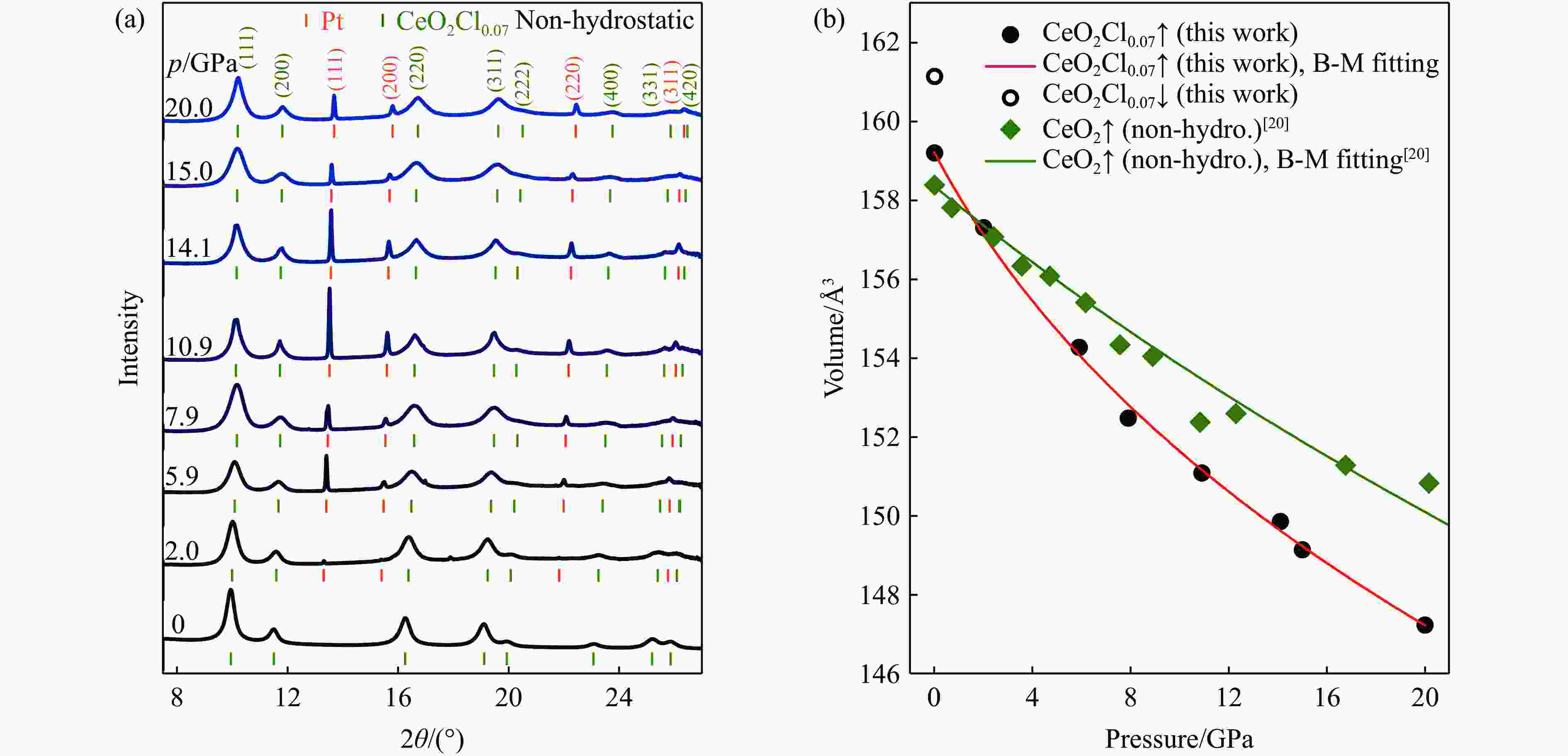
摘要: Ce的4f电子长久以来就因其独特的离域机制,以及对原子结构、相变行为、磁性结构的影响而受到广泛的关注。通过改变前驱体(CeCl3、MgO粉末)化学配比,在大腔体压机提供的高温高压(1873 K、5 GPa)环境下,通过调控高压固相复分解反应(high-pressure solid-state metathesis, HSM),合成了立方萤石结构的CeO2Cl0.07。利用金刚石对顶砧(diamond anvil cell,DAC),结合高压原位同步辐射X射线衍射、扫描电子显微镜、能谱仪、高压拉曼光谱等表征手段,获得了样品的压力-比容曲线,并与CeO2进行比较,发现CeO2Cl0.07更易被压缩,获得了高压拉曼声子谱(F2g),结果显示,非静水压下在0~2 GPa区间以及15 GPa附近CeO2Cl0.07的拉曼峰随压力的变化存在异常。分析认为,Cl元素的掺入带来氧空位,使得Ce3+浓度升高,进而引起4f电子离域。研究结果揭示了CeO2Cl0.07在高压条件下的行为,提供了一种新型铈基化合物的高压合成途径。Abstract: The 4f electron of Ce has long attracted extensive attention due to their unique delocalization mechanism and their influence on atomic structure, phase transformation behavior, and magnetic structure. In this paper, CeO2Cl0.07 was synthesized with a cubic fluorite structure by changing the stoichiometry of the precursors (CeCl3, MgO powder) and regulating the high-pressure solid-state metathesis (HSM) reaction under high temperature and high pressure conditions (
1873 K, 5 GPa) provided by a large volume press. Then pressure was provided by a diamond anvil cell (DAC), and the sample was characterized by high-pressure in-situ synchrotron X-ray diffraction (XRD), scanning electron microscope (SEM), energy dispersive spectrometer (EDS), and high-pressure Raman spectroscopy. By comparing the obtained pressure-volume (p-V) curve with CeO2, it is found that CeO2Cl0.07 is more compressible. The high-pressure Raman phonon spectrum (F2g) is obtained, indicating that the pressure-dependent behavior of CeO2Cl0.07 exhibits anomalous changes at 0–2 GPa and near 15 GPa under non-hydrostatic pressure. We believe that the doping of Cl elements introduces oxygen vacancies, which increases the concentration of Ce3+, thereby causing the delocalization of 4f electron and resulting in the observed phenomenon. This study developed a new high-pressure synthesis pathway for cerium-based compounds and revealed their behavior under high-pressure conditions. -
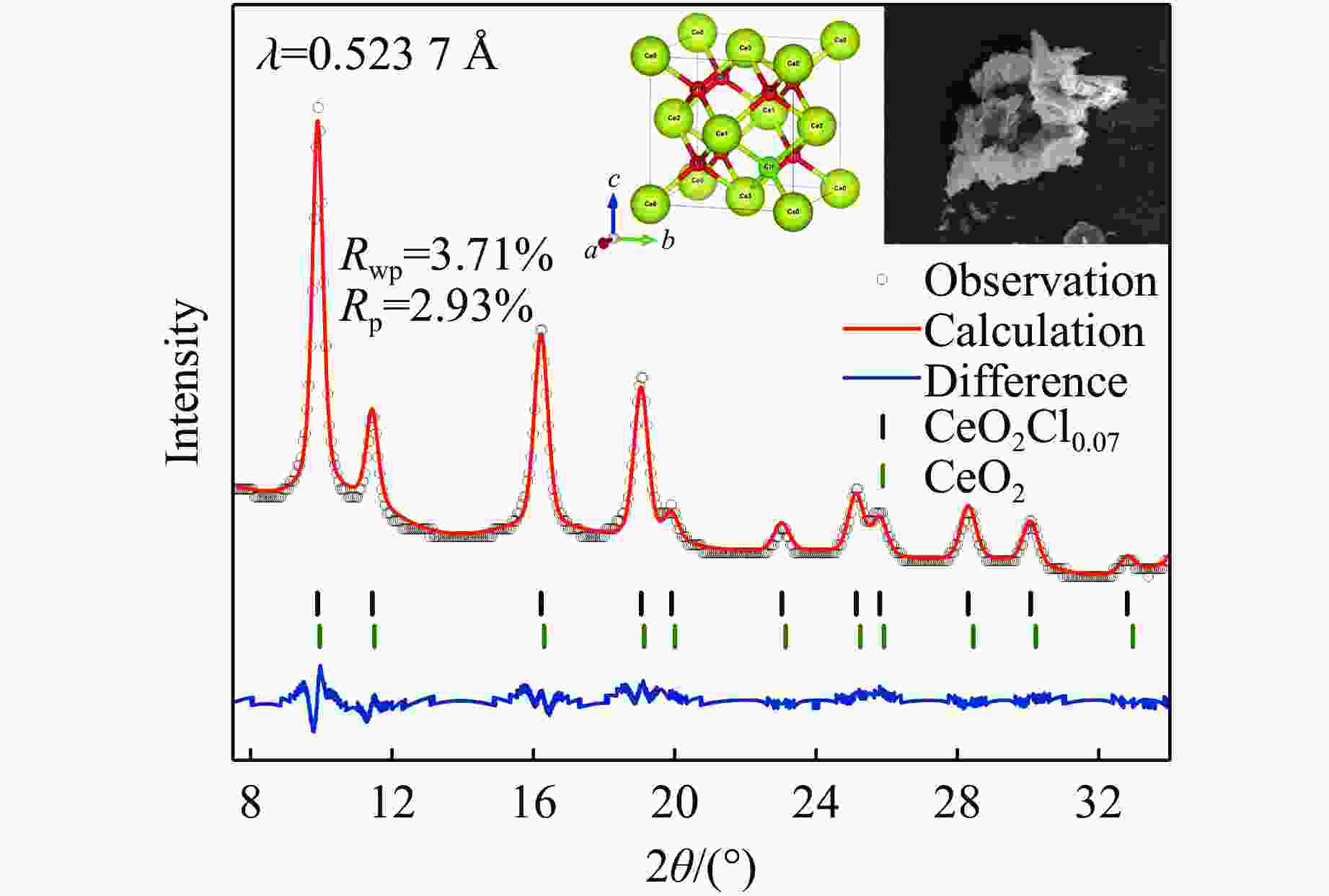
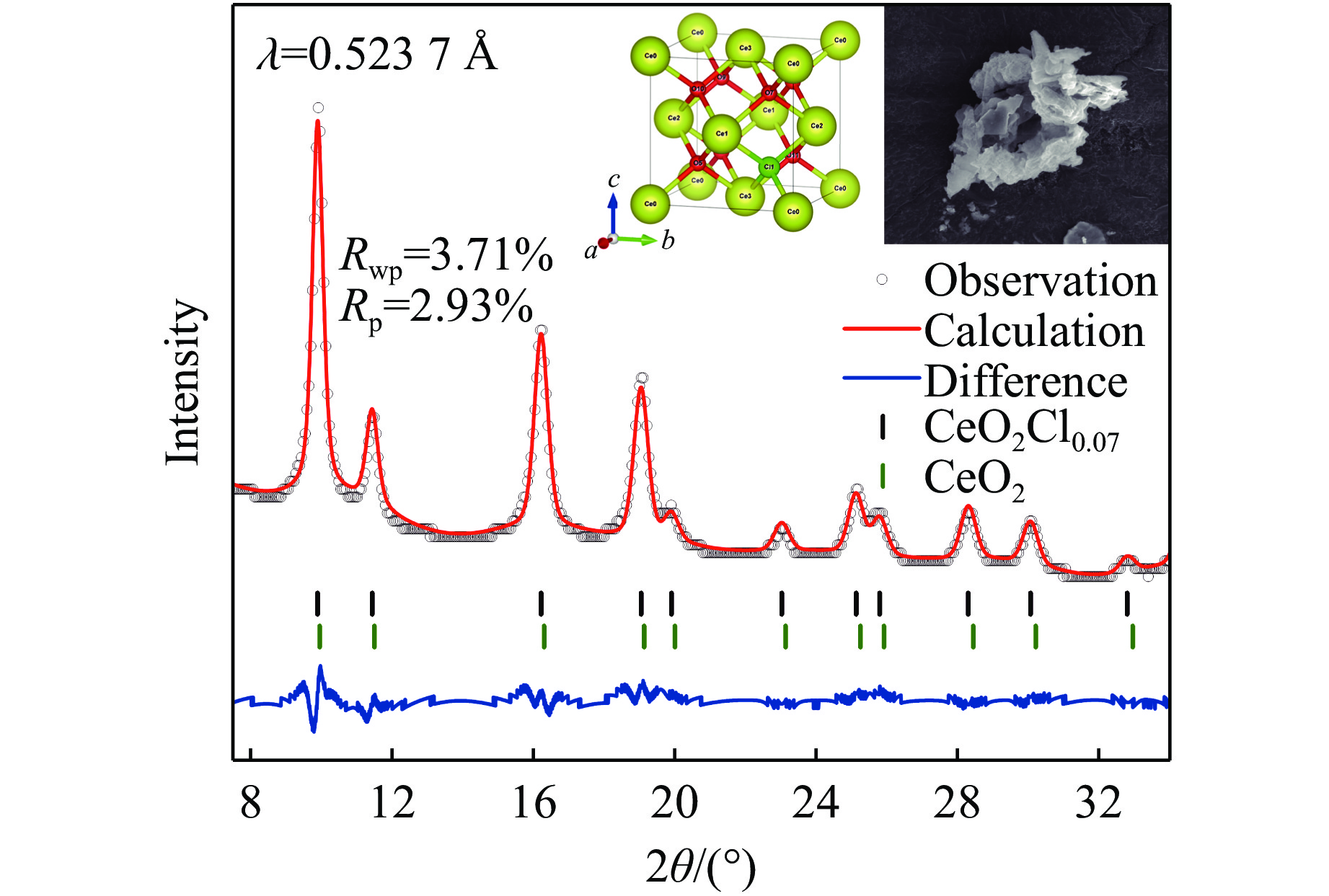
图 1 0 GPa 下同步辐射实验测得的合成样品的XRD 谱(左侧插图为样品晶体结构示意图,右侧插图为样品的SEM 图像)
Figure 1. XRD pattern of samples obtained from synchrotron radiation experiments at 0 GPa (The left inset is the schematic diagram of the crystal structure, and the right inset shows a SEM image of the sample.)
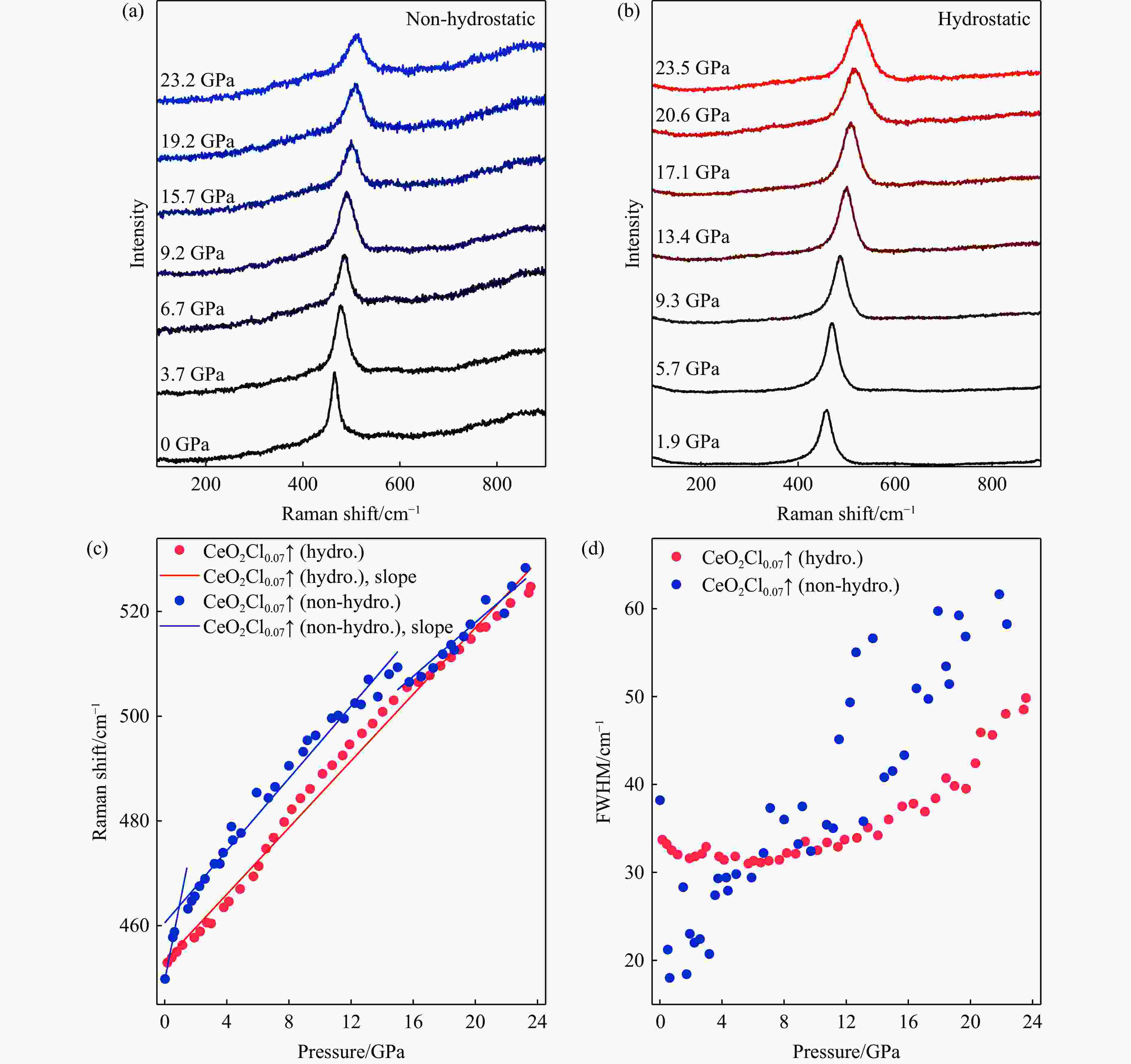
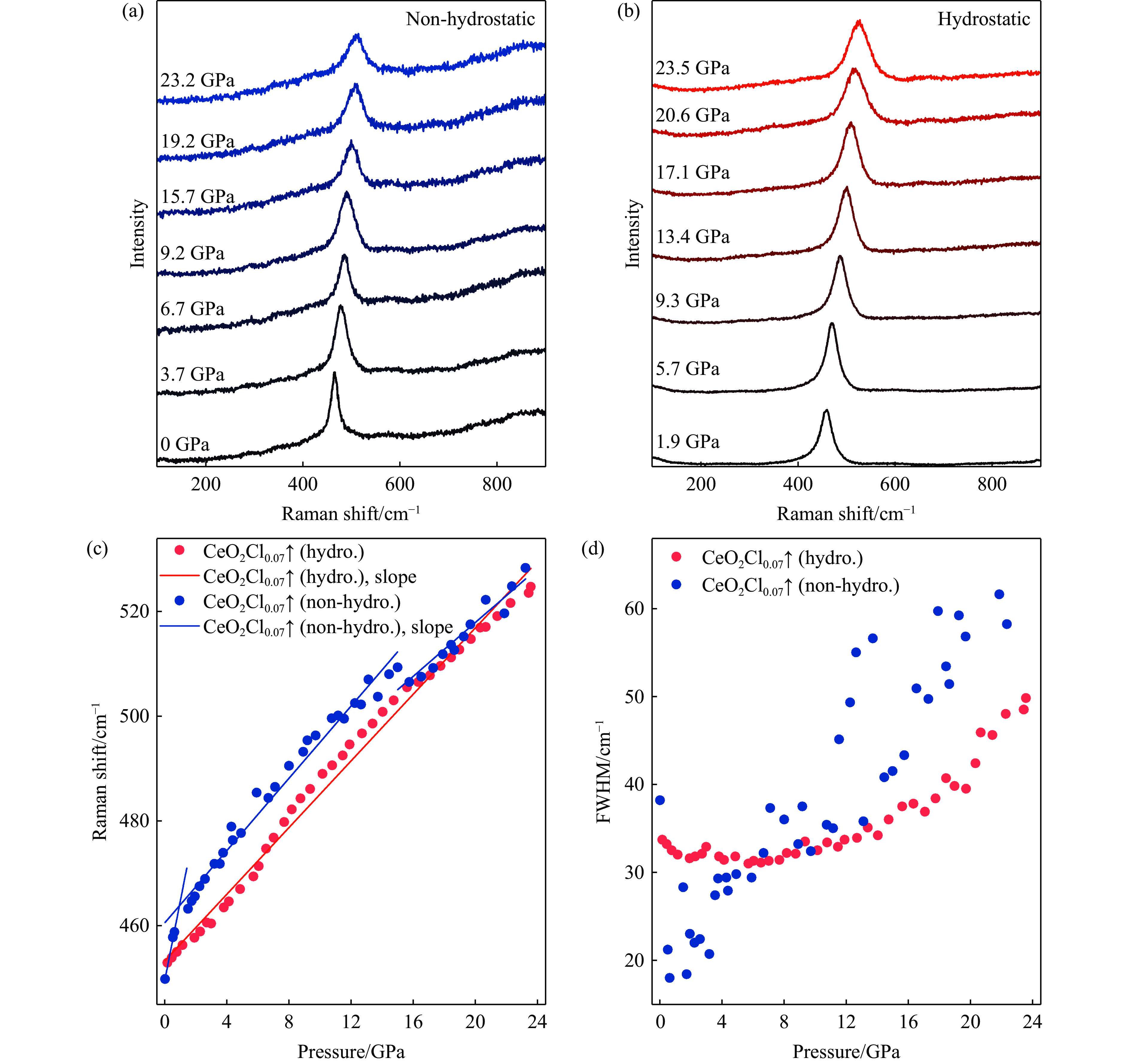
图 3 CeO2Cl0.07的非静水压升压拉曼谱(a)、静水压升压拉曼谱(b)、非静水压和静水压升压拉曼峰的峰位散点图(c)和半峰宽散点图(d)
Figure 3. Non-hydrostatic pressure boost Raman spectra (a), hydrostatic pressure boost Raman spectra (b), scatter plot of Raman peak positions for non-hydrostatic pressure boost and hydrostatic pressure boost (c), and scatter plot of full width at half maximum (FWHM) (d) of CeO2Cl0.07
-
[1] IQBAL J, JAN T, AWAN M S, et al. Mg doping induced effects on structural, optical, and electrical properties as well as cytotoxicity of CeO2 nanostructures [J]. Metallurgical and Materials Transactions B, 2016, 47(2): 1363–1368. doi: 10.1007/s11663-015-0560-2 [2] ISHII H, MIYAHARA T, TAKAYAMA Y, et al. Resonant photoemission study of CeRu4Sb12 [J]. Journal of Electron Spectroscopy and Related Phenomena, 2005, 144: 643−645. [3] MIMURA K, WATANABE Y, MIZOHATA H, et al. High-resolution resonant photoemission study of CeSi [J]. Physica B: Condensed Matter, 2004, 351(3/4): 295–297. doi: 10.1016/j.physb.2004.06.031 [4] 张恒源. 高压耦联反应合成Fe3N/RexN复合材料及其物性表征 [D]. 成都: 四川大学, 2023: 7−10.ZHANG H Y. High-pressure coupling reactions to produce Fe3N/RexN composite and study on the physical properties [D]. Chengdu: Sichuan University, 2023: 7−10. [5] GILLAN E G, KANER R B. Synthesis of refractory ceramics via rapid metathesis reactions between solid-state precursors [J]. Chemistry of Materials, 1996, 8(2): 333–343. doi: 10.1021/cm950232a [6] PARKIN I P. Solid state metathesis reaction for metal borides, silicides, pnictides and chalcogenides: ionic or elemental pathways [J]. Chemical Society Reviews, 1996, 25(3): 199–207. doi: 10.1039/cs9962500199 [7] O’LOUGHLIN J L, WALLACE C H, KNOX M S, et al. Rapid solid-state synthesis of tantalum, chromium, and molybdenum nitrides [J]. Inorganic Chemistry, 2001, 40(10): 2240–2245. doi: 10.1021/ic001265h [8] ZHAO H Z, LEI M, YANG X A, et al. Route to GaN and VN assisted by carbothermal reduction process [J]. Journal of the American Chemical Society, 2005, 127(45): 15722–15723. doi: 10.1021/ja055877i [9] SONG B, JIAN J K, WANG G, et al. Facile and general route to nitrides by a modified solid-state metathesis pathway [J]. Chemistry of Materials, 2007, 19(6): 1497–1502. doi: 10.1021/cm062796s [10] SONG B, CHEN X L, HAN J C, et al. Facile route to nitrides: transformation from single element to binary and ternary nitrides at moderate temperature through a new modified solid-state metathesis [J]. Inorganic Chemistry, 2009, 48(22): 10519–10527. doi: 10.1021/ic901861c [11] LEI L, ZHANG L L. Recent advance in high-pressure solid-state metathesis reactions [J]. Matter and Radiation at Extremes, 2018, 3(3): 95–103. doi: 10.1016/j.mre.2017.12.003 [12] LEI L, HE D W. Synthesis of GaN crystals through solid-state metathesis reaction under high pressure [J]. Crystal Growth & Design, 2009, 9(3): 1264–1266. doi: 10.1021/cg801017h [13] LEI L, YIN W W, JIANG X D, et al. Synthetic route to metal nitrides: high-pressure solid-state metathesis reaction [J]. Inorganic Chemistry, 2013, 52(23): 13356–13362. doi: 10.1021/ic4014834 [14] 刘德璞, 张恒源, 陶雨, 等. 高压偶联反应合成铂族金属氮化物OsNx [J]. 高压物理学报, 2025, 39(6): 060101. doi: 10.11858/gywlxb.20251020LIU D P, ZHANG H Y, TAO Y, et al. Synthesis of platinum-group metal nitride OsNx through high-pressure coupling reaction [J]. Chinese Journal of High Pressure Physics, 2025, 39(6): 060101. doi: 10.11858/gywlxb.20251020 [15] ZHANG L L, CHENG Y, LEI L, et al. High-pressure synthesis of CeOCl crystals and investigation of their photoluminescence and compressibility properties [J]. Crystal Growth & Design, 2018, 18(3): 1843–1847. doi: 10.1021/acs.cgd.7b01712 [16] ZHANG L L, CHENG Y, WANG X L, et al. High-pressure Raman spectroscopy of CeOCl: observation of the isostructural phase transition [J]. Journal of Raman Spectroscopy, 2019, 50(12): 1962–1968. doi: 10.1002/jrs.5717 [17] JIA X, ZHANG L L, TIAN Y, et al. Synthesis of large-sized spherical Co-C alloys with soft magnetic properties though a high-pressure solid-state metathesis reaction [J]. RSC Advances, 2024, 14(11): 7490–7498. doi: 10.1039/D3RA08967C [18] 龙海东, 陈杰, 肖雄, 等. 高熵过渡金属二硼化物的高温高压合成 [J]. 高压物理学报, 2024, 38(6): 063101. doi: 10.11858/gywlxb.20240790LONG H D, CHEN J, XIAO X, et al. High-temperature and high-pressure synthesis of high-entropy transition metal diborides [J]. Chinese Journal of High Pressure Physics, 2024, 38(6): 063101. doi: 10.11858/gywlxb.20240790 [19] 陈春华, 郭睿昂, 贺端威, 等. WC-5Co硬质合金的高温高压烧结及性能表征 [J]. 高压物理学报, 2025, 39(12): 123101. doi: 10.11858/gywlxb.20251067CHEN C H, GUO R A, HE D W, et al. Sintering and characterizing of WC-5Co cemented carbide under high temperature and high pressure [J]. Chinese Journal of High Pressure Physics, 2025, 39(12): 123101. doi: 10.11858/gywlxb.20251067 [20] 张雷雷, 雷力, 胡启威, 等. 高压下Al0.86Ga0.14N半导体合金“双模”拉曼声子行为研究 [J]. 高压物理学报, 2017, 31(5): 521–528. doi: 10.11858/gywlxb.2017.05.003ZHANG L L, LEI L, HU Q W, et al. Two-mode behavior in Raman spectra of Al0.86Ga0.14N alloy under high pressure [J]. Chinese Journal of High Pressure Physics, 2017, 31(5): 521–528. doi: 10.11858/gywlxb.2017.05.003 [21] 刘静仪, 张雷雷, 吴彬彬, 等. 锇在高压下发生电子拓扑转变的拉曼谱学证据 [J]. 光散射学报, 2023, 35(1): 1–7. doi: 10.13883/j.issn1004-5929.202301001LIU J Y, ZHANG L L, WU B B, et al. Raman spectroscopic evidence of an electron topological transition in osmium at high pressure [J]. The Journal of Light Scattering, 2023, 35(1): 1–7. doi: 10.13883/j.issn1004-5929.202301001 [22] 陶雨, 刘静仪, 吴彬彬, 等. 固态氨的极端条件光散射谱学研究进展 [J]. 光散射学报, 2022, 34(4): 261–272. doi: 10.13883/j.issn1004-5929.202204001TAO Y, LIU J Y, WU B B, et al. Recent progress in extreme condition light scattering spectroscopy of solid ammonia [J]. The Journal of Light Scattering, 2022, 34(4): 261–272. doi: 10.13883/j.issn1004-5929.202204001 [23] 张峰, 陶雨, 唐琦琪, 等. 三氧化二镓的高压拉曼光谱研究 [J]. 光散射学报, 2021, 33(1): 40–44. doi: 10.13883/j.issn1004-5929.202101005ZHANG F, TAO Y, TANG Q Q, et al. High-pressure Raman spectroscopy of Ga2O3 [J]. The Journal of Light Scattering, 2021, 33(1): 40–44. doi: 10.13883/j.issn1004-5929.202101005 [24] 刘静仪, 吴彬彬, 陶雨, 等. 关于层状结构聚合氮存在性的探讨 [J]. 高压物理学报, 2024, 38(4): 040105. doi: 10.11858/gywlxb.20240821LIU J Y, WU B B, TAO Y, et al. On the existence of layered polymeric nitrogen [J]. Chinese Journal of High Pressure Physics, 2024, 38(4): 040105. doi: 10.11858/gywlxb.20240821 [25] WANG Q M, HE D W, PENG F, et al. Unusual compression behavior of nanocrystalline CeO2 [J]. Scientific Reports, 2014, 4(1): 4441. doi: 10.1038/srep04441 [26] LIU B, LIU B B, LI Q J, et al. High-pressure Raman study on CeO2 nanospheres self-assembled by 5 nm CeO2 nanoparticles [J]. Physica Status Solidi (B), 2011, 248(5): 1154–1157. doi: 10.1002/pssb.201000807 [27] DOGRA S, SHARMA D N, SINGH J, et al. High pressure behavior of nano-crystalline CeO2 up to 35 GPa: a Raman investigation [J]. High Pressure Research, 2011, 31(2): 292–303. doi: 10.1080/08957959.2011.576674 [28] KOUROUKLIS G A, JAYARAMAN A, ESPINOSA G P. High-pressure Raman study of CeO2 to 35 GPa and pressure-induced phase transformation from the fluorite structure [J]. Physical Review B, 1988, 37(8): 4250–4253. doi: 10.1103/PhysRevB.37.4250 -

 下载:
下载:

计量
- 文章访问数: 1004
- HTML全文浏览量: 368
- PDF下载量: 90
