





Numerical Simulation Study on Hypervelocity Impact of High-Entropy Alloy Protective Structure
-
摘要: 空间碎片是当今空间环境保护领域最紧迫的问题。目前的航天器防护结构多数为Whipple结构,主体缓冲屏多采用铝合金材料。采用AUTODYN软件的光滑粒子流体动力学(smoothed particle hydrodynamics,SPH)方法,模拟研究了球形弹丸超高速撞击高熵合金防护结构,分析了不同工况下碎片云数量、质量和动量等特性,探讨了撞击速度以及结构厚度与弹丸直径之比(t/D)对高熵合金防护结构超高速撞击特性的影响。结果表明,在相同的撞击条件下,高熵合金防护结构产生的碎片云特性显著区别于铝合金防护结构:碎片总量增加约 51.86%;小质量碎片数量增加约 79.56%,大质量碎片数量减少;沿撞击方向碎片云的最大动量低于铝合金结构的 75%(多种弹丸直径下均成立)。影响因素分析表明:碎片云膨胀程度主要受撞击速度控制,受t/D的影响较小,且撞击速度越大,膨胀越快;而危险碎片(大质量或高动能碎片)的质量和动能则主要受t/D影响,且t/D越高,影响越大。研究结果可为高熵合金在新一代航天器防护结构中的工程应用提供理论支持和参考。Abstract: The space debris problem has become one of the most pressing challenges in the field of space environment protection. Currently, most spacecraft shielding systems adopt Whipple-type structures, in which aluminum alloys are commonly used as bumper materials. In this study, the smoothed particle hydrodynamics (SPH) method implemented in the AUTODYN software was employed to numerically investigate the hypervelocity impact of spherical projectiles on high-entropy alloy (HEA) protective structures. The characteristics of the resulting debris clouds, including fragment number, mass distribution, and momentum, were systematically analyzed under various impact conditions. In addition, the effects of impact velocity and the ratio of bumper thickness to projectile diameter (t/D) on the hypervelocity impact response of HEA shielding structures were examined. The results show that, under identical impact conditions, the debris cloud characteristics generated by HEA protective structures differ significantly from those of aluminum alloy structures, namely: the total number of fragments increases by approximately 51.86%; the number of small-mass fragments increases by about 79.56%, while the number of large-mass fragments decreases; and the maximum debris cloud momentum along the impact direction (z-direction) is less than 75% of that associated with aluminum alloy structures across multiple projectile diameters. Parametric analyses indicate that the expansion of the debris cloud is primarily governed by impact velocity, with higher velocities leading to faster expansion, while the influence of the t/D is relatively minor. In contrast, the mass and kinetic energy of hazardous fragments (large-mass/high-energy fragments) are mainly affected by t/D, with higher values resulting in greater impact severity. These findings provide theoretical support and reference for the application of high-entropy alloys in next-generation spacecraft shielding structures.
-
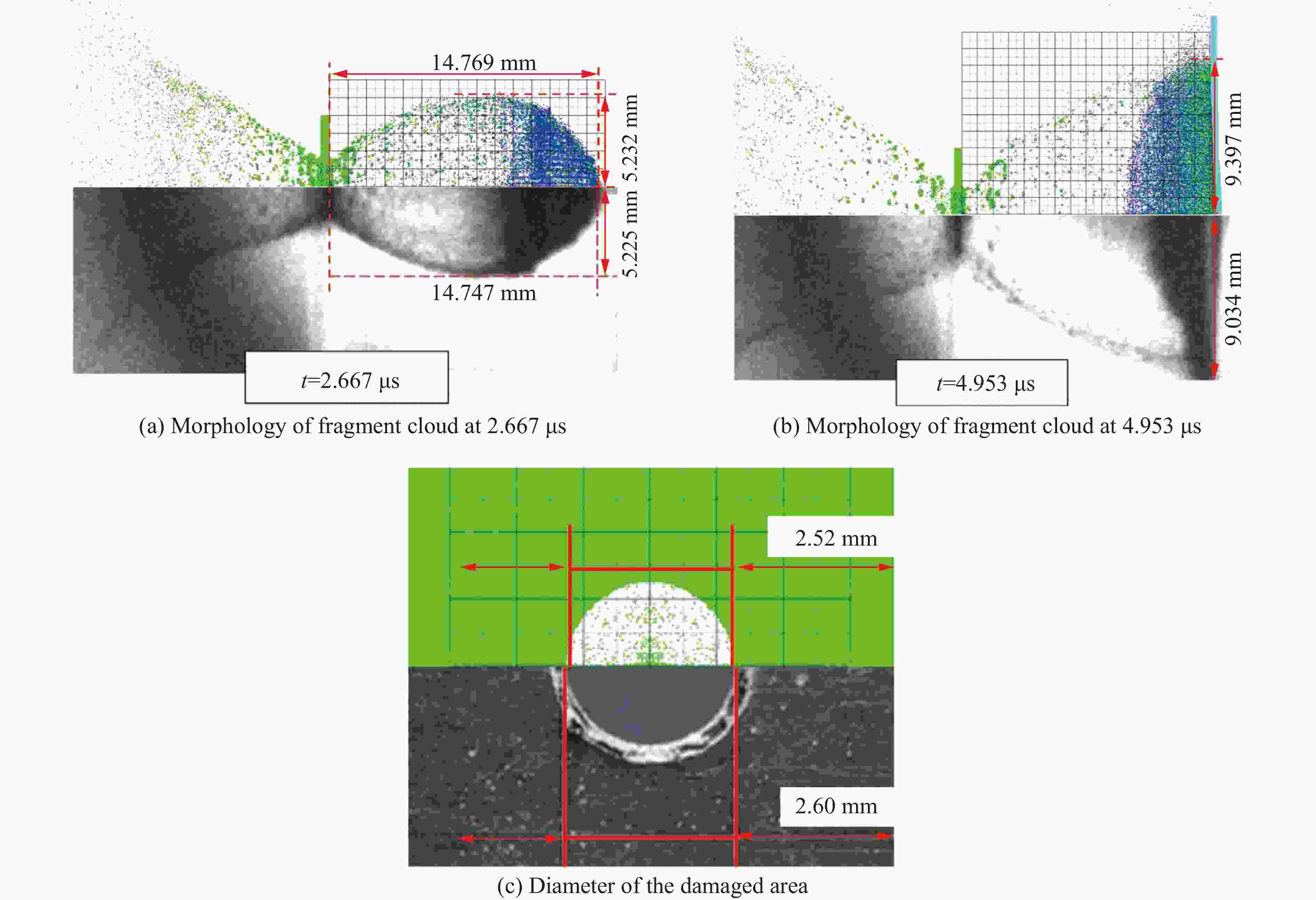
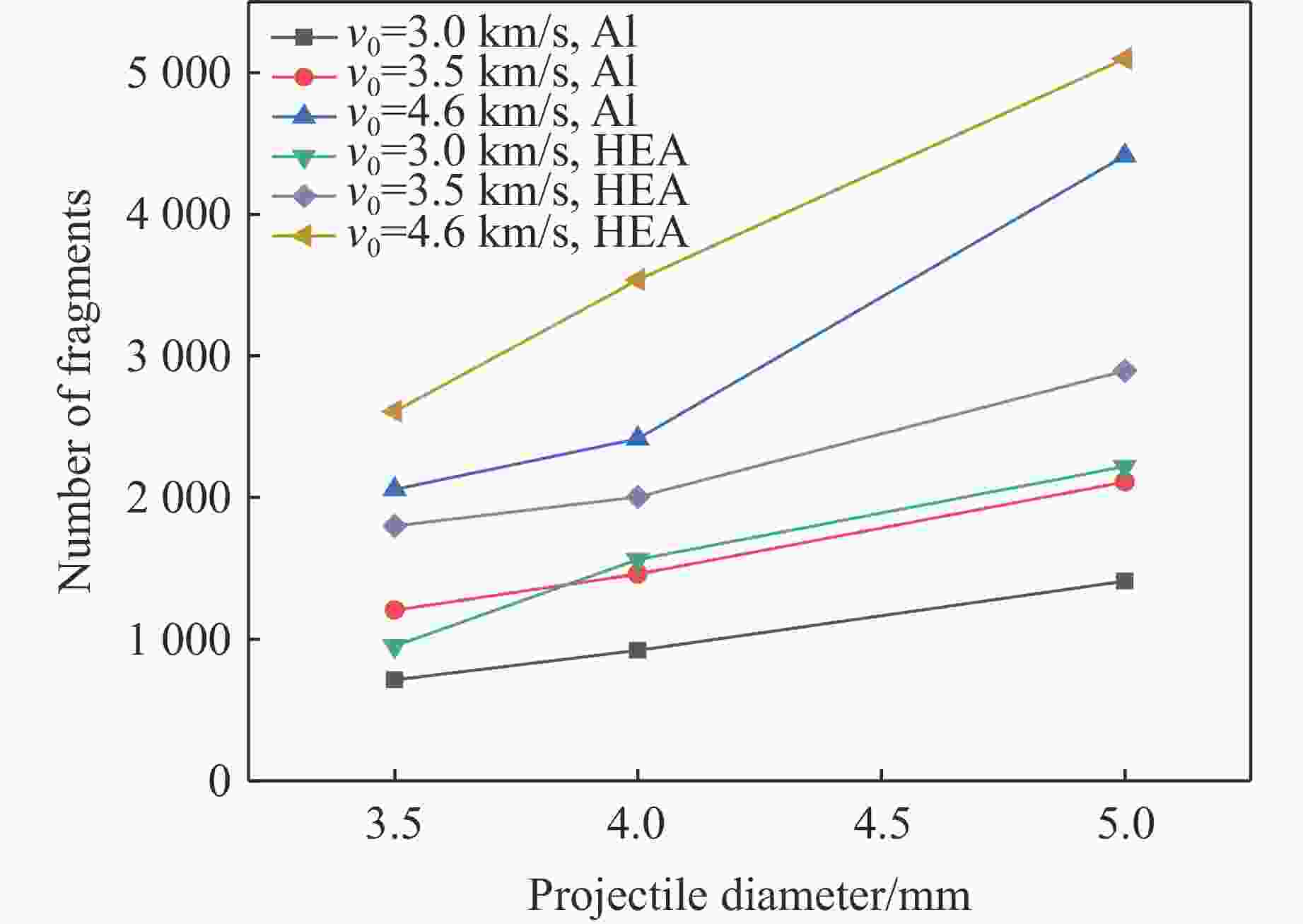
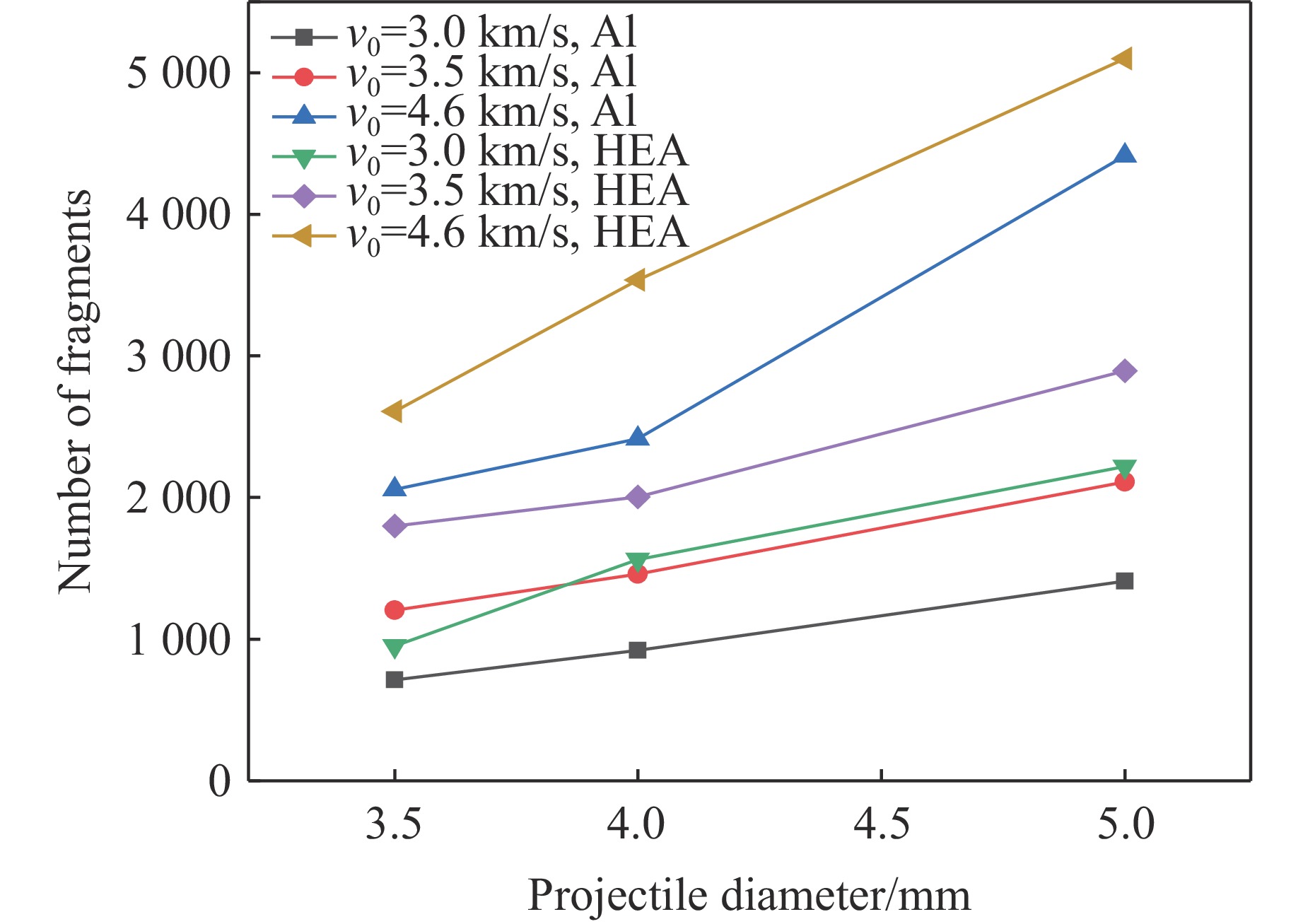
图 3 不同撞击速度下2种防护结构的碎片数量变化
Figure 3. Variations of fragments number of two protective structures under different impact velocities
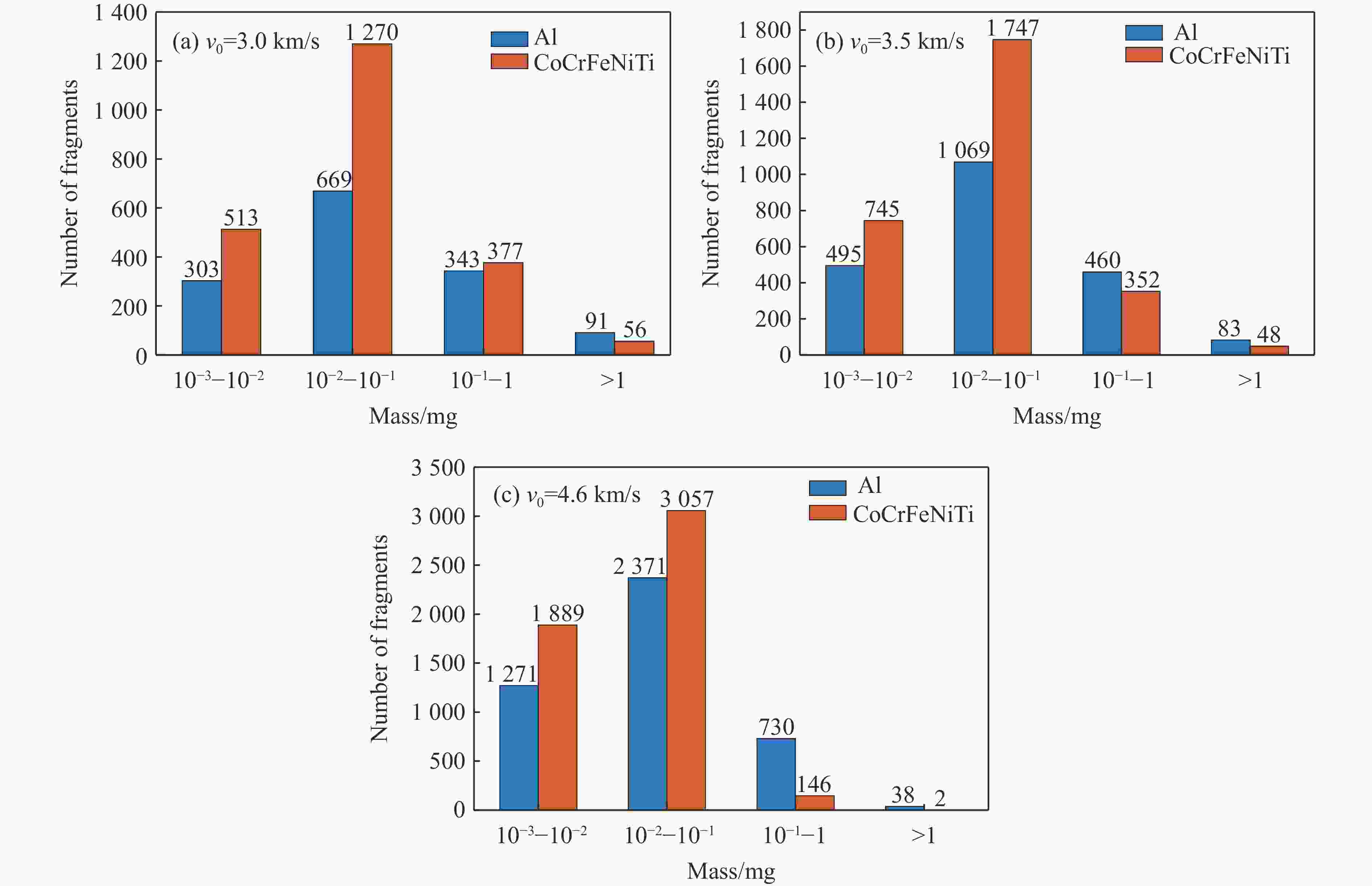
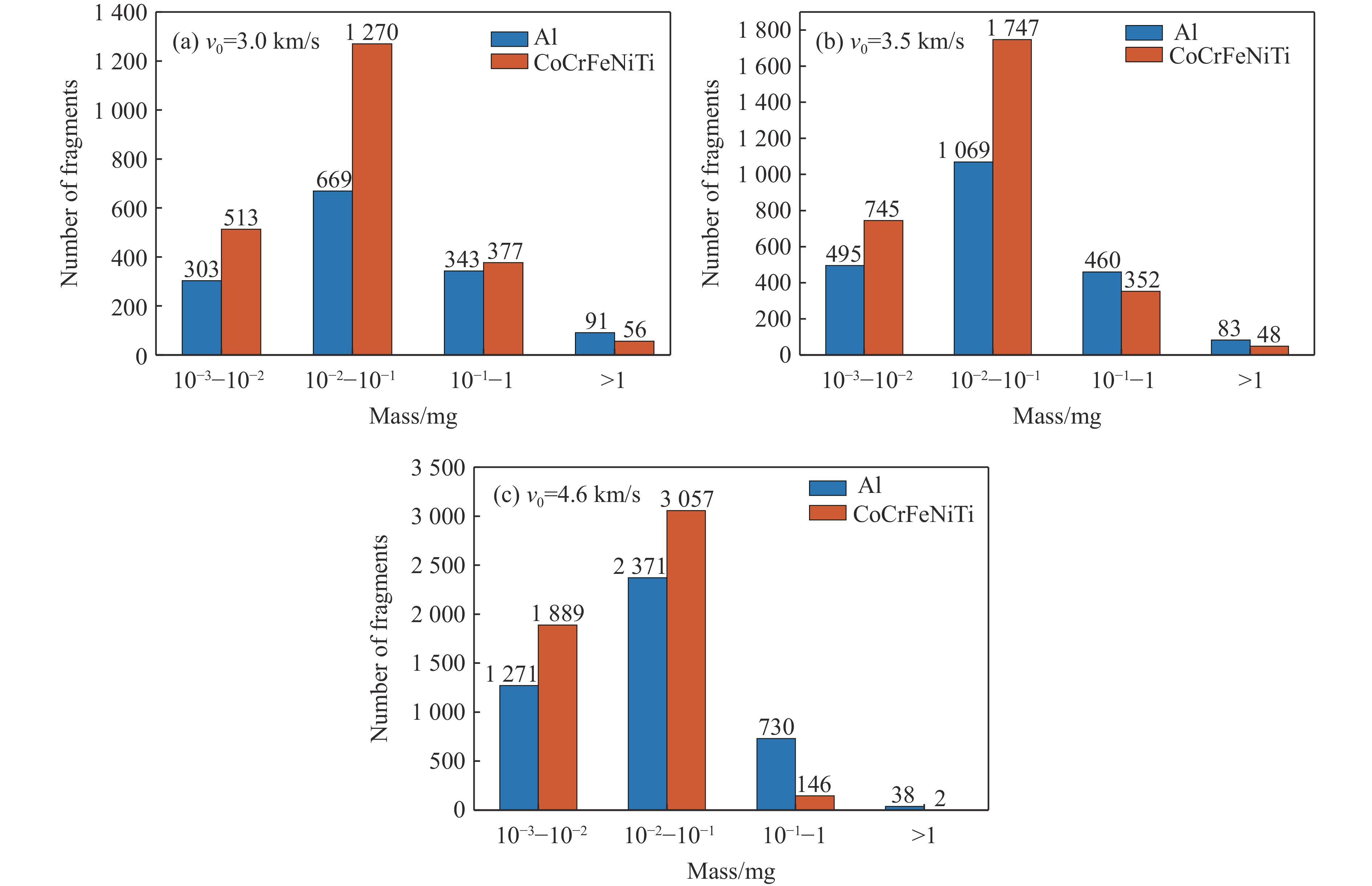
图 4 不同撞击速度下2种防护结构的碎片云质量分布
Figure 4. Mass distribution of debris cloud of two protective structures under different impact velocities
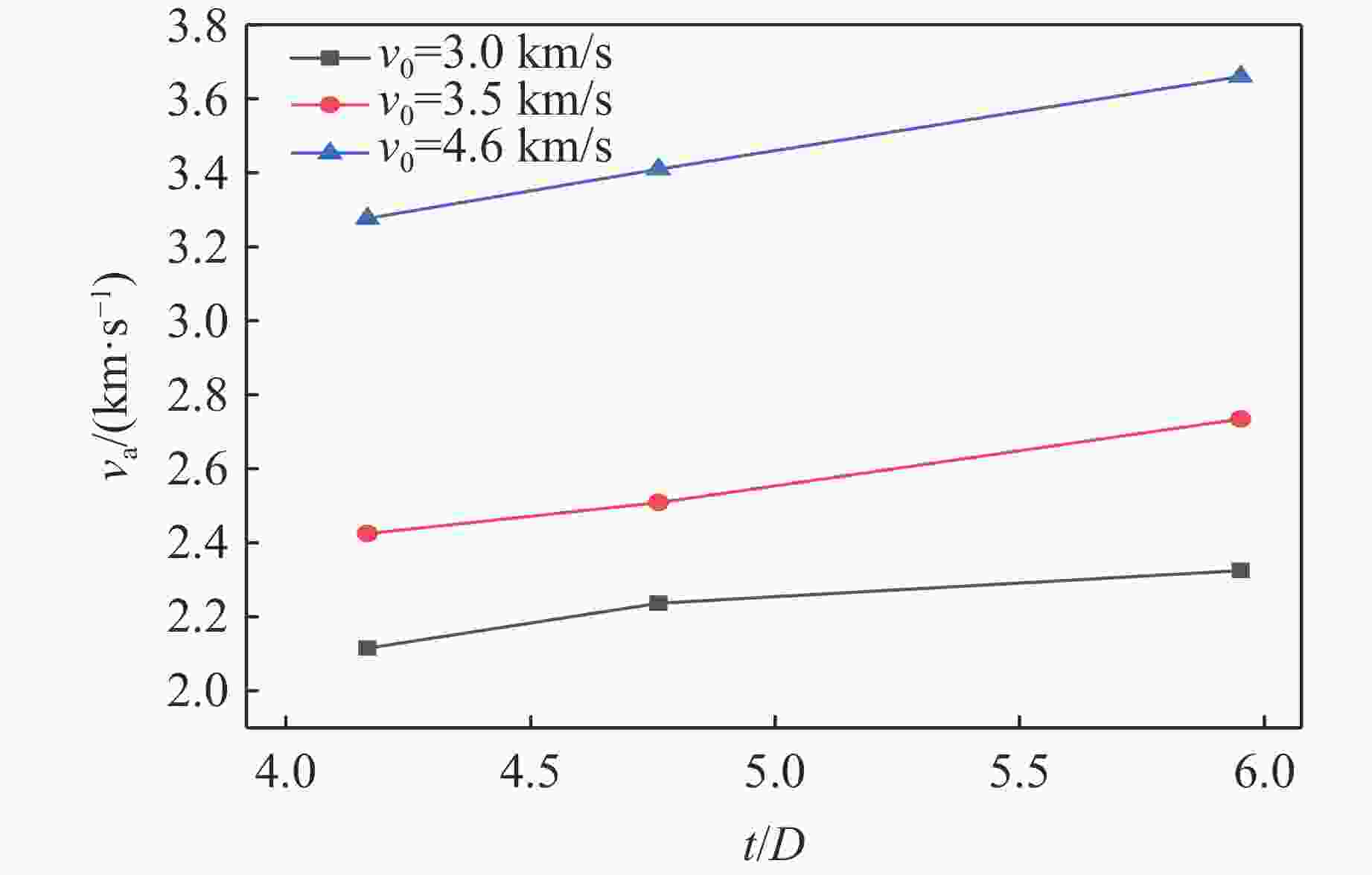
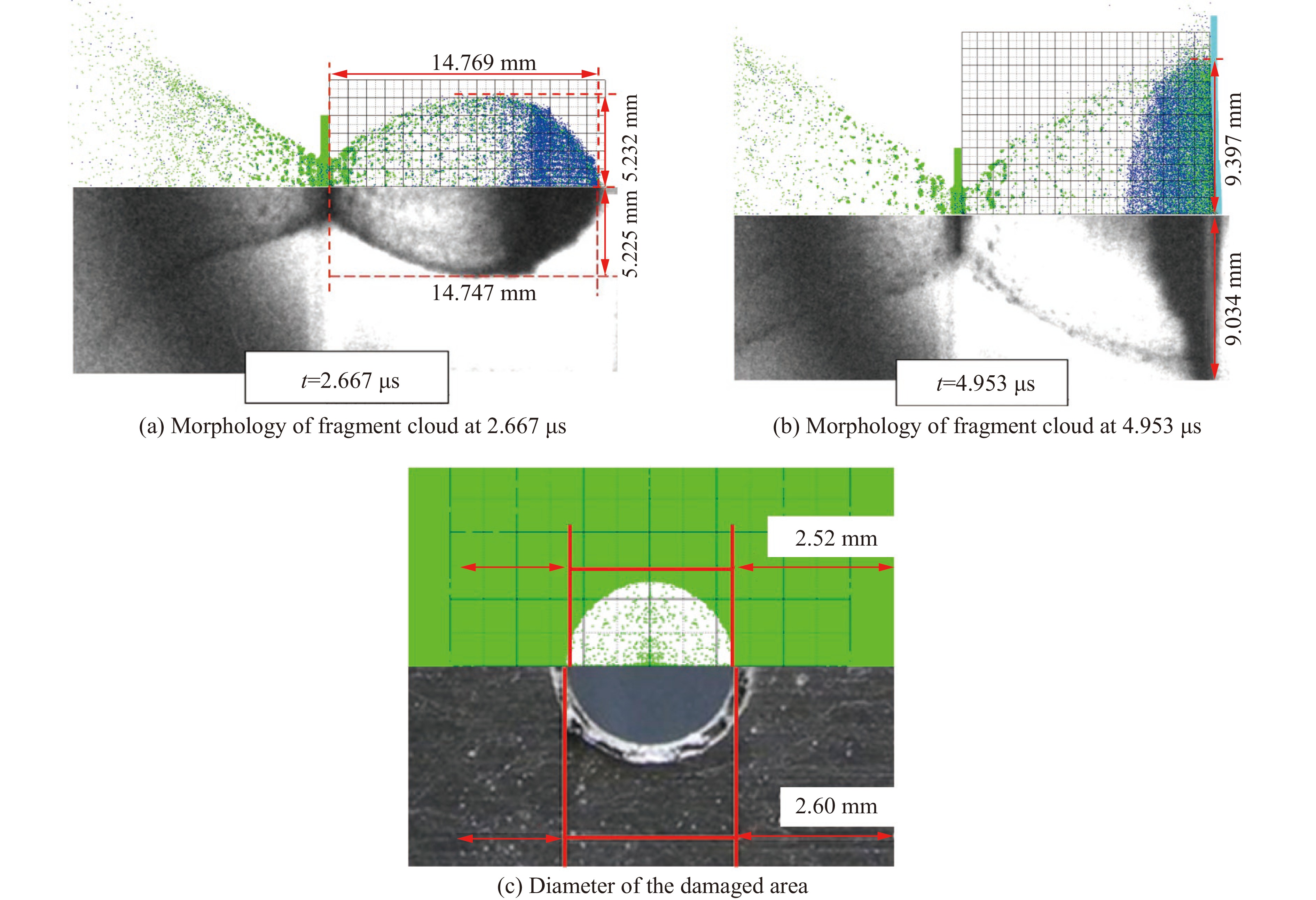
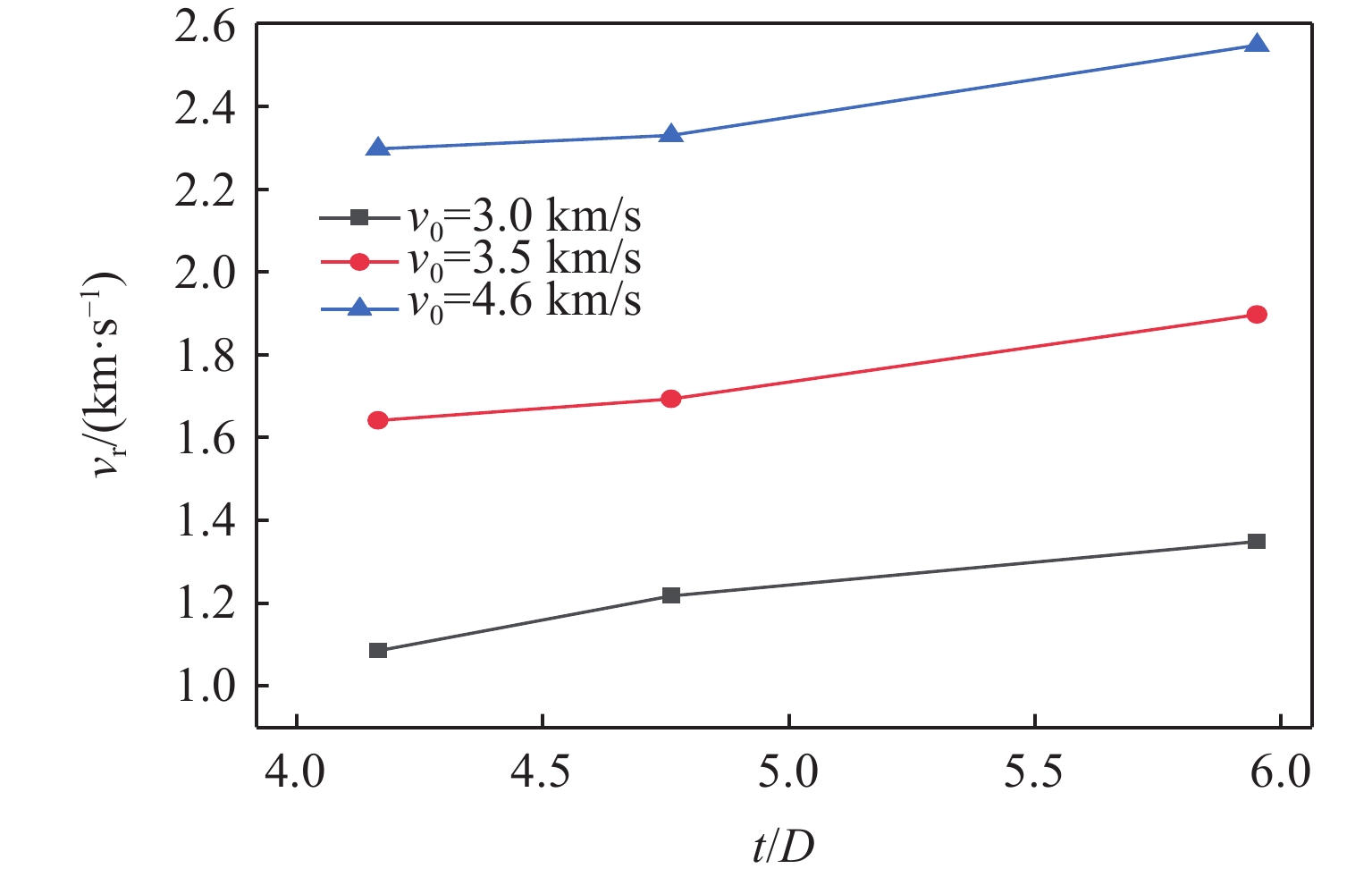
图 7 外泡碎片云头部膨胀速度
Figure 7. Expansion velocity of the head of the outer bubble debris cloud
表 1 材料所选模型
Table 1. Material models
Structure Material Equation of state Constitutive equation Failure model Projectile Al6061-T6 Grüneisen Johnson-Cook Grady Protection plate Al2024-T4 Grüneisen Johnson-Cook Grady Protection plate CoCrFeNiTi Grüneisen Johnson-Cook Grady Rear panel Al6061-T6 Grüneisen Johnson-Cook Johnson-Cook  下载: 导出CSV
表 2 材料参数
Table 2. Material parameters
Material $ \rho $/(g·cm−3) $ \gamma $ $ {C}_{0} $/(m·s−1) $ S $ $ {T}_{0} $/K $ {T}_{\rm m} $/K Al6061-T6 2.703 1.97 5240 1.40 293 885 Al2024-T4 2.785 2.0 5328 1.338 293 863 CoCrFeNiTi 6.42 1.9 4902 1.53 1775 Material $ A $/MPa $ B $/MPa $ C $ $ n $ $ \dot{\varepsilon }_0 $/s−1 $ m $ Al6061-T6 324 114 0.002 0.42 1.34 1.0 Al2024-T4 325 414 0.015 0.20 1.0 1.0 CoCrFeNiTi 381 755 0.0352 0.78 0.76 Material $ {\varepsilon }_{\mathrm{c}} $ $ {D}_{1} $ $ {D}_{2} $ $ {D}_{3} $ $ {D}_{4} $ $ {D}_{5} $ Al6061-T6 0.15 −0.77 1.45 −0.47 0 1.6 Al2024-T4 0.15 CoCrFeNiTi 0.20
下载: 导出CSV
-
[1] ARSHAD M, BAZZOCCHI M C F, HUSSAIN F. Emerging strategies in close proximity operations for space debris removal: a review [J]. Acta Astronautica, 2025, 228: 996–1022. doi: 10.1016/j.actaastro.2024.12.017 [2] 邸德宁, 陈小伟, 文肯, 等. 超高速碰撞产生的碎片云研究进展 [J]. 兵工学报, 2018, 39(10): 2016–2047. doi: 10.3969/j.issn.1000-1093.2018.10.018DI D N, CHEN X W, WEN K, et al. A review on the study of debris cloud produced by normal hypervelocity impact upon a thin plate [J]. Acta Armamentarii, 2018, 39(10): 2016–2047. doi: 10.3969/j.issn.1000-1093.2018.10.018 [3] 龚自正, 赵秋艳, 李明, 等. 空间碎片防护研究前沿问题与展望 [J]. 空间碎片研究, 2019, 19(3): 2–13.GONG Z Z, ZHAO Q Y, LI M, et al. The frontier problem and prospect of space debris protection research [J]. Space Debris Research, 2019, 19(3): 2–13. [4] HE Q G, CHEN X W, CHEN J F. Finite element-smoothed particle hydrodynamics adaptive method in simulating debris cloud [J]. Acta Astronautica, 2020, 175: 99–117. doi: 10.1016/j.actaastro.2020.05.056 [5] CAO X, ZHOU J Q, XU H D, et al. An SPH model reconstruction framework with fragment mapping method for multiplate structure hypervelocity impact simulation [J]. Advances in Space Research, 2025, 75(11): 8140–8157. doi: 10.1016/j.asr.2025.03.047 [6] PAI A, KAWASE M, NISHIDA M, et al. 3D numerical and experimental investigation of hypervelocity impacts on dual bumper plate Whipple shields for spacecraft protection [J]. Acta Astronautica, 2025, 232: 374–386. doi: 10.1016/j.actaastro.2025.03.012 [7] CLINE C J, CHRISTIANSEN E L, MCCANDLESS R, et al. Preliminary experimental investigation of multi-shock shield performance against meteoritic and other lithic projectiles [J]. International Journal of Impact Engineering, 2025, 203: 105324. doi: 10.1016/j.ijimpeng.2025.105324 [8] SATHISH KUMAR S K, KIM Y, CHA J H, et al. Hybrid interspaced and free-boundary aramid fabric back bumper for hypervelocity impact shielding system [J]. International Journal of Impact Engineering, 2023, 171: 104377. doi: 10.1016/j.ijimpeng.2022.104377 [9] LI J, WEN X Z, HUANG J, et al. Study on shielding performance of aerogel/fiberglass composite stuffed shield [J]. International Journal of Impact Engineering, 2023, 173: 104467. doi: 10.1016/j.ijimpeng.2022.104467 [10] PAI A, MUJUMDAR N, PICCHOLIYA A, et al. Computational studies on hyper velocity impact of spherical projectiles on whipple shield with hybrid Newtonian fluid-filled core [J]. Acta Astronautica, 2024, 220: 230–242. doi: 10.1016/j.actaastro.2024.04.033 [11] VOILLAT R, GALLIEN F, MORTENSEN A, et al. Hypervelocity impact testing on stochastic and structured open porosity cast Al-Si cellular structures for space applications [J]. International Journal of Impact Engineering, 2018, 120: 126–137. doi: 10.1016/j.ijimpeng.2018.05.002 [12] REN S Y, WU Q, ZHANG P L, et al. Damage effects of aluminum alloy honeycomb sandwich panel double-layer structure induced by reactive projectile hypervelocity impact [J]. Thin-Walled Structures, 2024, 202: 112076. doi: 10.1016/j.tws.2024.112076 [13] KAMAREH F, PANG B J, CAO W X, et al. Proposing novel body-centered cubic lattice core sandwich panels as satellite structure [J]. Advances in Space Research, 2024, 74(11): 5779–5802. doi: 10.1016/j.asr.2024.08.064 [14] ÖNDER A. Projectile fragmentation and debris cloud formation behaviour of wavy plates in hypervelocity impact [J]. International Journal of Impact Engineering, 2024, 183: 104788. doi: 10.1016/j.ijimpeng.2023.104788 [15] PUTZAR R, ZHENG S G, AN J, et al. A stuffed Whipple shield for the Chinese space station [J]. International Journal of Impact Engineering, 2019, 132: 103304. doi: 10.1016/j.ijimpeng.2019.05.018 [16] DUAN Y P, CHI R Q, PANG B J, et al. Experimental and numerical study of hypervelocity impact damage on composite overwrapped pressure vessels [J]. Defence Technology, 2024, 31: 58–72. doi: 10.1016/j.dt.2023.01.009 [17] HUANG X G, YIN C, RU H Q, et al. Hypervelocity impact damage behavior of B4C/Al composite for MMOD shielding application [J]. Materials & Design, 2020, 186: 108323. doi: 10.1016/j.matdes.2019.108323 [18] REN S Y, LONG R R, ZHANG Q M, et al. The hypervelocity impact resistance behaviors of NbC/Al2024 ceramic-metal composites [J]. International Journal of Impact Engineering, 2021, 148: 103759. doi: 10.1016/j.ijimpeng.2020.103759 [19] 武强, 张庆明, 龚自正, 等. 活性Whipple结构超高速撞击防护性能实验研究 [J]. 爆炸与冲击, 2021, 41(2): 021406. doi: 10.11883/bzycj-2020-0266WU Q, ZHANG Q M, GONG Z Z, et al. Experimental investigation into performances of an active Whipple shield against hypervelocity impact [J]. Explosion and Shock Waves, 2021, 41(2): 021406. doi: 10.11883/bzycj-2020-0266 [20] REN S Y, ZHANG Q M, Wu Q, et al. Influence of impact-induced reaction characteristics of reactive composites on hypervelocity impact resistance [J]. Materials & Design, 2020, 192: 108722. doi: 10.1016/j.matdes.2020.108722 [21] FAN J T, TANG J Q, CAI Z Q, et al. Transverse impact response of movable fiber bundle with constant resistance [J]. International Journal of Mechanical Sciences, 2026, 310: 111105. doi: 10.1016/j.ijmecsci.2025.111105 [22] ALI S F, FAN J T. Capturing dynamic behaviors of a rate sensitive, elastomer with strain energy absorptions and dissipation effects [J]. International Journal of Applied Mechanics, 2021, 13(9): 2150104. doi: 10.1142/S1758825121501040 [23] 刘承哲, 王海福, 张甲浩, 等. 轻质高熵合金聚能射流毁伤混凝土靶行为研究 [J]. 兵工学报, 2024, 45(Suppl 1): 60–69.LIU C Z, WANG H F, ZHANG J H, et al. Research on behavior of lightweight high-entropy alloy jet penetrating concrete targets [J]. Acta Armamentarii, 2024, 45(Suppl 1): 60–69. [24] CAO S, FAN J T. Numerical model for penetration process of a deformable projectile into ductile metallic target plate considering the interaction of projectile and target [J]. International Journal of Impact Engineering, 2025, 195: 105107. doi: 10.1016/j.ijimpeng.2024.105107 [25] UDDIN J, FAN J T. Interpretable machine learning framework to predict the glass transition temperature of polymers [J]. Polymers, 2024, 16(8): 1049. doi: 10.3390/polym16081049 [26] FATEH ALI S, FAN J T. Mechanism-based modeling of strain rate-dependent transition of macromechanical behavior accompanied by temperature rise effects of a toughened polymer composite [J]. Journal of Engineering Mechanics, 2024, 150(5): 04024015. doi: 10.1061/JENMDT.EMENG-7416 [27] TANG J Q, FAN J T, CHEN S H. A numerical model for calculating the impact-induced depression [J]. International Journal of Impact Engineering, 2024, 183: 104792. doi: 10.1016/j.ijimpeng.2023.104792 [28] 邸德宁, 陈小伟. 碎片云SPH方法数值模拟中的材料失效模型 [J]. 爆炸与冲击, 2018, 38(5): 948–956. doi: 10.11883/bzycj-2017-0328DI D N, CHEN X W. Material failure models in SPH simulation of debris cloud [J]. Explosion and Shock Waves, 2018, 38(5): 948–956. doi: 10.11883/bzycj-2017-0328 [29] CHERNIAEV A, TELICHEV I. Weight-efficiency of conventional shielding systems in protecting unmanned spacecraft from orbital debris [J]. Journal of Spacecraft and Rockets, 2017, 54(1): 75–89. doi: 10.2514/1.A33596 [30] HE Q G, CHEN J F, CHEN X W. Velocity-space analysis method for hazardous fragments in debris clouds [J]. International Journal of Impact Engineering, 2022, 161: 104087. doi: 10.1016/j.ijimpeng.2021.104087 [31] ADEBA M M, FAN J T. Framework and computational model of bubble dynamics under water [J]. Physics of Fluids, 2025, 37(10): 106127. doi: 10.1063/5.0289876 -

 下载:
下载:

计量
- 文章访问数: 1245
- HTML全文浏览量: 606
- PDF下载量: 148
