





Optimization Development and Application of Lee-Tarver Reaction Rate Model
-
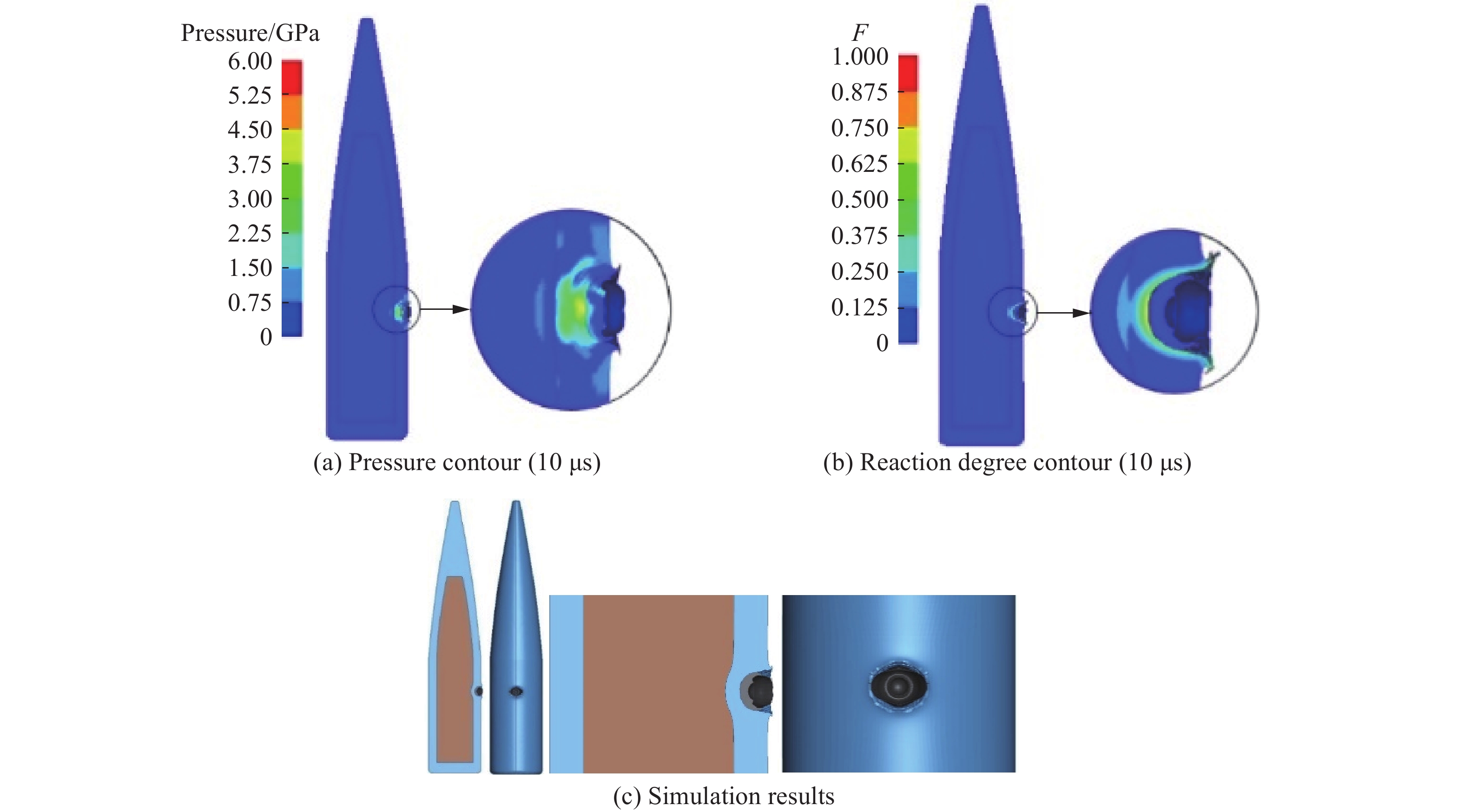
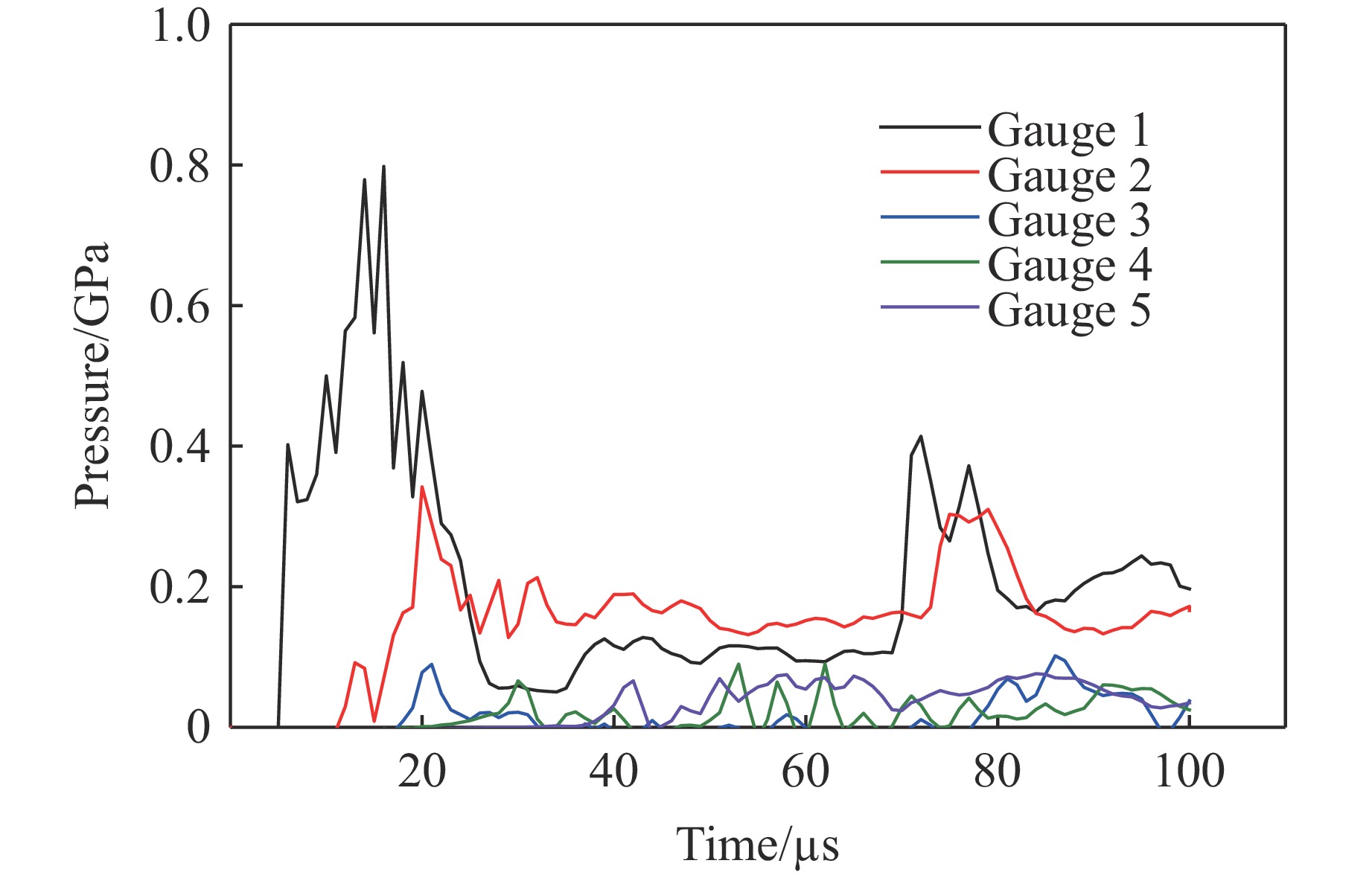
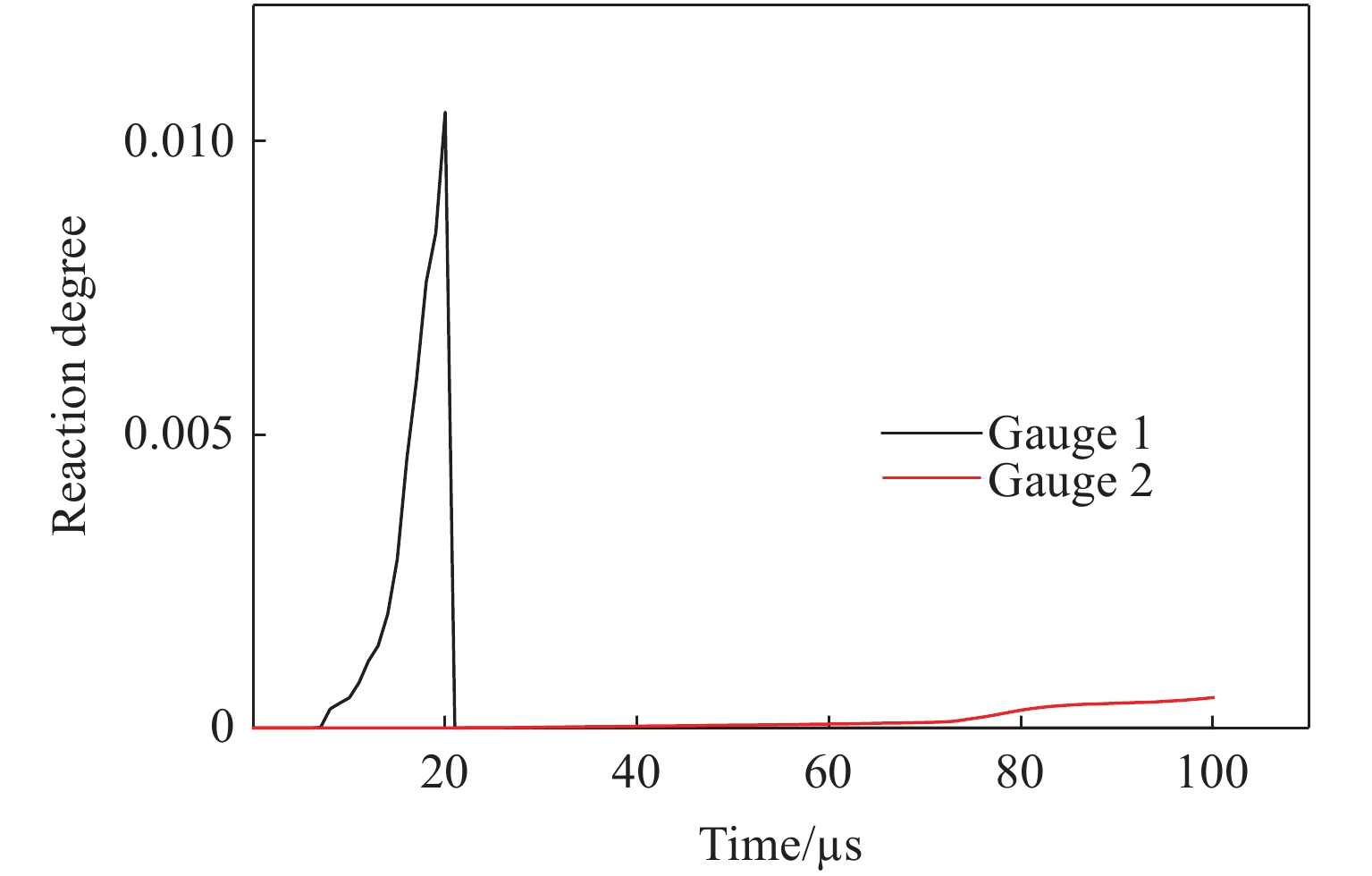
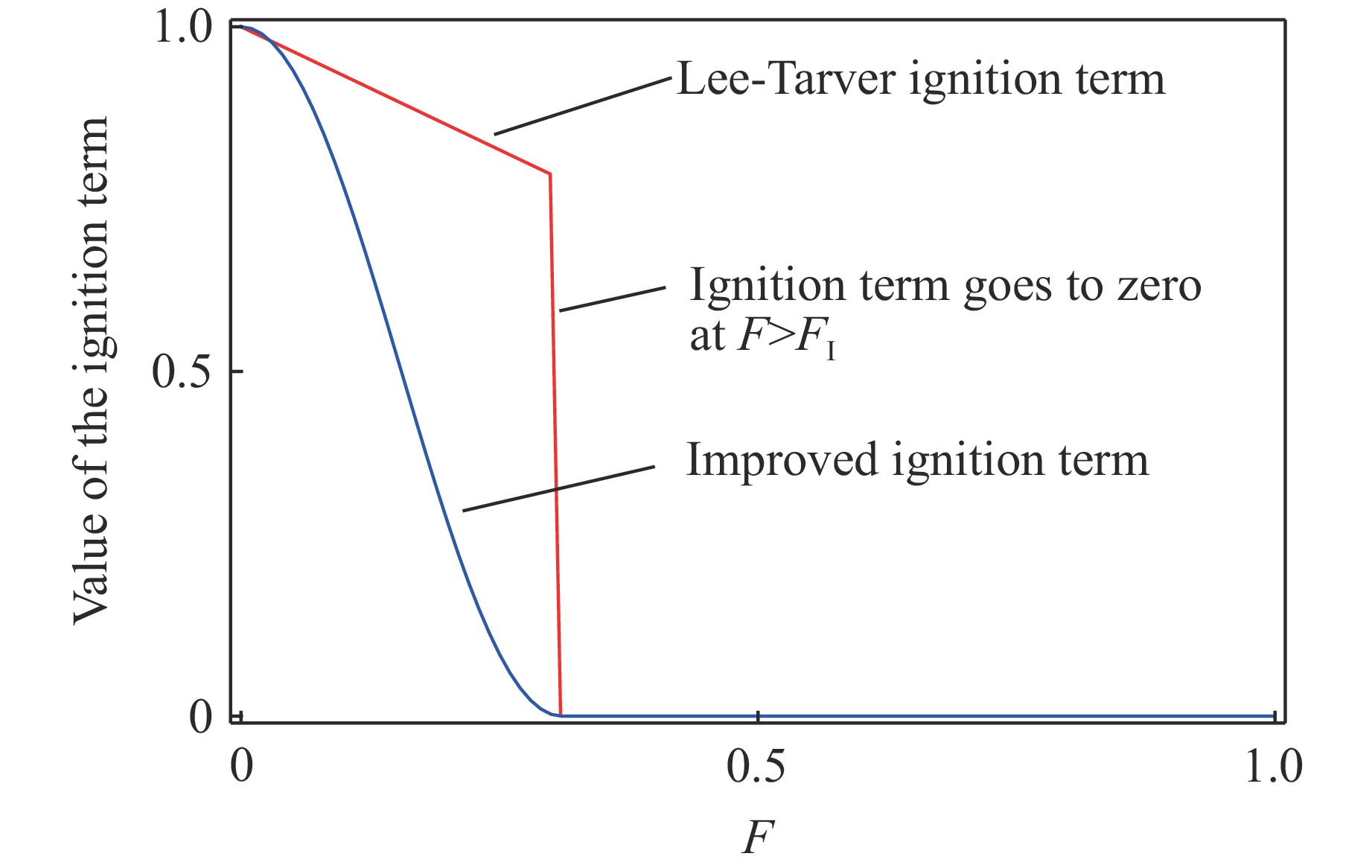
摘要: 针对Lee-Tarver点火增长反应速率方程参数多且不易标定的问题,在三项式结构的基础上,引入半周期三角函数对模型进行优化。新速率方程优化了点火项的连续性,将增长项和完成项的形状因子最大数值限制为1,减弱了比例系数和形状因子的参数补偿,消除了三项式的反应度极限,将反应速率方程参数由15个降至10个,提高了参数标定的效率。基于LS-DYNA对改进的点火增长模型进行二次开发,对比计算了Lee-Tarver模型和优化模型的冲击起爆仿真结果,炸药内部压力和反应度高度一致,验证了模型开发的正确性。基于炸药驱动金属板试验结果,应用LS-OPT标定了优化的点火增长模型参数,并统计了反应速率方程参数的敏感度,提炼出了关键参数,可为进一步提高参数标定效率提供参考。仿真结果与炸药驱动金属板试验结果的相对误差小于3%,验证了标定参数的准确性。应用改进的点火增长模型,结合子弹/破片撞击弹药的安全性试验,研究了子弹/破片撞击下弹药的冲击起爆响应特性。子弹撞击弹药后66 μs内炸药内部峰值超压达到14.5 GPa(爆压的48.3%),表明炸药未发生爆轰反应;破片撞击条件下,炸药内部峰值超压仅为0.79 GPa,近撞击点的反应度大于其他区域,最大反应度仅为0.01,炸药未起爆。优化模型的仿真结果与试验测试结果的一致性较好,验证了优化开发的点火增长模型的工程应用性。Abstract: To address the short comings of the Lee-Tarver ignition and growth reaction rate equation, which comprises numerous parameters (15) and is difficult to calibrate, semi-periodic trigonometric functions were introduced to optimize the model. The new reaction rate equation enhances the continuity of the ignition term, restricts the maximum value of the shape factors for the growth and completion terms to 1, mitigates the parameter compensation between the proportional coefficients and the shape factors, eliminates the reaction degree limit of the trinomial structure, reduces the number of parameters in the reaction rate equation to 10, thereby improving parameter calibration efficiency. Based on LS-DYNA, a secondary development was conducted for the improved ignition and growth model. Comparative calculations were performed to assess the shock initiation simulation results from the Lee-Tarver model and the optimized model, revealing highly consistent results for the internal pressure and reaction degree of the explosive, validating the correctness of the model development. Utilizing test data from explosive-driven metal plates, the parameters of the optimized ignition and growth model were calibrated with LS-OPT, and the sensitivity of the rate equation parameters was statistically analyzed to identify key parameters, providing a reference for further improving parameter calibration efficiency. Comparisons between test and simulated results of explosive-driven metal plates showed a simulation error of less than 3%, confirming the engineering validity of the calibrated parameters. Applying the improved ignition and growth model with safety experiments, the impact initiation response characteristics of ammunition under bullet/fragment impact were investigated. Within 66 μs after bullet impact, the peak internal pressure of the explosive reached 14.5 GPa (48.3% of the detonation pressure), indicating no detonation reaction occurred. Under fragment impact conditions, the peak internal pressure of the explosive was only 0.79 GPa, with the reaction degree near the impact point being higher than in other regions, but the maximum reaction degree was merely 0.01, confirming no detonation. The simulation results of the optimized model exhibited good consistency with test results, validating the engineering applicability of the optimized and developed ignition and growth model.
-

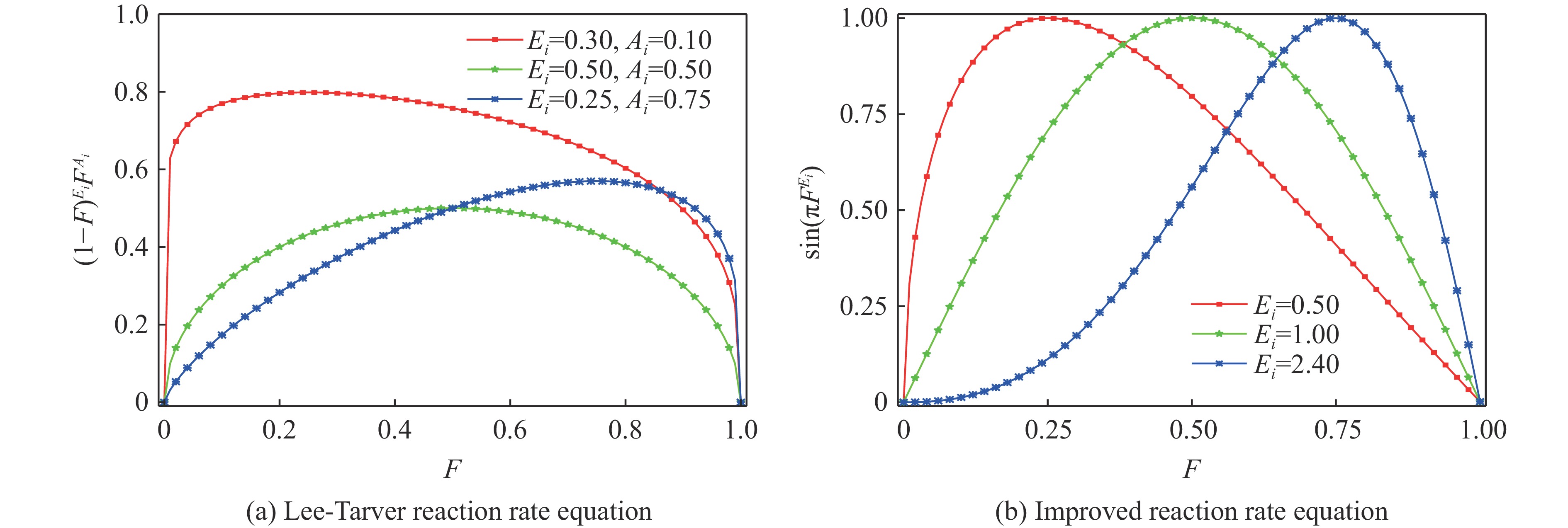
图 1 Lee-Tarver速率方程和优化速率方程的点火项对比
Figure 1. Comparison of the ignition terms of the Lee-Tarver reaction rate equation and the improved reaction rate equation

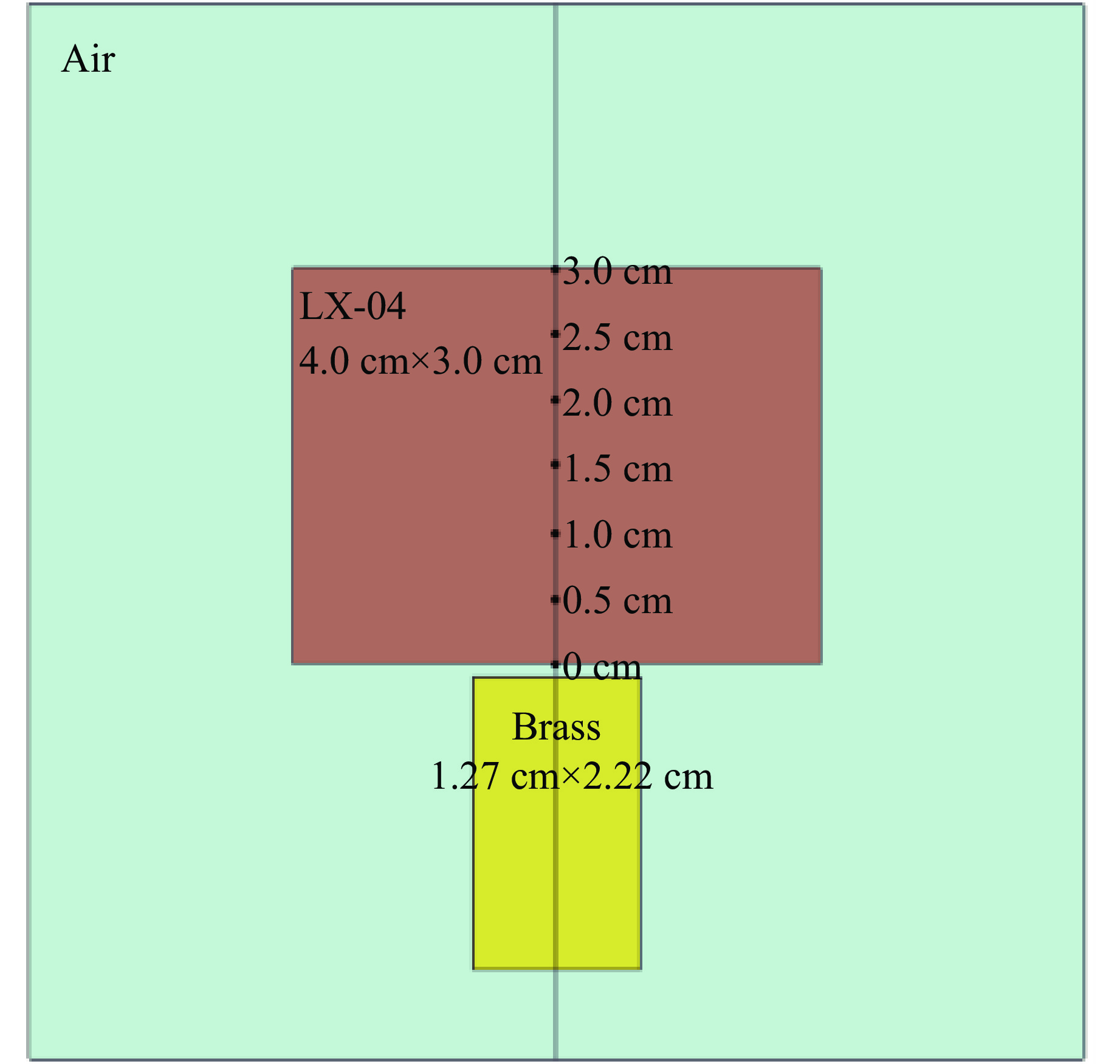
图 4 破片冲击裸炸药模型及测点分布
Figure 4. Model of fragment impact on bare explosive and distribution of gauge points

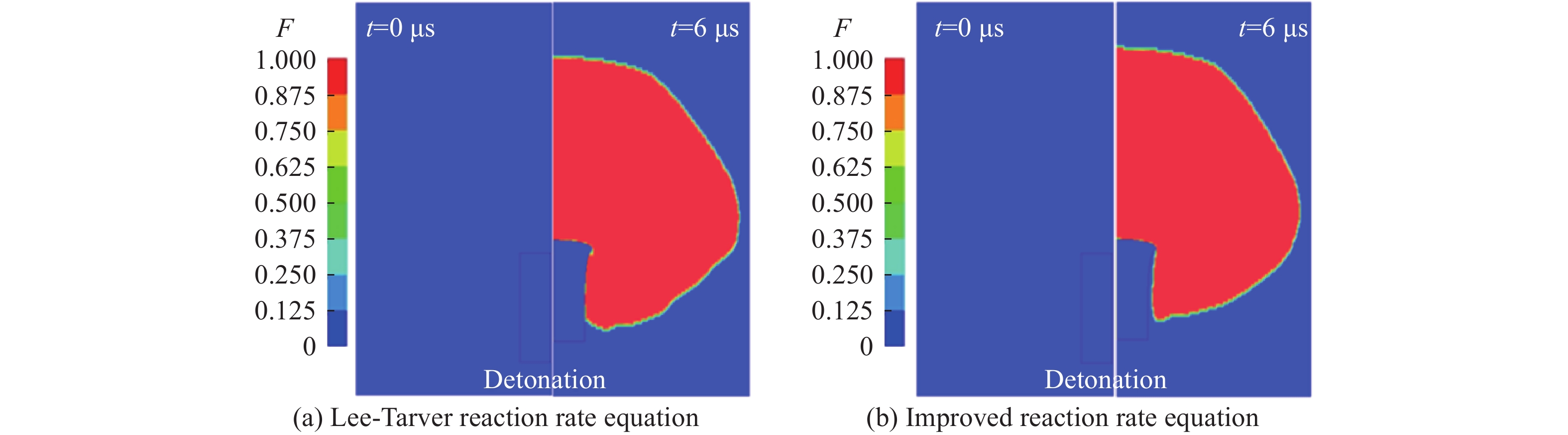
图 5 t=0 μs和t=6.0 μs时炸药反应度计算结果
Figure 5. Calculation results of reaction degree of explosive at t=0 μs and t=6.0 μs

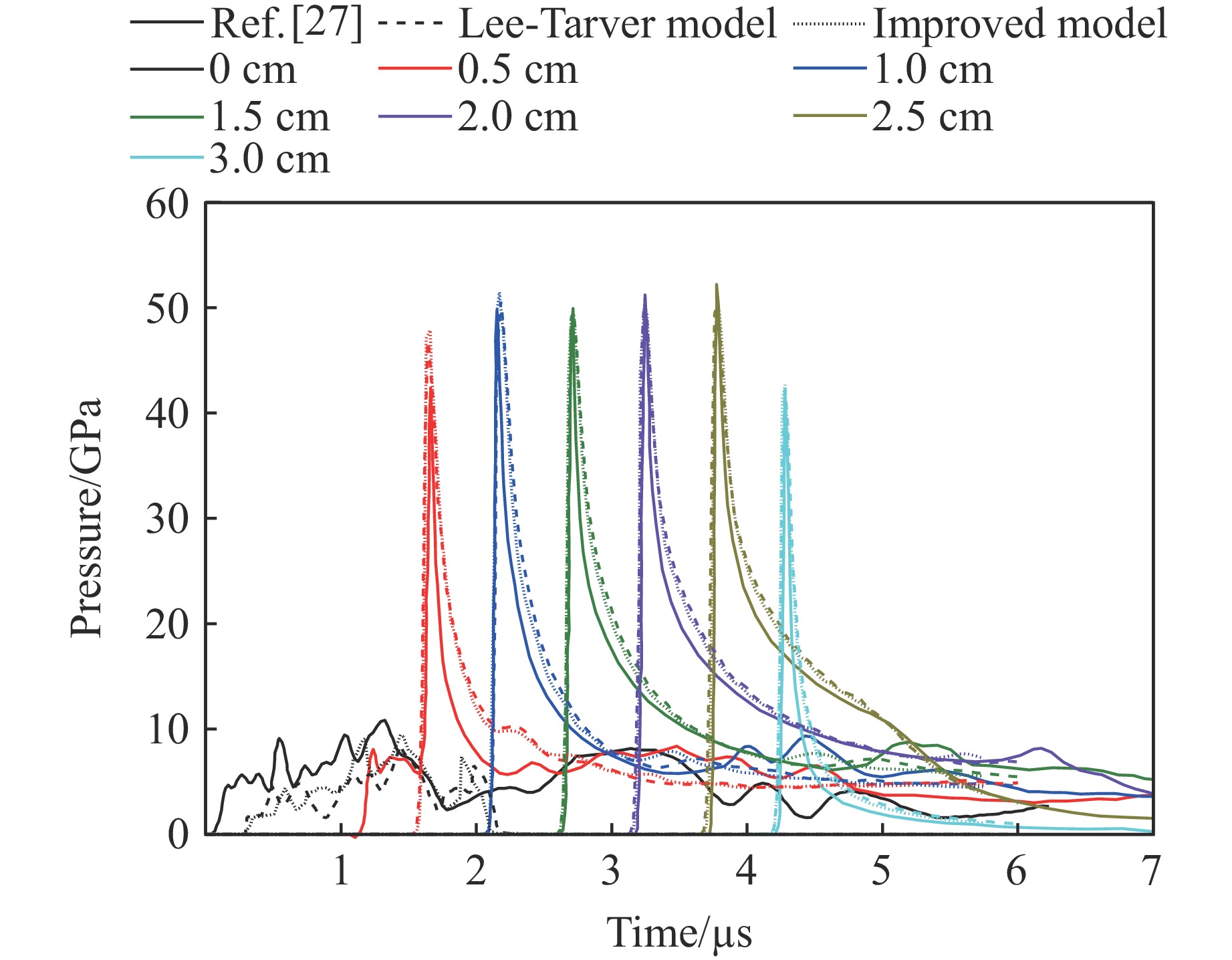
图 6 830 m/s冲击速度下不同监测点处的压力变化
Figure 6. Pressure histories measured at different monitoring points under impact velocity of 830 m/s
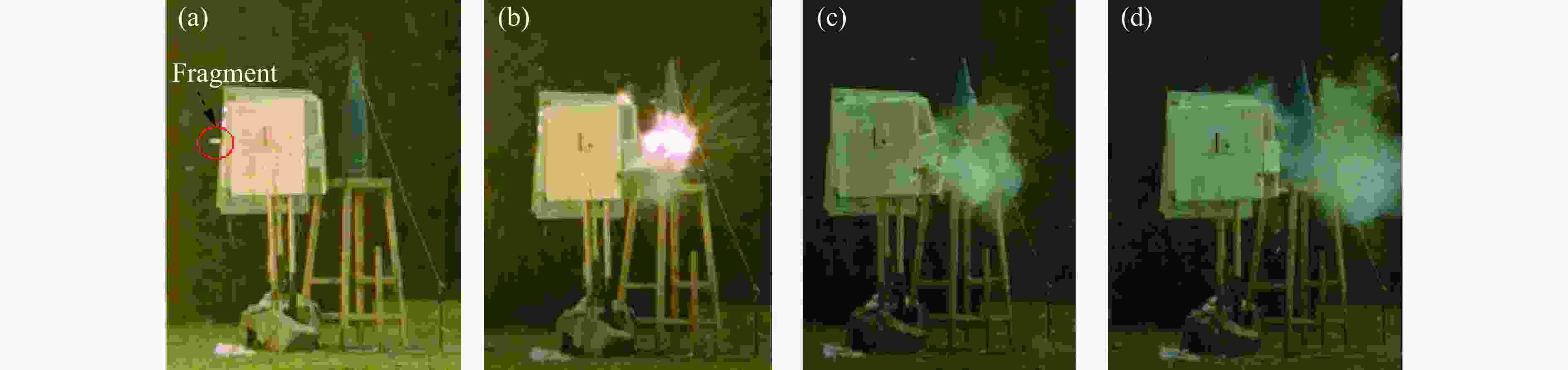
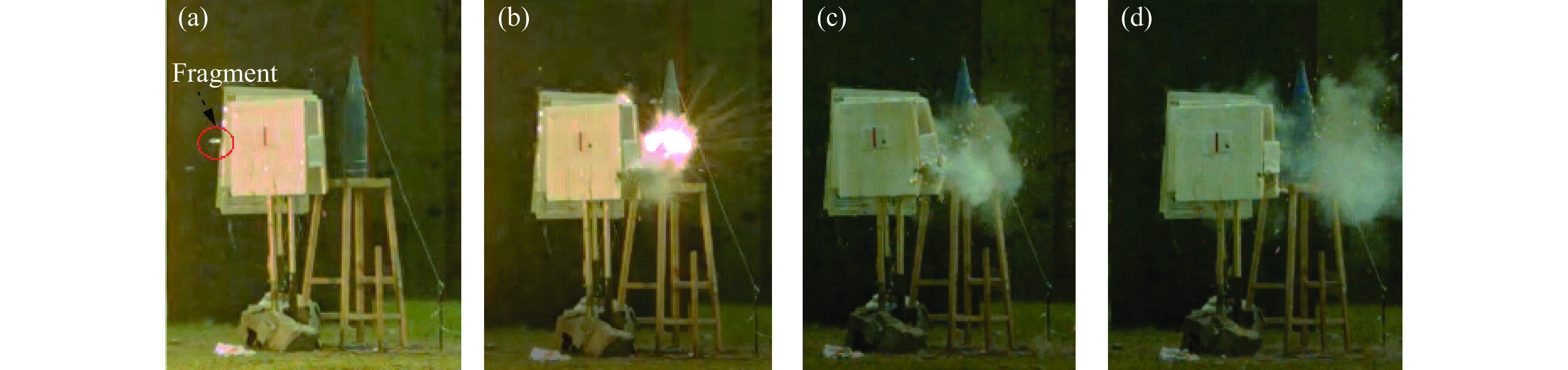
图 12 破片撞击试验的高速摄影结果
Figure 12. High-speed camera recording images of fragment impact test
表 1 黄铜材料的Johnson-Cook本构模型参数[27]
Table 1. Parameters of the Johnson-Cook constitutive model for brass[27]
ρ0/(g·cm−3) AJC/MPa BJC/MPa CJC n m Tm/K cp/(J·kg−1·K−1) 8.52 112 505 0.009 0.42 1.68 1189 385  下载: 导出CSV
ρ0/(kg·m−3) pk/Pa Cμ/(Pa·s) 1.29 −3 1.68×10⁻⁵
下载: 导出CSV
C0 C1 C2 C3 C4 C5 C6 E0/MPa V0 0 0 0 0 0.4 0.4 0 2.53 2
下载: 导出CSV
表 4 LX-04的改进反应速率模型参数
Table 4. Parameters of the improved reaction rate model for LX-04
f F1 C1 E3 $ {G}_{1} $ E1 m $ {G}_{2} $ E2 n 0.5 6×10⁴ 0.075 7 220 0.67 2 320 0.888 2.0
下载: 导出CSV
表 5 超压测试结果
Table 5. Shock wave overpressure test results
Gauge point Δpmax/kPa Δt+/ms 1 65.476 3.283 2 58.072 3.103 3 67.891 3.030 4 58.015 3.173
下载: 导出CSV
表 6 铜的Johnson-Cook本构模型参数[30]
Table 6. Parameters of the Johnson-Cook constitutive model for copper[30]
ρ0/(g·cm−3) AJC/MPa BJC/MPa CJC n m Tm/K cp/(J·kg−1·K−1) 8.96 90 292 0.025 0.31 1.09 1356 383
下载: 导出CSV
表 7 LS-OPT标定的优化模型参数
Table 7. Parameters of the improved model calibrated by LS-OPT
f F1 C1 E3 $ {G}_{1} $ E1 m $ {G}_{2} $ E2 n 0.31 3.13×10⁴ 0.042 8.49 570 1.34 1.76 442 1.37 0.68
下载: 导出CSV
-
[1] ZHOU T T, LOU J F, ZHANG Y G, et al. Hot spot formation and chemical reaction initiation in shocked HMX crystals with nanovoids: a large-scale reactive molecular dynamics study [J]. Physical Chemistry Chemical Physics, 2016, 18(26): 17627–17645. doi: 10.1039/C6CP02015A [2] SUN J, YANG P F, WANG Y Q, et al. Numerical study on detonation initiation by multiple hot spots [J]. Proceedings of the Combustion Institute, 2024, 40(1/2/3/4): 105191. doi: 10.1016/j.proci.2024.105191 [3] LIU W B, DUAN Z P, LIU Y, et al. Numerical simulation of the damage and ignition responses of high explosives under low-velocity impact using the SPH method [J]. Engineering Analysis with Boundary Elements, 2024, 166: 105830. doi: 10.1016/j.enganabound.2024.105830 [4] JOHNSON J N, TANG P K, FOREST C A. Shock-wave initiation of heterogeneous reactive solids [J]. Journal of Applied Physics, 1985, 57(9): 4323–4334. doi: 10.1063/1.334591 [5] LEE E L, TARVER C M. Phenomenological model of shock initiation in heterogeneous explosives [J]. Physics of Fluids, 1980, 23(12): 2362–2372. doi: 10.1063/1.862940 [6] MIAO F C, LI D D, CHENG Y F, et al. Shock initiation experiments with modeling on a DNAN based melt-cast insensitive explosive [J]. Defence Technology, 2024, 32: 655–662. doi: 10.1016/j.dt.2023.02.009 [7] YUAN J Y, DUAN Y L, HAN Y. Numerical simulation of multi-layer flyer impact initiation of a certain PBX explosive [J]. Propellants, Explosives, Pyrotechnics, 2024, 49(5): e202300252. doi: 10.1002/prep.202300252 [8] BOUYER V, SHEFFIELD S A, DATTELBAUM D M, et al. Experimental measurements of the chemical reaction zone of detonating liquid explosives [J]. AIP Conference Proceedings, 2009, 1195(1): 177–180. doi: 10.1063/1.3295096 [9] BOUYER V, HEBERT P, DOUCET M, et al. Experimental measurements of the chemical reaction zone of TATB and HMX based explosives [J]. AIP Conference Proceedings, 2012, 1426(1): 209–212. doi: 10.1063/1.3686256 [10] LOBOIKO B G, LUBYATINSKY S N. Reaction zones of detonating solid explosives [J]. Combustion, Explosion and Shock Waves, 2000, 36(6): 716–733. doi: 10.1023/A:1002898505288 [11] YANG Y, DUAN Z P, ZHANG L S, et al. Measurements of reaction zone and determination of the equation of state parameters of DNAN-based melt-cast aluminized explosive [J]. Journal of Energetic Materials, 2020, 38(2): 240–251. doi: 10.1080/07370652.2019.1679280 [12] 杨洋, 段卓平, 张连生, 等. 两种DNAN基含铝炸药的爆轰性能 [J]. 含能材料, 2019, 27(8): 679–684. doi: 10.11943/CJEM2018327YANG Y, DUAN Z P, ZHANG L S, et al. Detonation performance of two DNAN based aluminized explosives [J]. Chinese Journal of Energetic Materials, 2019, 27(8): 679–684. doi: 10.11943/CJEM2018327 [13] 李淑睿, 段卓平, 郑保辉, 等. 2, 4-二硝基苯甲醚基熔铸含铝炸药圆筒试验及爆轰产物状态方程 [J]. 兵工学报, 2021, 42(7): 1424–1430. doi: 10.3969/j.issn.1000-1093.2021.07.009LI S R, DUAN Z P, ZHENG B H, et al. Cylinder test and equation of state for DNAN-based aluminized melt-cast explosive [J]. Acta Armamentarii, 2021, 42(7): 1424–1430. doi: 10.3969/j.issn.1000-1093.2021.07.009 [14] 王永亮. 枪弹和破片对引信的打击及相关不敏感技术研究 [D]. 南京: 南京理工大学, 2018: 20−22.WANG Y L. Research on the impact of projectiles and fragments on fuze and related insensitive technology [D]. Nanjing: Nanjing University of Science and Technology, 2018: 20−22. [15] 路迎, 王芳, 卞晓兵, 等. 破片对复合壳体装药冲击起爆判据的研究 [J]. 兵工学报, 2017, 38(Suppl 1): 194–199.LU Y, WANG F, BIAN X B, et al. Shock initiation criterion of composite shell charges under impact of fragment [J]. Acta Armamentarii, 2017, 38(Suppl 1): 194–199. [16] PAREPALLI P, NGUYEN Y T, SEN O, et al. Multi-scale modeling of shock initiation of a pressed energetic material Ⅲ: effect of Arrhenius chemical kinetic rates on macro-scale shock sensitivity [J]. Journal of Applied Physics, 2024, 135(8): 085106. doi: 10.1063/5.0187735 [17] JIANG J, XIA Q Y, XU S Y, et al. Evaluating shock sensitivity and decomposition of energetic materials by ReaxFF molecular dynamics [J]. Journal of Materials Science, 2024, 59(1): 114–129. doi: 10.1007/s10853-023-09179-8 [18] LIU R Q, WU Y Q, WANG X J, et al. Shock-induced energy localization and reaction growth considering chemical-inclusions effects for crystalline explosives [J]. Defence Technology, 2024, 33: 278–294. doi: 10.1016/j.dt.2023.02.011 [19] 温丽晶, 段卓平, 张震宇, 等. 刚塑性黏结剂的双球壳塌缩热点反应模型 [J]. 北京理工大学学报, 2011, 31(8): 883–887. doi: 10.15918/j.tbit1001-0645.2011.08.003WEN L J, DUAN Z P, ZHANG Z Y, et al. Pore-collapse model of double hollow sphere with rigid-plastic binders for hot-spot ignition in shock explosives [J]. Transactions of Beijing Institute of Technology, 2011, 31(8): 883–887. doi: 10.15918/j.tbit1001-0645.2011.08.003 [20] MASSONI J, SAUREL R, BAUDIN G, et al. A mechanistic model for shock initiation of solid explosives [J]. Physics of Fluids, 1999, 11(3): 710–736. doi: 10.1063/1.869941 [21] 李淑睿, 段卓平, 张震宇, 等. 含铝熔铸炸药冲击起爆数值模拟 [J]. 兵工学报, 2020, 41(Suppl 2): 211–217.LI S R, DUAN Z P, ZHANG Z Y, et al. Numerical simulation on shock initiation of aluminized melt-cast explosives [J]. Acta Armamentarii, 2020, 41(Suppl 2): 211–217. [22] 白志玲, 段卓平, 黄风雷. 高聚物粘结炸药冲击起爆统计热点反应速率模型 [J]. 兵工学报, 2021, 42(11): 2379–2387. doi: 10.3969/j.issn.1000-1093.2021.11.011BAI Z L, DUAN Z P, HUANG F L. A statistical hot spot reaction rate model for shock initiation of PBX [J]. Acta Armamentarii, 2021, 42(11): 2379–2387. doi: 10.3969/j.issn.1000-1093.2021.11.011 [23] LU Y J, TAN B, LI Y X, et al. Numerical simulation study on impact initiation on shielded charge using hypervelocity composite-structure reactive fragments [J]. Polymers, 2024, 16(8): 1054. doi: 10.3390/polym16081054 [24] 焦纲领, 陈鹏万, 刘睿, 等. 子弹撞击下CL-20基PBX装药响应研究 [J]. 南京理工大学学报, 2024, 48(2): 127–133. doi: 10.14177/j.cnki.32-1397n.2024.48.02.001JIAO G L, CHEN P W, LIU R, et al. Response of CL-20 based PBX charge under bullet impact [J]. Journal of Nanjing University of Science and Technology, 2024, 48(2): 127–133. doi: 10.14177/j.cnki.32-1397n.2024.48.02.001 [25] 黎坤海. 破片和枪弹对带壳装药的冲击起爆研究 [D]. 南京: 南京理工大学, 2021: 23–25.LI K H. Research on shock initiation of charges by fragments and bullets [D]. Nanjing: Nanjing University of Science and Technology, 2021: 23–25. [26] 金博. 炸药冲击起爆唯象反应速率模型研究 [D]. 北京: 中国工程物理研究院, 2016: 60–65.JIN B. Research on phenomenological reaction rate models for shock initiation of explosives [D]. Beijing: China Academy of Engineering Physics, 2016: 60–65. [27] CICHOCKI M K, SOKOŁOWSKI D. Numerical analysis of shock initiation on highly energetic material LX-04 [J]. Problems of Mechatronics Armament Aviation Safety Engineering, 2020, 11(2): 57–66. doi: 10.5604/01.3001.0014.1993 [28] TARVER C M. Ignition and growth reactive flow modeling of detonating LX-04 using recent and older experimental data [J]. AIP Conference Proceedings, 2018, 1979(1): 100042. doi: 10.1063/1.5044914 [29] 段继. 含铝炸药爆轰驱动的非线性特征线模型 [J]. 爆炸与冲击, 2021, 41(9): 092102. doi: 10.11883/bzycj-2021-0072DUAN J. A nonlinear characteristic line model of the detonation process of aluminized explosives [J]. Explosion and Shock Waves, 2021, 41(9): 092102. doi: 10.11883/bzycj-2021-0072 [30] JOHNSON G R, COOK W H. A constitutive model and data for metals subjected to large strains, high strain rates and high temperatures [C]//Proceeding of 7th International Symposium on Ballistics. The Hague, The Netherlands, 1983: 541–547. [31] LU J P, LOCHERT I J, DANIEL M A, et al. Shock sensitivity studies for PBXN-109 [J]. Propellants, Explosives, Pyrotechnics, 2016, 41(3): 562–571. doi: 10.1002/prep.201500336 -

 下载:
下载:






计量
- 文章访问数: 1469
- HTML全文浏览量: 532
- PDF下载量: 130
