





Interatomic Potentials for Iron under Extreme Conditions
-
摘要: 铁在极端高温高压条件下的物理性质对于理解地球及类地行星内部结构和演化过程具有重要意义。为了刻画铁在超级地球内部极端条件下的动力学行为,结合第一性原理分子动力学模拟与实验测定的高压熔化曲线,构建了一套适用于超高压力与高温范围的嵌入式原子势函数。该势函数拟合了体心立方相、密排六方相和液相在400 GPa~1 TPa、
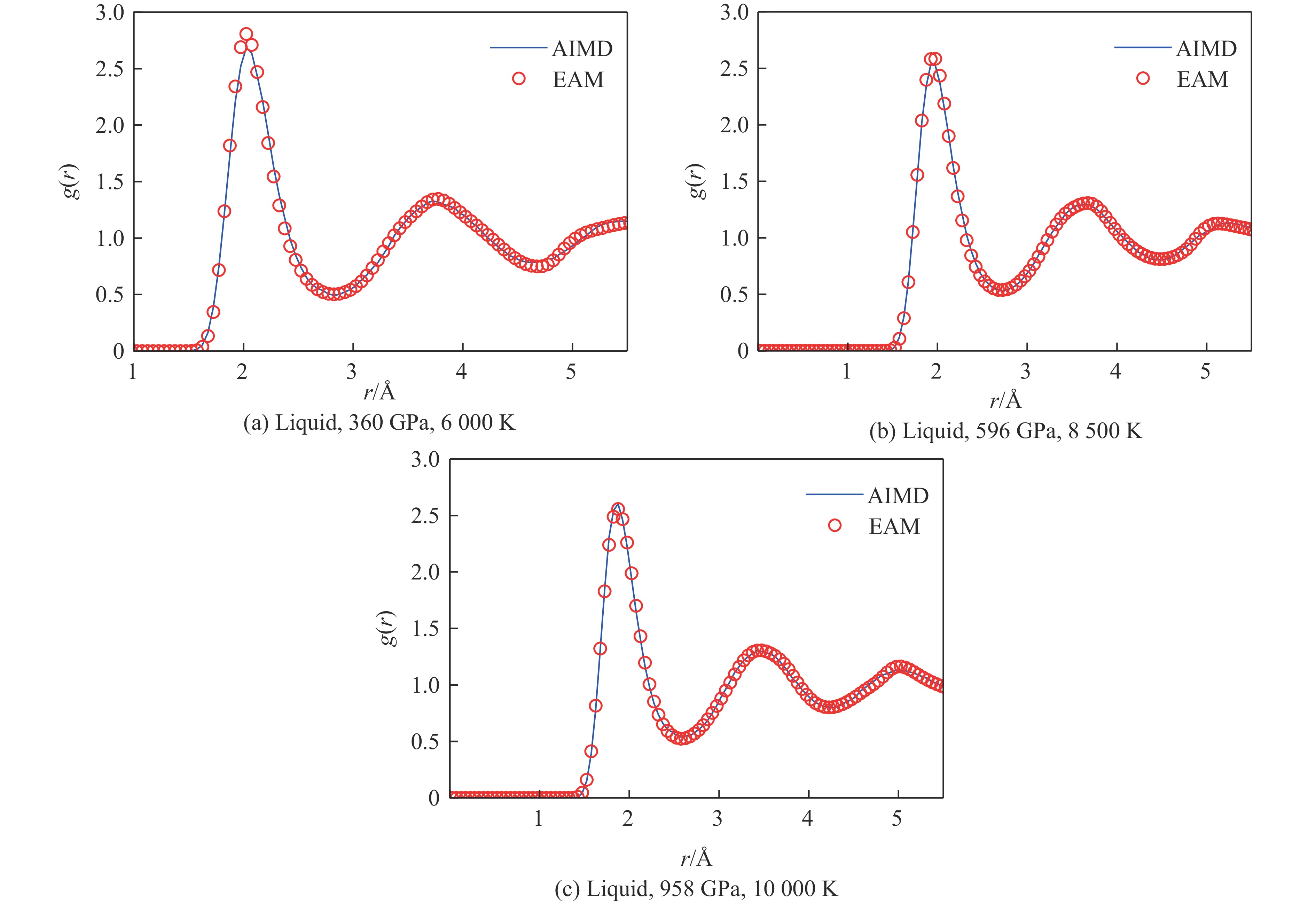
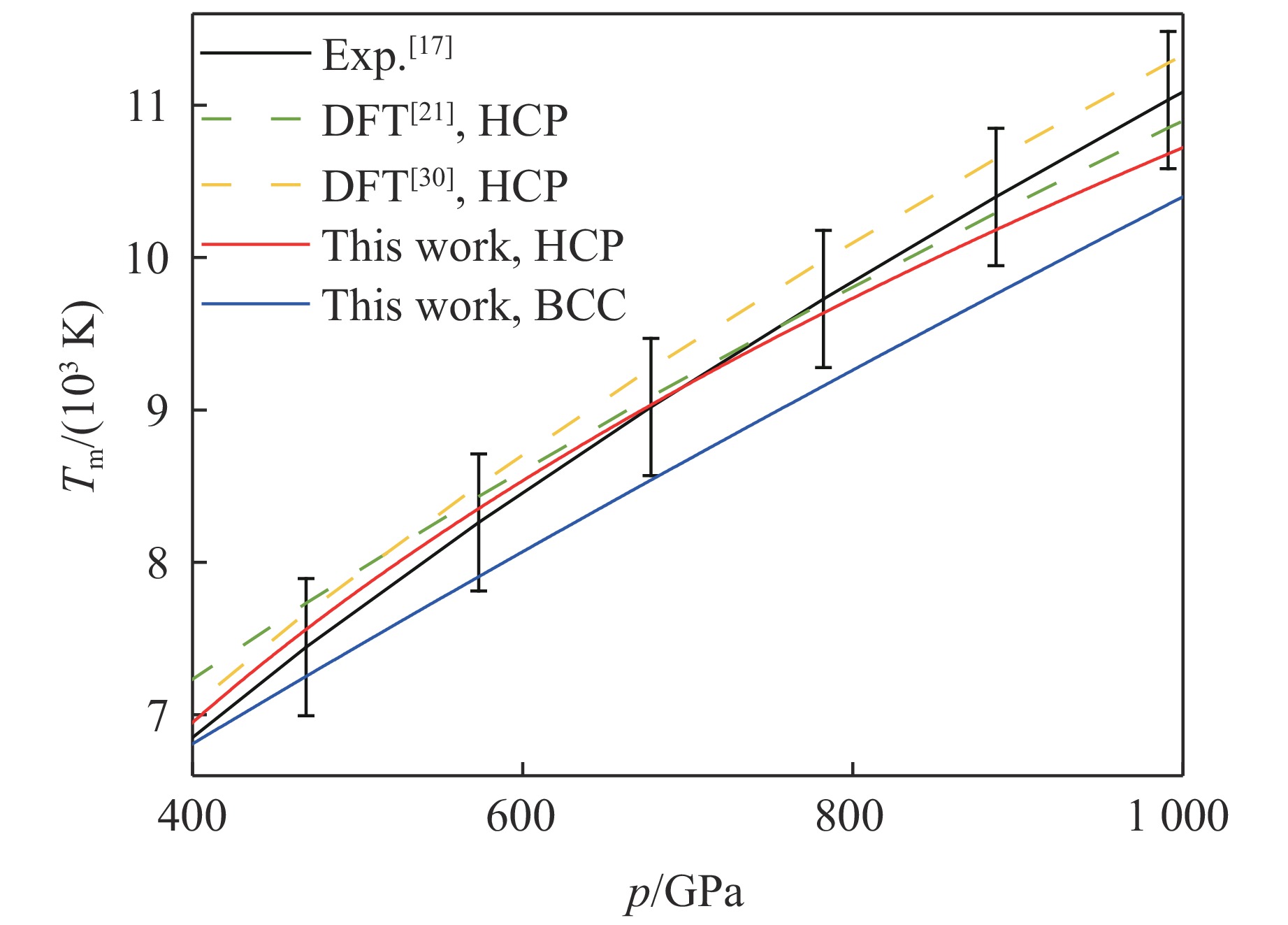
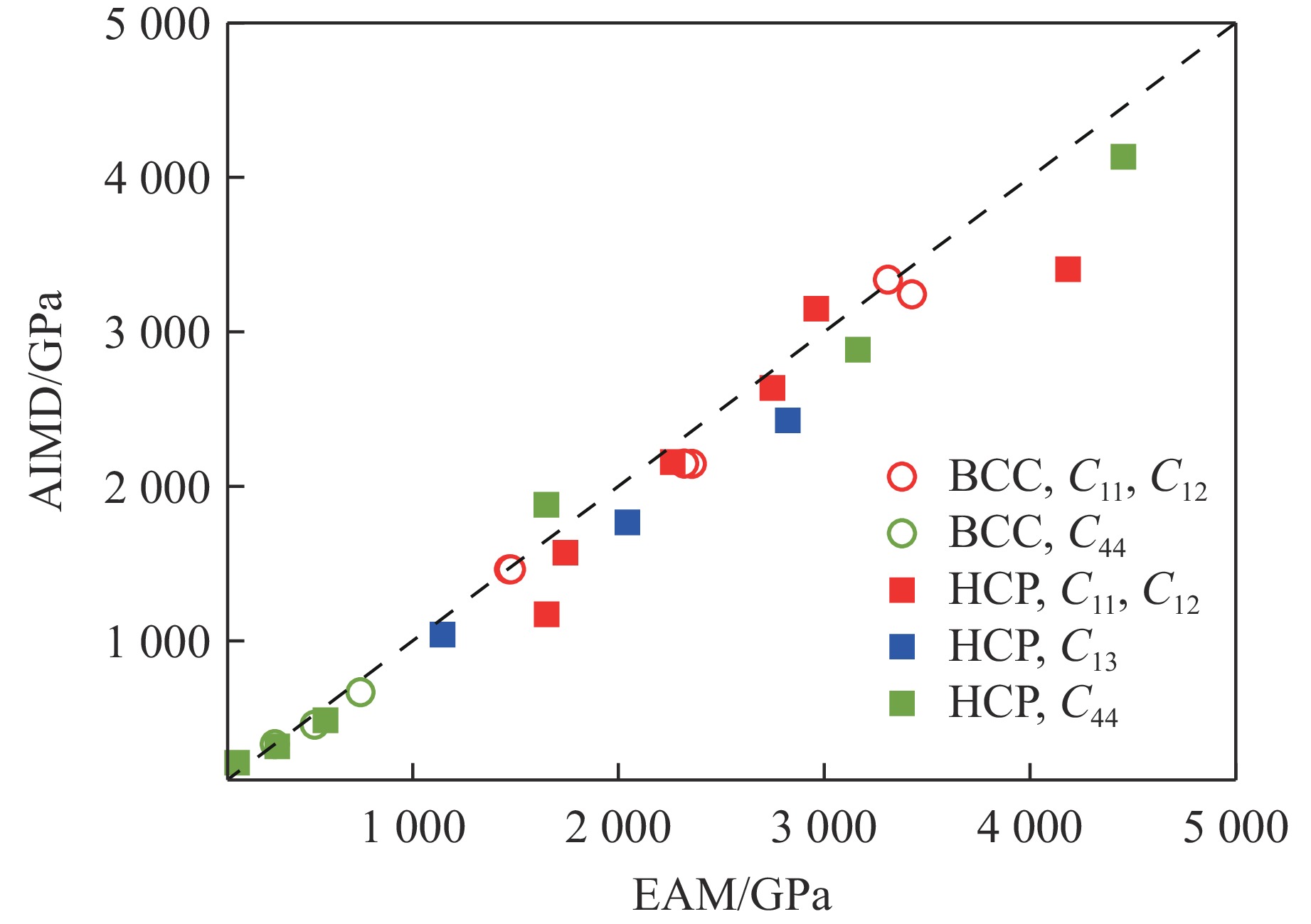
6000 ~10000 K下的多项物理性质,包括固态的弹性常数、液态的径向分布函数,以及实验获得的熔化曲线。在不同温压条件下对该势函数进行了系统检验,结果表明:其能够准确再现固态弹性常数与压力及温度的依赖关系;在3组典型温压点上与液相径向分布函数一致;预测的熔化曲线处于实验误差范围内,并且与第一性原理模拟结果基本吻合。基于该势函数的热力学计算进一步表明,在400 GPa~1 TPa压力区间内,铁的密排六方相保持热力学稳定,而体心立方相呈亚稳态。该势函数为大尺度模拟超级地球核心的形核结晶与固液共存提供了可靠的原子级工具;同时,该势函数与数据集为后续扩展多组分铁合金在超高压条件下的物性研究奠定了基础。Abstract: The physical properties of iron under extreme high-pressure and high-temperature conditions are crucial for understanding the internal structure and evolutionary processes of Earth and terrestrial planets. To characterize the dynamic behavior of iron under the extreme conditions inside super-Earths, we combine first-principles molecular dynamics simulations with experimentally measured high-pressure melting curves to construct an embedded-atom potential applicable across ultra-high pressures and temperatures. This potential is fitted to multiple properties of the body-centered cubic (BCC), hexagonal close-packed (HCP), and liquid phases over 400 GPa to 1 TPa and6000 to10000 K, including the elastic constants of the solid phases, the radial distribution functions of the liquid, and experimentally determined melting data. We systematically validate the potential across different pressure-temperature conditions and found that it accurately reproduces the pressure and temperature dependence of solid elastic constants, and matches liquid radial distribution functions at three representative pressure-temperature conditions. Moreover, it predicts melting curves that lie within experimental uncertainties and agree well with previous first-principles simulations. Thermodynamic calculations based on this potential further show that the HCP phase remains thermodynamically stable between 400 GPa and 1 TPa, while the BCC phase is metastable. This potential provides a reliable atomistic tool for large-scale simulations of nucleation, crystallization, and solid-liquid coexistence in the cores of super-Earths. Moreover, the potential and associated dataset lay the groundwork for future extensions to multicomponent Fe alloys and their properties under ultra-high-pressure conditions.-
Key words:
- iron /
- high temperature and high pressure /
- embedded atom method /
- melting curve /
- molecular dynamics
-
表 1 第一性原理模拟得到的BCC相和HCP相的晶格常数和平衡压强
Table 1. Lattice constants and equilibrium pressures of BCC and HCP phases from ab initio simulations
Phase T/K p/GPa a/Å Phase T/K p/GPa a/Å c/Å BCC 6000 396 2.37 HCP 6000 350 2.15 3.42 8500 665 2.27 8500 671 2.03 3.25 10000 1078 2.16 10000 1000 1.95 3.14  下载: 导出CSV
表 2 第一性原理模拟得到的BCC相和HCP相的弹性常数
Table 2. Elastic constants for BCC and HCP phases from ab initio simulations
Phase T/K p/GPa C11/GPa C12/GPa C13/GPa C33/GPa C44/GPa BCC 6000 396 1462 1462 331 8500 665 2146 2146 457 10000 1078 3243 3337 667 HCP 6000 350 1571 1173 1042 4134 211 8500 671 2639 2158 1767 2886 318 10000 1000 3407 3151 2427 1882 488
下载: 导出CSV
表 3 第一性原理模拟得到的液相密度和平衡压强
Table 3. Liquid densities and equilibrium pressures from ab initio simulations
T/K p/GPa Density/(g·cm−3) 6000 360 13.441 8500 596 15.202 10000 958 17.428
下载: 导出CSV
-
[1] DZIEWONSKI A M, ANDERSON D L. Preliminary reference Earth model [J]. Physics of the Earth and Planetary Interiors, 1981, 25(4): 297–356. doi: 10.1016/0031-9201(81)90046-7 [2] FIQUET G, AUZENDE A L, SIEBERT J, et al. Melting of peridotite to 140 Gigapascals [J]. Science, 2010, 329(5998): 1516–1518. doi: 10.1126/science.1192448 [3] ALFÈ D, GILLAN M J, PRICE G D. Temperature and composition of the Earth’s core [J]. Contemporary Physics, 2007, 48(2): 63–80. doi: 10.1080/00107510701529653 [4] KANE S R, HILL M L, KASTING J F, et al. A catalog of KEPLER habitable zone exoplanet candidates [J]. The Astrophysical Journal, 2016, 830(1): 1. doi: 10.3847/0004-637X/830/1/1 [5] HIROSE K, LABROSSE S, HERNLUND J. Composition and state of the core [J]. Annual Review of Earth and Planetary Sciences, 2013, 41: 657–691. doi: 10.1146/annurev-earth-050212-124007 [6] MORARD G, ANDRAULT D, ANTONANGELI D, et al. Properties of iron alloys under the Earth’s core conditions [J]. Comptes Rendus Geoscience, 2014, 346(5/6): 130–139. doi: 10.1016/j.crte.2014.04.007 [7] HIROSE K, WOOD B, VOČADLO L. Light elements in the Earth’s core [J]. Nature Reviews Earth & Environment, 2021, 2(9): 645–658. doi: 10.1038/s43017-021-00203-6 [8] 高宸, HO K M, 孙阳. 地核物质成分、结构与形核研究进展 [J]. 矿物岩石地球化学通报, 2025, 44(1): 94–115. doi: 10.3724/j.issn.1007-2802.20240094GAO C, HO K M, SUN Y. Progress in the study of the composition, structure and nucleation of the Earth’s core [J]. Bulletin of Mineralogy, Petrology and Geochemistry, 2025, 44(1): 94–115. doi: 10.3724/j.issn.1007-2802.20240094 [9] ELKINS-TANTON L. What makes a habitable planet? [J]. Eos, Transactions American Geophysical Union, 2013, 94(16): 149–150. doi: 10.1002/2013EO160001 [10] DEHANT V, LAMMER H, KULIKOV Y N, et al. Planetary magnetic dynamo effect on atmospheric protection of early Earth and Mars [J]. Space Science Reviews, 2007, 129(1): 279–300. doi: 10.1007/s11214-007-9163-9 [11] ANZELLINI S, DEWAELE A, MEZOUAR M, et al. Melting of iron at Earth’s inner core boundary based on fast X-ray diffraction [J]. Science, 2013, 340(6131): 464–466. doi: 10.1126/science.1233514 [12] ZHANG Y J, WANG Y, HUANG Y Q, et al. Collective motion in hcp-Fe at Earth’s inner core conditions [J]. Proceedings of the National Academy of Sciences of the United States of America, 2023, 120(41): e2309952120. doi: 10.1073/pnas.2309952120 [13] LI J, WU Q, LI J B, et al. Shock melting curve of iron: a consensus on the temperature at the Earth’s inner core boundary [J]. Geophysical Research Letters, 2020, 47(15): e2020GL087758. doi: 10.1029/2020GL087758 [14] TURNEAURE S J, SHARMA S M, GUPTA Y M. Crystal structure and melting of Fe shock compressed to 273 GPa: in situ X-ray diffraction [J]. Physical Review Letters, 2020, 125(21): 215702. doi: 10.1103/PhysRevLett.125.215702 [15] ZHANG D Z, JACKSON J M, ZHAO J Y, et al. Temperature of Earth’s core constrained from melting of Fe and Fe0.9Ni0.1 at high pressures [J]. Earth and Planetary Science Letters, 2016, 447: 72–83. doi: 10.1016/j.jpgl.2016.04.026 [16] LIU J, SUN Y, LV C J, et al. Iron-rich Fe-O compounds at Earth’s core pressures [J]. The Innovation, 2023, 4(1): 100354. doi: 10.1016/j.xinn.2022.100354 [17] KRAUS R G, HEMLEY R J, ALI S J, et al. Measuring the melting curve of iron at super-Earth core conditions [J]. Science, 2022, 375(6577): 202–205. doi: 10.1126/science.abm1472 [18] SUN T, BRODHOLT J P, LI Y G, et al. Melting properties from ab initio free energy calculations: iron at the Earth’s inner-core boundary [J]. Physical Review B, 2018, 98(22): 224301. doi: 10.1103/PhysRevB.98.224301 [19] SUN Y, MENDELEV M I, ZHANG F, et al. Ab initio melting temperatures of bcc and hcp iron under the Earth’s inner core condition [J]. Geophysical Research Letters, 2023, 50(5): e2022GL102447. doi: 10.1029/2022GL102447 [20] BOUCHET J, MAZEVET S, MORARD G, et al. Ab initio equation of state of iron up to 1500 GPa [J]. Physical Review B, 2013, 87(9): 094102. doi: 10.1103/PhysRevB.87.094102[21] GONZÁLEZ-CATALDO F, MILITZER B. Ab initio determination of iron melting at terapascal pressures and super-Earths core crystallization [J]. Physical Review Research, 2023, 5(3): 033194. doi: 10.1103/PhysRevResearch.5.033194 [22] SUN Y, MENDELEV M I, ZHANG F, et al. Unveiling the effect of Ni on the formation and structure of Earth’s inner core [J]. Proceedings of the National Academy of Sciences of the United States of America, 2024, 121(4): e2316477121. doi: 10.1073/pnas.2316477121 [23] ZHANG Z, SUN Y, WENTZCOVITCH R M. PBE-GGA predicts the B8↔B2 phase boundary of FeO at Earth’s core conditions [J]. Proceedings of the National Academy of Sciences of the United States of America, 2023, 120(28): e2304726120. doi: 10.1073/pnas.2304726120 [24] ALFÈ D. Temperature of the inner-core boundary of the Earth: melting of iron at high pressure from first-principles coexistence simulations [J]. Physical Review B, 2009, 79(6): 060101. doi: 10.1103/physrevb.79.060101 [25] POZZO M, DAVIES C, GUBBINS D, et al. Thermal and electrical conductivity of iron at Earth’s core conditions [J]. Nature, 2012, 485(7398): 355–358. doi: 10.1038/nature11031 [26] LI Y G, VOČADLO L, SUN T, et al. The Earth’s core as a reservoir of water [J]. Nature Geoscience, 2020, 13(6): 453–458. doi: 10.1038/s41561-020-0578-1 [27] WU Z Q, WANG W Z. Shear softening of Earth’s inner core as indicated by its high Poisson ratio and elastic anisotropy [J]. Fundamental Research, 2025, 5(1): 264–268. doi: 10.1016/j.fmre.2022.08.010 [28] HE Y, SUN S C, KIM D Y, et al. Superionic iron alloys and their seismic velocities in Earth’s inner core [J]. Nature, 2022, 602(7896): 258–262. doi: 10.1038/s41586-021-04361-x [29] WEI L R, WU Z P, HO K M, et al. The Fe-Ni phase diagram and the Earth’s inner core structure [J]. Science Advances, 2025, 11(23): eadu1998. doi: 10.1126/sciadv.adu1998 [30] STIXRUDE L. Structure of iron to 1 Gbar and 40 000 K [J]. Physical Review Letters, 2012, 108(5): 055505. doi: 10.1103/PhysRevLett.108.055505 [31] DAVIES C J, POZZO M, ALFÈ D. Assessing the inner core nucleation paradox with atomic-scale simulations [J]. Earth and Planetary Science Letters, 2019, 507: 1–9. doi: 10.1016/j.jpgl.2018.11.019 [32] ZHANG W J, LIU Z Y, LIU Z L, et al. Melting curves and entropy of melting of iron under Earth’s core conditions [J]. Physics of the Earth and Planetary Interiors, 2015, 244: 69–77. doi: 10.1016/j.pepi.2014.10.011 [33] BELONOSHKO A B, FU J, SMIRNOV G. Free energies of iron phases at high pressure and temperature: molecular dynamics study [J]. Physical Review B, 2021, 104(10): 104103. doi: 10.1103/PhysRevB.104.104103 [34] SUN Y, ZHANG F, MENDELEV M I, et al. Two-step nucleation of the Earth’s inner core [J]. Proceedings of the National Academy of Sciences of the United States of America, 2022, 119(2): e2113059119. doi: 10.1073/pnas.2113059119 [35] GAO C, HO K M, WENTZCOVITCH R M, et al. Understanding the two-step nucleation of iron at Earth’s inner core conditions: a comparative molecular dynamics study [J]. Physical Review B, 2025, 111(13): 134104. doi: 10.1103/PhysRevB.111.134104 [36] FINNIS M W, SINCLAIR J E. A simple empirical N-body potential for transition metals [J]. Philosophical Magazine A, 1984, 50(1): 45–55. doi: 10.1080/01418618408244210 [37] MENDELEV M I, SROLOVITZ D J. Determination of alloy interatomic potentials from liquid-state diffraction data [J]. Physical Review B, 2002, 66(1): 014205. doi: 10.1103/PhysRevB.66.014205 [38] THOMPSON A P, AKTULGA H M, BERGER R, et al. LAMMPS—a flexible simulation tool for particle-based materials modeling at the atomic, meso, and continuum scales [J]. Computer Physics Communications, 2022, 271: 108171. doi: 10.1016/j.cpc.2021.108171 [39] HOOVER W G. Canonical dynamics: equilibrium phase-space distributions [J]. Physical Review A, 1985, 31(3): 1695–1697. doi: 10.1103/PhysRevA.31.1695 [40] KRESSE G, FURTHMÜLLER J. Efficient iterative schemes for ab initio total-energy calculations using a plane-wave basis set [J]. Physical Review B, 1996, 54(16): 11169–11186. doi: 10.1103/PhysRevB.54.11169 [41] MERMIN N D. Thermal properties of the inhomogeneous electron gas [J]. Physical Review Journals Archive, 1965, 137(5A): A1441–A1443. doi: 10.1103/PhysRev.137.A1441 [42] WENTZCOVITCH R M, MARTINS J L, ALLEN P B. Energy versus free-energy conservation in first-principles molecular dynamics [J]. Physical Review B, 1992, 45(19): 11372–11374. doi: 10.1103/PhysRevB.45.11372 [43] MORRIS J R, WANG C Z, HO K M, et al. Melting line of aluminum from simulations of coexisting phases [J]. Physical Review B, 1994, 49(5): 3109–3115. doi: 10.1103/PhysRevB.49.3109 [44] CLAVIER G, DESBIENS N, BOURASSEAU E, et al. Computation of elastic constants of solids using molecular simulation: comparison of constant volume and constant pressure ensemble methods [J]. Molecular Simulation, 2017, 43(17): 1413–1422. doi: 10.1080/08927022.2017.1313418 [45] STURGEON J B, LAIRD B B. Adjusting the melting point of a model system via Gibbs-Duhem integration: application to a model of aluminum [J]. Physical Review B, 2000, 62(22): 14720–14727. doi: 10.1103/PhysRevB.62.14720 [46] WEI L R, SUN Y. Incorporating Gibbs free energy into interatomic potential fitting [J]. Physical Review B, 2026, 113(9): 094103. doi: 10.1103/9ctg-8fp7 [47] WU F L, WU S Q, WANG C Z, et al. Melting temperature of iron under the Earth’s inner core condition from deep machine learning [J]. Geoscience Frontiers, 2024, 15(6): 101925. doi: 10.1016/j.gsf.2024.101925 [48] LI Z, SCANDOLO S. Competing phases of iron at Earth’s core conditions from deep-learning-aided ab-initio simulations [J]. Geophysical Research Letters, 2024, 51(19): e2024GL110357. doi: 10.1029/2024GL110357 [49] YUAN L, STEINLE-NEUMANN G. Hydrogen distribution between the Earth’s inner and outer core [J]. Earth and Planetary Science Letters, 2023, 609: 118084. doi: 10.1016/j.jpgl.2023.118084 [50] ZHANG Z G, CSÁNYI G, ALFÈ D. Partitioning of sulfur between solid and liquid iron under Earth’s core conditions: constraints from atomistic simulations with machine learning potentials [J]. Geochimica et Cosmochimica Acta, 2020, 291: 5–18. doi: 10.1016/j.gca.2020.03.028 [51] FANG Y M, SUN Y, WANG R H, et al. Structural prediction of Fe-Mg-O compounds at super-Earth’s pressures [J]. Physical Review Materials, 2023, 7(11): 113602. doi: 10.1103/PhysRevMaterials.7.113602 [52] FANG Y M, SUN Y, WANG R H, et al. Unconventional iron-magnesium compounds at terapascal pressures [J]. Physical Review B, 2021, 104(14): 144109. doi: 10.1103/PhysRevB.104.144109 [53] ZHENG F, SUN Y, WANG R H, et al. Structure and motifs of iron oxides from 1 to 3 TPa [J]. Physical Review Materials, 2022, 6(4): 043602. doi: 10.1103/PhysRevMaterials.6.043602 -

 下载:
下载:

图(3) / 表(4)
计量
- 文章访问数: 981
- HTML全文浏览量: 481
- PDF下载量: 105
