





Effects of Solid Inerting Agent on Magnesium Powder Explosion under Fuel-Lean Conditions
-
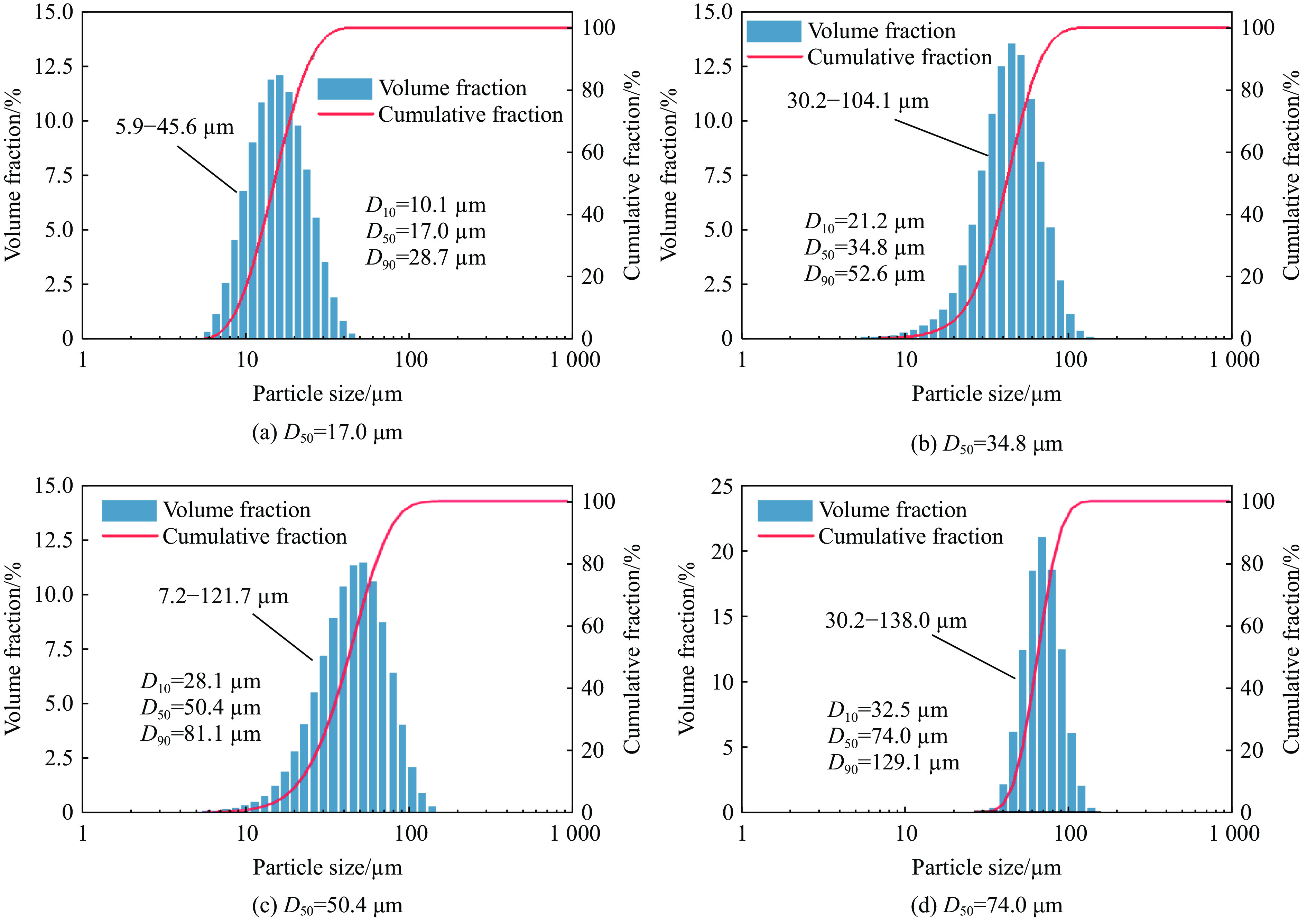
摘要: 为了更好地防控镁粉在贫燃条件下的爆炸风险,利用爆炸抑爆综合实验装置,对镁粉在不同粒径和浓度条件下的爆炸特性进行了研究,分析了固体惰化剂Mg(OH)2、Ca(OH)2、Ca(HCO3)2对镁粉的惰化效果,揭示了贫燃条件下固体惰化剂对镁粉的惰化机理。结果表明:镁粉粒径在17~74 μm范围内时,镁粉的最大爆炸压力随粒径的增大而减小;而增大镁粉浓度会导致最大爆炸压力呈先升后降的变化趋势;17.0 μm镁粉的最佳爆炸浓度和最大爆炸压力分别为350 g/m3和0.716 MPa;Mg(OH)2、Ca(OH)2、Ca(HCO3)2 3种惰化剂的加入均使镁粉的最大爆炸压力和最大压力上升速率下降,得到了3种惰化剂对镁粉有效惰化和完全惰化时的惰化比,其中,Mg(OH)2的惰化效果最优,达到有效惰化和完全惰化时的惰化比分别为170%和220%。通过分析3种惰化剂的惰化机理发现:Mg(OH)2通过受热分解产生MgO,MgO吸附到镁颗粒表面,阻碍镁与氧气接触,从而实现惰化;Ca(OH)2仅通过受热分解发挥惰化效果;Ca(HCO3)2通过受热分解产生CO2,从而增强惰化效果。研究结果为实现贫燃条件下镁粉爆炸的有效惰化提供了重要参考。Abstract: In order to prevent and control the deflagration hazard of magnesium powder in fuel-lean conditions, the explosion suppression experiment device was used to test the effect of solid inerting agents (Mg(OH)2, Ca(OH)2, Ca(HCO3)2) on the explosion characteristics of magnesium powder. The particle size and concentration were considered. The results show that within the particle size range from 17 to 74 μm, the maximum explosion pressure of magnesium powder decreases with increasing particle size, and rises first and then falls as powder concentration increases. For the 17.0 μm magnesium powder, the optimal explosion concentration and the maximum explosion pressure are 350 g/m3 and 0.716 MPa, respectively. The addition of three inerting agents, namely Mg(OH)2, Ca(OH)2, and Ca(HCO3)2, both reduces the maximum explosion pressure and the maximum pressure rise rate of magnesium powder. The inerting ratios for effective and complete inerting of magnesium powder by the three agents were obtained. Among them, Mg(OH)2 exhibits the best inerting performance, with the inerting ratios of 170% and 220% for effective and complete inerting, respectively. The inerting mechanism of solid inerting agents on magnesium powder under fuel-lean conditions is revealed. Mg(OH)2 decomposes upon heating to produce MgO, which adsorbs onto the surface of magnesium particles and prevents the contact between magnesium and oxygen, thereby achieving inerting; Ca(OH)2 exerts an inerting effect merely through thermal decomposition; Ca(HCO3)2 generates CO2 by thermal decomposition, which further enhances the inerting performance. The obtained conclusions provide an important reference for realizing the effective inerting of magnesium powder explosion under fuel-lean conditions.
-
Key words:
- magnesium powder explosion /
- solid inerting /
- explosion overpressure /
- inert mechanism /
- dust explosion
-
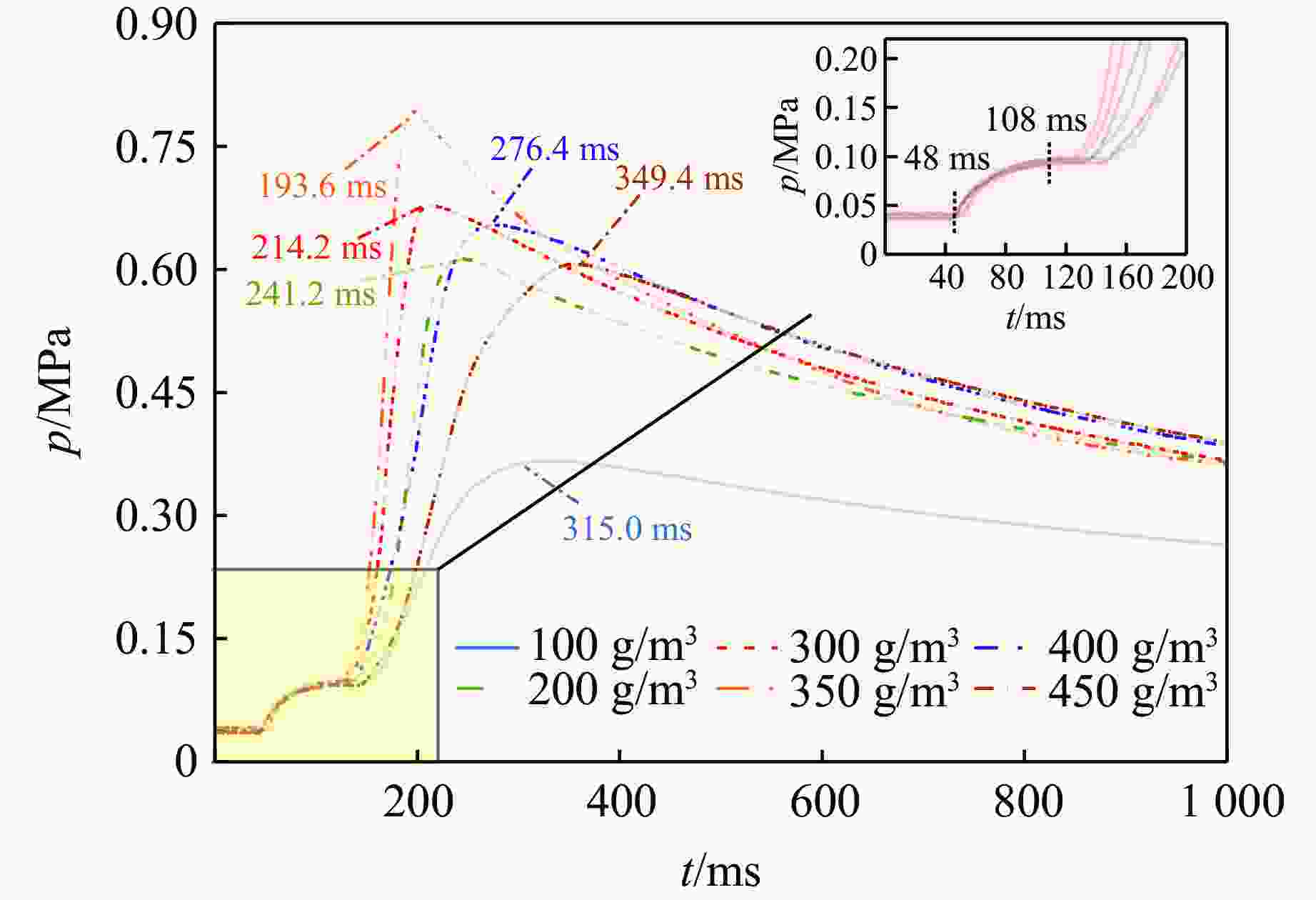
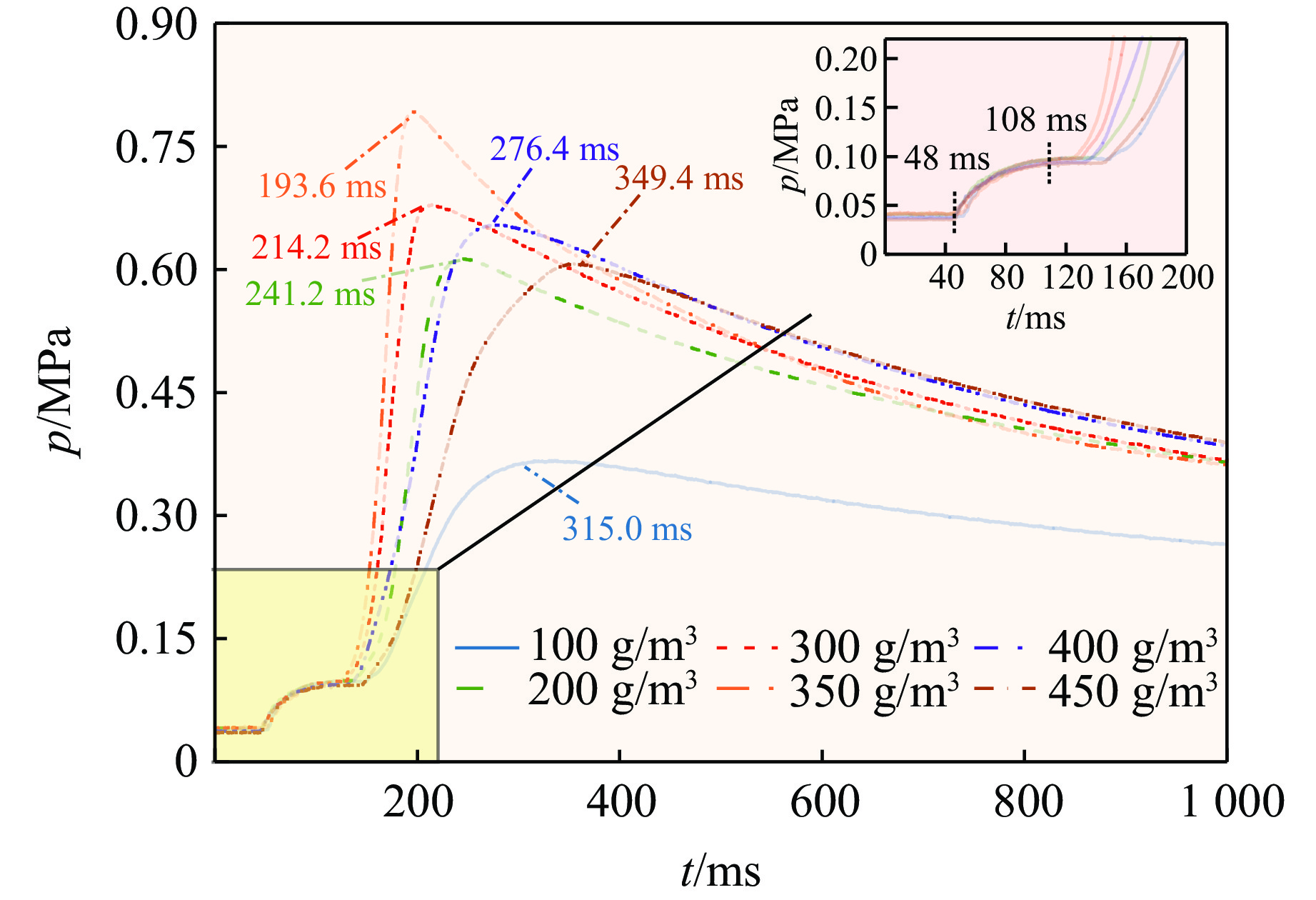
图 3 不同浓度镁粉的爆炸压力变化曲线
Figure 3. Explosion pressure-time curves of magnesium powder with different concentrations
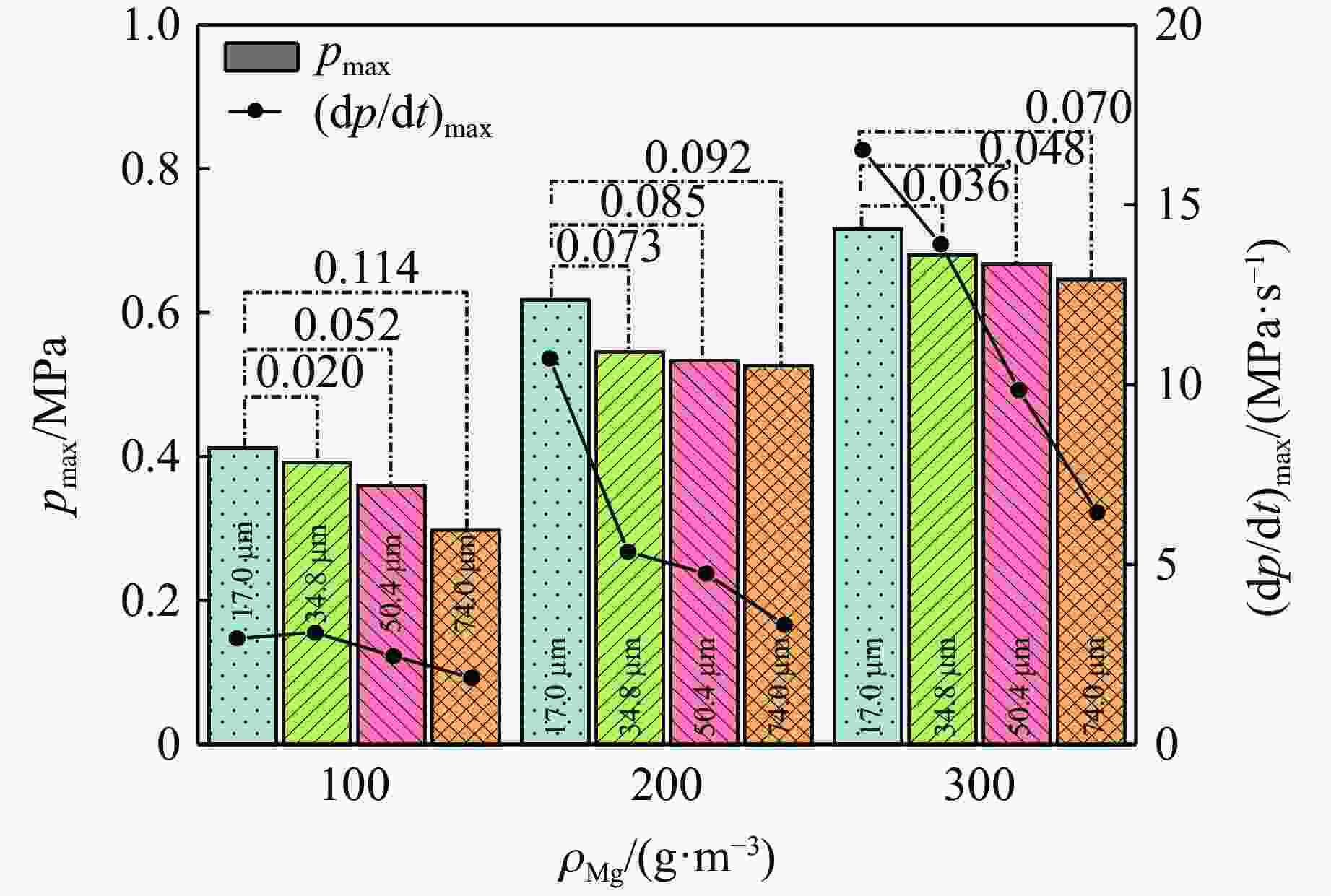
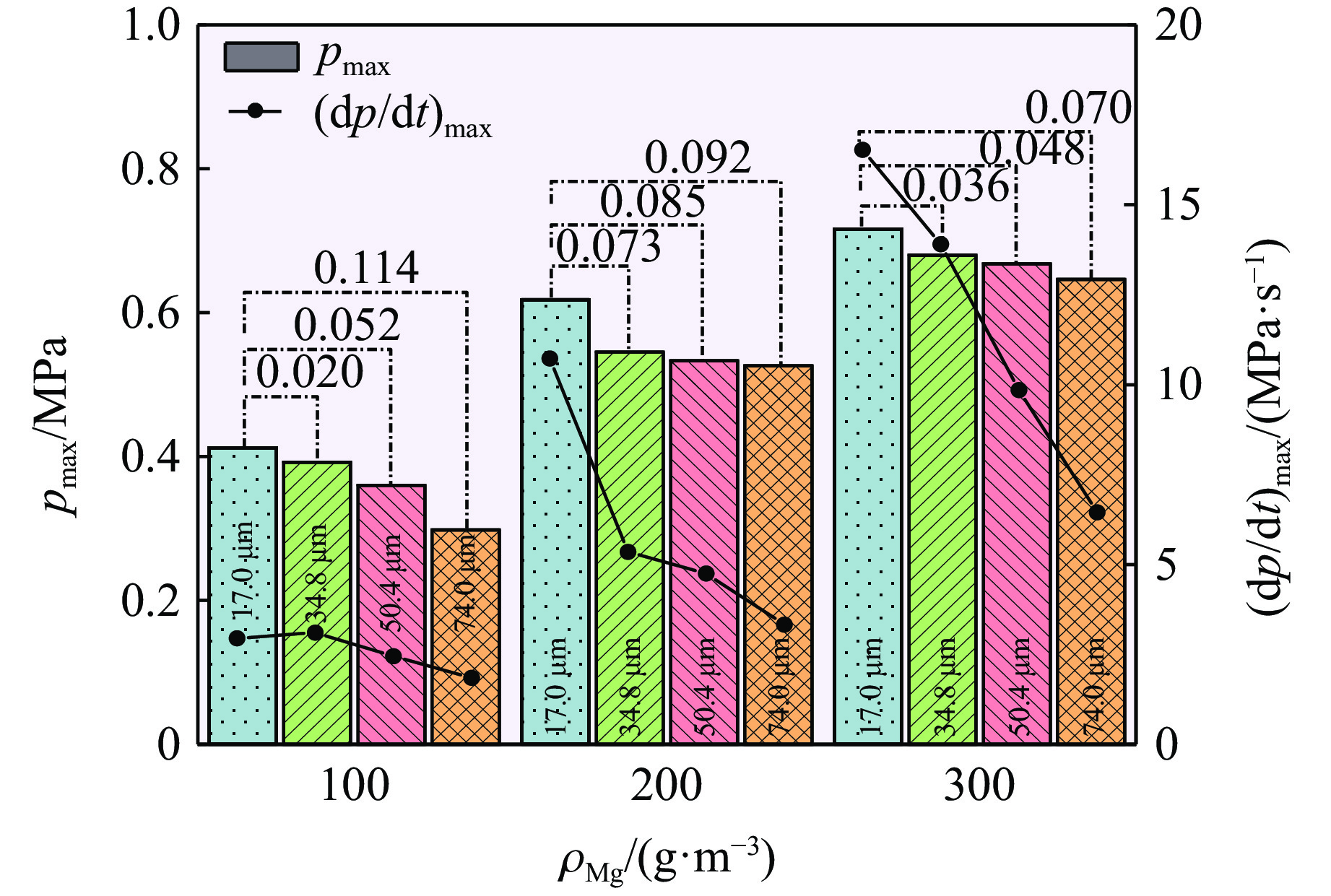
图 4 镁粉粒径和浓度对pmax及(dp/dt)max的影响
Figure 4. Effects of particle size and concentration of magnesium powder on pmax and (dp/dt)max
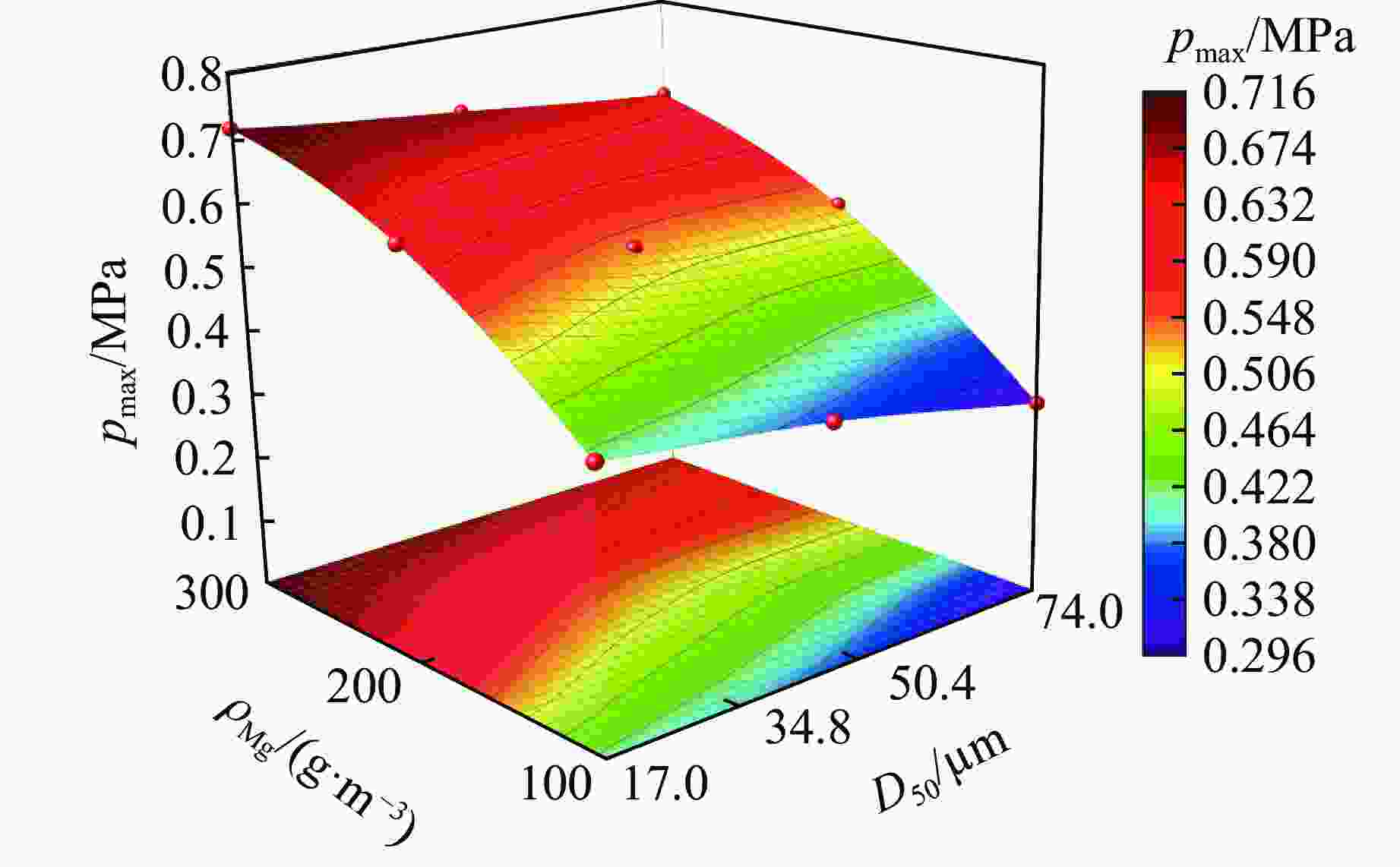
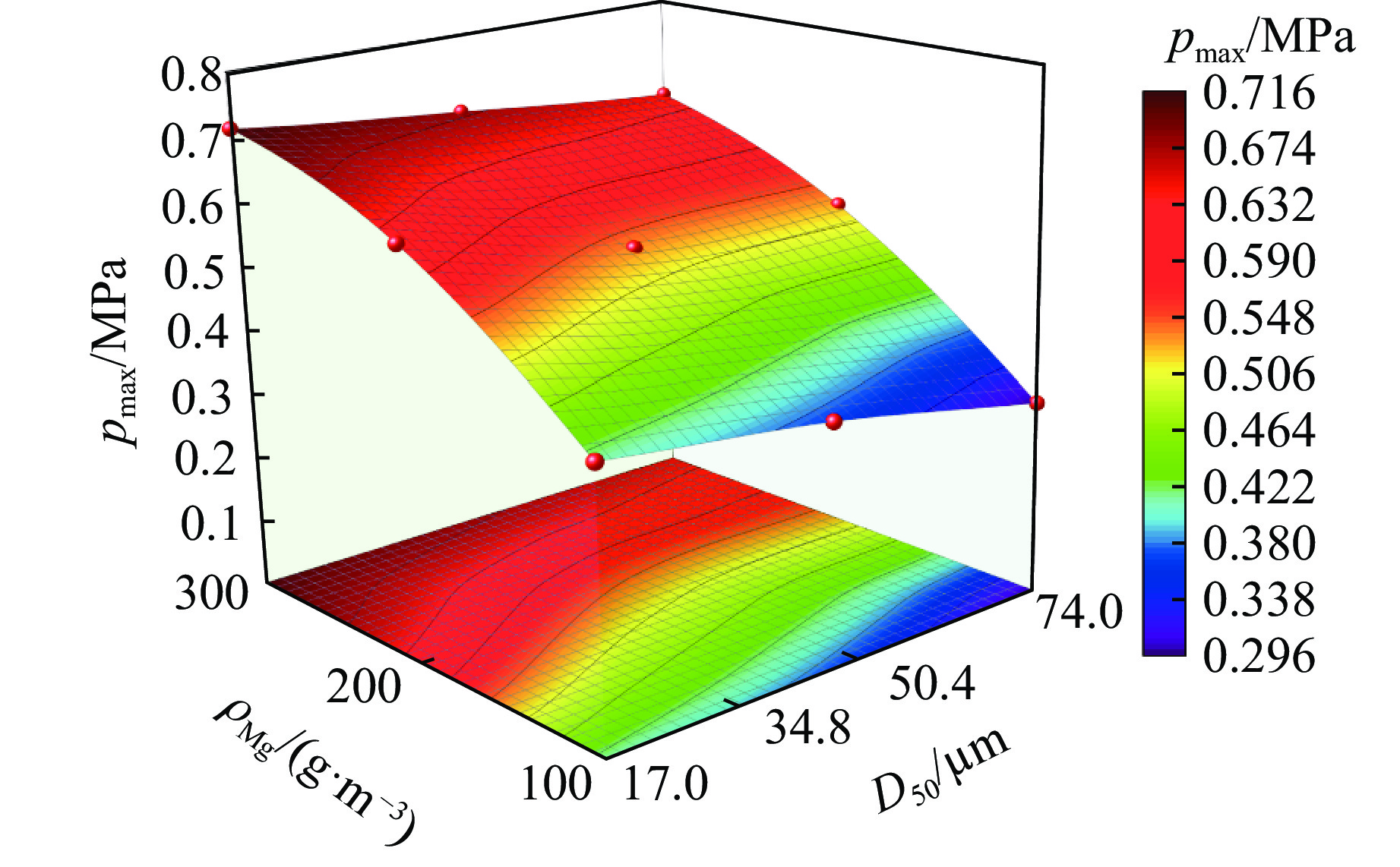
图 5 镁粉浓度和粒径对pmax的影响曲面图
Figure 5. Surface diagram of the influence of magnesium powder concentration and particle size on pmax
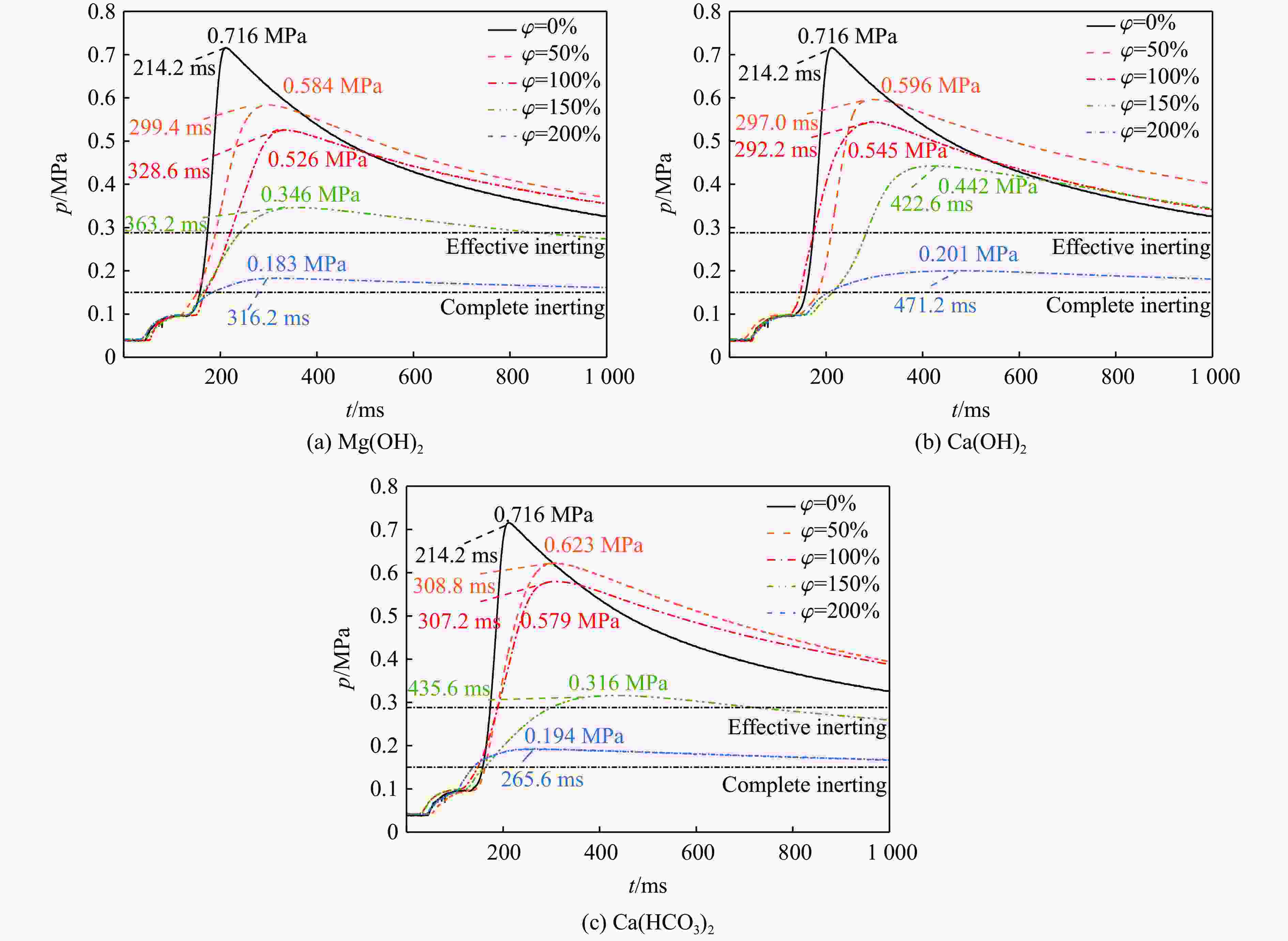
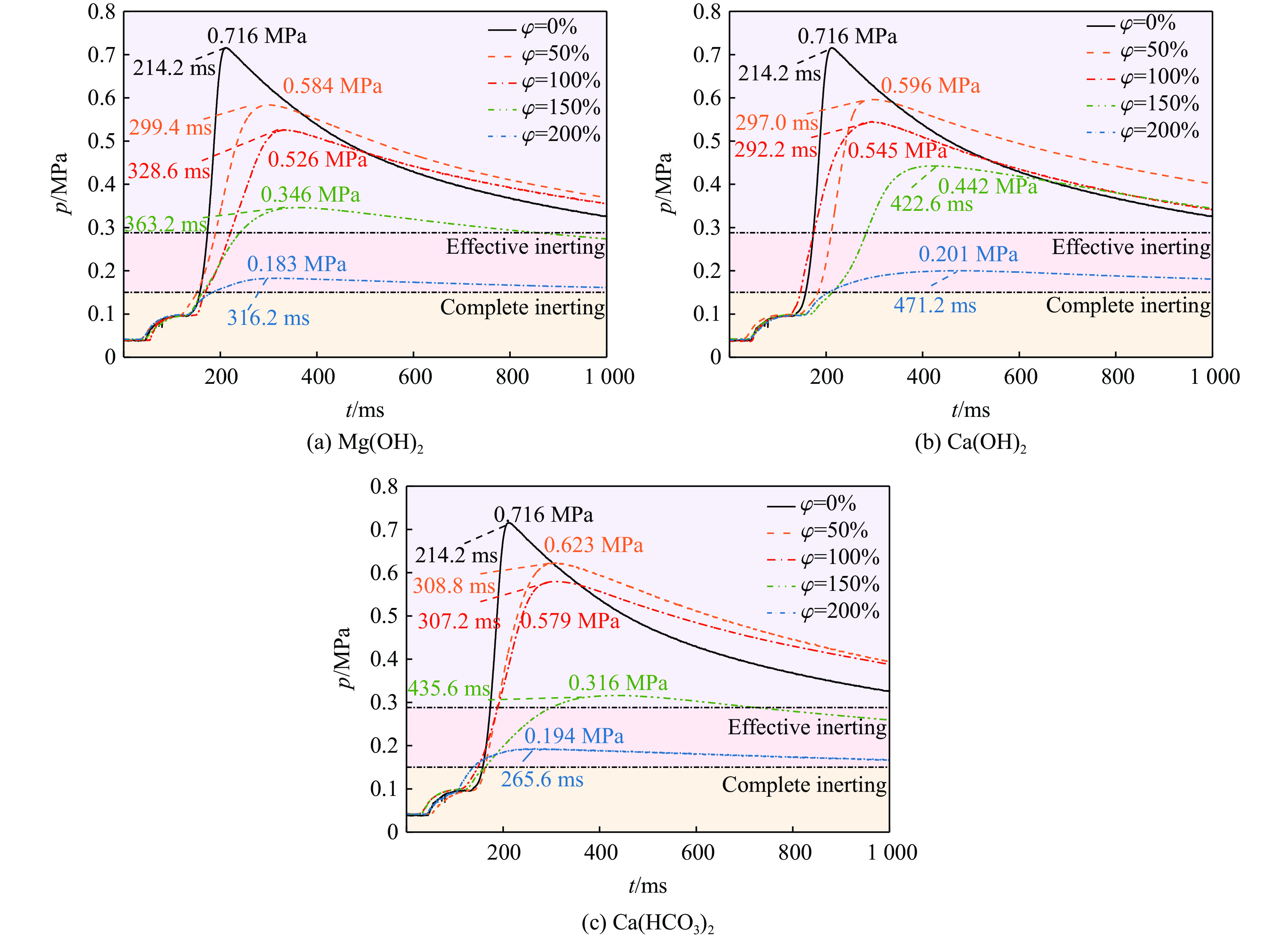
图 6 不同固体惰化剂条件下镁粉的爆炸压力曲线(ρMg,opt=300 g/m3)
Figure 6. Effect of solid inerting agent on the explosion pressure of magnesium powder (ρMg,opt=300 g/m3)
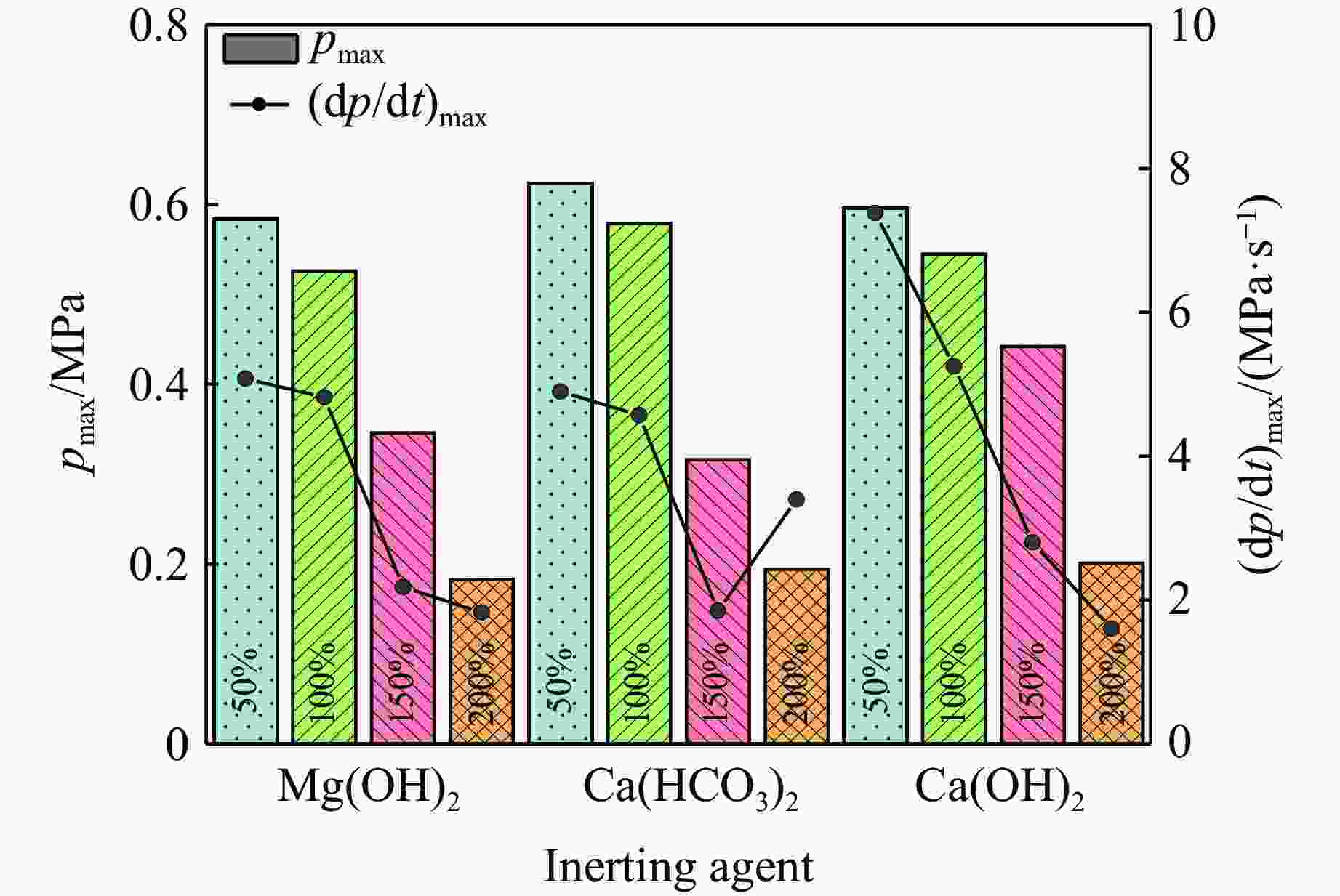
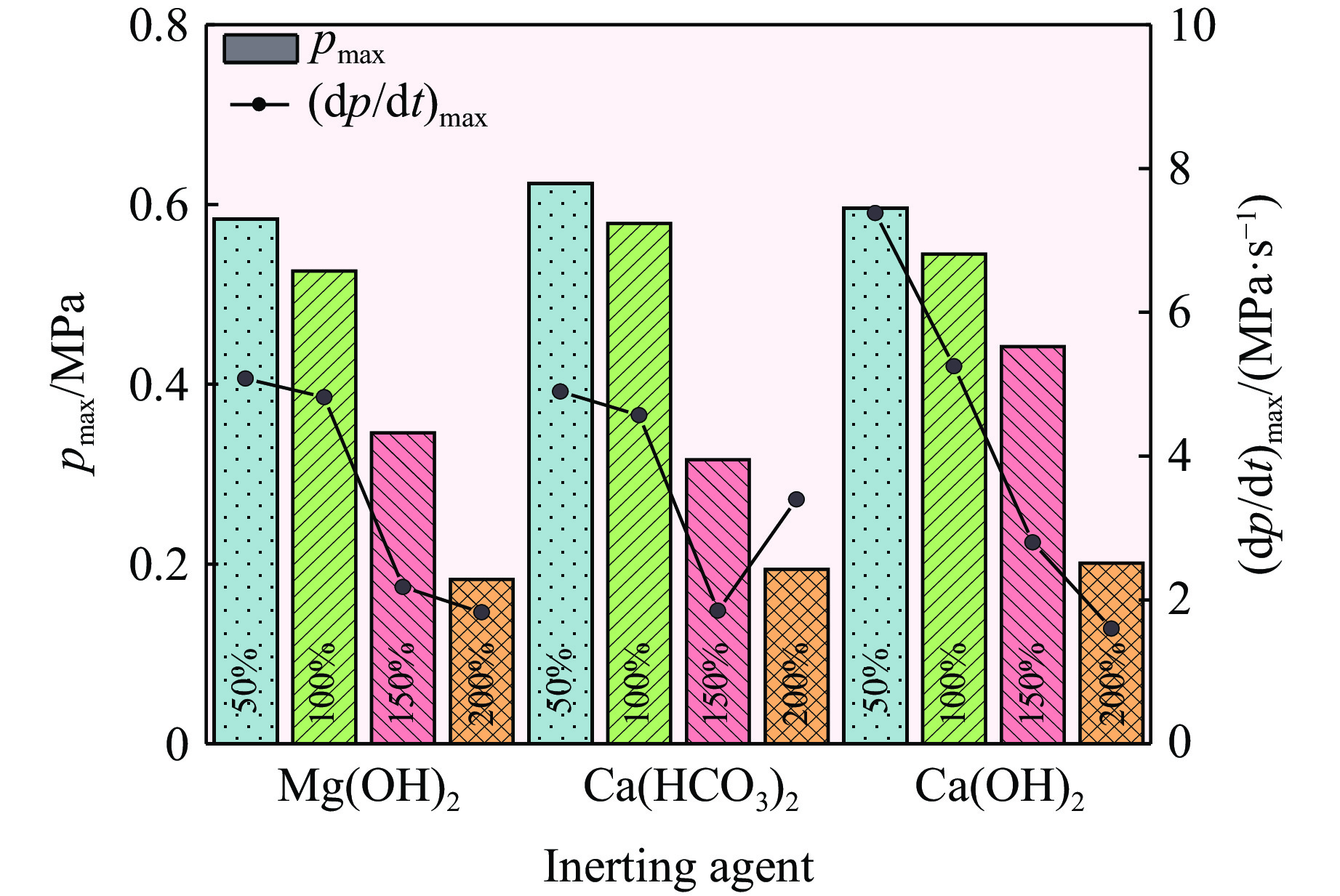
图 7 不同固体惰化剂的惰化比对镁粉pmax及(dp/dt)max的影响
Figure 7. Influence of different solid inerting agents on the pmax and (dp/dt)max of magnesium powder
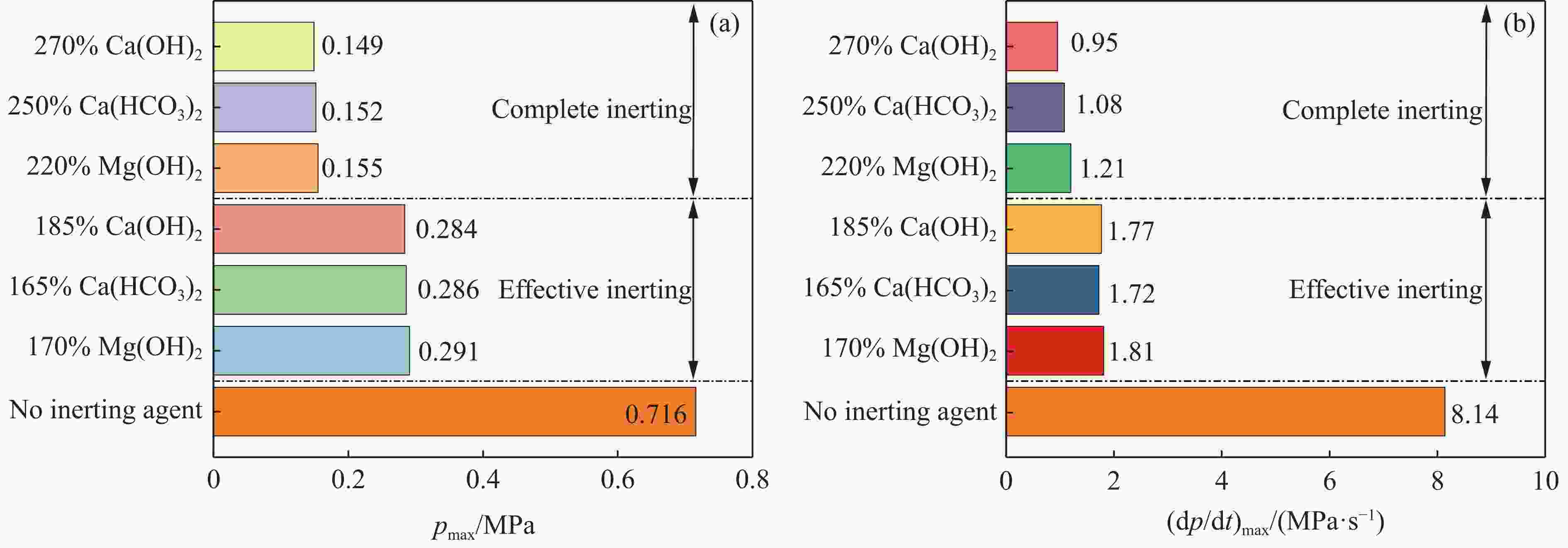
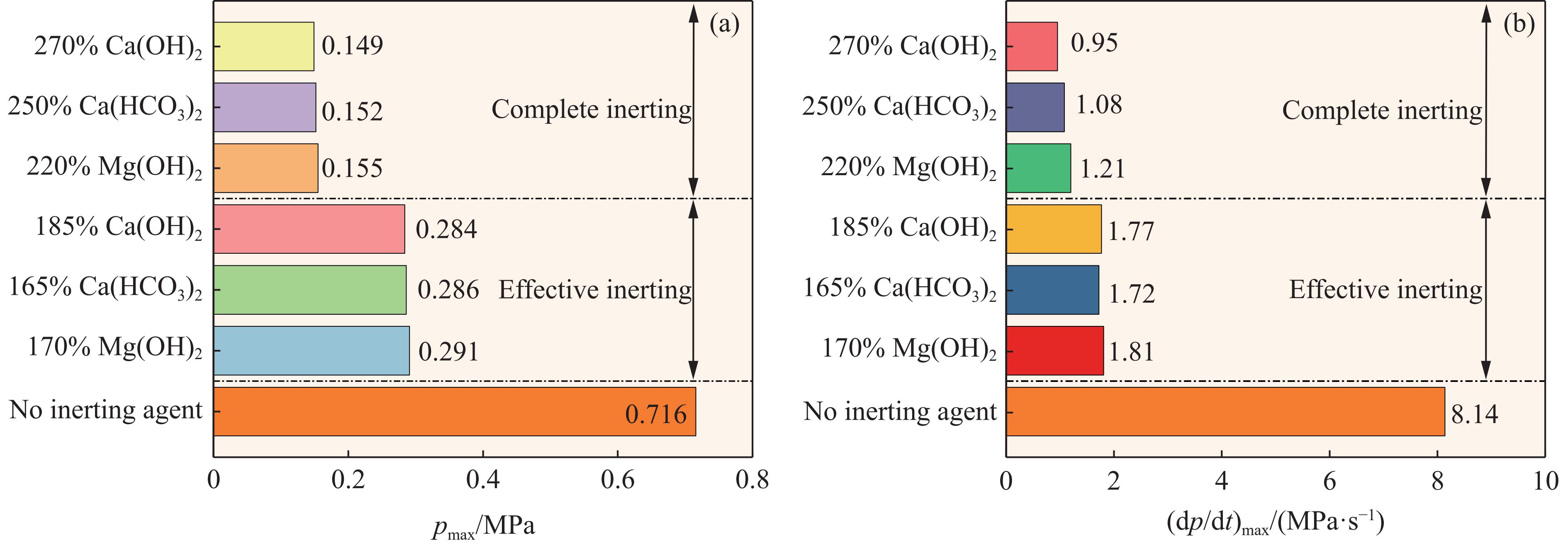
图 8 不同固体惰化剂对镁粉爆炸的惰化效果
Figure 8. Effects of solid inerting agents on the inerting performance of magnesium powder explosion
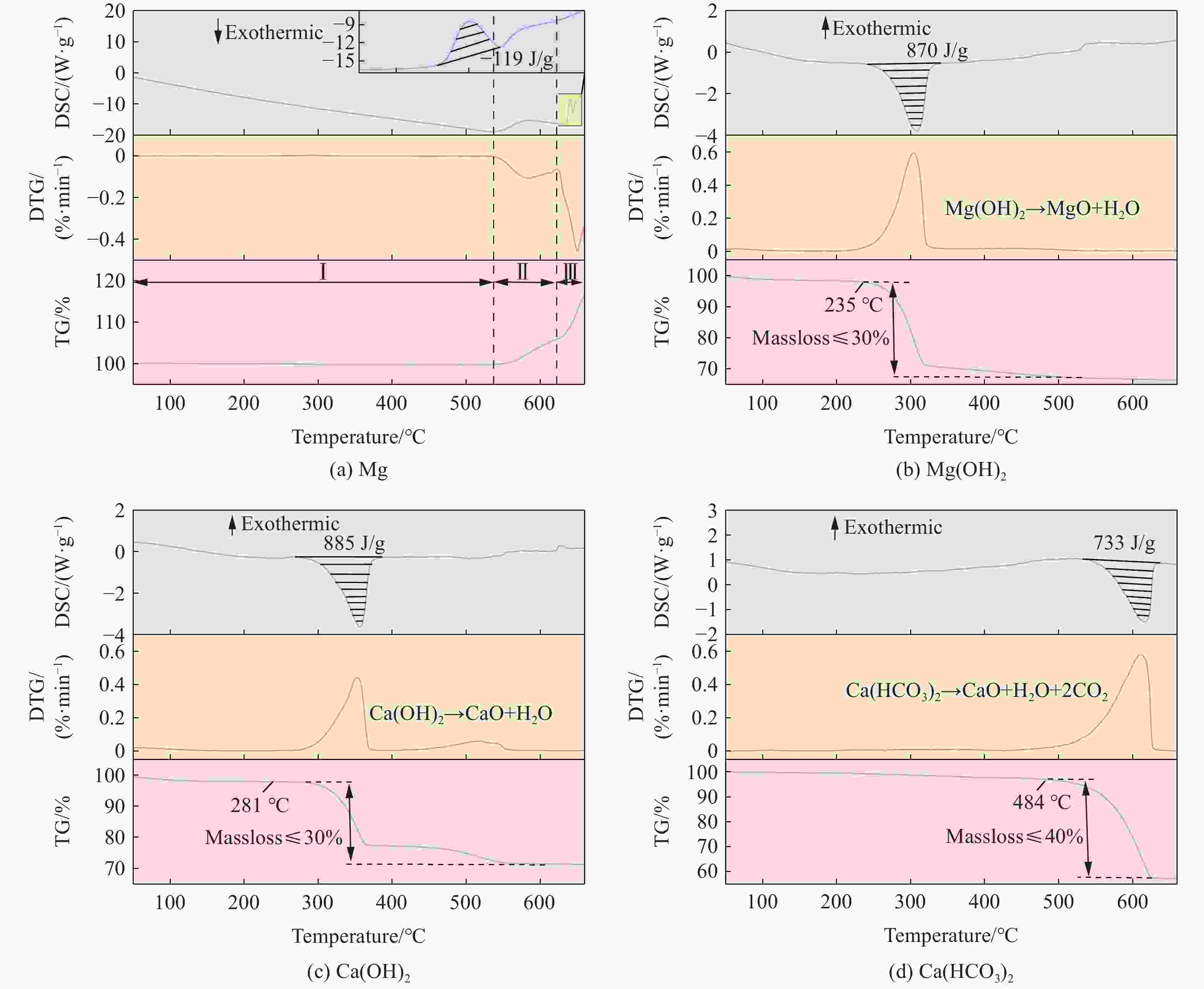
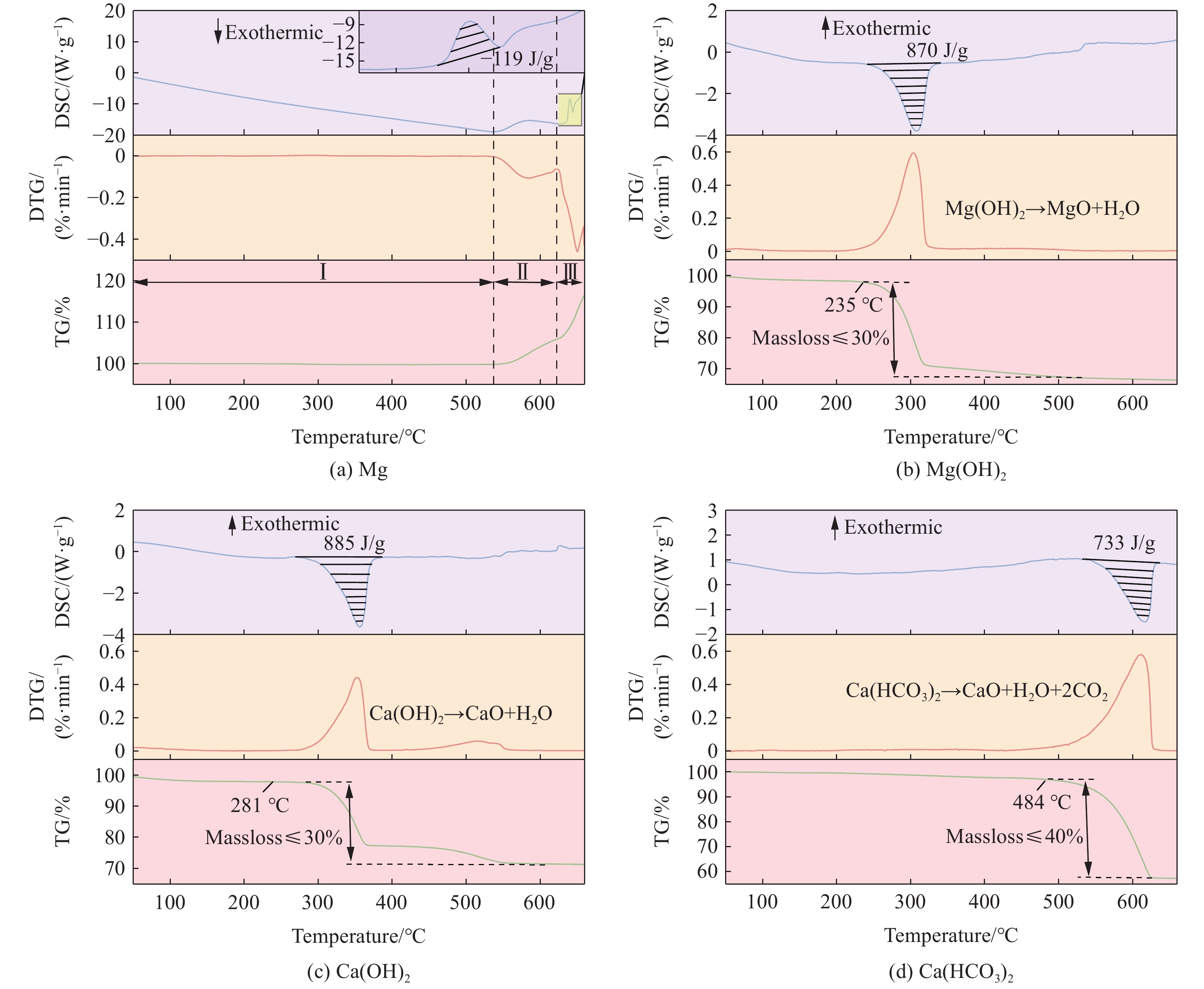
图 9 镁粉及3种固体惰化剂的TG-DSC曲线
Figure 9. TG-DSC curves of magnesium powder and three solid inerting agents
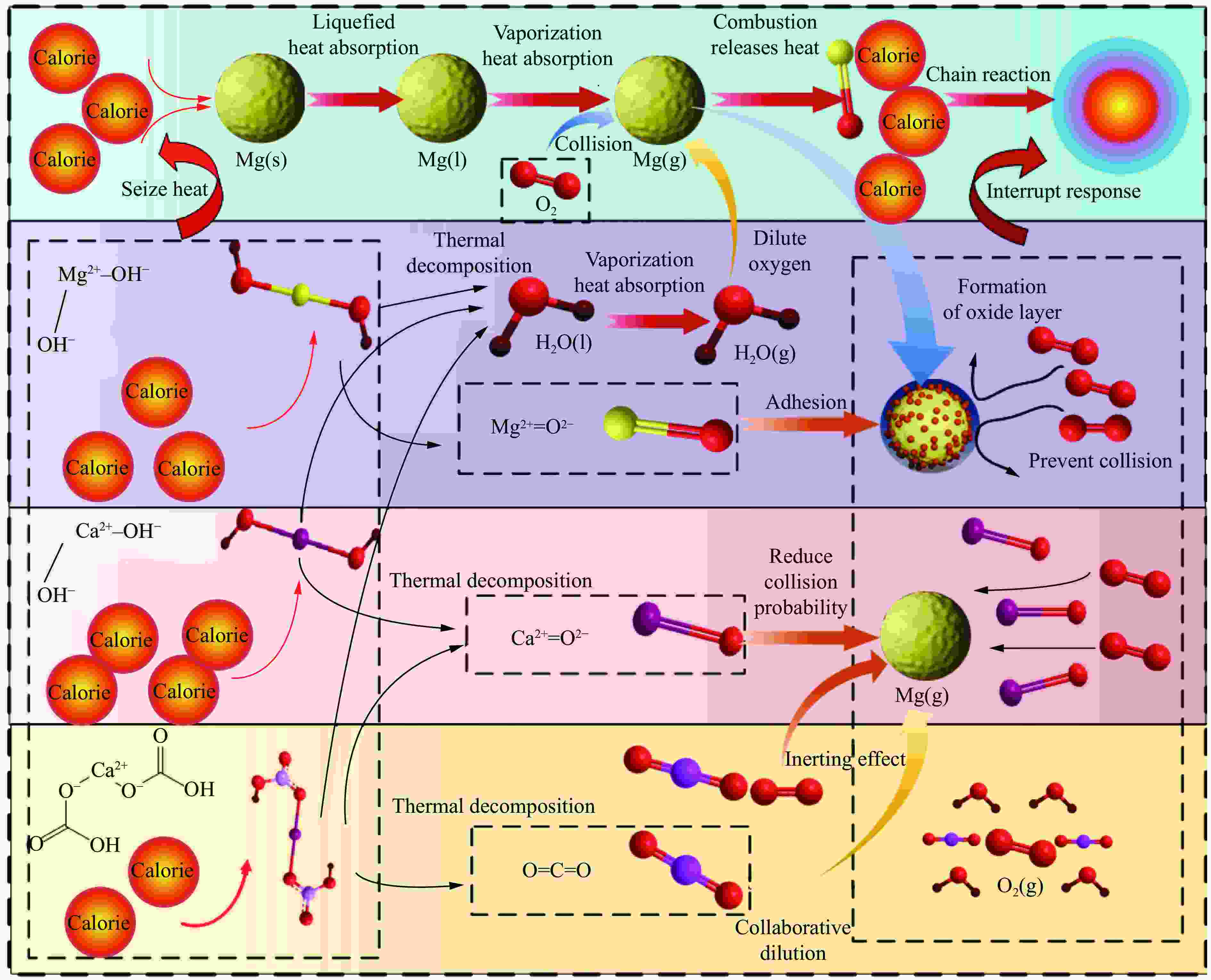
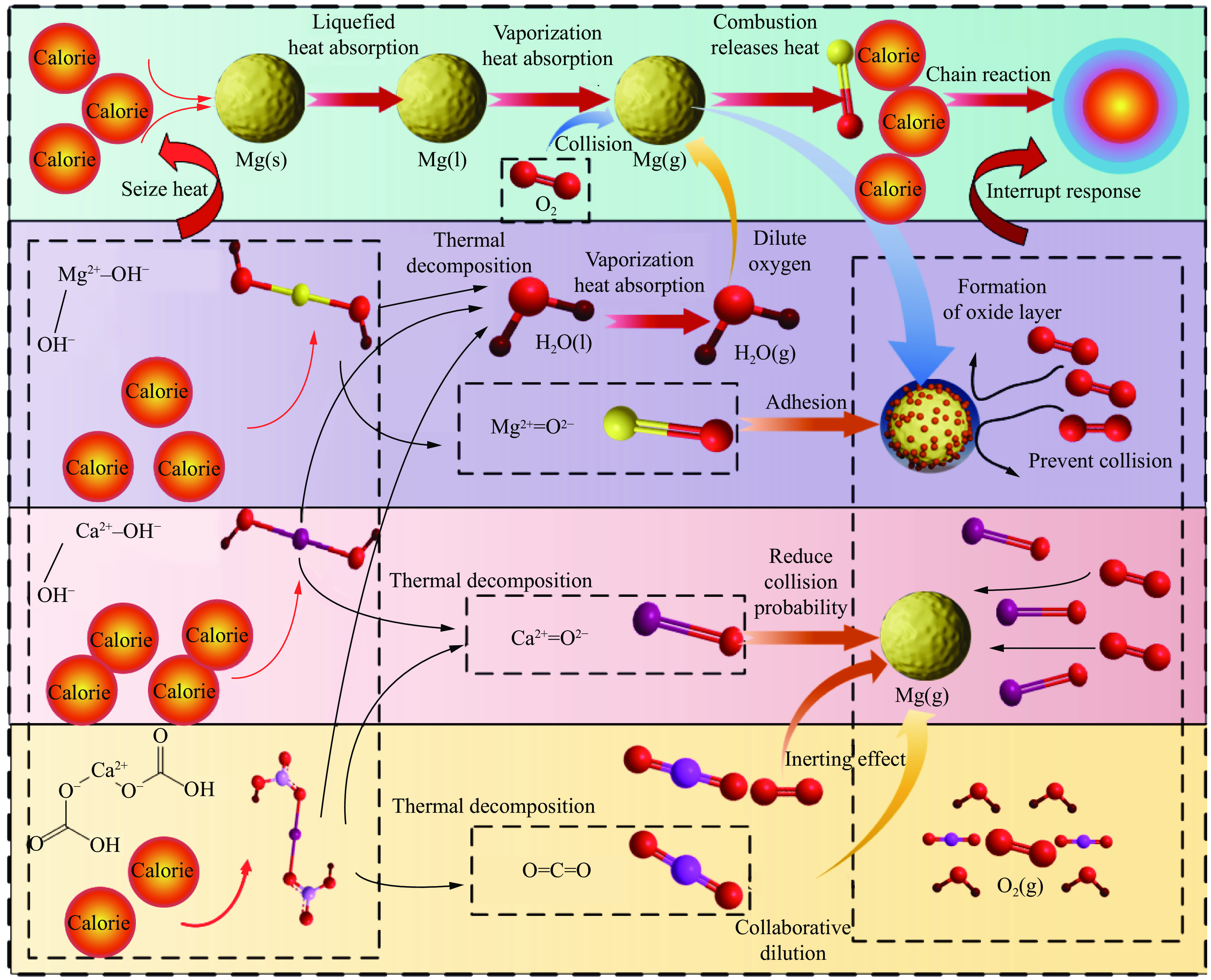
图 10 3种固体惰化剂对镁粉爆炸的惰化机理示意图
Figure 10. Schematic diagram of inerting mechanism of three solid inerting agents on magnesium powder explosion
表 1 固体惰化剂的基本物理参数
Table 1. Basic physical parameters of solid inerting agents
Solid inert substance D50/μm Purity grade Mass fraction of water Mg(OH)2 70 Analytical reagent <5% Ca(OH)2 70 Analytical reagent <5% Ca(HCO3)2 70 Analytical reagent <5%  下载: 导出CSV
表 2 镁粉粒径和浓度对$p_{\mathrm{max}} $及$({\mathrm{d}}p/{\mathrm{d}}t)_{\mathrm{max}} $的影响
Table 2. Effects of particle size and concentration of magnesium powder on $p_{\mathrm{max}} $ and $({\mathrm{d}}p/{\mathrm{d}}t)_{\mathrm{max}} $
ρMg/(g·m−3) D50/μm pmax/MPa (dp/dt)max/(MPa·s−1) ρMg/(g·m−3) D50/μm pmax/MPa (dp/dt)max/(MPa·s−1) 100 17.0 0.412 2.95 300 17.0 0.716 16.53 34.8 0.392 3.10 34.8 0.680 13.90 50.4 0.360 2.45 50.4 0.668 9.85 74.0 0.298 1.85 74.0 0.646 6.45 200 17.0 0.618 10.73 34.8 0.545 5.35 50.4 0.533 4.75 74.0 0.526 3.33
下载: 导出CSV
-
[1] 陆继锋, 李方, 刘吉庆. 非煤粉尘抑爆领域文献计量分析 [J]. 消防科学与技术, 2022, 41(10): 1464–1468. doi: 10.3969/j.issn.1009-0029.2022.10.030LU J F, LI F, LIU J Q. Bibliometric analysis in the field of non-coal dust explosion suppression [J]. Fire Science and Technology, 2022, 41(10): 1464–1468. doi: 10.3969/j.issn.1009-0029.2022.10.030 [2] 郭瑞, 李南, 张新燕, 等. 微米/纳米PMMA粉尘爆炸抑制过程中压力特性与热化学动力学的相关性 [J]. 爆炸与冲击, 2023, 43(12): 125401. doi: 10.11883/bzycj-2023-0058GUO R, LI N, ZHANG X Y, et al. Correlation between pressure characteristics and thermochemical kinetics during suppression of micro/nano PMMA dust explosion [J]. Explosion and Shock Waves, 2023, 43(12): 125401. doi: 10.11883/bzycj-2023-0058 [3] WANG Y, MAO W Z, SU Y, et al. Investigation on explosion overpressure and flame propagation characteristics of magnesium hydride dust of different particle sizes [J]. International Journal of Hydrogen Energy, 2025, 101: 438–449. doi: 10.1016/j.ijhydene.2024.12.312 [4] QIN C, FENG T, LI G, et al. Pre-carbonization and Mg powder induced synergistic optimization: enhancing the pore structure of coffee grounds-derived hard carbon to improve sodium storage performance [J]. Journal of Power Sources, 2025, 630: 236093. doi: 10.1016/j.jpowsour.2024.236093 [5] MENG F Y, LUO Z M, YU Y Y, et al. Multiple effects of high efficiency solid inertants on fire hazard of the accumulated Mg dust layer [J]. Energy, 2024, 313: 133807. doi: 10.1016/j.energy.2024.133807 [6] YUAN C M, YU L F, LI C, et al. Thermal analysis of magnesium reactions with nitrogen/oxygen gas mixtures [J]. Journal of Hazardous Materials, 2013, 260: 707–714. doi: 10.1016/j.jhazmat.2013.06.047 [7] 陈刚, 张晓蕾, 徐帅, 等. 我国2005—2020年粉尘爆炸事故统计分析 [J]. 中国安全科学学报, 2022, 32(8): 76–83. doi: 10.16265/j.cnki.issn1003-3033.2022.08.0812CHEN G, ZHANG X L, XU S, et al. Statistical analysis on dust explosion accidents in China from 2005 to 2020 [J]. China Safety Science Journal, 2022, 32(8): 76–83. doi: 10.16265/j.cnki.issn1003-3033.2022.08.0812 [8] 刘贞堂, 周西方, 林松, 等. 我国工业粉尘爆炸事故统计及趋势分析 [J]. 消防科学与技术, 2020, 39(6): 879–882. doi: 10.3969/j.issn.1009-0029.2020.06.039LIU Z T, ZHOU X F, LIN S, et al. Statistics and trend analysis of industrial dust explosion accidents in China [J]. Fire Science and Technology, 2020, 39(6): 879–882. doi: 10.3969/j.issn.1009-0029.2020.06.039 [9] 李珍宝, 李超, 王虎, 等. MPP抑制铝镁合金粉尘爆炸微观机理研究 [J]. 化工学报, 2023, 74(8): 3608–3614. doi: 10.11949/0438-1157.20230598LI Z B, LI C, WANG H, et al. The microscopic mechanism on MPP inhibiting explosion of Al-Mg alloy powder [J]. CIESC Journal, 2023, 74(8): 3608–3614. doi: 10.11949/0438-1157.20230598 [10] 冯晓美, 崔楚凝, 张轩鸣, 等. 粉尘爆炸及防护措施研究进展 [J]. 山东化工, 2022, 51(12): 204–206. doi: 10.3969/j.issn.1008-021X.2022.12.062FENG X M, CUI C N, ZHANG X M, et al. Process of dust explosion and protective measures [J]. Shandong Chemical Industry, 2022, 51(12): 204–206. doi: 10.3969/j.issn.1008-021X.2022.12.062 [11] 国家市场监督管理总局, 国家标准化管理委员会. 粉尘防爆安全规程: GB 15577—2018 [S]. 北京: 中国标准出版社, 2018.State Administration for Market Regulation, National Standardization Administration. Safety regulations for dust explosion prevention and protection: GB 15577—2018 [S]. Beijing: Standards Press of China, 2018. [12] 项国, 王继仁, 刘天奇. 基于20 L球形装置的镁粉爆炸压力特性 [J]. 辽宁工程技术大学学报(自然科学版), 2018, 37(3): 508–511.XIANG G, WANG J R, LIU T Q. Explosion pressure characteristics of magnesium powder based on 20 L spherical device [J]. Journal of Liaoning Technical University (Natural Science), 2018, 37(3): 508–511. [13] 王二飞. 受限空间内微米级镁粉及镁铝合金粉燃爆实验研究 [D]. 西安: 西安科技大学, 2020.WANG E F. Experimental research on the combustion and explosion of micron magnesium powder and magnesium aluminum alloy powder in confined space [D]. Xi’an: Xi’an University of Science and Technology, 2020. [14] 伍毅, 袁旌杰, 蒯念生, 等. 碳酸盐对密闭空间粉尘爆炸压力影响的试验研究 [J]. 中国安全科学学报, 2010, 20(10): 92–96. doi: 10.3969/j.issn.1003-3033.2010.10.017WU Y, YUAN J J, KUAI N S, et al. Effects of carbonates on dust explosion pressure in closed vessel [J]. China Safety Science Journal, 2010, 20(10): 92–96. doi: 10.3969/j.issn.1003-3033.2010.10.017 [15] 代琳琳. 碳酸、磷酸盐对铝粉爆炸的抑制作用研究及数值模拟 [D]. 天津: 天津大学, 2020.DAI L L. Inhibition and numerical simulation of carbonate and phosphate on aluminum powder explosion [D]. Tianjin: Tianjin University, 2020. [16] 付羽, 李刚, 孙飞, 等. 镁粉粉末惰化性能实验研究 [C]//2008(沈阳)国际安全科学与技术学术研讨会论文集. 沈阳: 东北大学, 2008: 616–620.FU Y, LI G, SUN F, et al. Experimental study on magnesium powder inerting performance [C]//Proceedings of the 2008 (Shenyang) International Colloquium on Safety Science and Technology. Shenyang: Northeastern University, 2008: 616–620. [17] WANG Z, MENG X B, YAN K, et al. Inhibition effects of Al(OH)3 and Mg(OH)2 on Al-Mg alloy dust explosion [J]. Journal of Loss Prevention in the Process Industries, 2020, 66: 104206. doi: 10.1016/j.jlp.2020.104206 [18] 陈攀. 粉末惰化条件下微纳米钛粉反应动力学研究 [D]. 沈阳: 东北大学, 2015.CHEN P. Study on the reaction kinetics of micro and nano Ti powders with inerting powders [D]. Shenyang: Northeastern University, 2015. [19] 谭迎新, 李亚男. 磷酸二氢铵对铝粉的爆炸抑制研究 [J]. 中北大学学报(自然科学版), 2015, 36(4): 458–461. doi: 10.3969/j.issn.1673-3193.2015.04.012TAN Y X, LI Y N. Research on the explosion restrain of (NH4)H2PO4 inhibitor to aluminum dust [J]. Journal of North University of China (Natural Science Edition), 2015, 36(4): 458–461. doi: 10.3969/j.issn.1673-3193.2015.04.012 [20] 国家市场监督管理总局, 国家标准化管理委员会. 惰化防爆指南: GB/T 37241—2018 [S]. 北京: 中国标准出版社, 2019.State Administration for Market Regulation, National Standardization Administration. Guide on inerting for the prevention of explosions: GB/T 37241—2018 [S]. Beijing: Standards Press of China, 2019. [21] 国家市场监督管理总局, 国家标准化管理委员会. 粉尘云爆炸下限浓度测定方法: GB/T 16425—2018 [S]. 北京: 中国标准出版社, 2018.State Administration for Market Regulation, National Standardization Administration. Determination for minimum explosive concentration of dust clouds: GB/T 16425—2018 [S]. Beijing: Standards Press of China, 2018. [22] 李雨成, 富健涛, 奇佳民, 等. 密闭空间镁粉爆炸压力特性研究 [J]. 爆破, 2018, 35(3): 114–119. doi: 10.3963/j.issn.1001-487X.2018.03.019LI Y C, FU J T, JI J M, et al. Pressure characteristics of magnesium powder explosion in confined space [J]. Blasting, 2018, 35(3): 114–119. doi: 10.3963/j.issn.1001-487X.2018.03.019 [23] MITTAL M. Explosion characteristics of micron- and nano-size magnesium powders [J]. Journal of Loss Prevention in the Process Industries, 2014, 27: 55–64. doi: 10.1016/j.jlp.2013.11.001 [24] 许扬, 黄骞, 宋民航, 等. 颗粒间距对煤粉颗粒着火和燃烧行为影响的理论研究 [J]. 煤炭学报, 2022, 47(4): 1701–1708. doi: 10.13225/j.cnki.jccs.2021.0398XU Y, HUANG Q, SONG M H, et al. Theoretical study on the effect of particle spacing on ignition and combustion behavior of pulverized coal particles [J]. Journal of China Coal Society, 2022, 47(4): 1701–1708. doi: 10.13225/j.cnki.jccs.2021.0398 [25] 王涛, 孟帆, 弋伟斋, 等. 碳酸钾改性干水-六氟丙烷抑制甲烷爆炸特性 [J]. 高压物理学报, 2025, 39(4): 045301. doi: 10.11858/gywlxb.20240927WANG T, MENG F, YI W Z, et al. Coupling inhibition effects of dry water modified by potassium carbonate and hexafluoropropane on methane explosion [J]. Chinese Journal of High Pressure Physics, 2025, 39(4): 045301. doi: 10.11858/gywlxb.20240927 [26] 谢度坤, 邹昀, 陈小鹏, 等. 碳酸氢钙改性及其热分解动力学 [J]. 广西大学学报(自然科学版), 2023, 48(1): 181–191. doi: 10.13624/j.cnki.issn.1001-7445.2023.0181XIE D K, ZOU Y, CHEN X P, et al. Thermal decomposition kinetics of modified calcium bicarbonate [J]. Journal of Guangxi University (Natural Science Edition), 2023, 48(1): 181–191. doi: 10.13624/j.cnki.issn.1001-7445.2023.0181 [27] 钟英鹏. 镁粉爆炸特性实验研究及其危险性评价 [D]. 沈阳: 东北大学, 2008.ZHONG Y P. Experimental research on magnesium dust explosion and its risk assessment [D]. Shenyang: Northeastern University, 2008. [28] CIUDAD A, HAURIE L, LACASTA A M. Kinetic analysis of endothermic degradation of magnesium hydroxide, calcium hydroxide and calcium carbonate in the context of passive fire protection [J]. Fire and Materials, 2015, 39(1): 14–25. doi: 10.1002/fam.2223 [29] LI G, YUAN C M, FU Y, et al. Inerting of magnesium dust cloud with Ar, N2 and CO2 [J]. Journal of Hazardous Materials, 2009, 170(1): 180–183. doi: 10.1016/j.jhazmat.2009.04.121 [30] XIONG X Y, GAO K, JI C Q, et al. Study on the characteristics parameters of magnesium dust explosion suppression by various inert gases [J]. Journal of Loss Prevention in the Process Industries, 2024, 87: 105242. doi: 10.1016/j.jlp.2023.105242 -

 下载:
下载:


计量
- 文章访问数: 1051
- HTML全文浏览量: 575
- PDF下载量: 91
