





Numerical Simulation and Safety Study of Kinetic Energy Projectiles Filled with Lead Sand Impacting Bionic Targets
-
摘要: 为提高国内现役38 mm防暴枪用非致命动能弹的安全性,采用有限元-离散元法,对填充铅砂的38 mm球形动能弹丸冲击人体仿生靶标过程进行数值模拟,利用刚性壁实验对建模方法和参数选取进行间接验证,获得了弹丸冲击仿生靶标过程的形变过程、动能、速度、位移、能量传递率等变化数据。在此基础上,对不同弹体速度和壁厚进行对比分析,提出了安全射击建议。结果表明:弹丸冲击仿生靶标时产生了较大形变,弹丸形变至圆饼状,靶标产生圆形凹陷,两者形变均可在一定程度上恢复;弹丸致伤威力随着速度的增加而增大,随着壁厚的增厚而减小;当弹丸壁厚为5、7、9 mm时,不造成腹部皮肤穿透损伤的最小射击安全距离分别为122.40、64.62、31.26 m。Abstract: To enhance the safety of the non-lethal kinetic energy ammunition used in the current 38 mm riot control guns, the finite element-discrete element method was employed to simulate the impact process of the 38 mm spherical kinetic energy projectile filled with lead sand on a human body-like target. The modeling method and parameter selection were indirectly verified through a rigid-wall experiment, and data on the deformation process, kinetic energy, velocity, displacement, and energy transfer rate during the projectile impacting on the target were obtained. Based on this, comparative analysis was conducted on different projectile velocities and wall thicknesses, and safety related shooting suggestions were proposed. The results show that the projectile undergoes significant deformation upon impact with the target, transforming into a disc like shape, while the target exhibits a circular indentation, with both deformations being partially recoverable to some extent. The wounding power of the projectile increases with velocity and decreases with wall thickness. The minimum safe shooting distances without causing abdominal skin penetration injuries for projectile wall thicknesses of 5, 7, and 9 mm are 122.40, 64.62, and 31.26 m, respectively.
-
Key words:
- kinetic projectile /
- impact dynamics /
- non-lethal effects /
- bionic targets
-
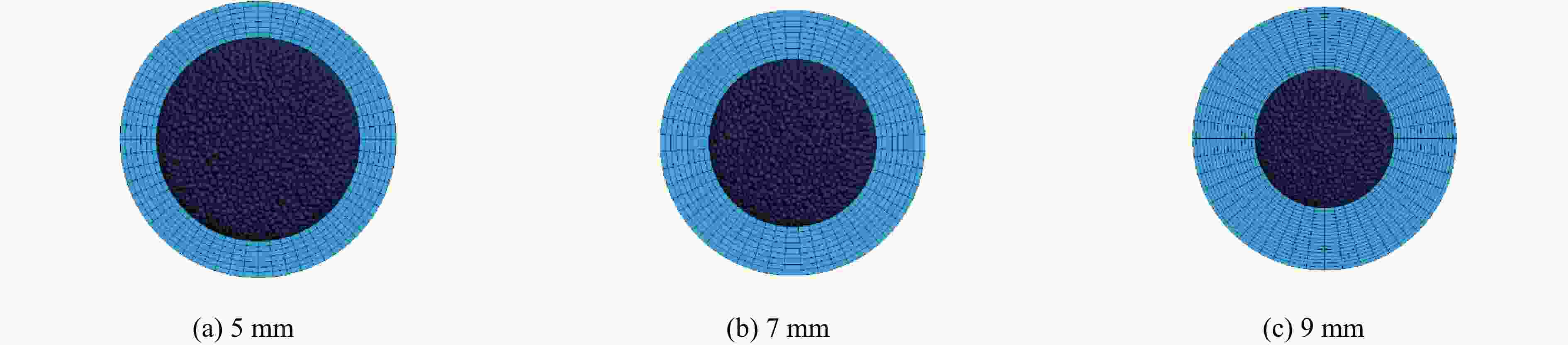
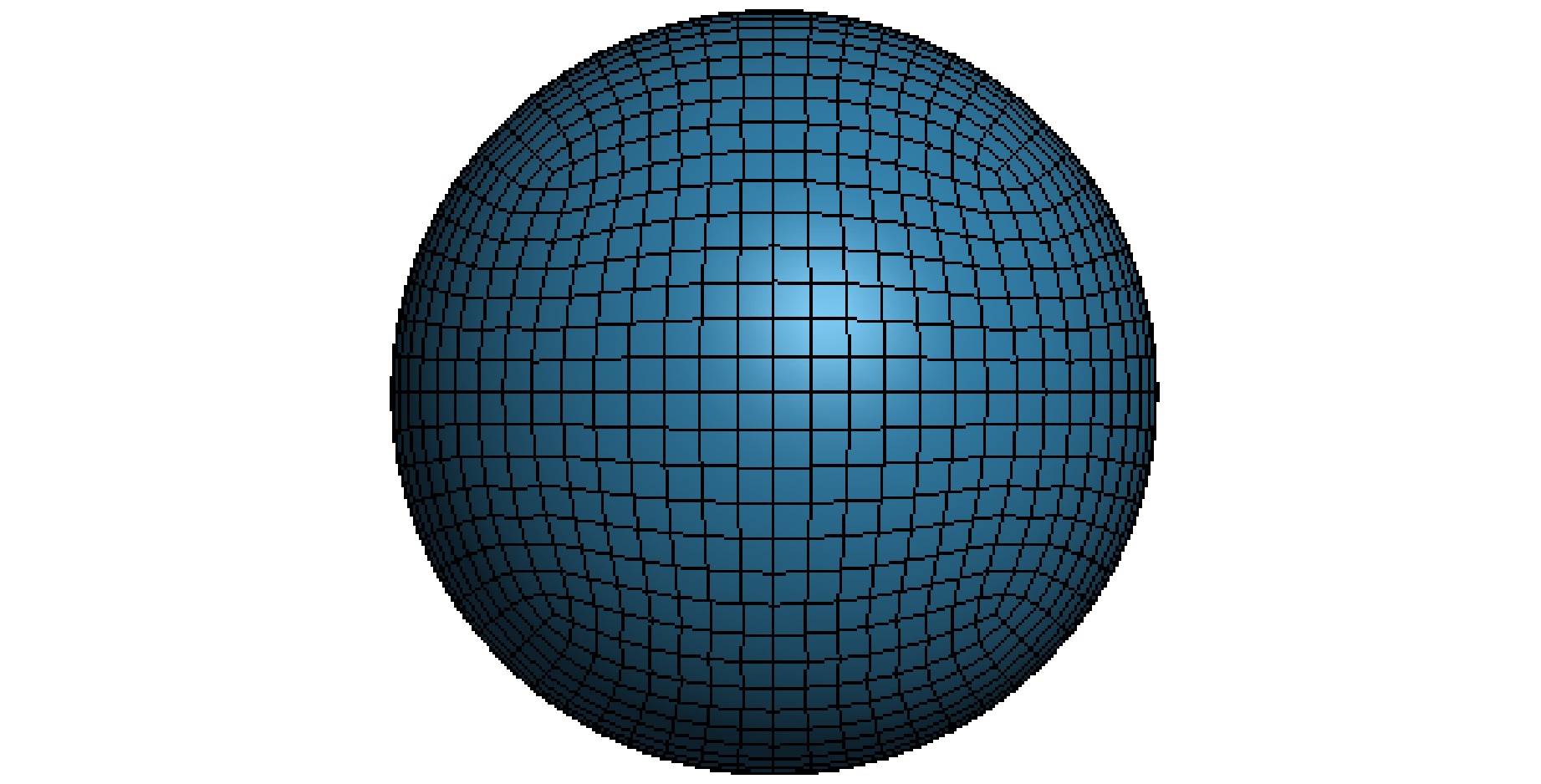
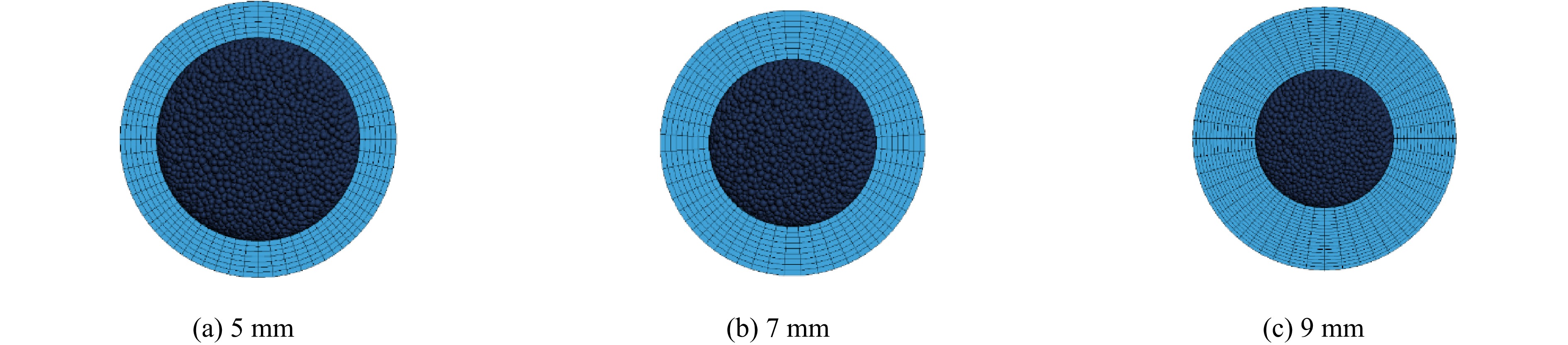
图 1 不同壁厚动能弹的有限元模型
Figure 1. Finite element model of kinetic energy projectile with different wall thicknesses
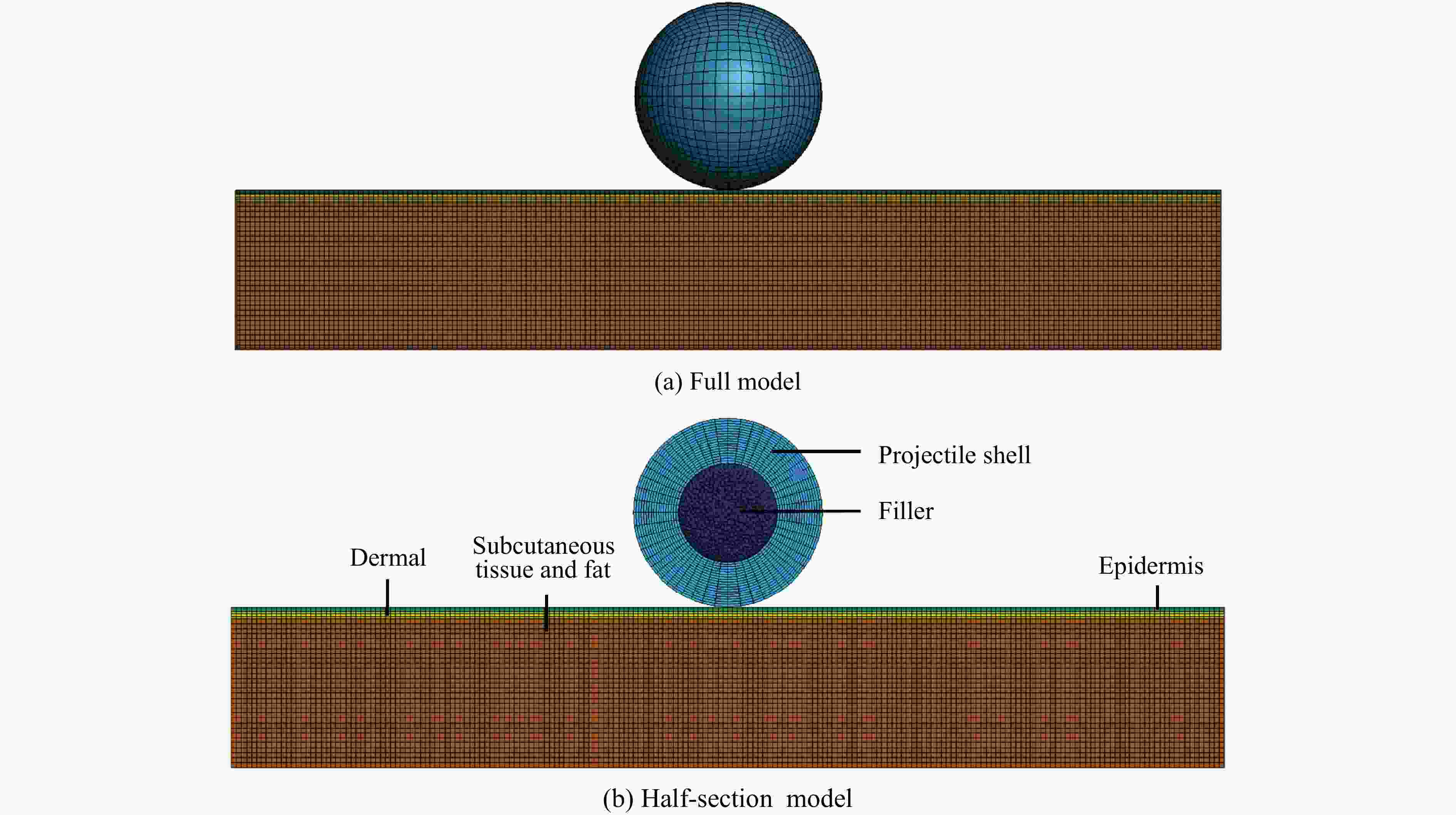
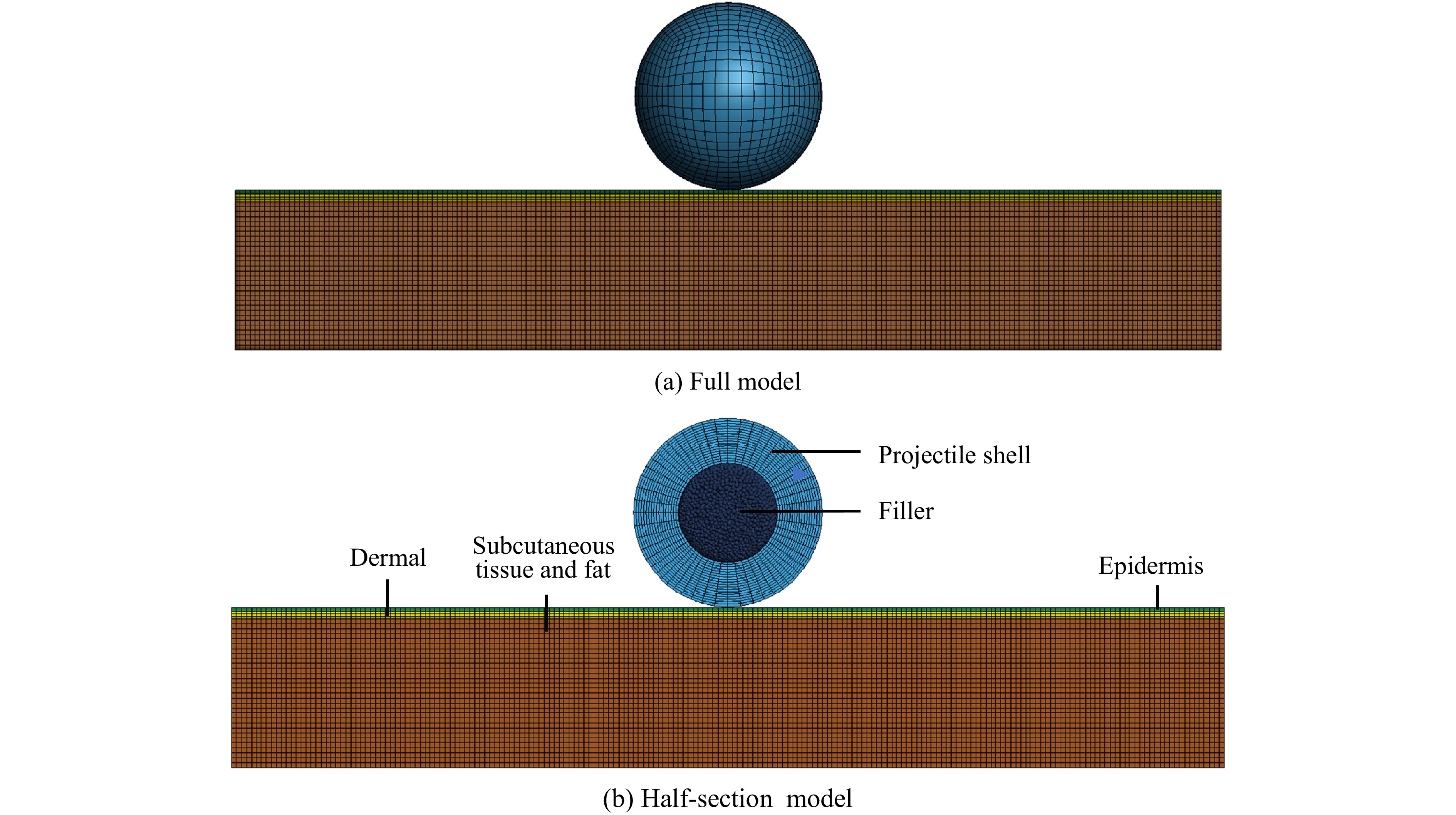
图 2 9 mm壁厚动能弹丸冲击仿生靶标有限元模型
Figure 2. Finite element model of a kinetic energy projectile with a wall thickness of 9 mm impacting biomimetic target
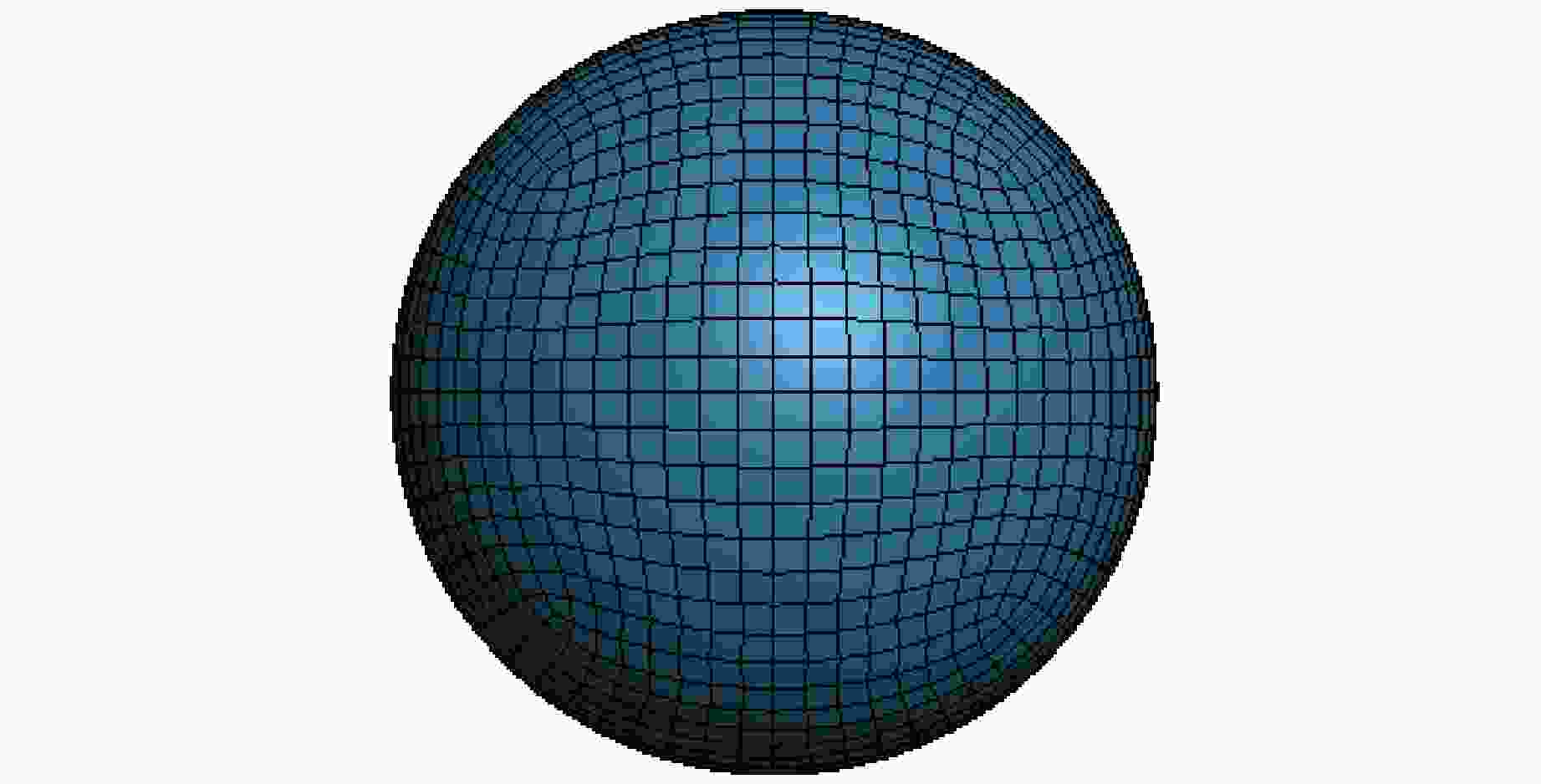
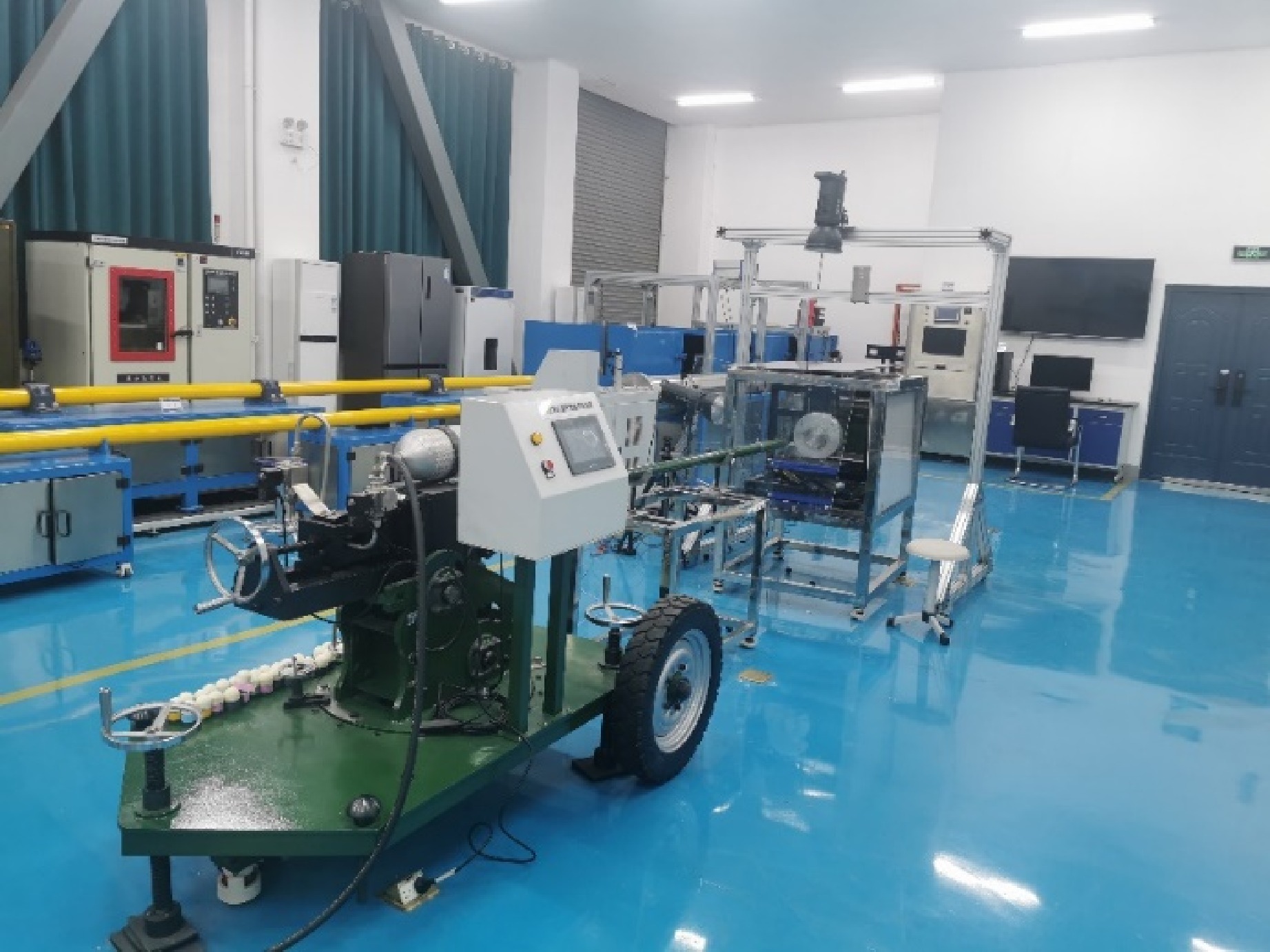
图 4 弹丸冲击刚性壁有限元模型
Figure 4. Finite element model of a projectile impacting a rigid wall
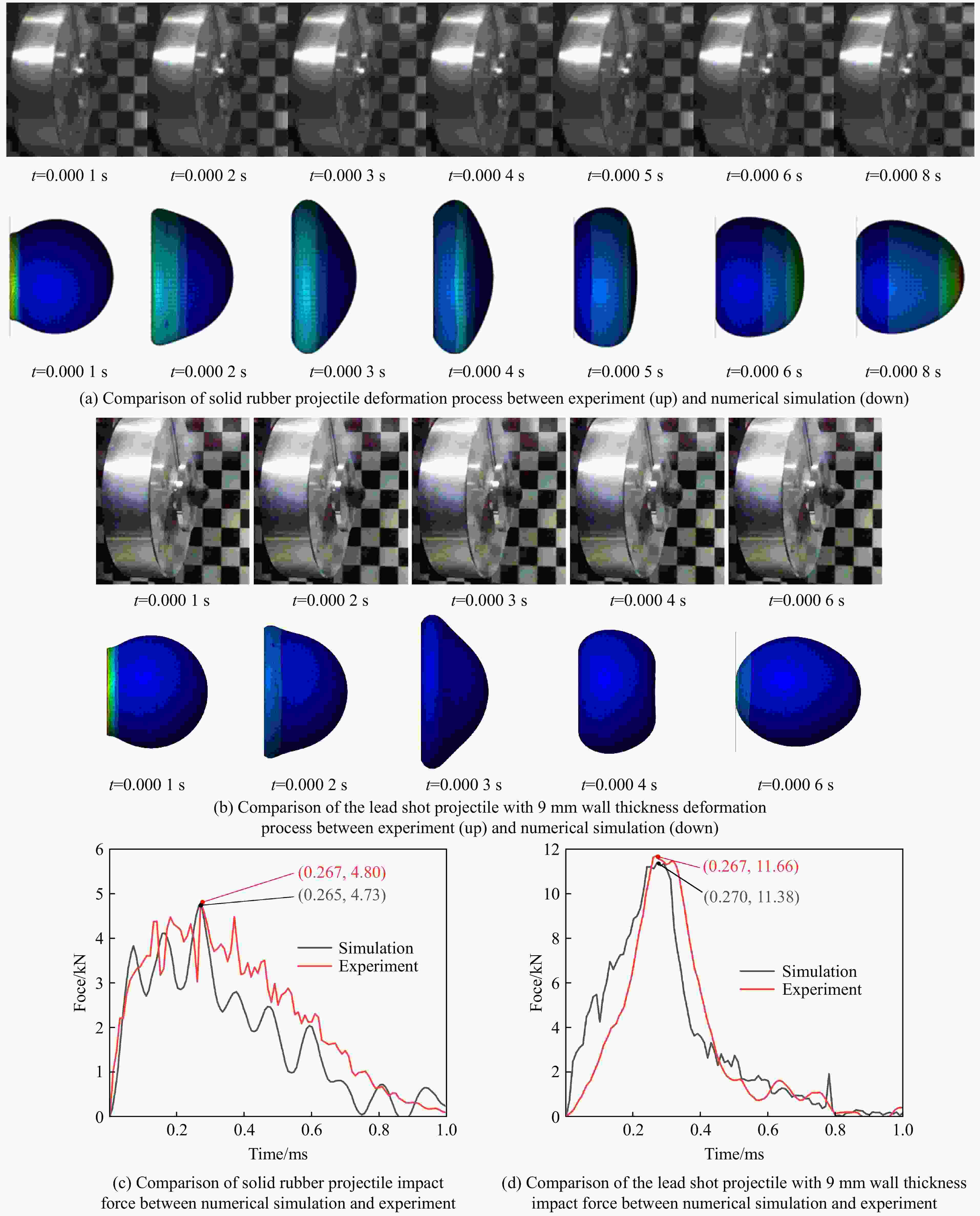
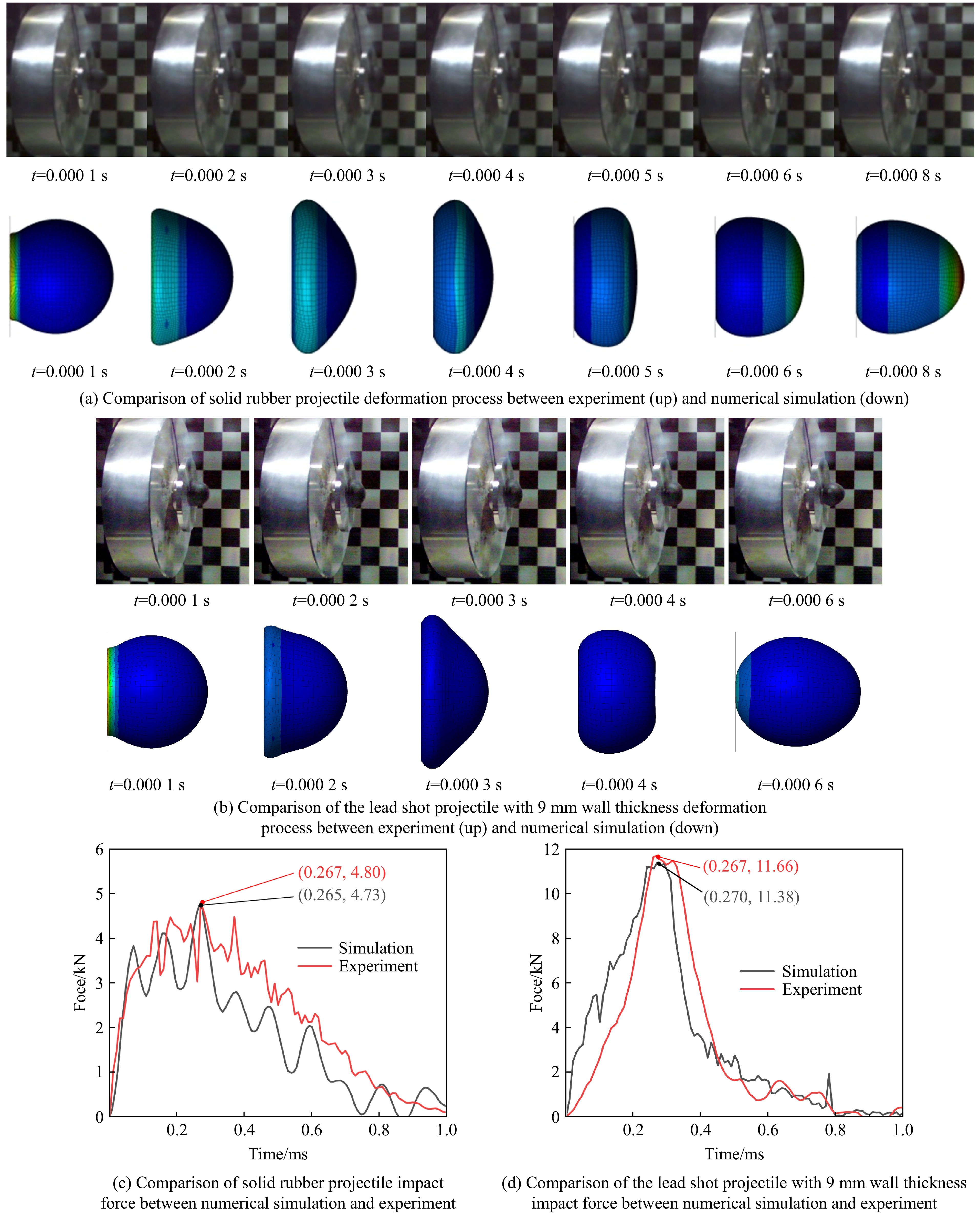
图 5 弹丸冲击刚性壁数值模拟与实验对比
Figure 5. Comparison between numerical and experimental results for projectile impact on a rigid wall
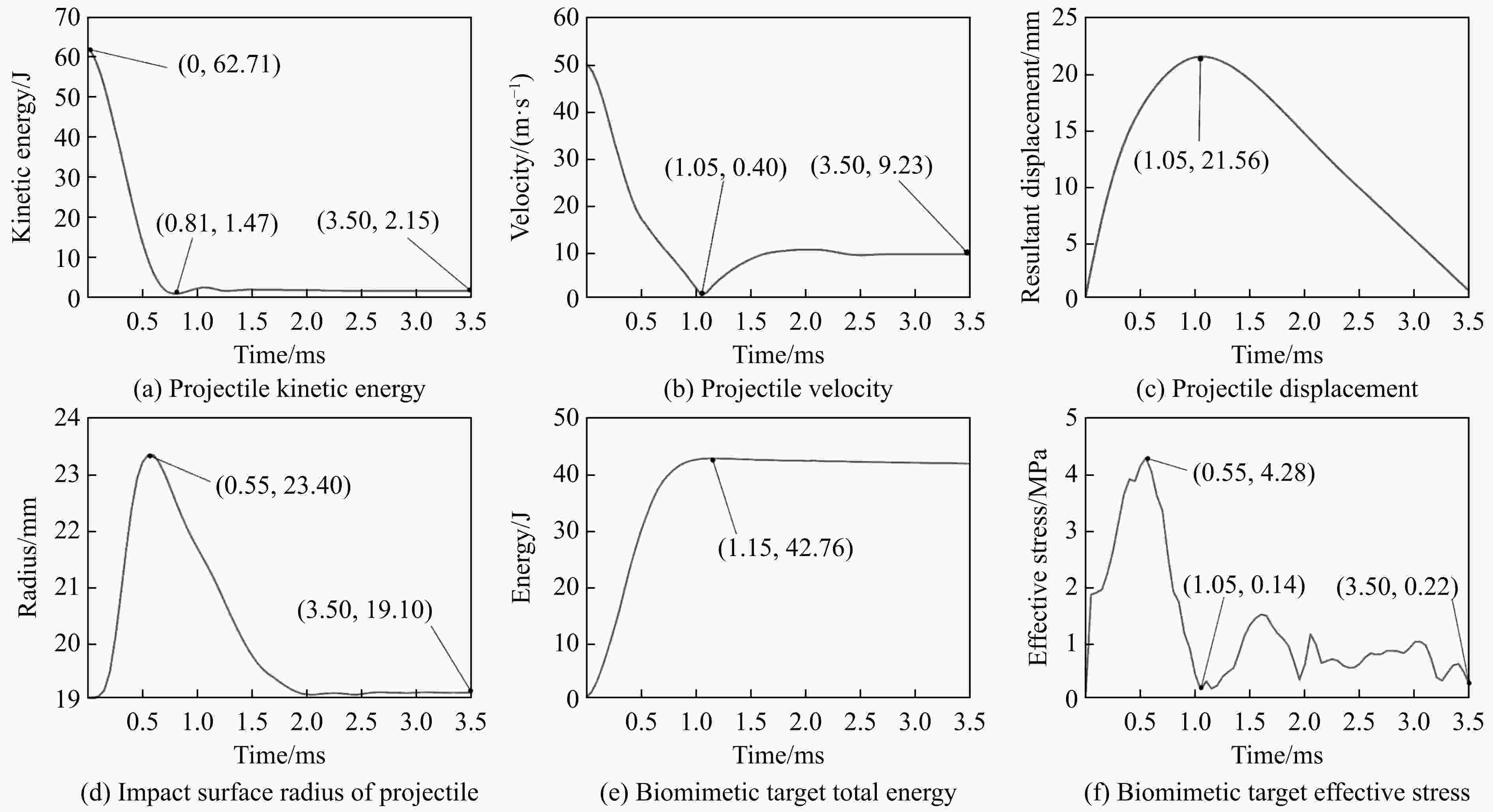
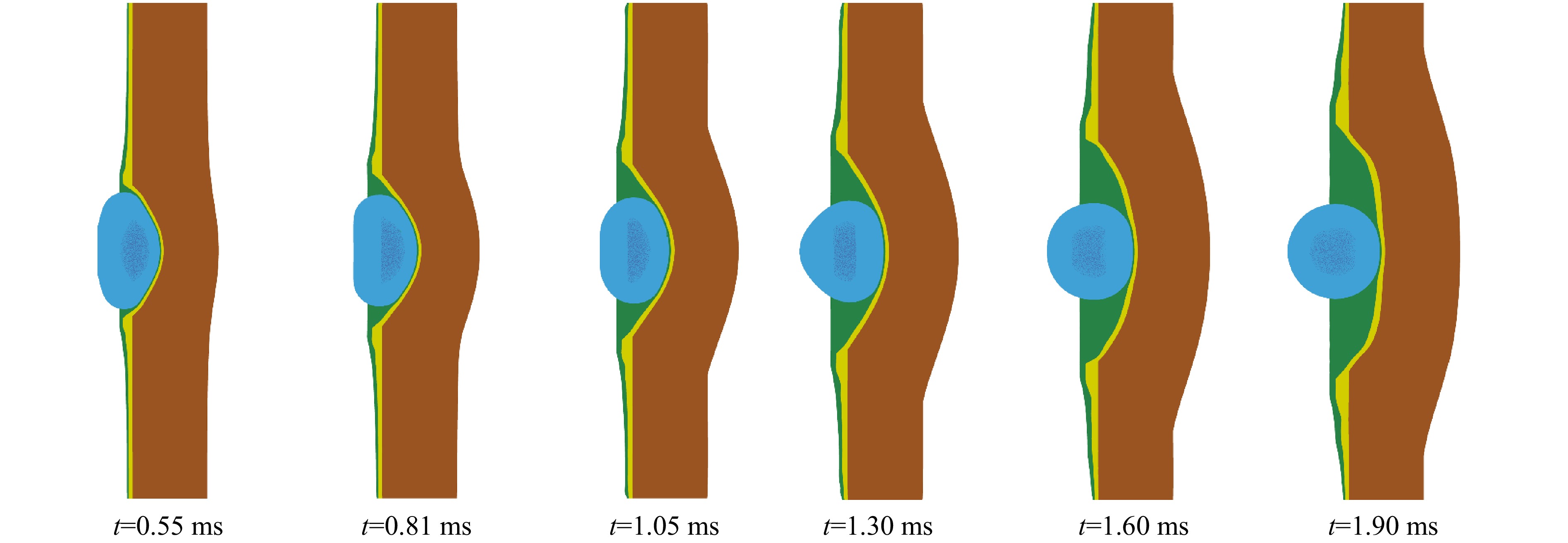
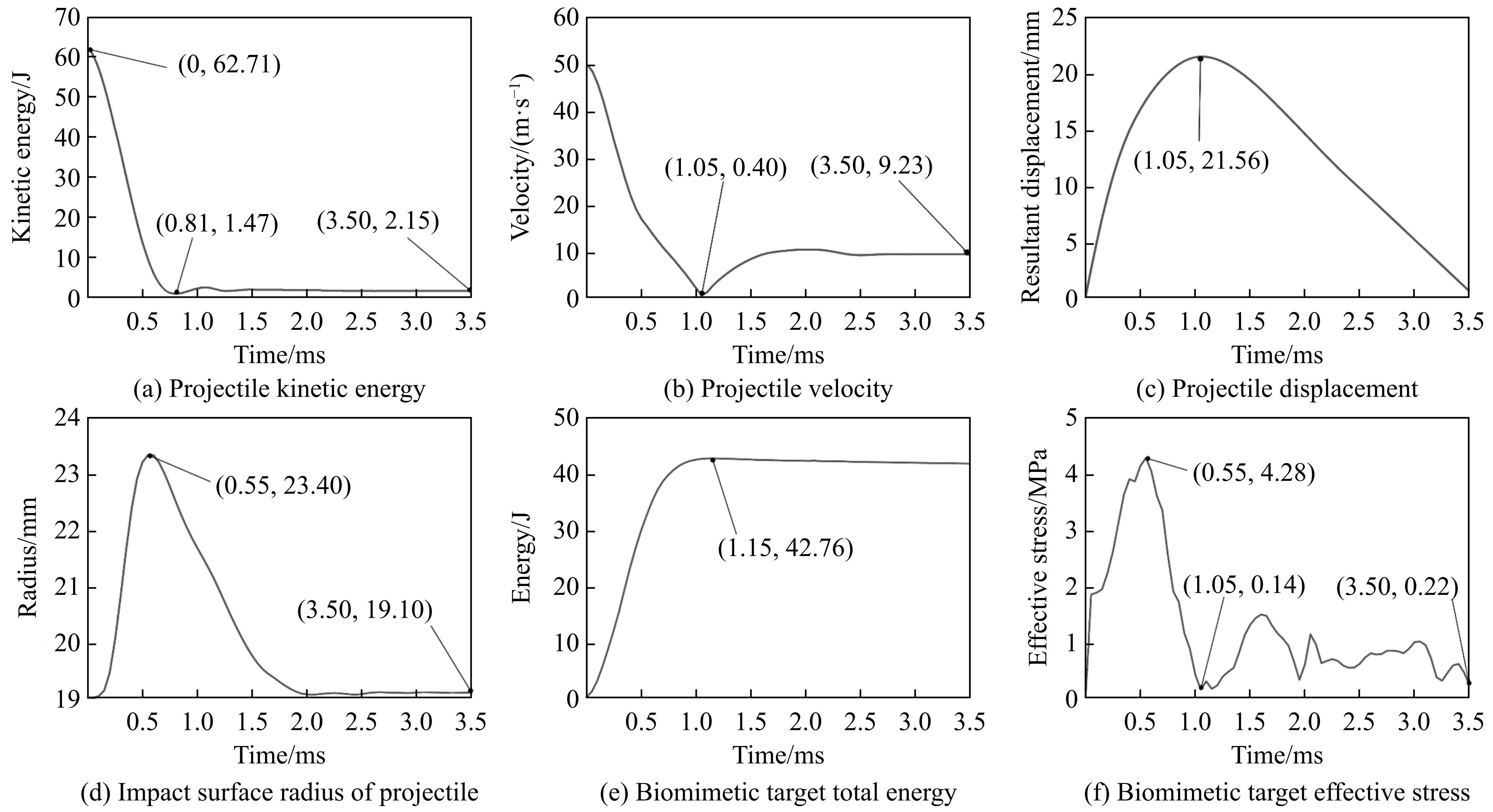
图 7 壁厚9 mm弹丸冲击仿生靶标数据变化曲线
Figure 7. Data history for 9 mm wall projectile impacting biomimetic target
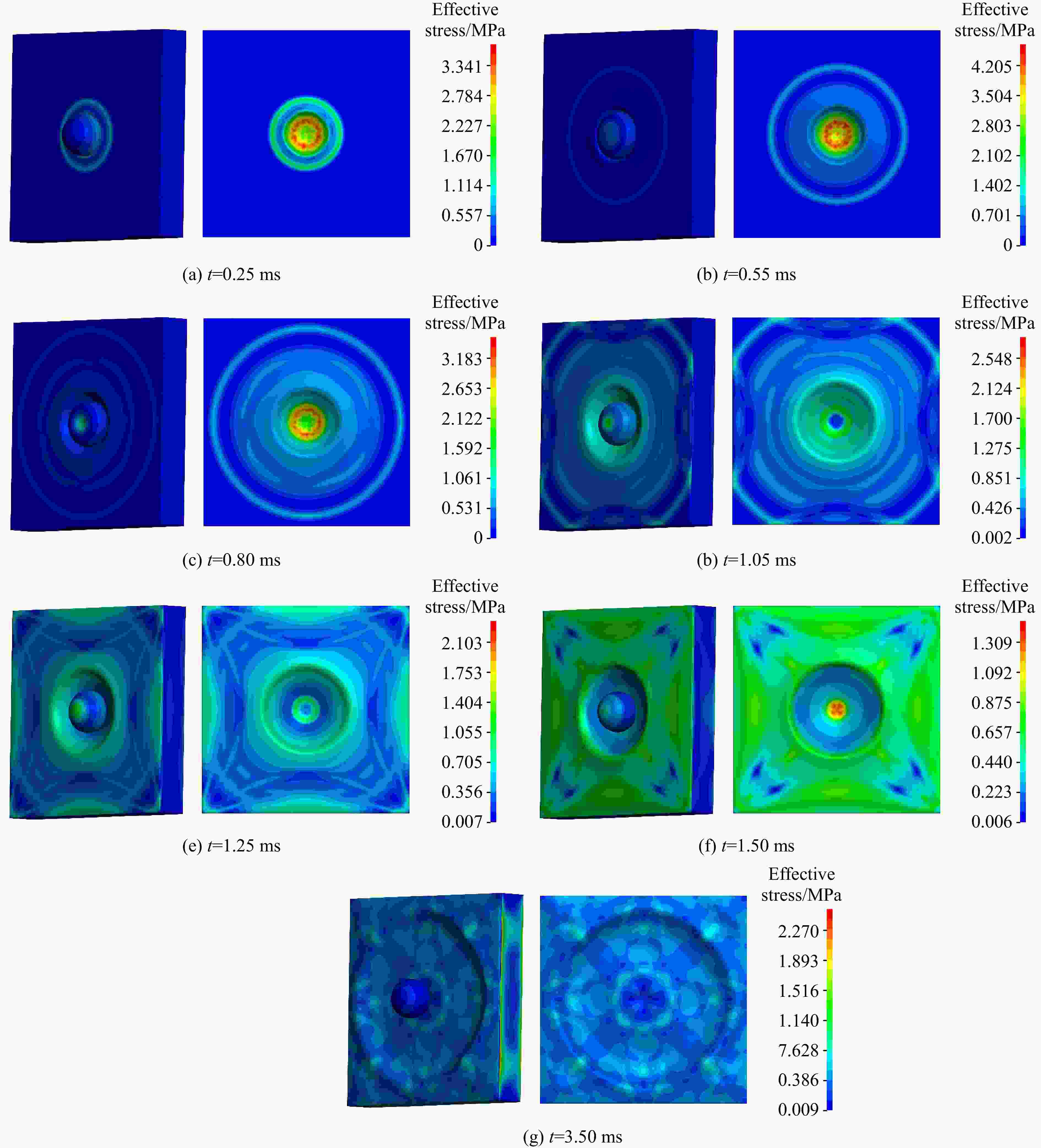
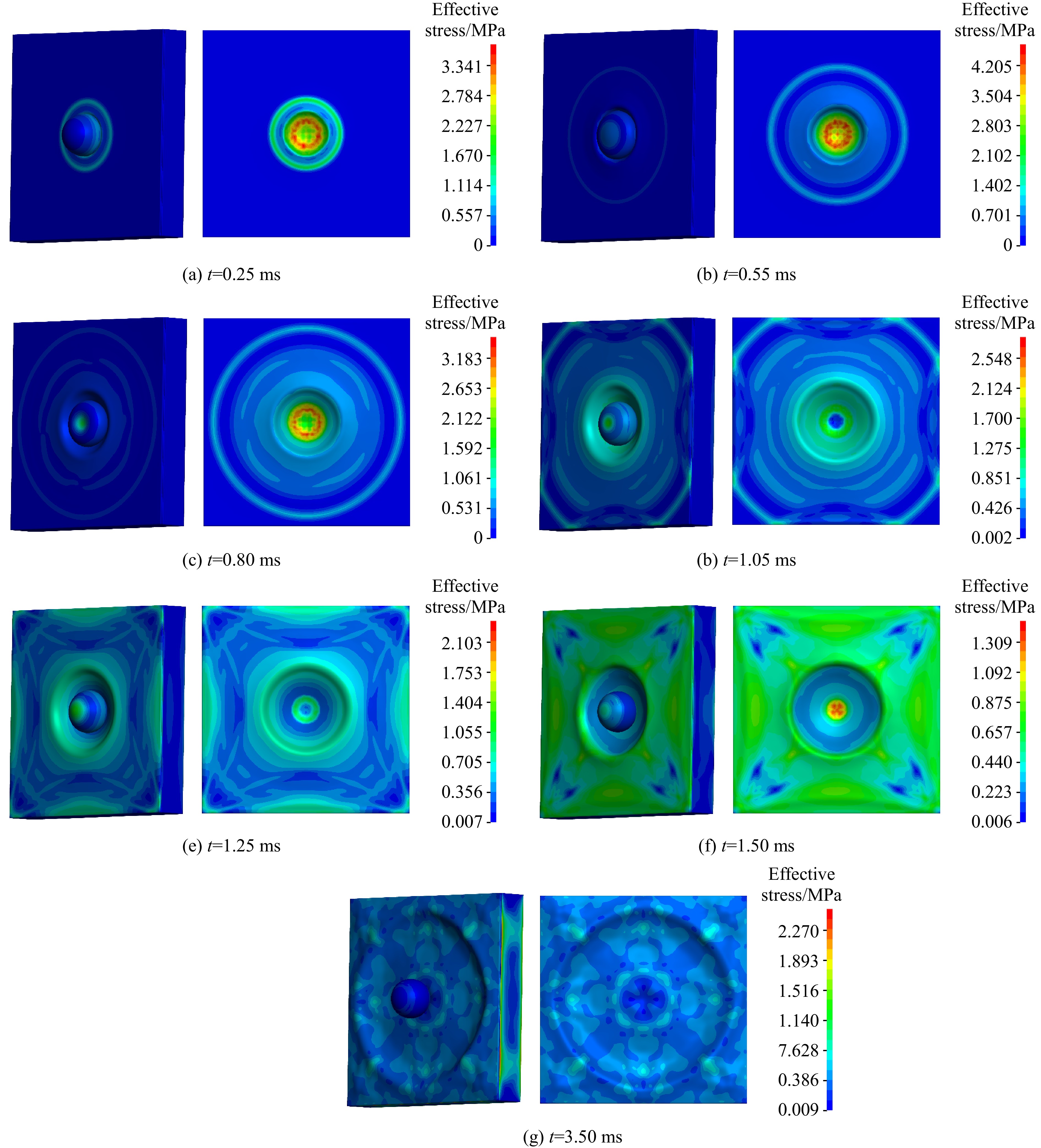
图 8 弹丸冲击仿生靶标von Mises应力云图
Figure 8. Von Mises stress contour plot of the projectile impacting biomimetic target
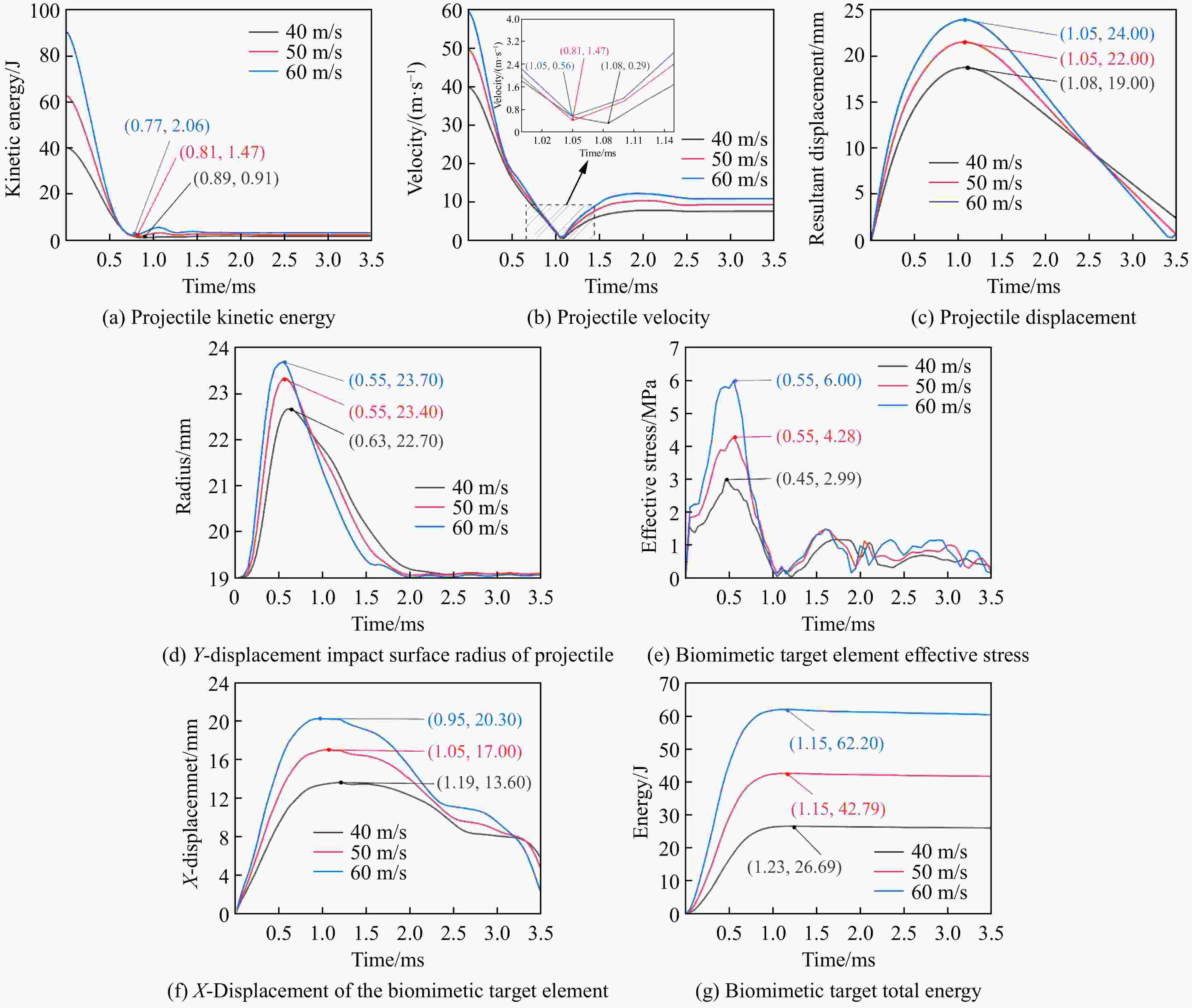
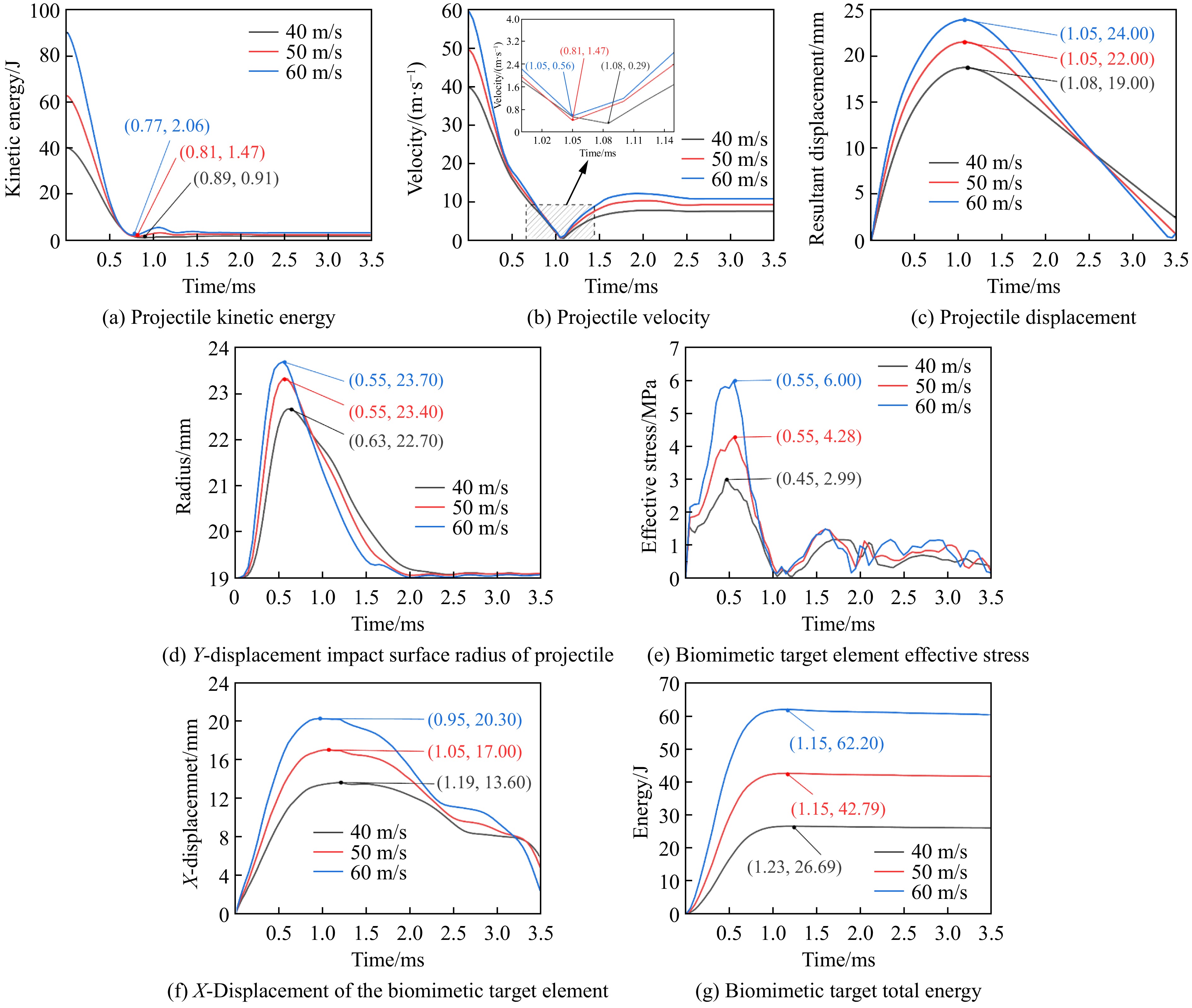
图 9 不同速度弹丸冲击仿生靶标数据变化曲线
Figure 9. Comparison of data curves for projectile impactingbiomimetic target across different velocities
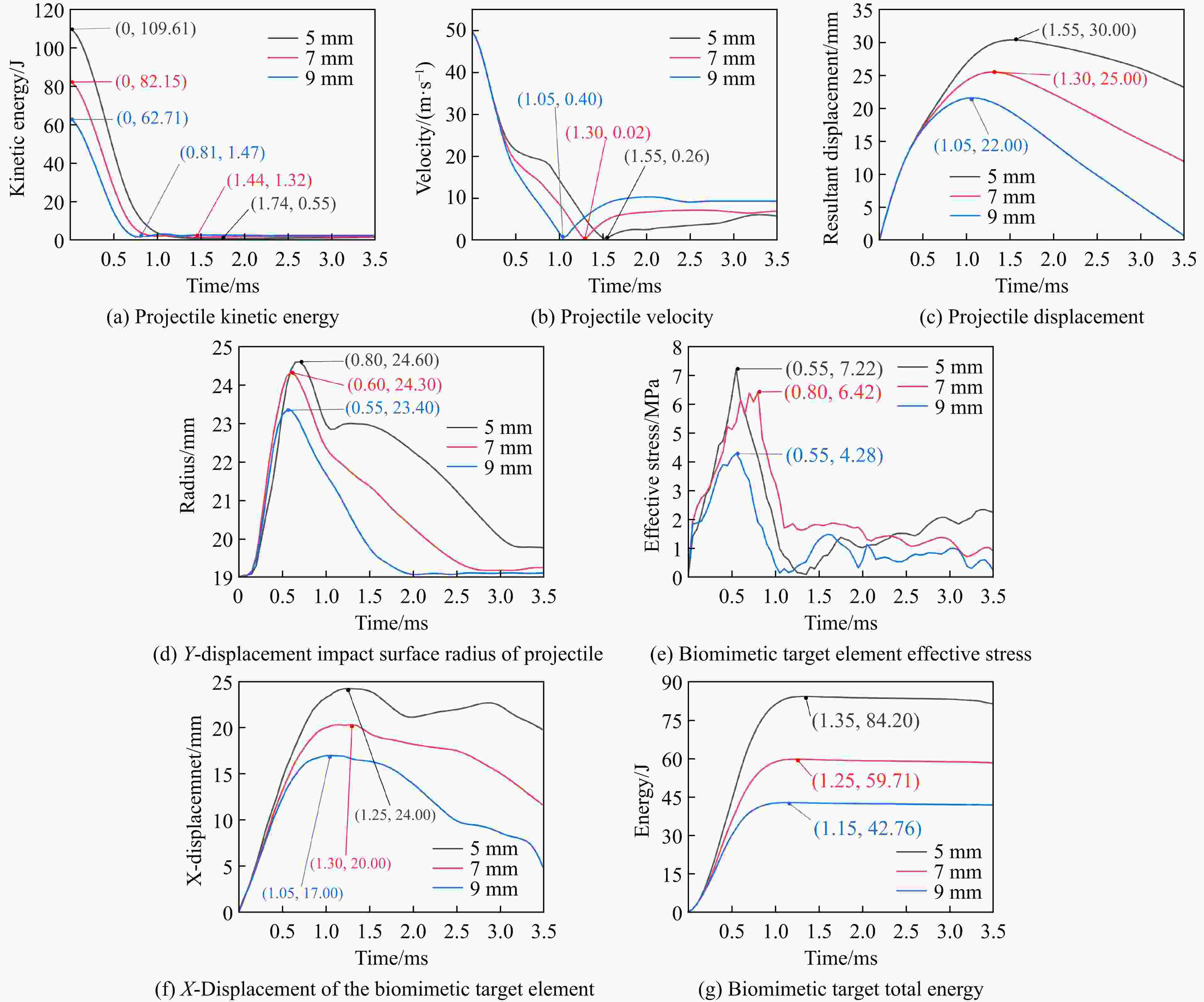
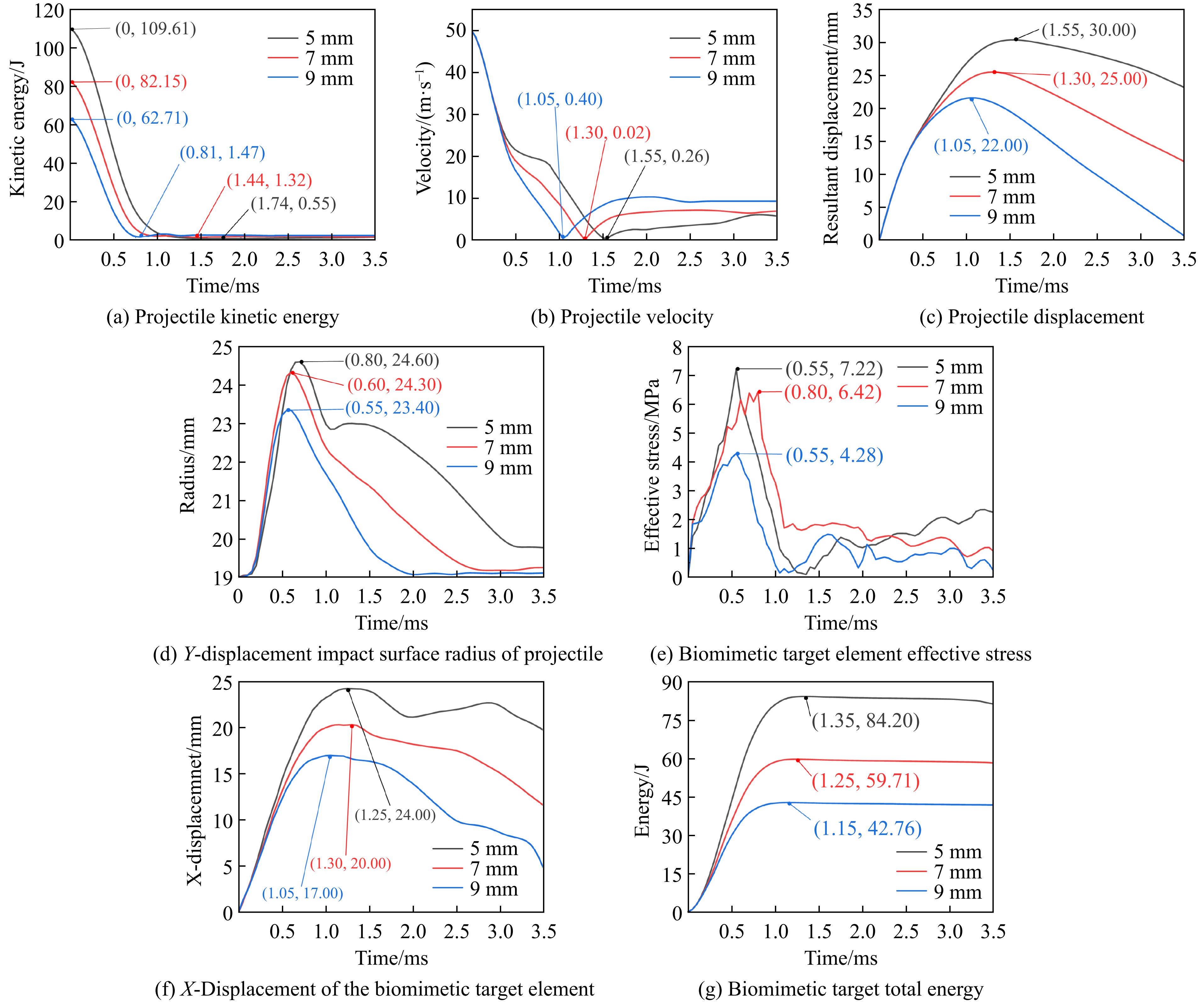
图 10 不同壁厚弹丸冲击仿生靶标数据变化曲线
Figure 10. Comparison of data curves for projectile impacting biomimetic target across different wall thicknesses
表 1 弹丸外壳材料模型参数
Table 1. Material parameters of projectile shell
Material ρ0/(kg·m−3) μ G/MPa C10 C01 Projectile shell 1030 0.49 19.53 5.473×10⁵ 2.152×10⁵  下载: 导出CSV
表 2 填充物材料模型参数
Table 2. Material parameters of filler
Material ρ0/(kg·m−3) E/GPa μ Filler 1.104×10⁴ 200 0.3
下载: 导出CSV
Material ρ0/(kg·m−3) μ E/MPa SRC SRP Epidermis 1300 0.47 7.73 50 6
下载: 导出CSV
Material ρ0/(kg·m−3) μ G/MPa C10 C01 Dermis 1030 0.48 2.548 6.89×10⁵ 5.85×10⁵
下载: 导出CSV
Material ρ0/(kg·m−3) K N M Subcutaneous tissue and fat 920 5.00×10⁵ 6.00 6.00
下载: 导出CSV
表 6 刚性壁实验2种弹丸实验数据
Table 6. Experimental data of two types of projectiles in rigid wall experiment
Projectile Mass/g Velocity/(m·s−1) Impact force/N Solid rubber projectile 1 29.49 56.20 4617.50 Solid rubber projectile 2 29.50 56.20 4888.40 Solid rubber projectile 3 29.44 56.80 4813.60 Lead shot projectile with 9 mm wall thickness 1 52.86 51.70 11848.70 Lead shot projectile with 9 mm wall thickness 2 51.73 51.50 11723.20 Lead shot projectile with 9 mm wall thickness 3 51.67 50.90 11422.10
下载: 导出CSV
表 7 刚性壁材料模型参数
Table 7. Material parameters of rigid wall
Material ρ0/(kg·m−3) $\mu $ E/GPa Rigid wall 7850 0.3 200
下载: 导出CSV
表 8 不同壁厚动能弹丸最小射击安全距离与皮肤穿透速度阈值
Table 8. Minimum shooting safety distance and skin penetration velocity threshold of kinetic projectiles with different wall thicknesses
Wall thickness/mm Velocity/(m·s−1) Distance/m 5 45.03 122.40 7 51.99 64.62 9 59.50 31.26
下载: 导出CSV
-
[1] RAVI S, LEATHERS K O, WEINFELD A B, et al. Kinetic impact projectiles and craniofacial trauma: a case series and literature review [J]. Face, 2023, 4(3): 397–403. doi: 10.1177/27325016231182603 [2] Small Arms Survey, Geneva. Procurement and policy: police use of emerging weapons technology [M]//Small Arms Survey. Small Arms Survey 2011: States of Security. Cambridge: Cambridge University Press, 2011: 69–100. [3] KOENE L, PAPY A. Towards a better, science-based, evaluation of kinetic non-lethal weapons [J]. International Journal of Intelligent Defence Support Systems, 2011, 4(2): 169–186. doi: 10.1504/ijidss.2011.039548 [4] WANG S. Simulation design of non-lethal hollow spherical kinetic energy projectile based on ANSYS LS-DYNA [C]//Proceedings of the 4th International Conference on Mechanical Design and Simulation. Singapore: Springer, 2025: 269–283. [5] SEHGAL A, CHALLONER K R. The flexible baton TM-12: a case report involving a new police weapon [J]. The Journal of Emergency Medicine, 1997, 15(6): 789–791. doi: 10.1016/S0736-4679(97)00186-8 [6] WAHL P, SCHREYER N, YERSIN B. Injury pattern of the Flash-Ball®, a less-lethal weapon used for law enforcement: report of two cases and review of the literature [J]. The Journal of Emergency Medicine, 2006, 31(3): 325–330. doi: 10.1016/j.jemermed.2005.09.022 [7] 向爱和. 防暴枪弹致死2例分析 [J]. 中国法医学杂志, 2003, 18(5): 311, 316.XIANG A H. Analysis of 2 cases of death caused by riot guns [J]. Chinese Journal of Forensic Medicine, 2003, 18(5): 311, 316. [8] BALOURIS C A. Rubber and plastic bullet eye injuries in Palestine [J]. The Lancet, 1990, 335(8686): 415. doi: 10.1016/0140-6736(90)90252-z [9] HAAR R J, IACOPINO V, RANADIVE N, et al. Death, injury and disability from kinetic impact projectiles in crowd-control settings: a systematic review [J]. BMJ Open, 2017, 7(12): e018154. doi: 10.1136/bmjopen-2017-018154 [10] FRANK M, BOCKHOLDT B, PETERS D, et al. Blunt criterion trauma model for head and chest injury risk assessment of cal. 380 R and cal. 22 long blank cartridge actuated gundog retrieval devices [J]. Forensic Science International, 2011, 208(1/2/3): 37–41. doi: 10.1016/j.forsciint.2010.10.023 [11] PRAT N, RONGIERAS F, DE FREMINVILLE H, et al. Comparison of thoracic wall behavior in large animals and human cadavers submitted to an identical ballistic blunt thoracic trauma [J]. Forensic Science International, 2012, 222(1/2/3): 179–185. doi: 10.1016/j.forsciint.2012.05.022 [12] KNEUBUEHL B P. Wound ballistics: basics and applications [M]. 2nd ed. Berlin: Springer, 2022. [13] LYON D H, BIR C A, PATTON B J. Injury evaluation techniques for non-lethal kinetic energy munitions [R]. 1999. [14] ARMOR P B. Ballistic resistance of personal body armor NIJ standard—0101.04 [R]. Washington: National Institute of Justice, Accessed Nov, 2008, 1: 2024. [15] ROBERTS J C, MERKLE A C, BIERMANN P J, et al. Computational and experimental models of the human torso for non-penetrating ballistic impact [J]. Journal of Biomechanics, 2007, 40(1): 125–136. doi: 10.1016/j.jbiomech.2005.11.003 [16] 王文, 刘斌胜, 赵志亮. 防暴动能弹弹丸设计原则 [J]. 山西科技, 2010, 25(5): 103–104. doi: 10.3969/j.issn.1004-6429.2010.05.050WANG W, LIU B S, ZHAO Z L. Designing principles of the projectiles of riot kinetic energy missiles [J]. Shanxi Science and Technology, 2010, 25(5): 103–104. doi: 10.3969/j.issn.1004-6429.2010.05.050 [17] 江星, 汪送. 防暴动能弹致伤威力影响因素层次结构研究 [J]. 弹箭与制导学报, 2020, 40(1): 59–64. doi: 10.15892/j.cnki.djzdxb.2020.01.012JIANG X, WANG S. Research on hierarchical structure of injury power influence factors of anti-riot kinetic energy ammunitions [J]. Journal of Projectiles, Rockets, Missiles and Guidance, 2020, 40(1): 59–64. doi: 10.15892/j.cnki.djzdxb.2020.01.012 [18] 万小庆, 赵雁. 防暴动能弹头部形状对侵彻影响的数值模拟研究 [J]. 现代科技(现代物业下旬刊), 2009, 8(11): 66–67.WAN X Q, ZHAO Y. Numerical simulation research on the influence of warhead shape on penetration for riot kinetic energy projectile [J]. Modern Science and Technology (Modern Property Management Late Issue), 2009, 8(11): 66–67. [19] 黄东, 何帆, 李其祥, 等. 防暴动能弹对人体非致命效应的模拟研究 [J]. 军械工程学院学报, 2016, 28(1): 11–15. doi: 10.3969/j.issn.1008-2956.2016.01.003HUANG D, HE F, LI Q X, et al. A simulation study on the non-lethal effects on the human body of a riot control kinetic energy ammunition [J]. Journal of Ordnance Engineering College, 2016, 28(1): 11–15. doi: 10.3969/j.issn.1008-2956.2016.01.003 [20] 刘硕, 陈毅雨, 朱光涛, 等. 基于LS-DYNA的橡皮碰击弹非致命效应仿真研究 [J]. 计算机测量与控制, 2016, 24(11): 171–173, 214. doi: 10.16526/j.cnki.11-4762/tp.2016.11.049LIU S, CHEN Y Y, ZHU G T, et al. Simulation to non-lethal efficiency of rubber hit grenade based on LS-DYNA [J]. Computer Measurement & Control, 2016, 24(11): 171–173, 214. doi: 10.16526/j.cnki.11-4762/tp.2016.11.049 [21] 孙宪照, 汪送. 38 mm中空球形弹冲击仿生靶标的有限元模拟 [J]. 计算机仿真, 2022, 39(10): 12–17. doi: 10.3969/j.issn.1006-9348.2022.10.003SUN Xianzhao, WANG Song. Finite element simulation of 38 mm hollow sphere projectile impact biomimetic target [J]. Computer Simulation, 2022, 39(10): 12–17. doi: 10.3969/j.issn.1006-9348.2022.10.003 [22] 汪送. 布袋式防暴动能弹冲击损伤模式研究进展 [J]. 中国法医学杂志, 2020, 35(5): 522–527. doi: 10.13618/j.issn.1001-5728.2020.05.017WANG S. Study on impact injury patterns of bean bag anti-riot kinetic energy projectiles [J]. Chinese Journal of Forensic Medicine, 2020, 35(5): 522–527. doi: 10.13618/j.issn.1001-5728.2020.05.017 [23] TAWELL M G. Kinetic energy less lethal weapons and their associated blunt trauma injuries [D]. Cranfield University, 2010. [24] PAPY A, PIRLOT M C. Evaluation of kinetic-energy non-lethal weapons [C]//23rd International Symposium on Ballistics. Tarragona, 2007: 1211–1218. [25] KLINGER D. Impact munitions: a discussion of key information [J]. Policing: An International Journal of Police Strategies & Management, 2007, 30(3): 385–397. doi: 10.1108/13639510710778804 [26] NDOMPETELO N. Numerical assessment of non-lethal projectile thoracic impacts [D]. Liege: Universite de Liege, 2016. [27] 蒲利森, 黄宇宏, 李绪强, 等. 10 mm布袋弹的生物损伤效应特点研究 [J]. 创伤外科杂志, 2014, 16(3): 253–256.PU L S, HUANG Y H, LI X Q, et al. Experimental study of the biological wounding effects caused by 10 mm bag bullet [J]. Journal of Traumatic Surgery, 2014, 16(3): 253–256. [28] 蒲利森, 李绪强, 徐鹏, 等. 柔性防暴弹致伤威力评估技术研究 [J]. 兵工学报, 2016, 37(2): 253–259. doi: 10.3969/j.issn.1000-1093.2016.02.009PU L S, LI X Q, XU P, et al. Study of wounding assessment methods for flexible anti-riot kinetic-energy projectiles [J]. Acta Armamentarii, 2016, 37(2): 253–259. doi: 10.3969/j.issn.1000-1093.2016.02.009 [29] 于小牧, 汪送. 非致命动能弹头部冲击响应分析 [J]. 兵器装备工程学报, 2022, 43(4): 67–73. doi: 10.11809/bqzbgcxb2022.04.012YU X M, WANG S. Head impact response analysis of non-lethal kinetic energy projectiles [J]. Journal of Ordnance Equipment Engineering, 2022, 43(4): 67–73. doi: 10.11809/bqzbgcxb2022.04.012 [30] OUYANG D H, QIN C W, QIN X W, et al. Numerical study on the blocking effect of skin on Flash-Ball impact and damage assessment [J]. Defence Technology, 2024, 33: 532–545. doi: 10.1016/j.dt.2023.05.005 [31] OUKARA A, NSIAMPA N, ROBBE C, et al. Injury risk assessment of non-lethal projectile head impacts [J]. The Open Biomedical Engineering Journal, 2014, 8: 75–83. doi: 10.2174/1874120701408010075 [32] 汪送. 防暴动能弹钝性弹道冲击实验测试研究综述 [J]. 兵器装备工程学报, 2020, 41(12): 1–7. doi: 10.11809/bqzbgcxb2020.12.001WANG S. Review on experimental tests of anti-riot kinetic projectiles blunt ballistic impact [J]. Journal of Ordnance Equipment Engineering, 2020, 41(12): 1–7. doi: 10.11809/bqzbgcxb2020.12.001 [33] 朱永杰, 翟晓军, 董旭丹. 97式18.4 mm动能痛块弹终点效应实验 [J]. 火力与指挥控制, 2013, 38(2): 94–97. doi: 10.3969/j.issn.1002-0640.2013.02.025ZHU Y J, ZHAI X J, DONG X D. Research on experiment terminal effect of 97 type 18.4 mm kinetic energy pain block bullet [J]. Fire Control & Command Control, 2013, 38(2): 94–97. doi: 10.3969/j.issn.1002-0640.2013.02.025 [34] ROTHSCHILD M A, COUPLAND R M, THALI M J. Wundballistik: grundlagen und anwendungen [M]. Berlin, Heidelberg: Springer, 2008. [35] BIR C A, STEWART S J, WILHELM M. Skin penetration assessment of less lethal kinetic energy munitions [J]. Journal of Forensic Sciences, 2005, 50(6): 1426–1429. [36] ROBBE C, PAPY A, NSIAMPA N, et al. NATO standardized method for assessing the thoracic impact of kinetic energy non-lethal weapons [J]. Human Factors and Mechanical Engineering for Defense and Safety, 2023, 7(1): 7. doi: 10.1007/s41314-023-00060-9 -

 下载:
下载:

计量
- 文章访问数: 1560
- HTML全文浏览量: 619
- PDF下载量: 69
