





Optical Experimental Study on the Multiple Expansion-Contraction Motion Characteristics of Underwater Explosion Bubbles
-
摘要: 水下爆炸气泡的膨胀-收缩运动会持续多次,在此过程中将发生能量的相互转换。在爆炸水池内分别开展了20、40和60 g RS211装药的气泡运动光测试验,采用高速相机拍摄气泡多次脉动的演化过程,对图像进行智能化识别处理,得到气泡的脉动周期和最大半径。在此基础上,理论分析了气泡多次脉动过程中势能、内能的转换机制。结果表明:第2次气泡脉动相对于第1次气泡脉动的余能率为0.31;气泡内能占总能的比例为5.4%~6.6%;工程计算时,可忽略气泡内能,采用气泡势能表征气泡能。Abstract: The underwater explosion bubbles expand and contract several times until it runs out of energy, during the pulsations, the mutual conversion of energy occurs. At present, there is insufficient attention paid to multiple pulsations characteristics and energy conversion of underwater explosion bubbles. In this paper, the underwater explosion tests of 20, 40, and 60 g RS211 charges were carried out, and the evolution process of the bubbles multiple pulsations were photographed with a high-speed camera, then pulsation period and maximum radius of the bubbles were obtained after intelligent processing. On this basis, the theoretical analysis was conducted on the conversion mechanism of the potential energy, internal energy during the multiple pulsations. The results show that: (1) the residual energy rate of the second bubble pulsation relative to the first bubble pulsation was 0.31; (2) the proportion of internal energy of the bubbles to total energy is 5.4%−6.6%, so the internal energy could be ignored, and energy of the bubbles could be represented by the potential energy in the engineering application.
-
Key words:
- underwater explosion /
- bubble pulsation /
- optical measurement /
- energy conversion
-
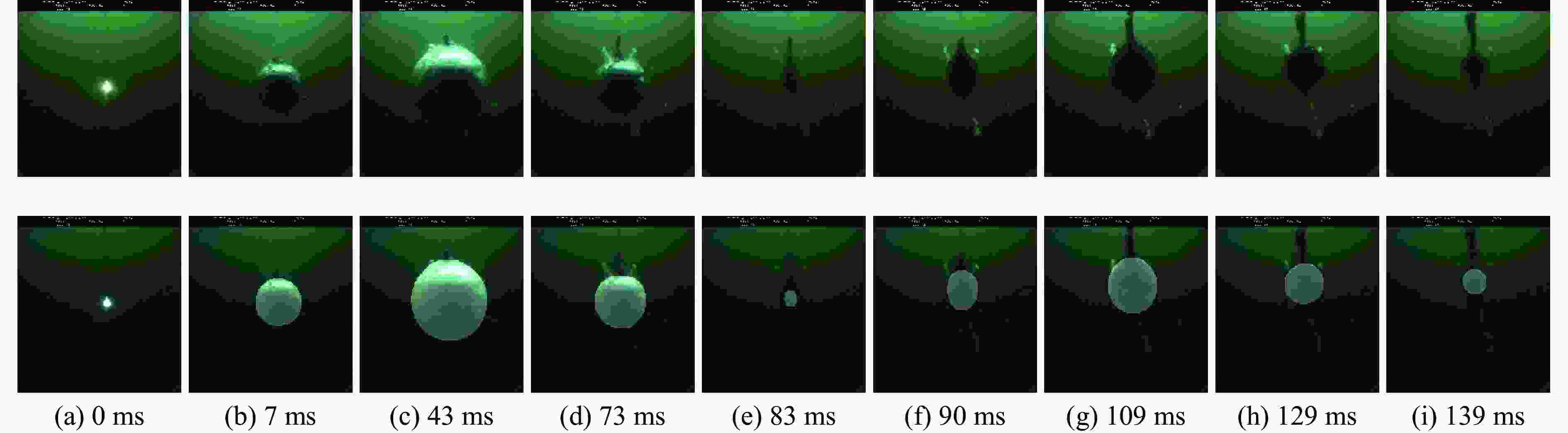
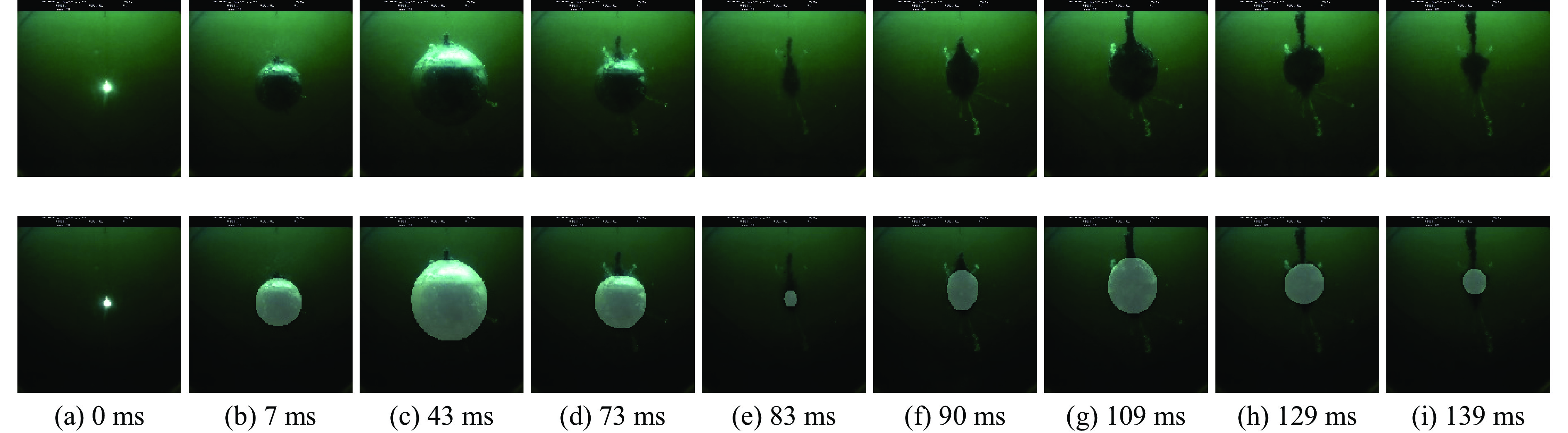
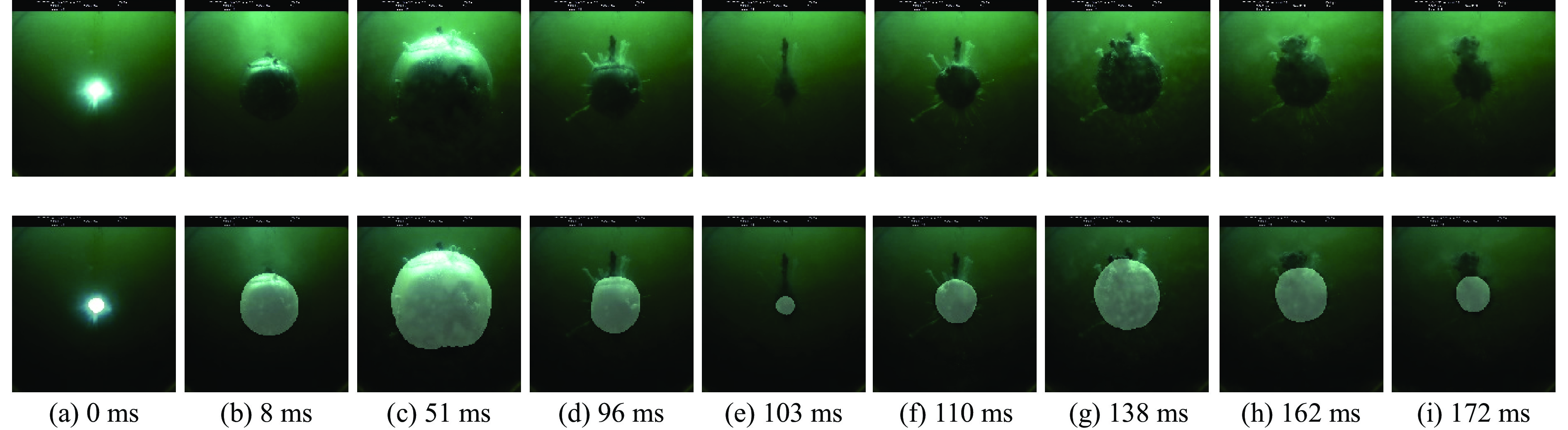
图 4 20 g RS211装药爆炸气泡运动过程图像(上图为拍摄图像,下图为软件输出结果)
Figure 4. Bubble motion images for RS211 charge of 20 g (Upper: original images; lower: processed results by software.)
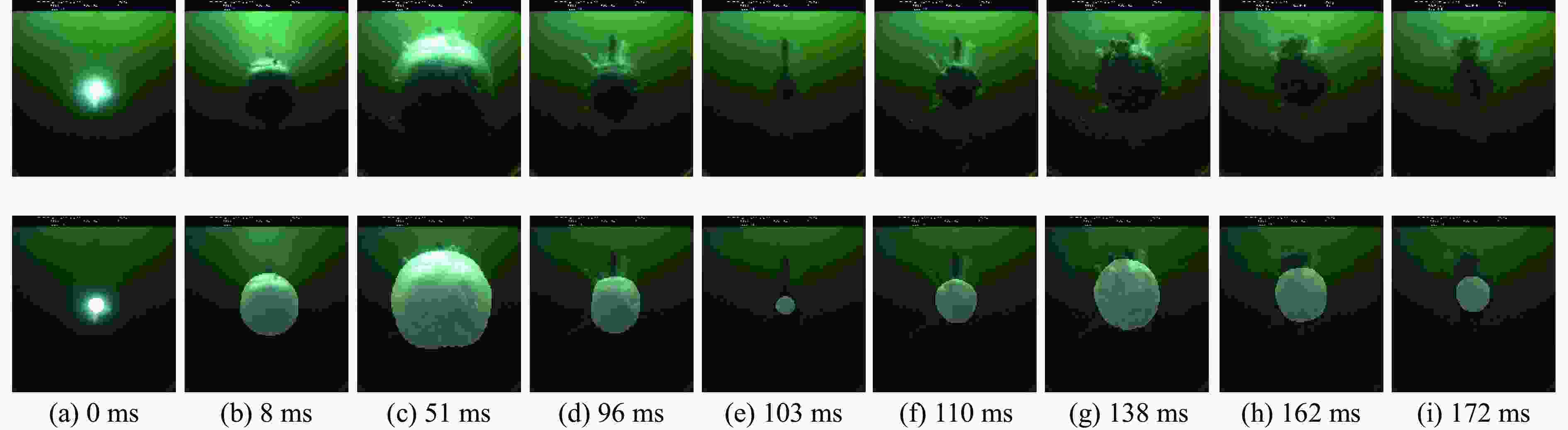
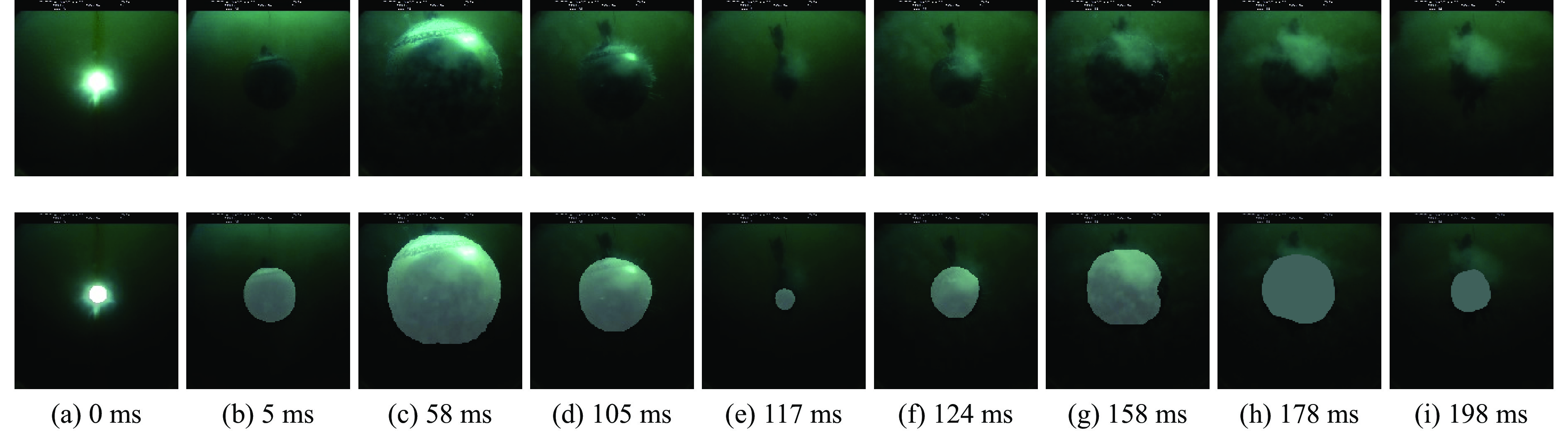
图 5 40 g RS211装药爆炸气泡运动过程图像(上图为拍摄图像,下图为软件输出结果)
Figure 5. Bubble motion images for RS211 charge of 40 g (Upper: original images; lower: processed results by software.)
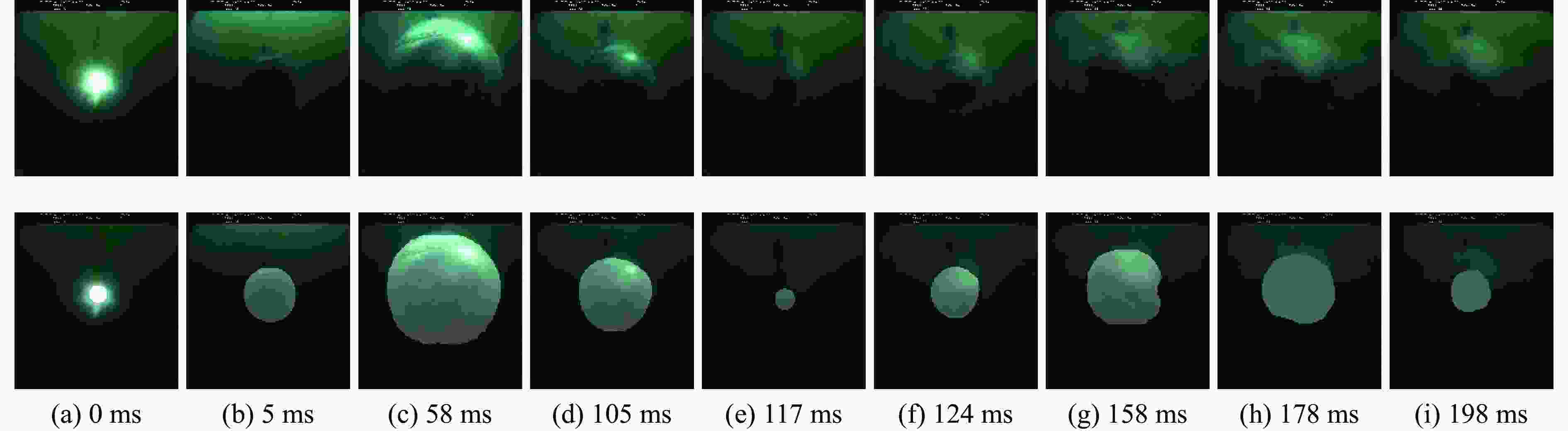
图 6 60 g RS211装药爆炸气泡运动过程图像(上图为拍摄图像,下图为软件输出结果)
Figure 6. Bubble motion images for aluminized charge of 60 g (Upper: original images; lower: processed results by software.)
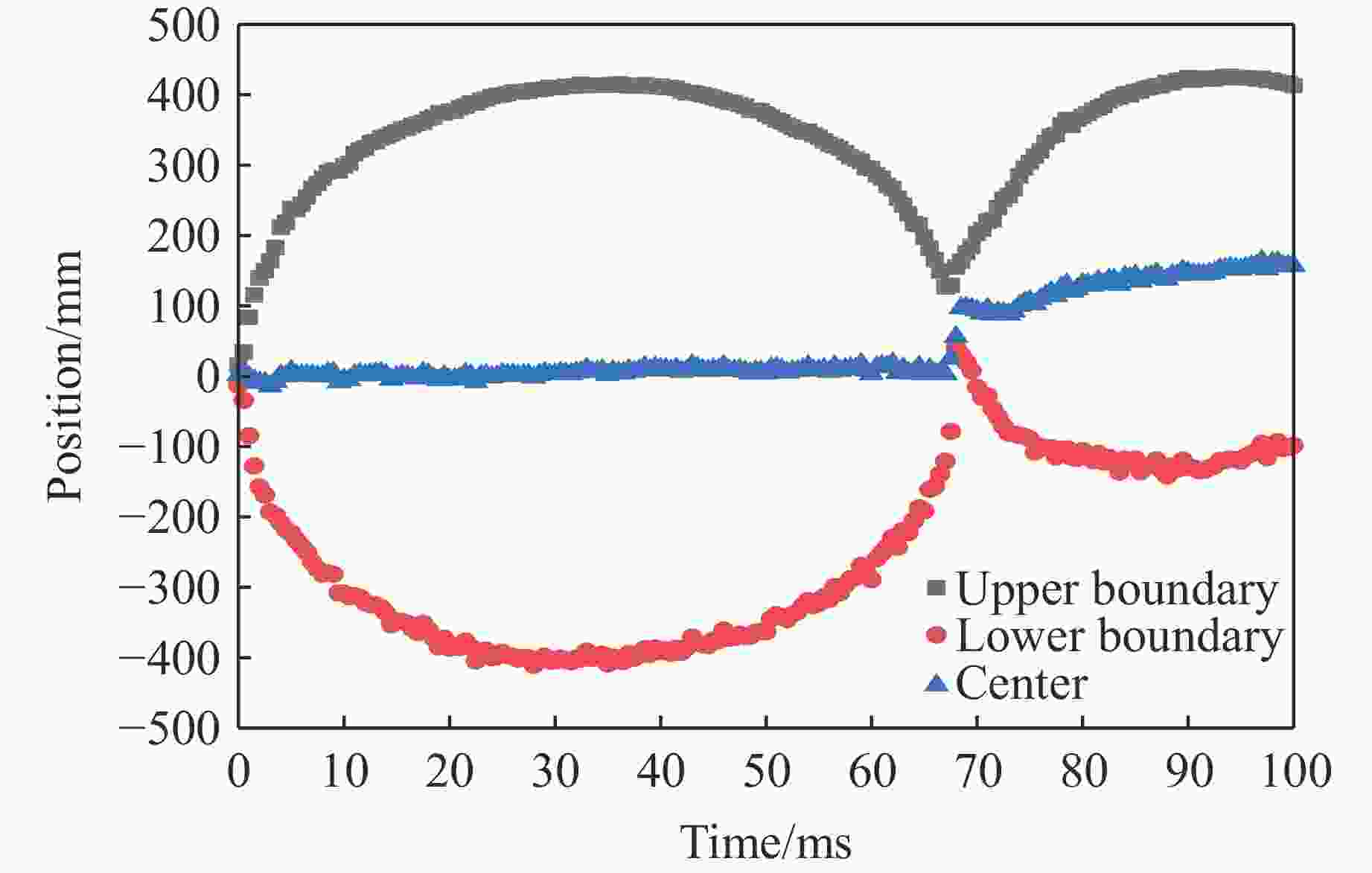
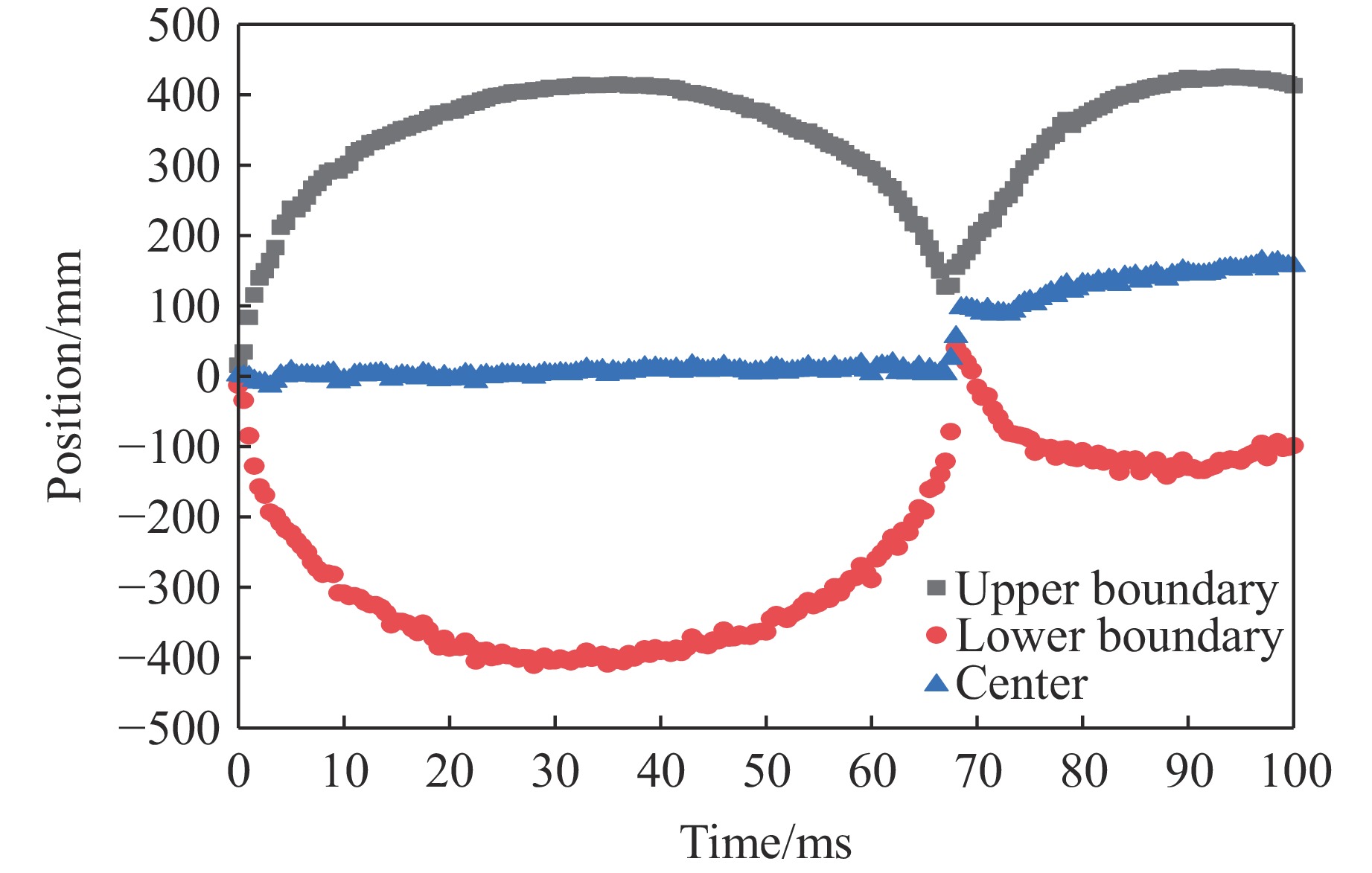
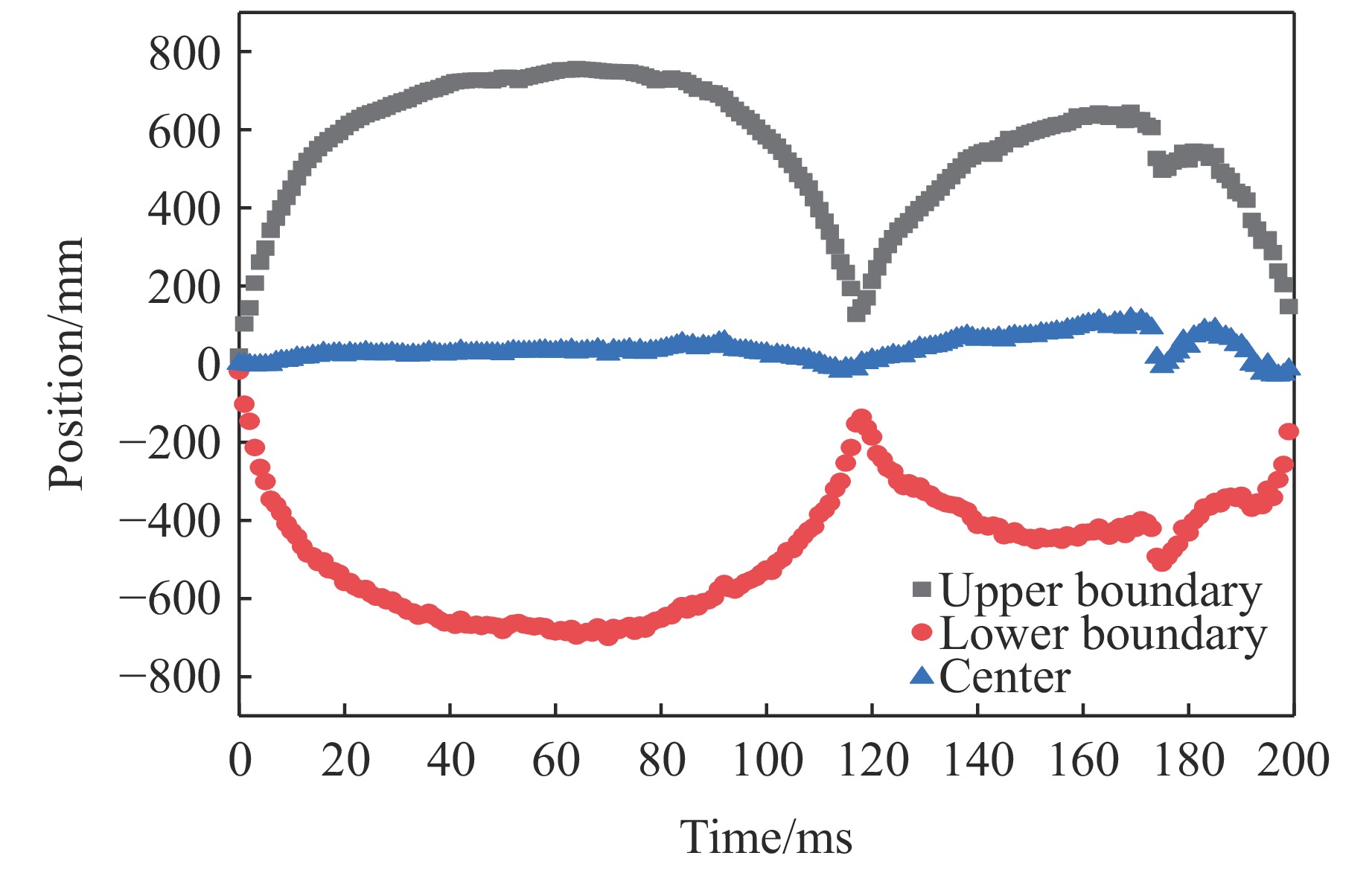
图 7 20 g RS211装药爆炸气泡边界和中心的位移时程曲线
Figure 7. Position-time curves of boundary and center of bubble for an RS211 charge of 20 g
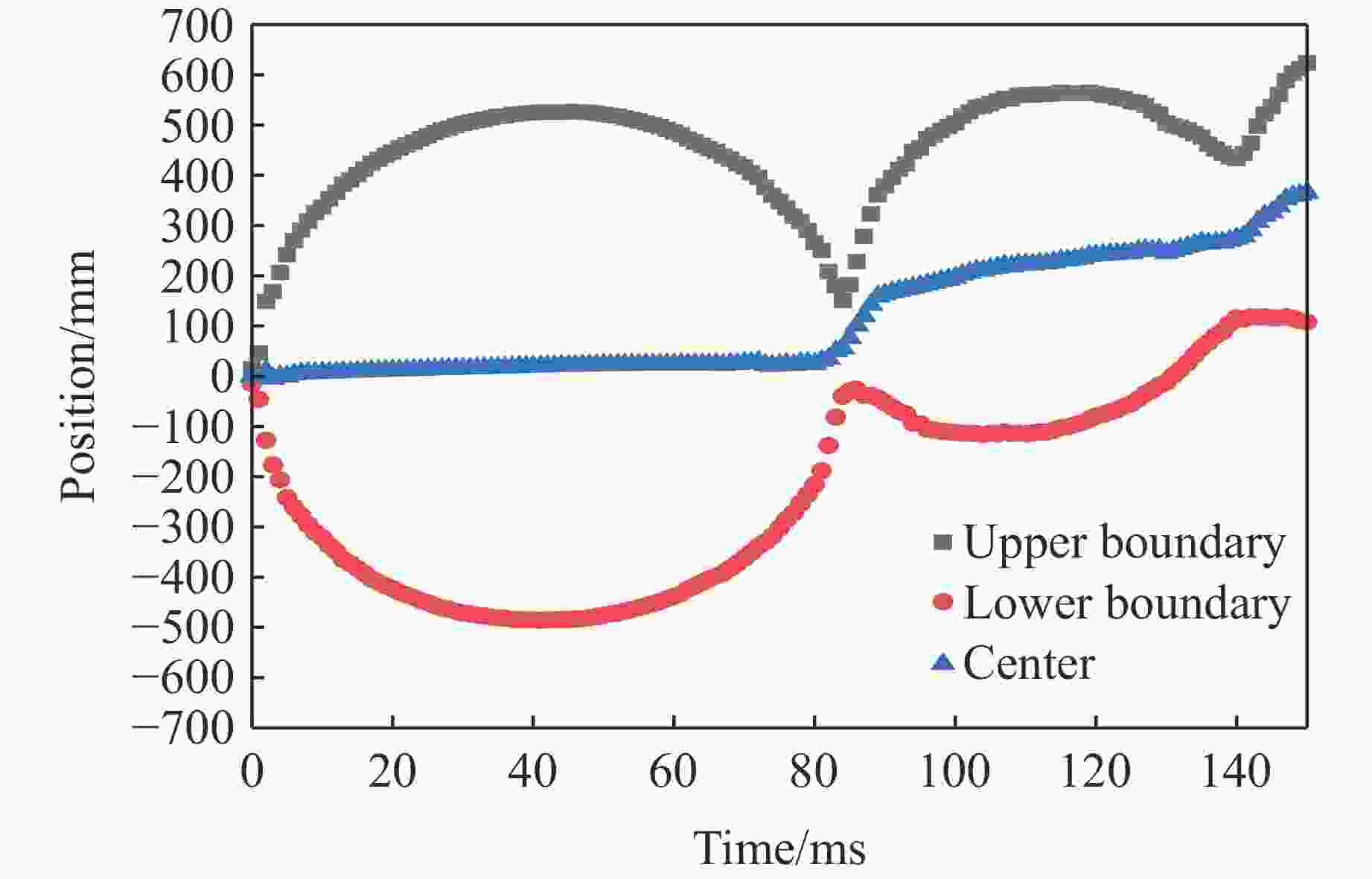
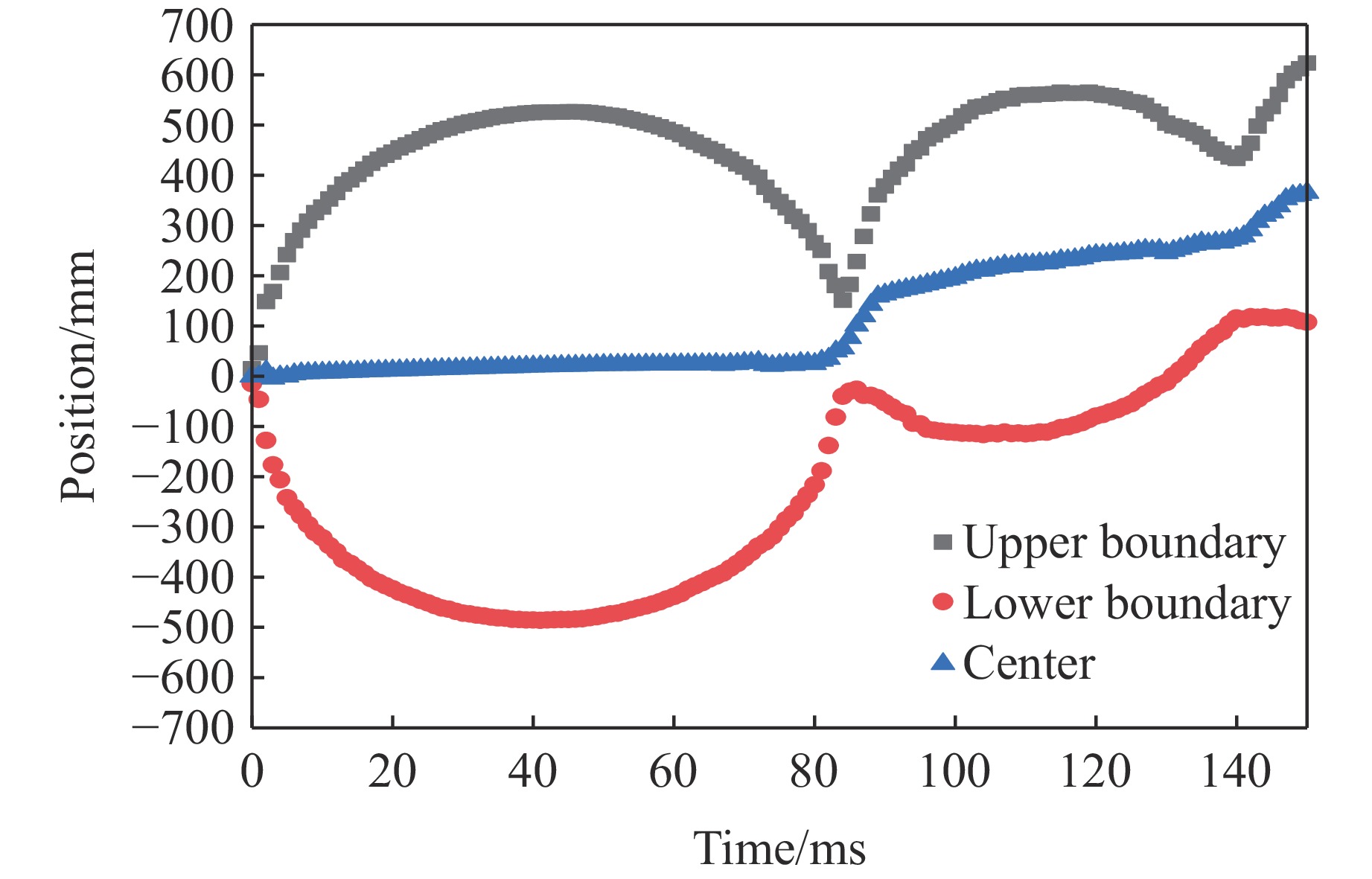
图 8 40 g RS211装药爆炸气泡边界和中心的位移时程曲线
Figure 8. Position-time curves of boundary and center of bubble for an RS211 charge of 40 g
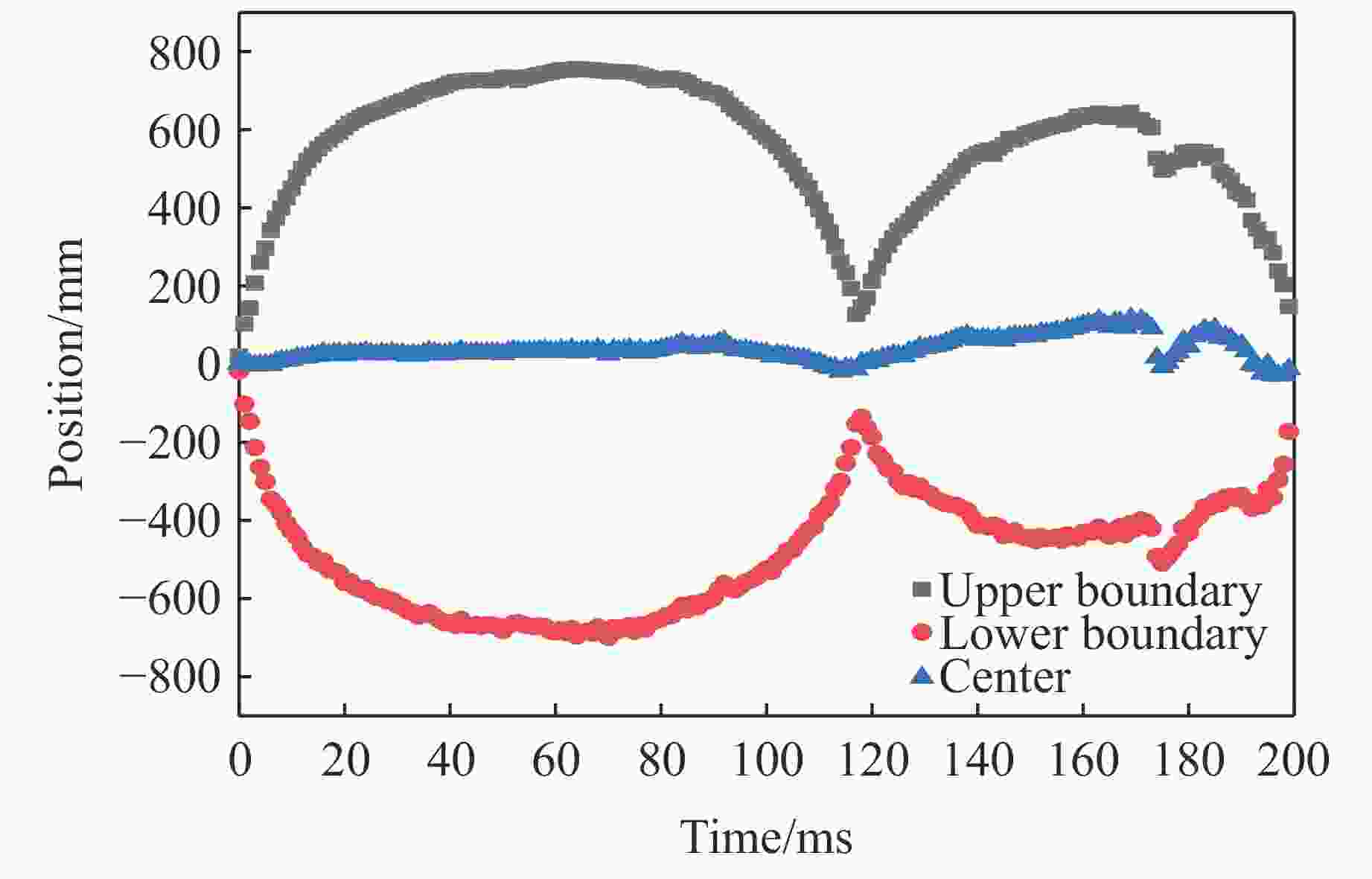
图 9 60 g RS211装药爆炸气泡边界和中心的位移时程曲线
Figure 9. Position-time curves of boundary and center of bubble for an RS211 charge of 60 g
表 1 TNT气泡的最大半径试验值与Cole理论值对比
Table 1. Comparison of TNT bubble maximum radius between test results and Cole theoretical results
Charge mass/g Water depth/m Maximum radius Test result/mm Theoretical result/mm Deviation/% 20 3.01 413.2 401.8 2.76 40 3.02 526.9 506.1 3.95 60 3.01 579.7 579.4 0.05  下载: 导出CSV
表 2 RS211装药气泡的运动参数
Table 2. Parameters of bubble motion for RS211 charge
Charge mass/g Water depth/m The first pulsation The second pulsation Period/ms Maximum radius/mm Period/ms Maximum radius/mm 20 3.0 83 505.9 56 337.7 84 507.9 56 335.0 84 502.4 56 338.5 84 510.3 56 335.8 40 3.0 103 666.6 69 449.0 104 655.2 70 432.5 104 654.7 71 440.9 104 657.9 71 444.6 60 3.0 117 726.1 81 537.8 117 726.4 81 532.5 118 722.0 81 534.0
下载: 导出CSV
表 3 气泡脉动周期试验值与Cole理论值的对比
Table 3. Comparison of bubble pulse period between test results and Cole theoretical results
Charge mass/g Water depth/m Period Test result/ms Theoretical result/ms Deviation/% 20 3.01 68.00 66.4 2.35 40 3.02 85.33 83.6 2.03 60 3.01 97.33 95.7 1.67
下载: 导出CSV
表 4 气泡最大半径试验值与Cole理论值对比
Table 4. Comparison of bubble maximum radius between experiment results and Cole theoretical results
Charge mass/g Water depth/m Maximum radius Test result/mm Theoretical result/mm Deviation/% 20 3.01 413.2 401.8 2.76 40 3.02 526.9 506.1 3.95 60 3.01 579.7 579.4 0.05
下载: 导出CSV
表 5 气泡上浮位移试验值与Cole理论值对比
Table 5. Comparison of bubble migration between test results and Cole theoretical results
Charge mass/g Bubble migration Theoretical result/mm Test result/mm Deviation/% 20 254.3 56.0 −5.7 40 349.3 44.1 8.2 60 420.7 37.6 −11.7
下载: 导出CSV
表 6 第1次气泡最大半径和第2次气泡最大半径时的能量分配
Table 6. Energy distributions at time of the first and the second maximum bubble radius
Charge mass/g Water depth/m $ {E}_{\mathrm{p}1} $/kJ $ {E}_{\text{i}1} $/kJ $ {E}_{\text{z}1} $/kJ $ {E}_{\text{i}1}/{E}_{\text{z}1} $ $ {E}_{\mathrm{p}2} $/kJ $ {E}_{\text{i}2} $/kJ $ {E}_{\text{z}2} $/kJ $ {E}_{\text{i}2}/{E}_{\text{z}2} $ Energy dissipated/kJ 20 3.0 70.8 4.8 75.6 6.3 21.1 1.5 22.6 6.6 53.0 40 3.0 162.0 9.2 171.2 5.4 49.5 2.9 52.4 5.5 118.9 60 3.0 209.4 14.3 223.7 6.4 72.5 4.3 76.8 6.6 146.9
下载: 导出CSV
-
[1] KLASEBOER E, KHOO B C, HUNG K C. Dynamics of an oscillating bubble near a floating structure [J]. Journal of Fluids and Structures, 2005, 21(4): 395–412. doi: 10.1016/j.jfluidstructs.2005.08.006 [2] HUNG C F, HWANGFU J J. Experimental study of the behaviour of mini-charge underwater explosion bubbles near different boundaries [J]. Journal of Fluid Mechanics, 2010, 651: 55–80. doi: 10.1017/S0022112009993776 [3] ZHANG A M, WANG S P, HUANG C, et al. Influences of initial and boundary conditions on underwater explosion bubble dynamics [J]. European Journal of Mechanics-B/Fluids, 2013, 42: 69–91. doi: 10.1016/j.euromechflu.2013.06.008 [4] 朱锡, 牟金磊, 洪江波, 等. 水下爆炸气泡脉动特性的试验研究 [J]. 哈尔滨工程大学学报, 2007, 28(4): 365–368. doi: 10.3969/j.issn.1006-7043.2007.04.001.ZHU X, MU J L, HONG J B, et al. Experimental study of characters of bubble impulsion induced by underwater explosions [J]. Journal of Harbin Engineering University, 2007, 28(4): 365–368. doi: 10.3969/j.issn.1006-7043.2007.04.001. [5] 王海坤, 刘建湖, 毛海斌, 等. 水下爆炸气泡及其射流的光电联合测量研究 [J]. 防护工程, 2015, 37(4): 36–42.WANG H K, LIU J H, MAO H B, et al. Photoelectric combined measurements of underwater explosion bubble and jet [J]. Protective Engineering, 2015, 37(4): 36–42. [6] 盛振新, 刘建湖, 张显丕, 等. 水下爆炸气泡射流载荷阵列测量技术探索 [J]. 爆炸与冲击, 2021, 41(3): 031405. doi: 10.11883/bzycj-2020-0346SHENG Z X, LIU J H, ZHANG X P, et al. On an array-sensor technology for measuring bubble jet load generated by underwater explosion [J]. Explosion and Shock Waves, 2021, 41(3): 031405. doi: 10.11883/bzycj-2020-0346 [7] 盛振新, 刘建湖, 王海坤, 等. 自由水面和刚性水底联合作用下水下爆炸气泡上浮运动特性研究 [J]. 振动与冲击, 2023, 42(12): 1–7, 17. doi: 10.13465/j.cnki.jvs.2023.012.001SHENG Z X, LIU J H, WANG H K, et al. A study on migration characteristics for underwater explosion bubble under combined action of a free surface and a rigid bottom [J]. Journal of Vibration and Shock, 2023, 42(12): 1–7, 17. doi: 10.13465/j.cnki.jvs.2023.012.001 [8] COLE R H. Underwater explosions [M]. Princeton: Princeton University Press, 1948. [9] ARONS A B, SLIFKO J P, CARTER A. Secondary pressure pulses due to gas globe oscillation in underwater explosions. Ⅰ. experimental data [J]. The Journal of the Acoustical Society of America, 1948, 20(3): 271–276. doi: 10.1121/1.1906371 [10] ARONS A B. Secondary pressure pulses due to gas globe oscillation in underwater explosions. Ⅱ. selection of adiabatic parameters in the theory of oscillation [J]. The Journal of the Acoustical Society of America, 1948, 20(3): 277–282. doi: 10.1121/1.1906372 -

 下载:
下载:



计量
- 文章访问数: 928
- HTML全文浏览量: 544
- PDF下载量: 77
