





Effect of Metalwire Materials on the Energy Deposition in Electro-Chemical Coupling Explosions
-
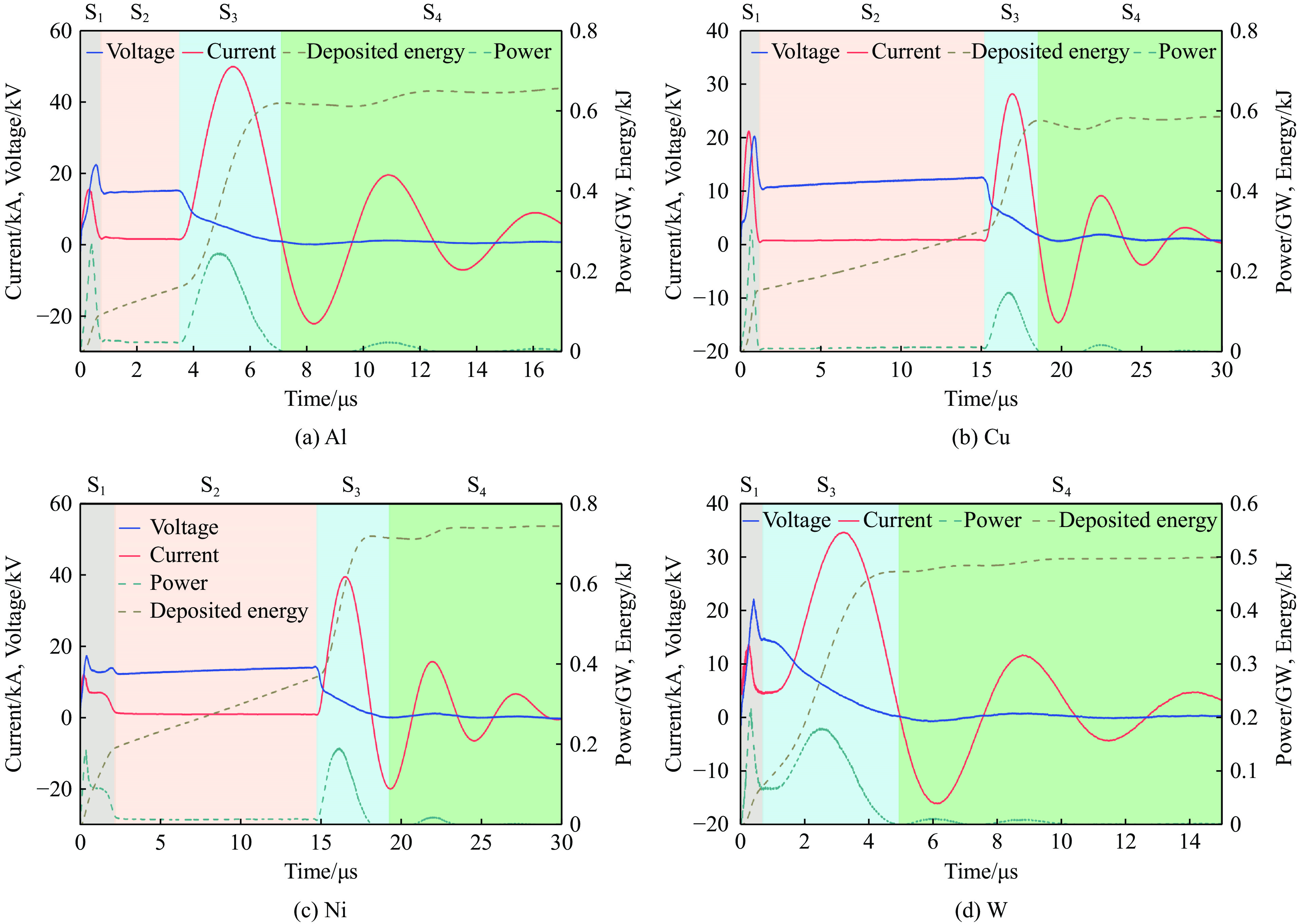
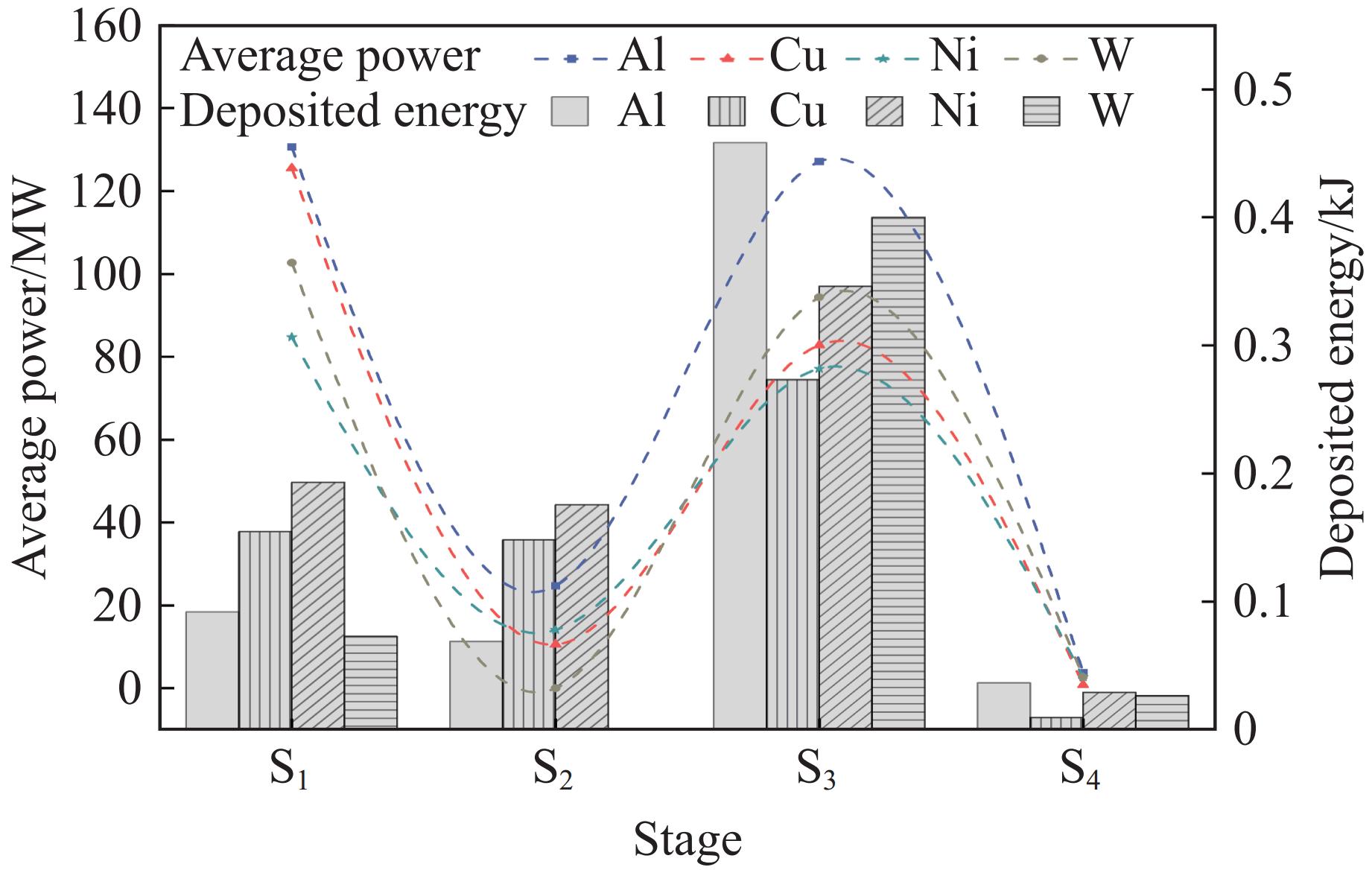
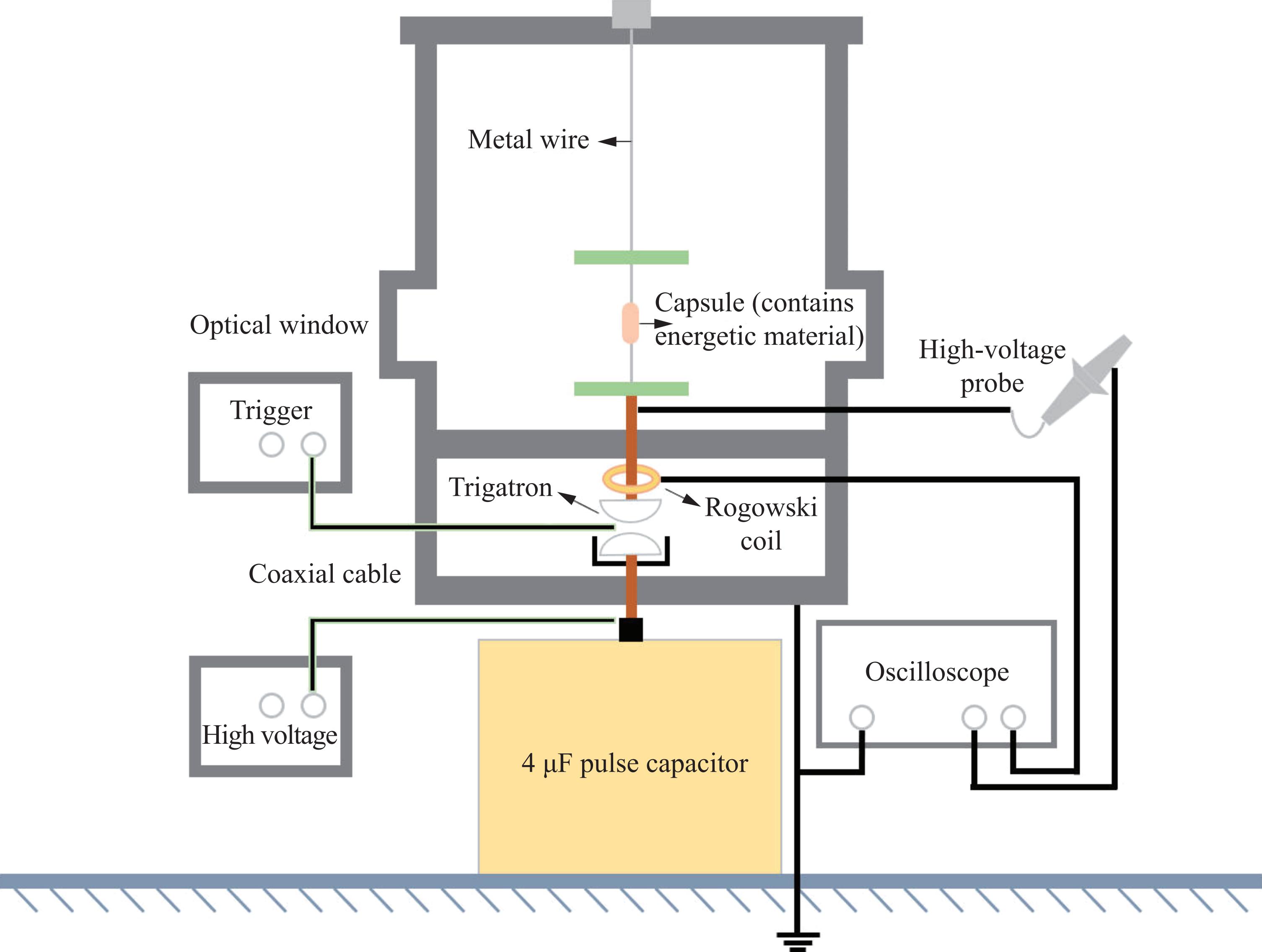
摘要: 为提高含能材料爆炸能量的输出总量和功率,通过金属丝电爆炸产生的等离子体驱动含能材料环四亚甲基四硝胺(HMX)起爆,实现电能与化学能的耦合释放。通过搭建的电-化耦合爆炸实验系统,在常温常压空气中测量了爆炸过程中的电压、电流曲线,将电-化耦合爆炸划分为金属丝相变、电流暂停、等离子体放电和振荡放电4个典型阶段。研究表明,不同材质金属的主要能量沉积发生在不同阶段:镍和铜等凭借中等沸点及高电阻温度系数在金属丝相变和电流暂停阶段实现了高效的相变能量沉积;在等离子体放电阶段,铝因氧化层破裂发生爆发式汽化,并凭借低电离能形成高导等离子体,沉积能量显著跃升;钨通过液态显热蓄积和电阻急剧上升,在等离子体放电阶段的沉积能量占比超过80%。研究还发现,电流暂停现象受到金属材质(如电阻温度系数、沸点及汽化潜热等)的影响,其中,铜表现出最长的电流暂停时间,而钨则未出现该现象。研究结果揭示了金属材质对能量沉积过程的影响机制,为提升含能材料的能量输出总量和功率提供了实验依据与技术支撑。Abstract: To enhance the total output energy and power of energetic materials, plasma that generated by electrically exploded metal wires was employed to initiate the detonation of energetic materials, thereby achieving the coupled release of electrical and chemical energy. The voltage and current curves of electro-chemical coupling explosion were measured using a self-built experimental system under ambient temperature and pressure in air during the explosion process. The electro-chemical coupling explosion was divided into four typical phases: metal wire phase transition, current pause, plasma discharge, and oscillatory discharge. The research results indicate that the primary energy deposition of different metal materials occurs at different stages. Nickel and copper wires with medium boiling points and temperature coefficients of high resistance achieve efficient phase change energy deposition during the wire phase transition and current pause stages. During the plasma discharge stage, aluminum undergoes explosive vaporization due to fracture of the oxide layer. This process forms a highly conductive plasma owing to its low ionization energy, which leads to a significant leap in energy deposition. The resistance of tungsten increases sharply due to latent heat accumulation in the liquid phase, accounting for over 80% of its energy deposition during the plasma discharge stage. The study also reveals that the unique current pause phenomenon in electro-chemical coupling explosions is influenced by metal properties (such as temperature coefficient of resistance, boiling point, and latent heat of vaporization). Copper wires exhibit the longest current pause duration, while tungsten wires show no such phenomenon. This paper systematically investigates the power and energy deposition characteristics during electro-chemical coupling explosions, elucidates the influence mechanisms of metal materials on the energy release process, and provides experimental evidence and technical support for enhancing the total output energy and power of energetic materials.
-
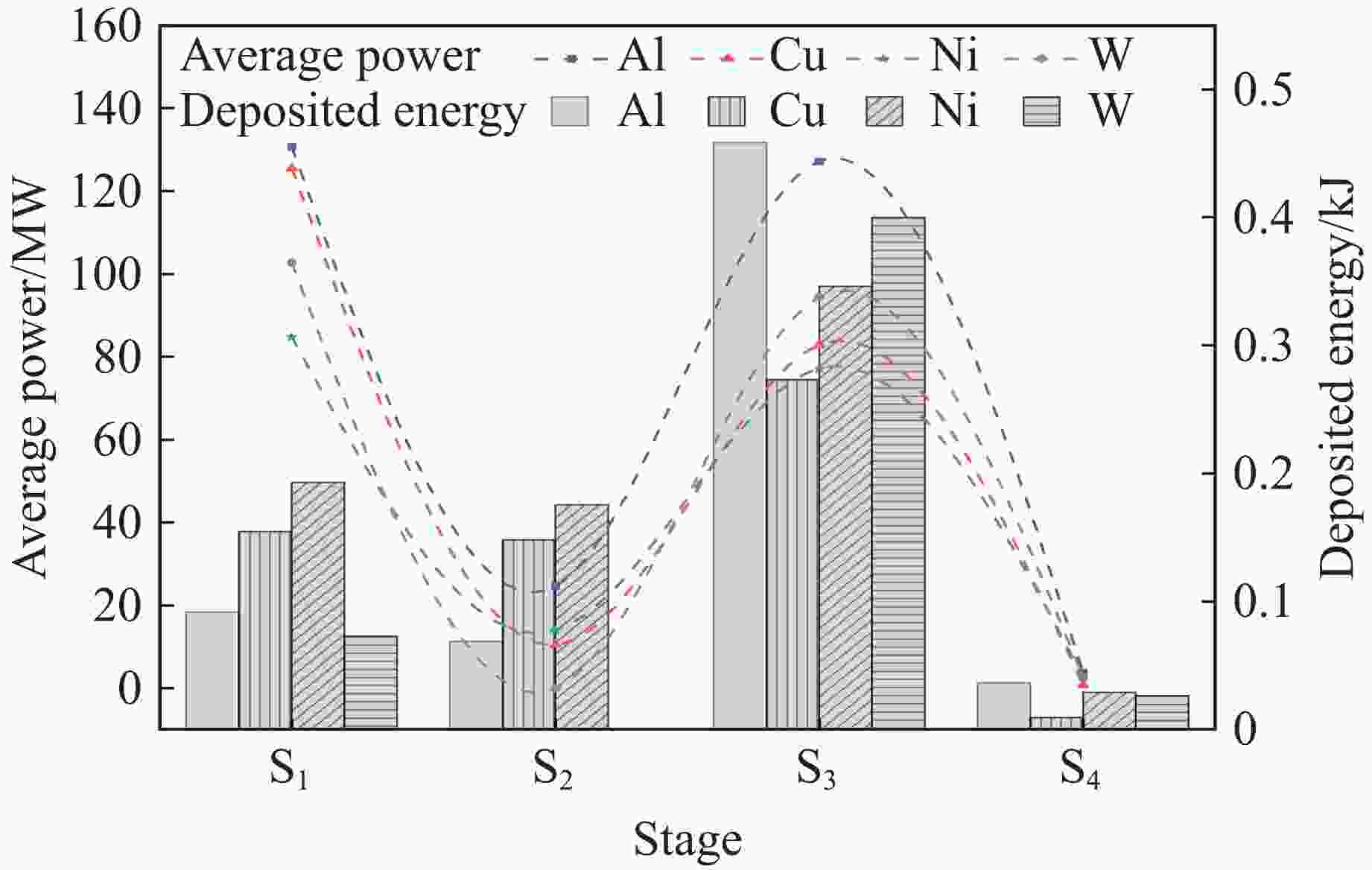
图 6 不同材质金属丝各阶段平均功率与沉积能量
Figure 6. Average power and deposited energy of metal wires with different materials at each stage
Molecular formula ρ0/(g·cm−3) p/GPa D/(m·s−1) Qv/(J·g−1) C4H8N8O8 1.9 39.1 9 100 6 038  下载: 导出CSV
表 2 不同材质金属丝的放电曲线特征参数
Table 2. Characteristic parameters of discharge curves for metal wires with different materials
Material tcp/μs Up/kV Ip1/kA Ip2/kA Pp1/MW Pp2/MW Al 2.8 22.38 15.45 49.86 272.82 245.70 Cu 13.6 20.31 21.24 28.18 304.65 148.69 Ni 12.5 17.43 12.11 39.56 186.29 191.33 W 22.15 13.64 34.64 216.44 180.07
下载: 导出CSV
-
[1] KRASIK Y E, EFIMOV S, SHEFTMAN D, et al. Underwater electrical explosion of wires and wire arrays and generation of converging shock waves [J]. IEEE Transactions on Plasma Science, 2016, 44(4): 412–431. doi: 10.1109/TPS.2015.2513757 [2] MALER D, ROSOSHEK A, EFIMOV S, et al. Efficient target acceleration using underwater electrical explosion of wire array [J]. Journal of Applied Physics, 2021, 129(3): 034901. doi: 10.1063/5.0034435 [3] ROSOSHEK A, EFIMOV S, TEWARI S V, et al. Phase transitions of copper, aluminum, and tungsten wires during underwater electrical explosions [J]. Physics of Plasmas, 2018, 25(10): 102709. doi: 10.1063/1.5049904 [4] FEDOTOV-GEFEN A, EFIMOV S, GILBURD L, et al. Generation of a 400 GPa pressure in water using converging strong shock waves [J]. Physics of Plasmas, 2011, 18(6): 062701. doi: 10.1063/1.3599425 [5] 伍俊英, 冯长根, 陈朗, 等. 金属电爆炸等离子体辐射温度测量 [J]. 战术导弹技术, 2006(5): 31–33. doi: 10.3969/j.issn.1009-1300.2006.05.007WU J Y, FENG C G, CHEN L, et al. Plasma radiation temperature measurement of metal explosion [J]. Tactical Missile Technology, 2006(5): 31–33. doi: 10.3969/j.issn.1009-1300.2006.05.007 [6] 伍俊英, 于红新, 汪龙, 等. 金属桥箔水中电爆炸流场数值模拟研究 [J]. 兵工学报, 2016, 37(Suppl 1): 51–56.WU J Y, YU H X, WANG L, et al. Numerical simulation of electric exploding of metal bridge foil in water [J]. Acta Armamentarii, 2016, 37(Suppl 1): 51–56. [7] KRASIK Y E, GRINENKO A, SAYAPIN A, et al. Underwater electrical wire explosion and its applications [J]. IEEE Transactions on Plasma Science, 2008, 36(2): 423–434. doi: 10.1109/TPS.2008.918766 [8] MALER D, LIVERTS M, EFIMOV S, et al. Addressing the critical parameters for overdamped underwater electrical explosion of wire [J]. Physics of Plasmas, 2022, 29(10): 102703. doi: 10.1063/5.0118003 [9] KRASIK Y E, GRINENKO A, SAYAPIN A, et al. Generation of sub-Mbar pressure by converging shock waves produced by the underwater electrical explosion of a wire array [J]. Physical Review E, 2006, 73(5): 057301. doi: 10.1103/physreve.73.057301 [10] HAN R Y, ZHOU H B, LIU Q J, et al. Generation of electrohydraulic shock waves by plasma-ignited energetic materials: Ⅰ. fundamental mechanisms and processes [J]. IEEE Transactions on Plasma Science, 2015, 43(12): 3999–4008. doi: 10.1109/TPS.2015.2468064 [11] WANG H Y, WEI D, GAN Y D, et al. Energy release in electrical wire explosions coupled with energetic materials [J]. AIP Advances, 2024, 14(10): 105116. doi: 10.1063/5.0209283 [12] ROSOSHEK A, EFIMOV S, VIROZUB A, et al. Particularities of shocks generated by underwater electrical explosions of a single wire and wire arrays [J]. Applied Physics Letters, 2019, 115(7): 074101. doi: 10.1063/1.5115134 [13] LIU H Y, ZHAO J P, ZHANG R, et al. Dimensional effects of electrically exploding aluminum wires in argon gas: experimental investigation [J]. Journal of Applied Physics, 2020, 128(7): 073301. doi: 10.1063/5.0016233 [14] HAN R Y, ZHOU H B, WU J W, et al. Relationship between energy deposition and shock wave phenomenon in an underwater electrical wire explosion [J]. Physics of Plasmas, 2017, 24(9): 093506. doi: 10.1063/1.4989790 -

 下载:
下载:

图(6) / 表(2)
计量
- 文章访问数: 1250
- HTML全文浏览量: 683
- PDF下载量: 84
